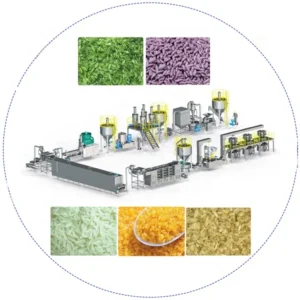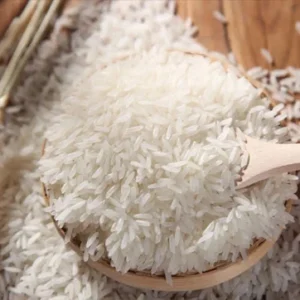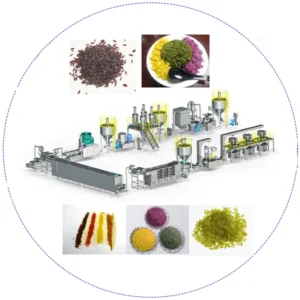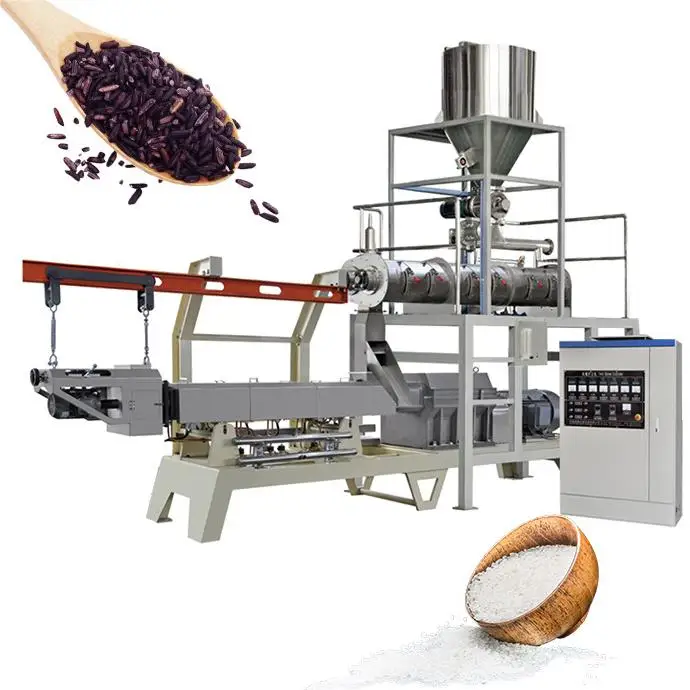
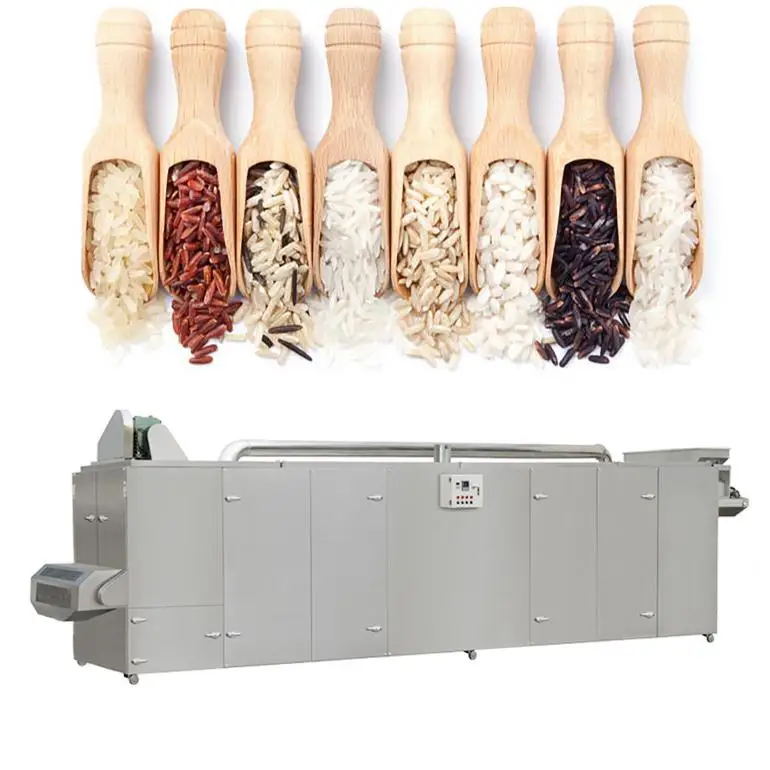
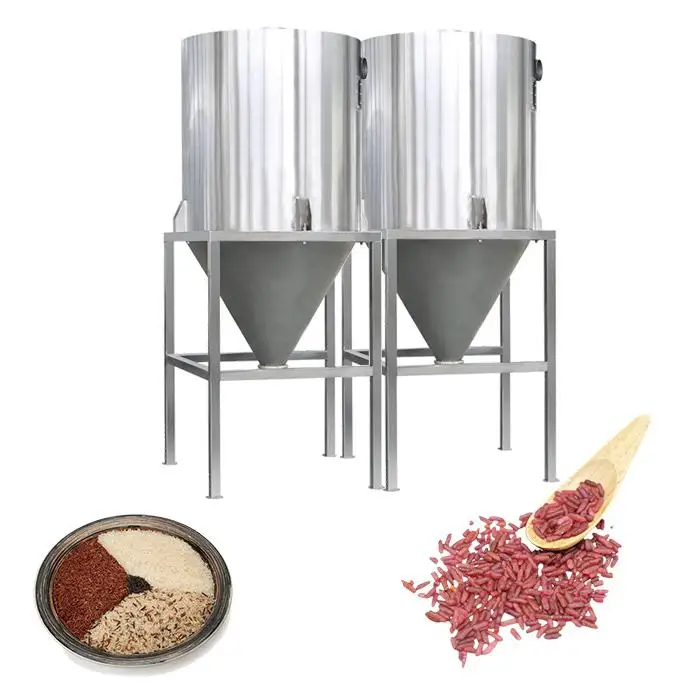
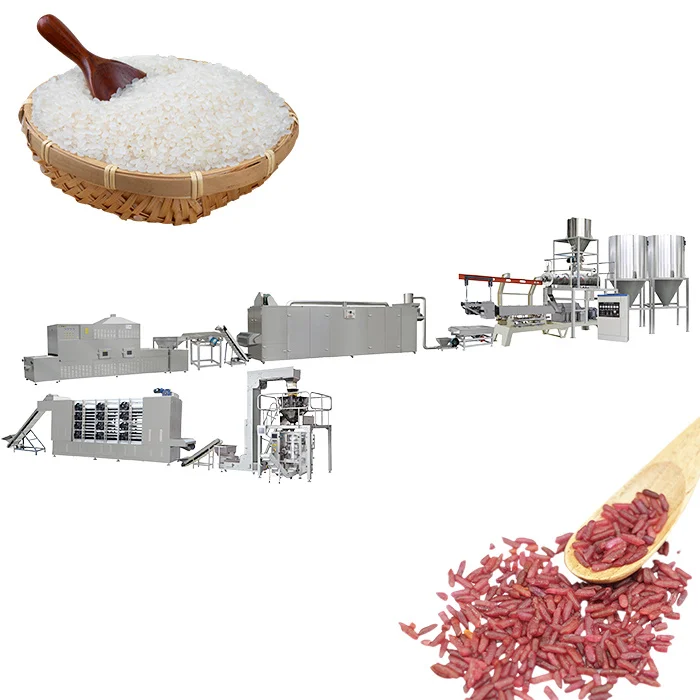


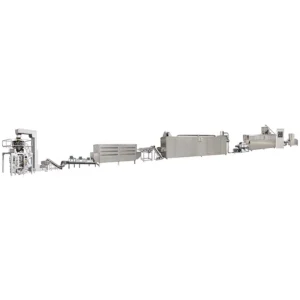
MT95 Automatic Nutritional Rice Production Line, 260KW Installed Power, Twin-Screw Extrusion — engineered for fortified artificial rice processing from broken rice, corn, millet and starch-based formulations with added vitamins and minerals.
- Full turnkey layout: Mixing → Extruding → Vibrating → Low Temperature Drying → Cooling → High Temperature Roasting → Cooling → Packing
- Screw configuration and die design specified to your raw material and target kernel density, with automated PLC and frequency speed control across every station
Trial runs on your actual raw material are completed in our in-house testing workshop before shipment, ensuring the line performs to your formulation from day one.
Description
Turnkey Line Integration — Throughput at every station from batching through extrusion to packing is calculated against the preceding output, preventing the dryer or cooler from becoming a bottleneck on this nutritional rice production line turnkey.
Technical Specifications
| Parameter | Value |
|---|---|
| Product Type | Automatic Nutritional Rice Production Line |
| Model | MT95 (also available: MT65, MT70, MT75, MT85) |
| Screw Type | Twin-screw |
| Installed Power | 260 kW |
| Power Consumption | 195 kW |
| Output Capacity | 800–1000 kg/h (basis not stated in source — confirm raw material, moisture content, and kernel size) |
| Overall Dimensions (L×W×H) | 36 × 3.5 × 4.3 m |
| Control System | Frequency speed controlling with high automation |
| Heating Source (Dryer) | Electric or gas |
| Line Stations | Mixing → Extruding → Vibrating → Low Temperature Drying → Cooling → High Temperature Roasting → Cooling → Packing |
| Assembly State | Complete turnkey line |
| Voltage & Frequency | Customized to customer local supply |
| Standards | CE, ISO |
Application Suitability
| Application | Material or Output |
|---|---|
| Fortified artificial rice for nutrition programmes | Broken rice, rice flour, corn, millet blended with vitamin and mineral premix |
| Value-added grain processing | Broken rice and rice bran converted into reconstituted nutritional rice kernels |
| Multi-grain nutritional rice | Wheat, oats, buckwheat, bean, and starch as base ingredients with micro-nutrient addition |
| Institutional and humanitarian food supply | Fortified rice kernels meeting programme-specific micronutrient specifications |
What "800 kg/h" Actually Means on a Nutritional Rice Production Line Turnkey
Capacity figures only hold when the raw material blend, moisture content, and target kernel geometry match the conditions under which they were measured.
I remember a nutritional powder line we shipped a few years back. The trial run went perfectly on standard rice flour. Then the customer’s actual blend turned out to carry a significant whey protein fraction, and the gelatinisation behaviour changed entirely. Screw speed, barrel temperatures, and die pressure all had to be re-dialed on site during commissioning. The same risk applies here: a nutritional rice production line turnkey rated on one formulation may behave differently on yours [NEED_CITE: raw material variability effects on extrusion throughput]. That is why we push for raw material samples before the screw configuration is locked in.
Screw Configuration Matched to Your Grain Blend
The twin-screw extruder at the heart of this line is configured after reviewing your specific raw material composition. Different base grains — broken rice, corn, millet, buckwheat — each carry distinct starch and protein profiles that affect gelatinisation temperature and melt viscosity inside the barrel. The screw elements and die geometry are selected to produce a kernel that holds its shape through drying and roasting without cracking or collapsing.
Throughput Balancing Across Every Station
A nutritional rice production line turnkey only performs when each downstream station can absorb the output of the one before it. The vibrating conveyor, low temperature dryer, cooling section, high temperature roaster, second cooler, and packing station are all sized against the extruder’s actual throughput on your blend. This eliminates the common problem where the extruder runs at capacity but the dryer cannot keep up, forcing the entire line to slow down [NEED_CITE: line balancing principles in continuous food processing].
Reading the Specifications for Your Project
The MT95 carries an installed power of 260 kW with a working consumption of 195 kW, which tells you the electrical infrastructure needed at your facility. The overall footprint of 36 × 3.5 × 4.3 m defines the minimum hall length and ceiling clearance required for installation. The twin-screw design provides a longer residence time and more thorough mixing than a single-screw alternative, which matters when you are dispersing vitamin and mineral premix uniformly through a starchy matrix. Frequency speed control allows operators to adjust screw speed and feeder rates independently, maintaining consistent kernel density across production runs with varying ambient conditions.
The Hidden Cost of Mismatched Station Capacity
When an extruder is purchased separately and paired with an undersized dryer, the result is a line that physically cannot reach its nameplate output. Operators end up running the extruder at reduced feed rates, which changes the residence time and shear profile inside the barrel, altering kernel texture. In fortified rice production, inconsistent density means the micronutrient distribution per kernel drifts outside the specification the nutrition programme requires [NEED_CITE: micronutrient uniformity standards in fortified rice programmes]. Correcting this after installation means replacing equipment or accepting lower throughput.
Why Source the Complete Line Here
Every station on this nutritional rice production line turnkey is engineered under one supplier, so throughput calculations are coordinated rather than left to guesswork between separate vendors. The screw configuration and die design are specified against your raw material sample, not copied from a generic build. An in-house testing workshop allows trial runs on your actual grain blend before the line ships, reducing on-site commissioning surprises. Pre-sales engineering covers line layout and utility planning, and the same team handles installation, operator training, and ongoing maintenance support.
Documentation & Verification
- Line layout and capacity calculation confirming throughput match across all stations
- Trial run report on your actual grain blend and premix formulation before dispatch
- Screw and die configuration record specific to your kernel geometry target
- Electrical schematic with voltage and frequency confirmed to your local supply
- Factory test record documenting run parameters and output samples
- Operation and maintenance manual with wear parts list for the MT95
Installation, Commissioning & Support
- Foundation plan based on the 36 m line length and 4.3 m maximum height clearance
- Dedicated power circuit sized for 260 kW installed load with local voltage confirmation
- Modular station delivery with sequenced assembly to match your hall readiness
- On-site commissioning including screw speed and barrel temperature dial-in on your blend
- Operator training covering frequency speed control interface and changeover procedures
- Wear parts inventory for screws, dies, and dryer belts aligned to your production schedule
Preparing Your Inquiry
To move this project forward, share your raw material composition including the base grain types and any vitamin or mineral premix ratios you plan to use. Confirm your target daily output, workshop dimensions, and ceiling height so we can verify the 36 × 3.5 × 4.3 m footprint fits your space. Specify your local voltage and frequency along with your preferred control language so the electrical design is finalised before production begins.
Frequently Asked Questions
Q: How is line capacity verified against my specific raw material and formulation?
A: We request a sample of your actual grain blend and premix, then run it through the extruder in our testing workshop. Screw speed, barrel temperature profile, and die pressure are adjusted until the kernel meets your density and shape specification. The results are documented in a trial run report shared before shipment.
Q: How do you ensure throughput is matched between extruder, dryer, and packing stations?
A: Each station is sized during the layout phase based on the extruder’s verified output on your blend. The dryer belt length, roaster capacity, and packing speed are calculated so no single station forces the line to run below its balanced rate.
Q: What voltage, frequency, and control language options are confirmed before production?
A: We confirm your facility’s supply voltage and frequency during the quotation stage, then design the electrical system accordingly. Control interface language is agreed upon before the PLC is programmed, ensuring operators can navigate the system from day one.
Q: Can I run a trial on my raw material before the line ships?
A: Yes. Our in-house testing workshop is equipped to run your grain blend and premix through the extruder configuration specified for your order. You receive a trial run report with process parameters and product samples before the line is cleared for dispatch.
Q: What does the installation and commissioning schedule look like for a complete turnkey line?
A: Installation follows a phased sequence matching your hall readiness, starting with the extruder and progressing through drying, roasting, and packing stations. Commissioning includes parameter dial-in on your raw material, operator training, and a supervised production run to confirm output stability.
Related products
-

High Quality Automatic PLC Controlled 500kg/h Twin Screw Extruder Machine for Baby Rice Nutrition Powder
¥8,238.27 Add to cart -
Hygienic Stainless Steel Infant Rice Powder Processing Line Automatic 500kg/h Capacity PLC Controlled
¥9,500.00 Add to cart -

High Precision Automatic 500kg/h Baby Food Nutrition Powder Rice Extrusion Processing Line
¥9,500.00 Add to cart -
High Productivity New Condition Nutritious Baby Food Meal Replacement Powder Production Line
¥30.00 Select options This product has multiple variants. The options may be chosen on the product page