

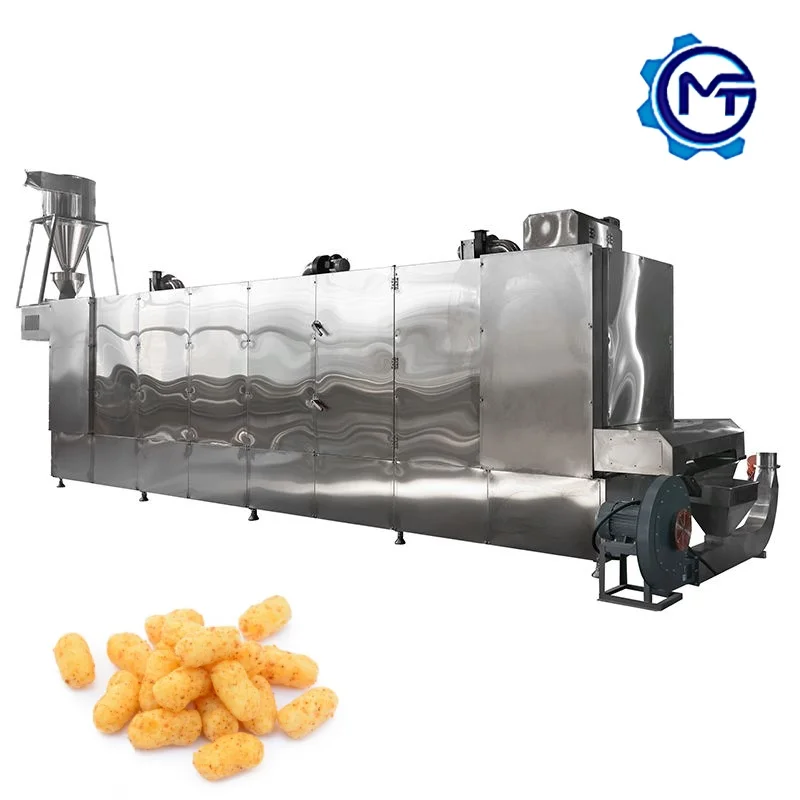
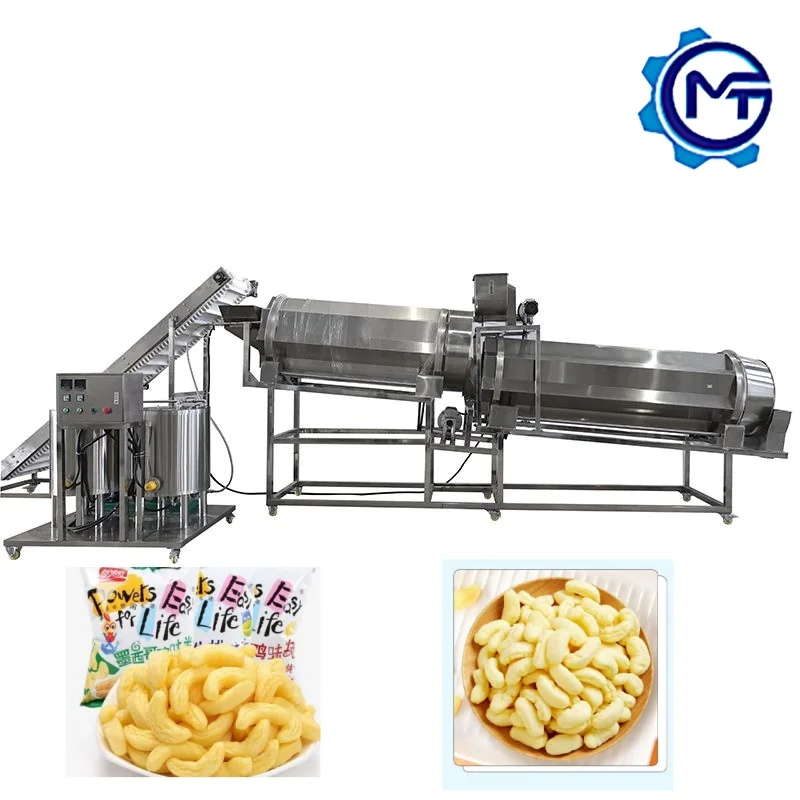
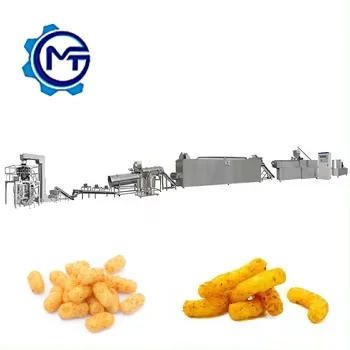
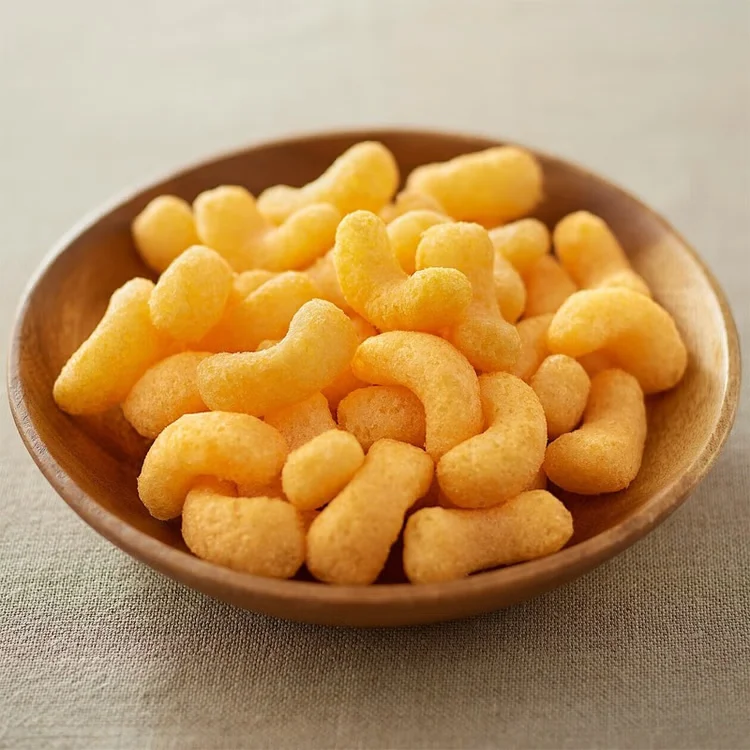
MT65 / MT70 / MT85 / MT100 Twin Screw Extruder Puffed Snack Production Line, 130–240 kW, CE Certified — engineered as a complete turnkey project from batching through extrusion, drying, flavoring, cooling, and packing.
- Twin-screw configuration with interchangeable dies producing cheese balls, tubes, rings, stars, and core-filled formats from a single base line
- Drying station configurable to electric, steam, or gas heating, with throughput matched across every station to prevent bottlenecks
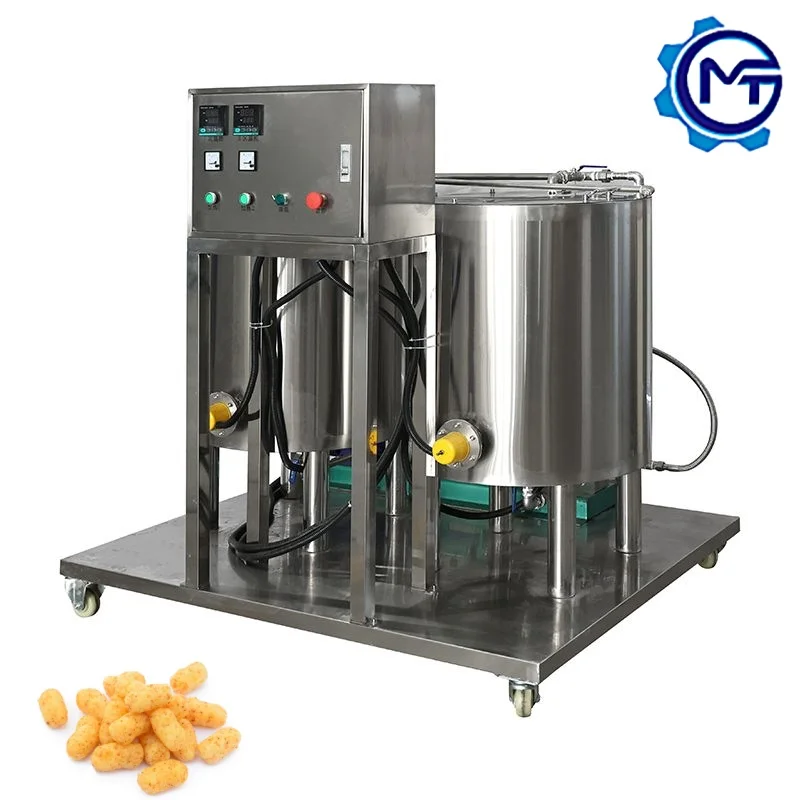
- Double drum flavoring system integrates sugar melting and spraying for uniform coating at line speed
Layout, capacity calculation, and in-house trial runs on your raw material are delivered before shipment to confirm real-world performance on your specific formulation.
Description
Complete Line Integration — every station from batching through extrusion to packing is throughput-matched as a single project rather than sourced from separate vendors, eliminating the bottleneck risk when a twin-screw puffed snack extrusion line runs at full speed.
Technical Specifications
| Parameter | Value |
|---|---|
| Product Type | Twin Screw Extruder Puffed Snack Production Line |
| Models Available | MT65, MT70, MT85, MT100 |
| Screw Type | Twin-screw |
| Installed Power | 130 kW (MT65) / 180 kW (MT70) / 220 kW (MT85) / 240 kW (MT100) |
| Real Consumption | 95 kW (MT65) / 120 kW (MT70) / 130 kW (MT85) / 160 kW (MT100) |
| Output Capacity | 120–150 kg/h (MT65) / 200–300 kg/h (MT70) / 300–500 kg/h (MT85) / 600–800 kg/h (MT100) (basis not stated in source — confirm raw material, moisture content, and die configuration) |
| Control System | Frequency speed controlling system |
| Die Configuration | Interchangeable dies for cheese ball, tube, stick, ring, fruit loop, star, wheel, flower, heart shapes |
| Drying Heat Source | Electric, steam, or gas (configurable) |
| Flavoring System | Double drum with sugar melting and spraying nozzle |
| Core Filling Option | Available with additional core filling and cutting machine |
| Lubrication | Automatic lubricating and cooling system |
| Warranty | 1 year |
| Standards | CE, ISO |
Application Suitability
| Application | Material or Output |
|---|---|
| Corn puffed snack production | Corn flour, corn grits at confirmed moisture content |
| Rice and wheat extruded snacks | Rice flour, wheat flour, blended cereal formulations |
| Breakfast cereal rings and balls | Oat, barley, and multi-grain flour mixes |
| Core-filled snack formats | Cereal-based shell with cream, chocolate, or fruit filling |
| Multi-shape snack variety | Die changes producing tubes, sticks, stars, wheels, and loops on the same line |
Why the Raw Material Question Must Come Before the Line Quote
A puffed snack extrusion production line turnkey configuration only holds its rated output when the screw combination and die geometry match the buyer’s actual flour blend and moisture level.
I spent years on the workshop floor assembling twin-screw extruders before moving into full-line project coordination. One project stands out: a customer producing corn-based puffed snacks received a line configured to nominal capacity, but their corn flour ran at higher moisture than assumed. The screw shear was insufficient, expansion dropped, and actual throughput fell to barely over half the quoted figure. That failure was not a machine defect — it was a specification mismatch that could have been caught with a trial run on the customer’s own material before the line left the factory [NEED_CITE: common causes of throughput shortfall in cereal extrusion lines].
When buyers evaluate a puffed snack extrusion production line turnkey proposal, the capacity number on the quotation sheet often assumes an ideal raw material profile. Real production floors deal with seasonal moisture variation, different flour suppliers, and blended formulations that behave differently under shear and heat.
Screw Configuration and Die Selection as a Project Variable
The twin-screw extruder at the heart of this line is not a fixed machine — it is a configurable platform. Screw elements can be rearranged to adjust shear intensity and residence time, while die geometry determines the expansion profile and final snack density. For a corn puff target, the screw combination needs enough shear to gelatinise starch fully at the moisture level the buyer’s flour actually carries. Switching to a rice-based formulation may require a different element arrangement to maintain expansion without over-working the dough.
Throughput Matching Across Every Station
A complete puffed snack extrusion production line turnkey project involves more than the extruder itself. The dryer must remove moisture at a rate that keeps pace with extruder output. The double drum flavoring system must coat product uniformly at line speed without creating a backlog. If any single station is undersized, the entire line throttles down to that station’s limit [NEED_CITE: throughput balancing principles in multi-station food processing lines]. This is why layout planning treats every station as part of one integrated system rather than a collection of independent machines.
Reading the Spec Sheet Against Your Production Reality
The installed power and real consumption figures across the MT65 through MT100 range show a clear gap between peak draw and steady-state operation. This difference matters for electrical infrastructure planning — the control panel and supply cables must handle startup surges, while the running load determines monthly energy cost. The interchangeable die system allows shape changes without swapping the entire barrel assembly, but each shape has a different expansion ratio and therefore a different effective throughput. Cheese balls, tubes, rings, and fruit loops all exit the die at different mass flow rates even on the same extruder model, which is why capacity figures must always be confirmed against a specific die and raw material combination.
The Cost of Skipping the Trial Run
When a line ships without a factory trial on the buyer’s actual raw material, the first real test happens during on-site commissioning. If expansion falls short or product density misses the target, the fix involves reconfiguring screw elements, adjusting barrel temperature zones, or resizing the die — all while the production floor waits. In some cases, the dryer or flavoring drum turns out to be mismatched because the actual extruder output differed from the nominal value used to size downstream equipment [NEED_CITE: financial impact of delayed commissioning in food extrusion projects]. These problems compound: a bottleneck at the dryer forces the extruder to run below capacity, which changes the thermal profile inside the barrel, which further affects product quality.
Why This Line Is Quoted as a Project
Each puffed snack extrusion production line turnkey proposal starts with the buyer’s target product, raw material specification, and local utility conditions. The drying heat source — electric, steam, or gas — is selected based on what the buyer’s facility can supply. The electrical schematic is drawn to match local voltage and frequency before production begins. The core filling module, if included, is integrated into the cutting station so that shell thickness and filling ratio are adjusted together rather than treated as separate variables. Documentation includes a line layout with capacity calculations for every station, a screw and die configuration record specific to the buyer’s product, and a trial run report from the in-house testing workshop. The factory test verifies that throughput, product shape, and coating uniformity all meet specification before the line is dismantled for shipment.
Documentation & Verification
- Line layout drawing with throughput calculation at each station for your snack format
- Screw and die configuration record matched to your flour blend and target shape
- Trial run report on your raw material from the in-house testing workshop before dispatch
- Electrical schematic confirming voltage, frequency, and control language for your facility
- CE declaration of conformity and ISO certificate included with shipment documentation
- Operation and maintenance manual with wear parts list for screw elements and dies
Installation, Commissioning & Support
- Foundation and utility layout provided to match the MT-series extruder footprint and dryer length
- Power supply specification detailing dedicated circuit requirements for the 130–240 kW installed power range
- Assembly sequence plan covering extruder barrel alignment, dryer ducting, and flavoring drum mounting
- First-run parameter setting including barrel temperature profile and screw speed for your confirmed raw material
- Operator training on die changeover procedure and automatic lubricating system maintenance
- Wear parts inventory list covering screws, dies, and cutting blades with reorder intervals
What We Need to Build Your Line Proposal
To configure a line that holds its output on your production floor, share your target snack format, the flour or blend you will run, and the moisture range your supplier delivers. Confirm your local voltage, frequency, and available heat source for the dryer. If you are adding this line alongside existing equipment, note the upstream and downstream interfaces so the layout accounts for material flow in your current facility.
Frequently Asked Questions
Q: How is line capacity verified on my specific raw material before shipment?
A: Your raw material is run through the extruder in the in-house testing workshop before the line ships. The trial run confirms actual throughput, expansion ratio, and product density against your target specification. A written report documents the screw configuration, barrel temperature profile, and die geometry used, so commissioning starts from a proven baseline rather than a generic setting.
Q: How do you match throughput between the extruder, dryer, and flavoring stations?
A: Each station is sized based on the confirmed extruder output for your specific die and raw material, not on a nominal catalogue figure. The dryer residence time and heat input are calculated to handle the actual moisture load. The double drum flavoring line is set to coat at line speed without product accumulation between stations.
Q: What is the phased installation and commissioning schedule?
A: The line arrives in sections — extruder, dryer, flavoring drums, cooling conveyor, and packing station. Mechanical assembly and utility connections come first, followed by barrel alignment and screw insertion. Commissioning runs through dry testing, product trials with parameter adjustment, and operator training. The full sequence typically spans several weeks depending on line size and site readiness.
Q: How are voltage and control language confirmed for my factory?
A: Before production begins, you confirm local voltage, frequency, and preferred control language. The electrical schematic is drawn to those specifications, and the frequency speed controlling system is configured accordingly. This prevents commissioning delays caused by mismatched electrical components or unreadable interface labels on the production floor.
Q: What wear parts and maintenance support is included after commissioning?
A: The shipment includes a wear parts list identifying screws, dies, cutting blades, and lubrication components with recommended replacement intervals. The automatic lubricating and cooling system reduces routine maintenance burden. Ongoing support covers spare parts supply and technical guidance for screw reconfiguration when you introduce new snack formats or change raw material suppliers.
Related products
-

New Stainless Steel Automatic Snack Food Machinery Extruder Puffed Corn Maize Puff Processing Line for Food Industry High
¥12,350.00 Select options This product has multiple variants. The options may be chosen on the product page -

Crunchy Puffed Snack Breakfast Cereal Corn Flakes Making Machine
¥1,000.00 Select options This product has multiple variants. The options may be chosen on the product page -

Hot Sale Corn Snack Extruder Puffed Snacks Production Machine Corn Puffs Making Machine
¥20,000.00 Select options This product has multiple variants. The options may be chosen on the product page -

Automatic Corn Crisps Extruder Production Machine for Maize Chips and Corn Sticks New Condition
¥8,000.00 Select options This product has multiple variants. The options may be chosen on the product page


