

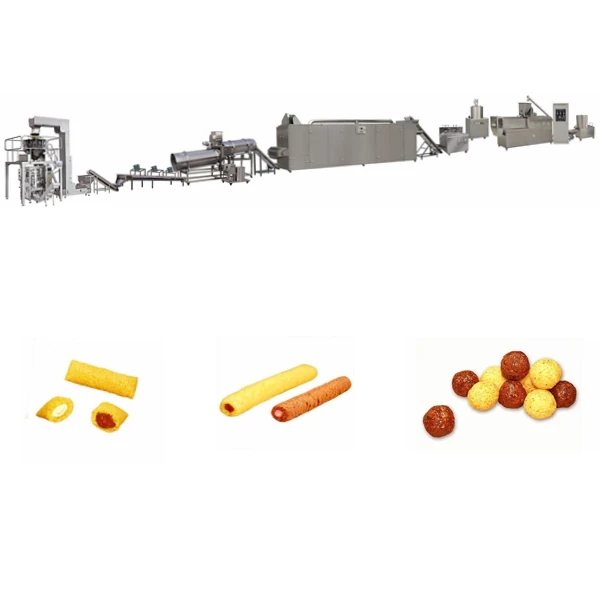

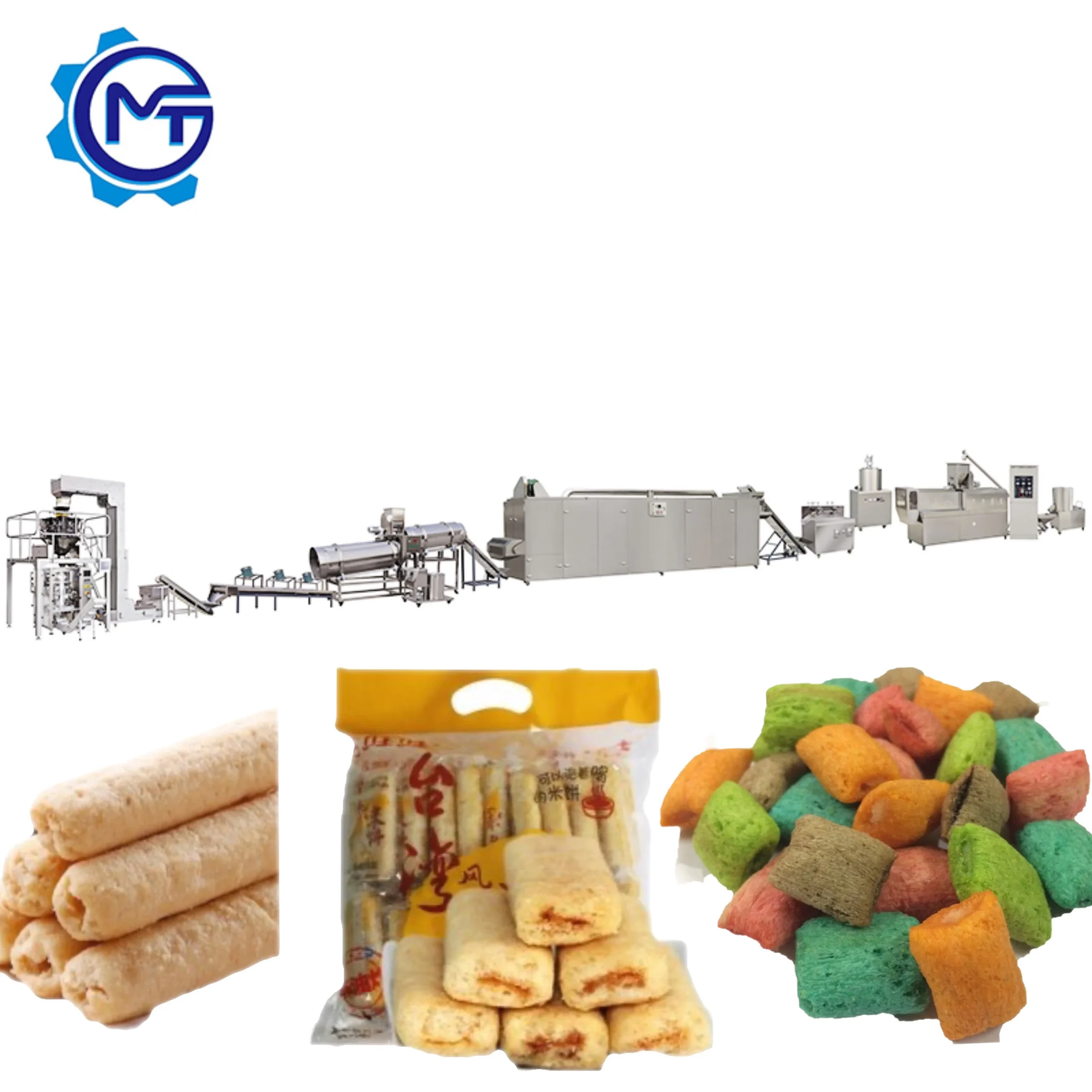
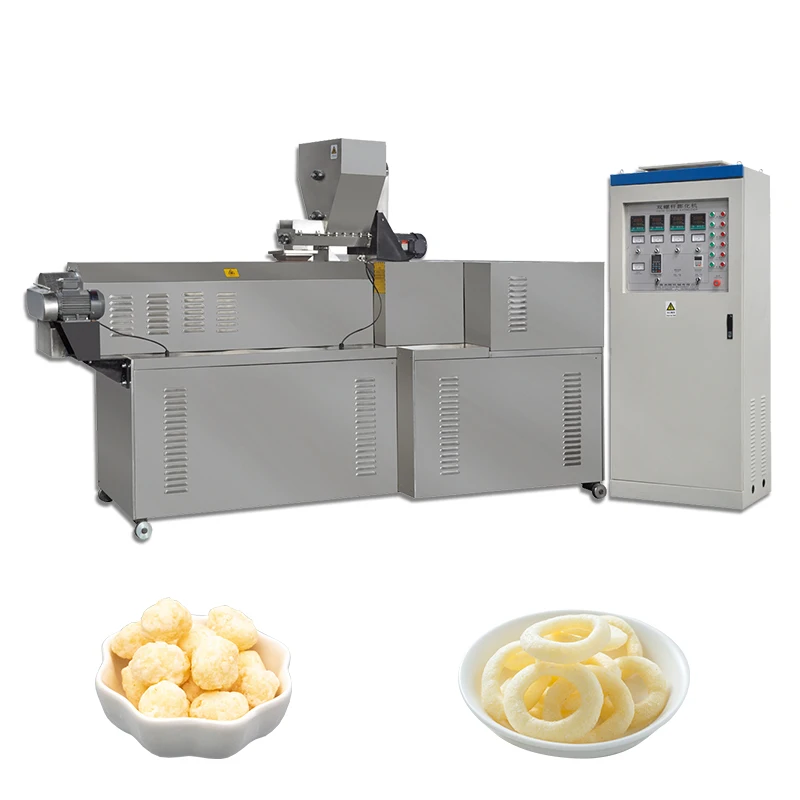
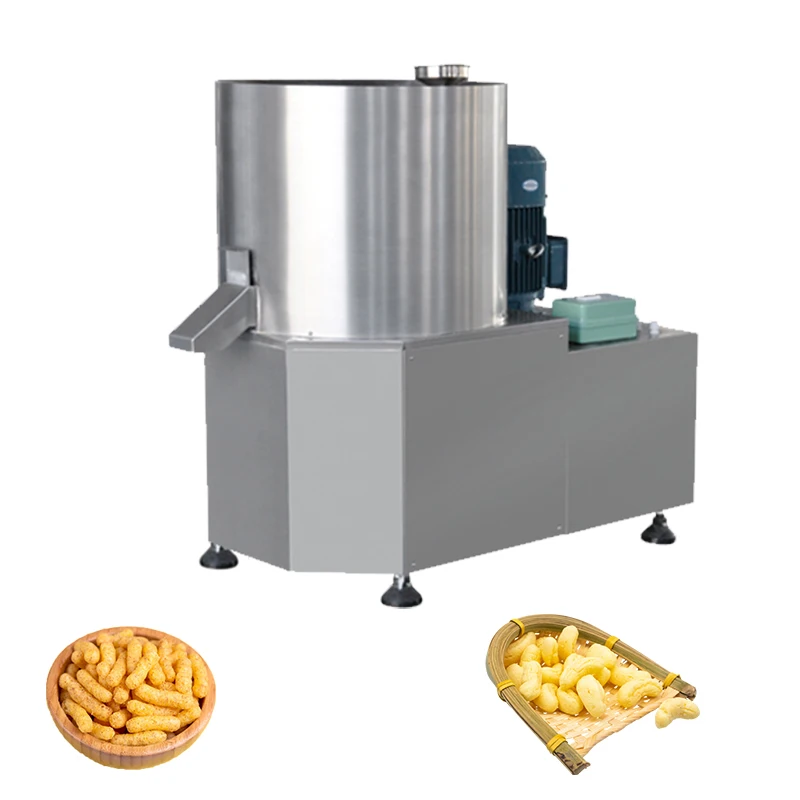
MT70 / MT85 / MT75 Twin Screw Extrusion Puffed Snack Production Line, PLC & MCC Control, Gas/Electric Dryer — complete turnkey layout from batching to packing, with throughput matched across mixing, extruding, drying, coating and cooling stations. Screw configuration and die design are specified to your raw material and target snack shape, ensuring consistent expansion and density on corn, rice or wheat flour.
- Twin-screw extruder with matched dryer and coating capacity to prevent bottlenecks
- In-house testing workshop runs your raw material before shipment, producing a verified trial report
- Multiple capacity tiers and customizable voltage, frequency and control language to suit your factory
On-site installation, commissioning and operator training ensure the line meets rated output from day one.
Description
Turnkey throughput matching — Every station from batching to packing is sized to sustain the extruder’s rated output without bottlenecking the line.
Technical Specifications
| Parameter | Value |
|---|---|
| Model | MT70 / MT85 / MT75 |
| Product Type | Twin Screw Extrusion Puffed Snack Production Line |
| Screw Type | Twin Screw |
| Installed Power | 130 kW (MT70) / 180 kW (MT85) / 220 kW (MT75) |
| Power Consumption | 95 kW (MT70) / 120 kW (MT85) / 130 kW (MT75) |
| Output Capacity | 100–120 kg/h (MT70) / 200–300 kg/h (MT85) / 300–500 kg/h (MT75) (basis not stated in source — confirm raw material / moisture / product shape) |
| Overall Dimensions | 21 × 1.5 × 2.2 m (MT70) / 25 × 1.5 × 2.2 m (MT85) / 28 × 1.5 × 2.2 m (MT75) |
| Raw Materials | Corn, rice, wheat, oat, barley flour |
| Product Shapes | Cheese ball, tube, stick, ring, fruit loop, star, wheel, flower, heart (via die change) |
| Control System | PLC and MCC control |
| Heating Source (Dryer) | Gas / Electric |
| Line Stations | Mixing → Extruding → Drying → Coating/Flavoring → Cooling → Packing |
| Coating System | Double tumble for sugar melting, elevator, coating drum, spraying nozzle |
| Assembly State | Complete turnkey line |
| Voltage & Frequency | Customized to local requirement |
| Standards | CE, ISO |
Application Suitability
| Application | Material or Output |
|---|---|
| Corn puff and cheese ball production | Corn flour and grits, direct-expanded shapes |
| Shaped cereal snack manufacturing | Rice, wheat, oat, and barley flour blends |
| Fruit loop and ring snack lines | Multi-grain flour mixes with sugar coating |
| Stick and tube snack formats | Corn and rice flour with seasoning application |
| Contract packaging snack lines | High-volume extruded shapes for co-packing |
Why Nominal Capacity Figures Can Mislead Snack Producers
A puffed snack extrusion production line turnkey rated at 300 kg/h on paper may deliver far less when your actual corn flour carries higher moisture than the test standard.
I learned this the hard way early in my career. A client in Southeast Asia ordered a corn snack line based on a quoted throughput figure. We ran the factory acceptance test with standard corn grits at controlled moisture. The line performed well. But when the client ran their locally sourced material — which absorbed ambient humidity during shipping — the extrudate came out dense, expansion dropped, and the dryer could not keep up. Production fell noticeably below the nameplate figure, and the coating drum sat idle waiting for product. Since then, I insist on receiving the buyer’s actual raw material for a trial run before finalizing screw configuration and die selection. A puffed snack extrusion production line turnkey must be validated against the specific formula and moisture profile the buyer will use every day, not a generic benchmark. [NEED_CITE: moisture content influence on extrusion expansion and throughput]
Screw Geometry and Die Selection for Each Snack Shape
The twin-screw extruder at the heart of this line allows the screw configuration to be adjusted segment by segment. Different snack shapes — rings, balls, sticks, fruit loops — demand distinct shear profiles and residence times inside the barrel. A cheese ball requires moderate shear and a specific die land length to achieve uniform spherical expansion, while a thin-walled tube needs higher shear and tighter temperature control to prevent collapse after the die exit. The screw elements and die geometry are specified together against the buyer’s target shape and raw material blend, so the extrudate leaves the die at the correct moisture and temperature for stable expansion.
Throughput Matching Across Every Line Station
A puffed snack extrusion production line turnkey only performs as well as its slowest station. The dryer must handle the full moisture load exiting the extruder; the coating drum must tumble and season at a rate that matches upstream output; the cooling conveyor must bring product temperature down before packing. When any station is undersized, the entire line throttles back. On this line, each station — mixing, extruding, drying, coating, cooling, packing — is calculated against the extruder’s capacity so rated throughput is sustainable end-to-end. The double-tumble coating system with sugar melting, elevator, and spraying nozzle is sized to handle the full output without product queuing or temperature loss. [NEED_CITE: line balancing principles in continuous food processing]
Reading the Specification Sheet Against Your Production Reality
Installed power ranges from 130 kW on the MT70 to 220 kW on the MT75, while actual power consumption sits lower — 95 kW to 130 kW respectively — reflecting the difference between motor nameplate rating and typical operating draw under load. The overall line length stretches from 21 meters to 28 meters depending on model, which affects factory floor planning and utility routing. The PLC and MCC control system manages barrel temperature zones, screw speed, and feeder rates to maintain batch-to-batch consistency, which matters when a snack brand must deliver identical texture and density across every production run. The dryer offers gas or electric heating options, a choice that depends on local energy costs and available utility infrastructure at the installation site.
The Hidden Cost of Skipping the Trial Run
Buyers who approve shipment without a factory trial on their own raw material often discover problems only after installation. Screw elements optimized for one flour blend may produce under-expanded or over-expanded product on another. A die that forms perfect rings with low-moisture corn grits may yield misshapen ovals with a higher-moisture rice-corn blend. The dryer settings calibrated at the factory may not remove enough moisture from a denser extrudate, leading to short shelf life or soggy texture after packing. These issues are solvable, but fixing them on-site costs more time and money than running a trial before the line leaves the factory. [NEED_CITE: cost of post-installation process correction versus pre-shipment validation]
Why Buyers Source This Line From One Supplier
The entire puffed snack extrusion production line turnkey comes from a single source, so throughput calculations, electrical schematics, and mechanical interfaces are coordinated before fabrication rather than reconciled on the factory floor. Screw configuration and die design are matched to the buyer’s specific raw material and target product shape, not copied from a generic build. The in-house testing workshop allows trial runs on the buyer’s actual material before shipment, producing a documented report. The three-model range — MT70, MT85, MT75 — lets buyers select capacity that fits their production target and available floor space. Pre-sales consultation, on-site installation, commissioning, and ongoing maintenance support are handled by the same engineering team that configured the line.
Documentation & Verification
- Line layout and capacity calculation showing throughput matching across every station
- Screw and die configuration record specific to your raw material and target shape
- Trial run report on your actual raw material before shipment approval
- Electrical schematic with voltage and frequency confirmed to your local supply
- CE declaration of conformity and ISO certificate for import compliance
- Operation and maintenance manual with wear parts list and replacement intervals
Installation, Commissioning & Support
- Floor space of 21 to 28 meters in length requires level concrete foundation with utility trenches
- Power supply must match the confirmed voltage and frequency, with dedicated circuit for 130–220 kW installed load
- Line ships in modular sections for container loading and reassembly at your facility
- First startup includes barrel temperature profiling, screw speed calibration, and die alignment for your product shape
- Operator training covers PLC interface navigation, recipe storage, and emergency stop procedures
- Wear parts list includes screw elements, die plates, and dryer belts with recommended replacement schedule
What to Include in Your Inquiry
To configure a line that matches your production target, share your raw material type and typical moisture range, the snack shapes you plan to produce, and your target hourly output in kilograms. Include your factory’s available floor length and ceiling height, local voltage and frequency, and preferred control language. If you have existing upstream or downstream equipment you want to integrate, note the connection points. Sending a sample of your actual raw material allows us to run a trial and verify throughput before the quotation is finalized.
Frequently Asked Questions
Q: How is line capacity verified against my specific raw material and recipe?
A: We ask you to send a batch of your actual raw material to our testing workshop. We run the extruder with your formula, measure expansion, density, and moisture at each station, and document the results in a trial run report. If throughput or product quality does not meet your target, we adjust screw configuration and die design and retest before finalizing the line specification.
Q: How do you match dryer and coating capacity to the extruder so no station bottlenecks the line?
A: Each station is calculated against the extruder’s output during the layout phase. The dryer belt length and heating capacity are sized to remove the moisture load from the full extruder throughput. The coating drum volume and tumble speed are matched so seasoning application keeps pace. We show these calculations in the line layout and capacity document you receive before production.
Q: What voltage, frequency, and control language options are confirmed before production?
A: Before fabrication begins, we confirm your factory’s supply voltage, frequency, and phase with your electrical team. The PLC and MCC control system is then configured to those specifications. The HMI language is set to your operator’s preference so training and daily operation proceed without translation delays.
Q: Can I see a trial run on my raw material before the line ships?
A: Yes. Our in-house testing workshop runs your raw material through the configured extruder, dryer, and coating stations. You receive a trial run report with product samples, throughput data, and process parameters. Shipment approval is tied to your sign-off on this report.
Q: What does on-site installation, commissioning, and operator training cover?
A: Our engineers supervise unloading, station positioning, and utility connections at your facility. Commissioning includes running your raw material through the full line, fine-tuning temperature profiles and screw speed, and verifying product quality against your specification. Operator training covers PLC operation, recipe changeover, daily maintenance, and wear part replacement procedures.
Related products
-

Automatic Puff Corn Snack Stick Production Line Equipment New Condition Machines
¥100.00 Select options This product has multiple variants. The options may be chosen on the product page -

Puff Corn Extruder Machine Puffed Core Filled Snack Food Production Line Machine
¥8,500.00 Select options This product has multiple variants. The options may be chosen on the product page -

Full Automatic Crispy Maize Chocos Corn Flakes Breakfast Cereals Processing Production Line Industrial Equipment
¥1,000.00 Select options This product has multiple variants. The options may be chosen on the product page -

Twin Screw Corn Puffs Extruder Machine Small Corn Snack Food Extruder Machine
¥100.00 Select options This product has multiple variants. The options may be chosen on the product page

