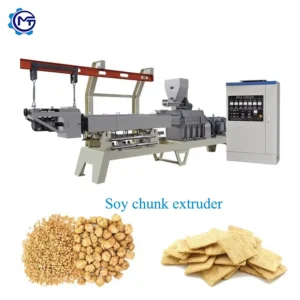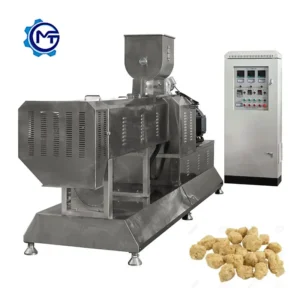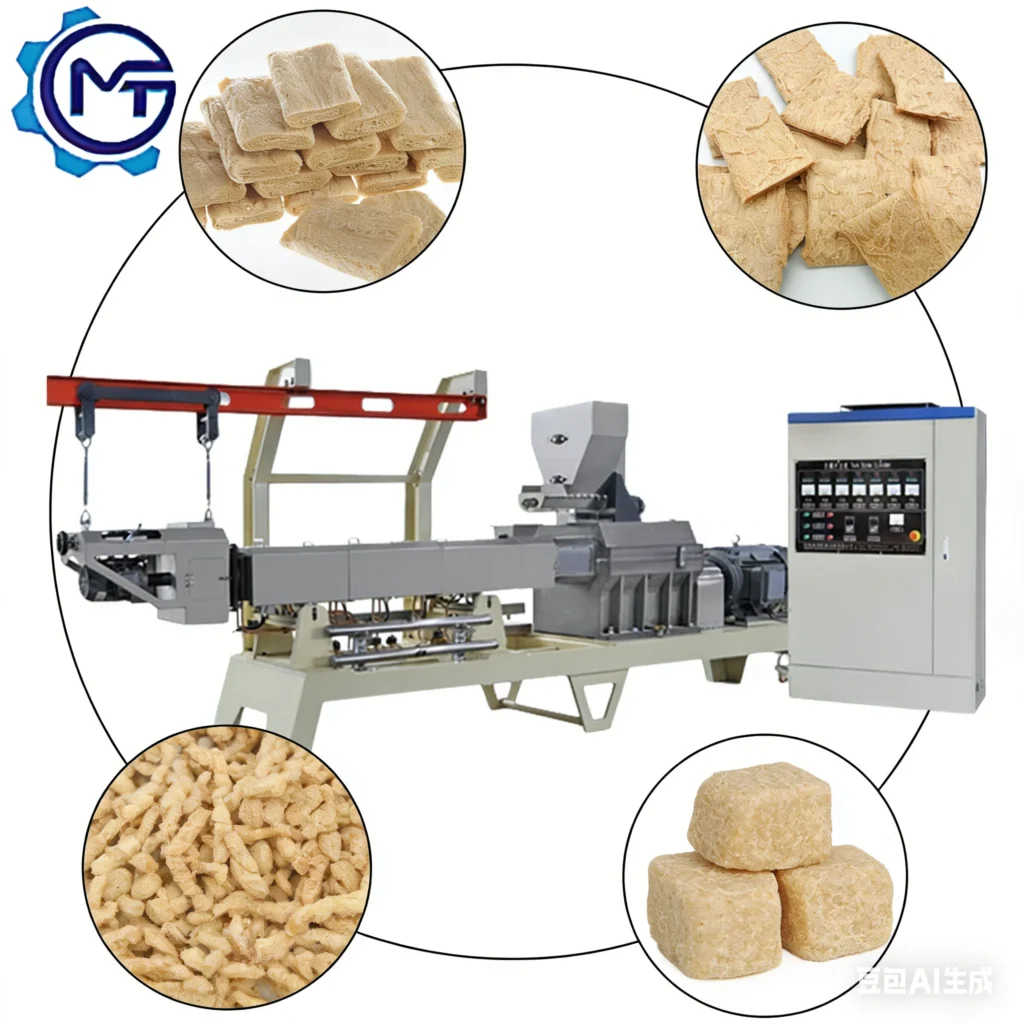


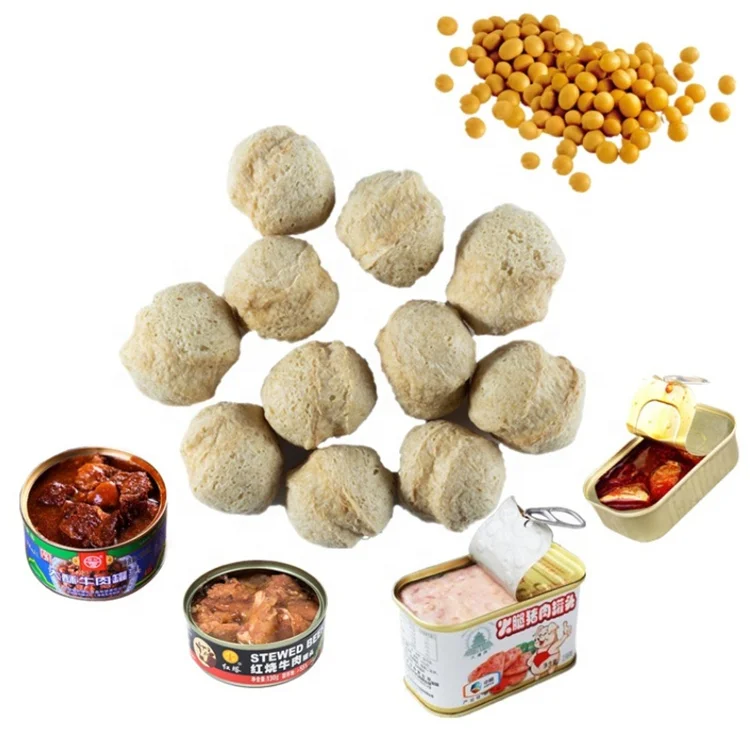
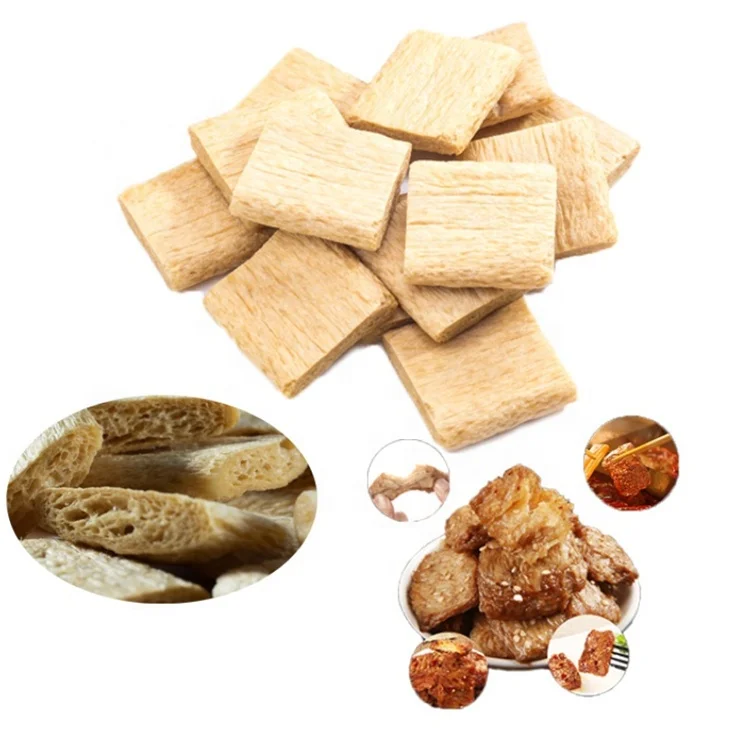
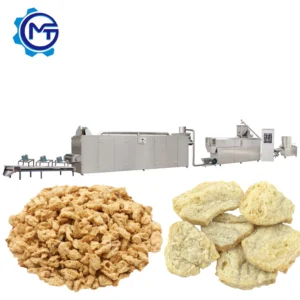
MT65 Twin Screw Extruder for Textured Vegetable Protein, 84 kW, 100-150 kg/h — engineered for defatted soya flour and low-temperature soya flakes across the full TVP station sequence from mixer through extruder, air conveyor, multi-layer dryer to cooling machine. Screw configuration and die design are matched to raw material behaviour and target texture — chunks, nuggets, or granules — controlling moisture, shear, and expansion at each barrel zone for consistent fibre structure. Turnkey layout delivered with throughput matched at every station, pre-shipment trial runs on your raw material, and voltage confirmed to your facility before production starts.
Description
Turnkey TVP Line Integration — Every station from mixing through drying is throughput-matched under one supplier, so your textured vegetable protein output holds steady instead of bottlenecking at the dryer.
Technical Specifications
| Parameter | Value |
|---|---|
| Model | MT65 |
| Product Type | Twin Screw Extruder for Textured Vegetable Protein |
| Screw Type | Twin screw |
| Installed Power | 84 kW |
| Power Consumption | 59 kW |
| Output Capacity | 100–150 kg/h (basis not stated in source — confirm raw material, moisture, and target TVP format) |
| Overall Dimensions (L×W×H) | 40000 × 1200 × 2200 mm |
| Line Stations | Mixer → Screw Conveyor → Twin Screw Extruder → Air Conveyor → Multi-layer Dryer → Cooling Machine |
| Raw Materials | Defatted soya flour, low temperature soya flakes |
| Standards | CE certified |
Application Suitability
| Application | Material or Output |
|---|---|
| Soya chunks and nuggets for meat analogue production | Defatted soya flour rehydrated and extruded into fibrous, bite-sized pieces |
| Textured vegetable protein mince for ready meals | Low temperature soya flakes processed into granular TVP for frozen food integration |
| Plant-based patty and burger base material | Soya protein extruded into layered sheets or chunks, then ground or formed downstream |
| Vegetarian snack and fast food ingredients | TVP chunks sized and dried for consistent frying or seasoning absorption |
What "100–150 kg/h" Really Means for Your Raw Material
Nominal capacity figures only hold when the extruder is configured for the exact feedstock you plan to run.
A textured vegetable protein production line turnkey proposal that quotes output without specifying raw material, moisture content, and target TVP format is incomplete. I have seen projects where the trial ran perfectly on standard soy isolate, then the customer switched to a pea-soy blend with higher starch content on their own floor. The first production run produced rubbery pellets instead of fibrous chunks. Two weeks on-site were spent reworking the screw profile and barrel temperature zones to recover acceptable texture [NEED_CITE: raw material variability effects on twin-screw extrusion output]. The lesson carries forward: capacity verification must happen on your actual feedstock before the line ships.
Matching Screw Profile to Soya Protein Behaviour
The twin-screw configuration on the MT65 is not a generic build. Screw elements are arranged to control residence time, shear intensity, and moisture distribution specific to defatted soya flour or low temperature soya flakes. A textured vegetable protein production line turnkey setup requires this matching because soya protein undergoes thermoplastic extrusion — the protein molecules must align under heat and shear to form the fibrous structure that mimics meat. Wrong screw spacing or insufficient barrel length means the protein never reaches the right degree of texturisation.
Dryer and Cooling Throughput Must Follow Extruder Output
An extruder pushing material faster than the downstream dryer can handle creates a backlog that forces line stoppages. The multi-layer dryer and cooling machine in this line are sized to handle the MT65 extruder output range so that moisture removal and temperature reduction happen continuously. When these stations are sourced from separate vendors, throughput mismatches are common — the extruder runs at full capacity while the dryer falls behind, and operators end up throttling production to keep pace [NEED_CITE: throughput balancing in food extrusion lines].
Reading the Specifications That Matter
The 84 kW installed power and 59 kW operating consumption reflect the energy needed to maintain barrel temperature zones and drive the twin screws through dense soya protein mass. The 40-metre line footprint encompasses every station from mixer to cooling machine, which matters when planning your facility layout. Twin-screw extrusion for TVP depends on precise temperature staging along the barrel — too cool and the protein fails to texturise, too hot and you get surface burning without internal fibre development. The screw type designation here means co-rotating intermeshing screws, which provide the consistent shear needed for uniform protein alignment across the full cross-section of the die.
The Cost of Skipping Configuration Verification
When screw and die configurations are copied from a generic build rather than matched to your specific soya material, the texture and density of the output will miss market expectations. Soya chunks that are too dense do not rehydrate properly in cooking applications. Chunks that are too porous absorb too much oil during frying. I have watched lines produce acceptable product during factory trials, then drift once installed because the die geometry was never adjusted for the customer’s actual flake particle size and moisture range [NEED_CITE: die configuration impact on TVP density and rehydration].
Why Procurement Through One Supplier Matters Here
The complete line from batching to cooling comes from a single source, meaning throughput calculations account for every transfer point. The in-house testing workshop runs your raw material before the line leaves the factory — not after installation on your floor. Screw configuration and die design are documented and recorded against your specific feedstock and target TVP format. Pre-sales engineering covers line layout and utility planning, and on-site commissioning includes operator training on the actual machine parameters [NEED_CITE: CE machinery directive compliance for food extrusion equipment]. Documentation packages include the trial run report, electrical schematics, and wear parts lists specific to your configuration.
Documentation & Verification
- Line layout drawing with throughput calculations at each station from mixer to cooling machine
- Screw and die configuration record matched to your soya flour or flake specification
- Trial run report generated on your raw material in the testing workshop before dispatch
- Electrical schematic with voltage and frequency confirmed for your facility
- Operation and maintenance manual covering all line stations with wear parts list
- CE declaration of conformity and factory test record included with shipment
Installation, Commissioning & Support
- 40-metre line footprint requires floor planning with clearance for screw conveyor and air conveyor routing
- 84 kW installed power needs dedicated electrical circuit with confirmed voltage and frequency before energising
- Line arrives in sectional modules for on-site assembly, alignment, and utility connection
- First production run includes barrel temperature profiling and screw speed adjustment on your raw material
- Operator training covers mixer ratios, extruder parameter setting, dryer temperature staging, and cooling cycle timing
- Wear parts list identifies screw elements, die plates, and conveyor belts with replacement intervals
What to Include in Your Inquiry
To move from a generic quote to a configured line proposal, we need your raw material specification including protein content and particle size, your target TVP format such as chunks, nuggets, or granules, and your daily production volume. Your facility voltage and frequency, available floor space with ceiling height, and any existing upstream or downstream equipment should also be included. If you want a trial run on your feedstock before commitment, send a sample batch and we will run it through the testing workshop.
Frequently Asked Questions
Q: How is line capacity verified on my specific soya raw material and target TVP format?
A: We run your actual defatted soya flour or low temperature soya flakes through the MT65 in our testing workshop before shipment. The trial covers screw speed, barrel temperature profile, moisture addition rate, and die selection. You receive a trial run report documenting output rate, texture assessment, and the exact machine parameters that produced acceptable product on your feedstock.
Q: How are screw and die configurations selected for different TVP textures?
A: Chunky, nugget-style TVP requires different screw element spacing and die geometry compared to fine granular mince. We adjust the screw profile to control shear intensity and residence time, then match die hole diameter and land length to the expansion ratio your target product requires. Each configuration is recorded and shipped with the machine.
Q: How do you ensure throughput matching between extruder, dryer, and cooling?
A: Every station is calculated from the same throughput baseline. The mixer batch size, screw conveyor rate, extruder output, dryer belt speed, and cooling cycle duration are all set so material flows continuously without accumulation. The line layout document shows capacity at each station against your target production rate.
Q: What does the pre-shipment trial run cover?
A: The trial processes your raw material through the full line sequence in our testing workshop. We measure output rate, product moisture after drying, texture and density, and dimensional consistency. The report includes all adjustable parameters — screw speed, barrel zone temperatures, moisture addition percentage, dryer settings — so your team can replicate results from day one.
Q: How is voltage, frequency, and control language confirmed before production?
A: During the specification confirmation stage, you provide your facility electrical standards and preferred operating language. We issue an electrical schematic showing motor ratings, control panel layout, and wiring diagrams matched to your supply. This is signed off before the machine enters production so there are no commissioning delays.
Related products
-
New High Efficiency Protein Production Line Plant Protein Equipment for Artificial Vegetarian Meat Processing Food Grade
¥65.00 Select options This product has multiple variants. The options may be chosen on the product page -
High Moisture Vegetarian Meat Extrusion Machine
¥9,500.00 Select options This product has multiple variants. The options may be chosen on the product page -
Vegetable Meat Making Machine Textured Soybean Protein Maker
¥30.00 Select options This product has multiple variants. The options may be chosen on the product page -
Meat Taste Textured Soybean Protein Processing Machine Vegetable Protein Soy Meat Making Machine
¥8,650.00 Select options This product has multiple variants. The options may be chosen on the product page