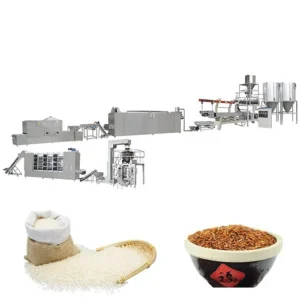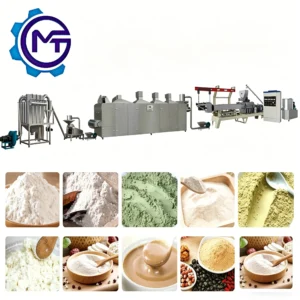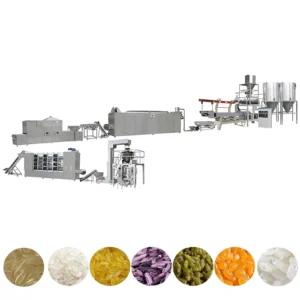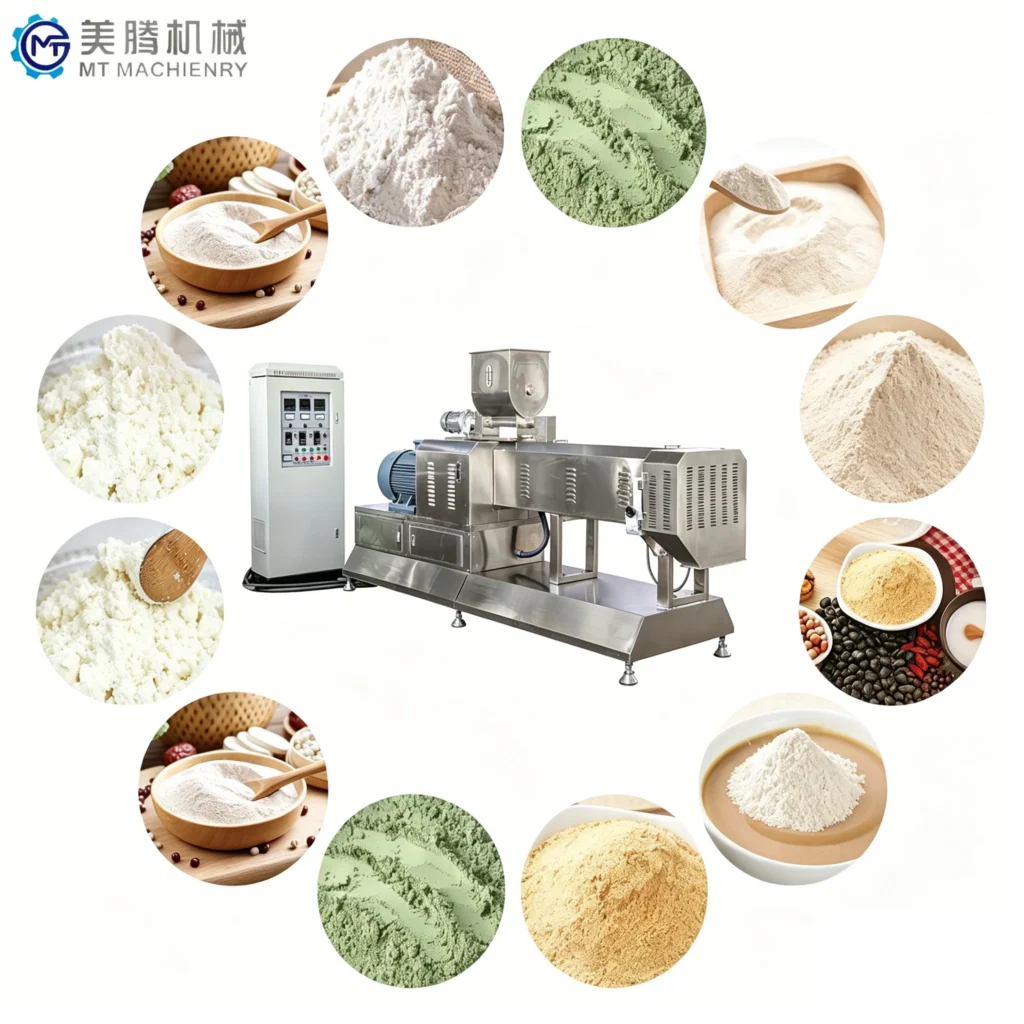


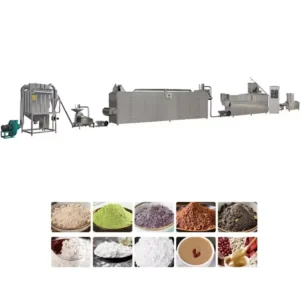
MT65 / MT70 / MT75 / MT85 Twin Screw Extruder Nutrition Powder Processing Line, 380V 50Hz Three Phase, 304 SS Mixer — complete layout from batching through extrusion, drying and pulse grinding with throughput matched across every station. Screw configuration and die design specified to the buyer’s raw material formulation and target product density.
- In-house testing workshop runs trial production on your specific formulation before shipment to verify real-world output
- Dryer heating selectable between fuel, gas or electricity with adjustable residence time for moisture control
- Line capacity calculation and electrical schematic confirmed to your facility standard before production
Description
Engineered Line Integration — Throughput is balanced across every station from batching to pulse grinding, eliminating bottlenecks that occur when extruders are sourced separately from downstream equipment.
Technical Specifications
| Parameter | Value |
|---|---|
| Product Type | Twin Screw Extruder Nutrition Powder Processing Line |
| Model Options | MT65 / MT70 / MT75 / MT85 |
| Screw Type | Twin Screw |
| Installed Power | MT65 — 84 kW / MT70 — 160 kW / MT75 — 190 kW / MT85 — 210 kW |
| Power Consumption | MT65 — 59 kW / MT70 — 120 kW / MT75 — 140 kW / MT85 — 150 kW |
| Output Capacity | MT65 — 120–150 kg/h / MT70 — 150–200 kg/h / MT75 — 200–250 kg/h / MT85 — 300–400 kg/h (basis to be confirmed — depends on raw material, moisture content, target particle size) |
| Overall Dimensions | MT65 — 20000×1500×2200 mm / MT70 — 21000×1500×2200 mm / MT75 — 23000×1500×3200 mm / MT85 — 25000×1500×3500 mm |
| Voltage & Frequency | 380 V, 50 Hz, Three Phase (configurable for target market) |
| Control System | Available with PLC or MCC control (confirm configuration) |
| Mixer Capacity Options | 20–30 kg/batch / 70–80 kg/batch / 170–180 kg/batch |
| Mixer Power Options | 4 kW / 7.5 kW / 15 kW |
| Mixer Material | 304 Stainless Steel |
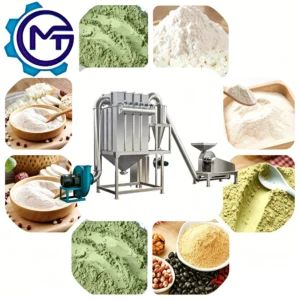
| Pulse Crusher Capacity | ~200 kg/h (basis to be confirmed — depends on target mesh size and material) |
| Pulse Crusher Power | 11 kW |
| Pulse Crusher Weight | 1500 kg |
| Pulse Crusher Dimensions | 3000×900×2200 mm |
| Line Stations | Raw material mixing → Screw conveying → Extruding → Air conveying → Drying → Air conveyor → Pulse grinding |
| Dryer Heating Options | Fuel / Gas / Electricity (buyer selectable) |
| Dryer Drive | Double pitch roller chain drive, round-trip drying |
| Assembly State | Complete line with supporting equipment |
| Certification | CE, ISO |
Application Suitability
| Application | Material or Output |
|---|---|
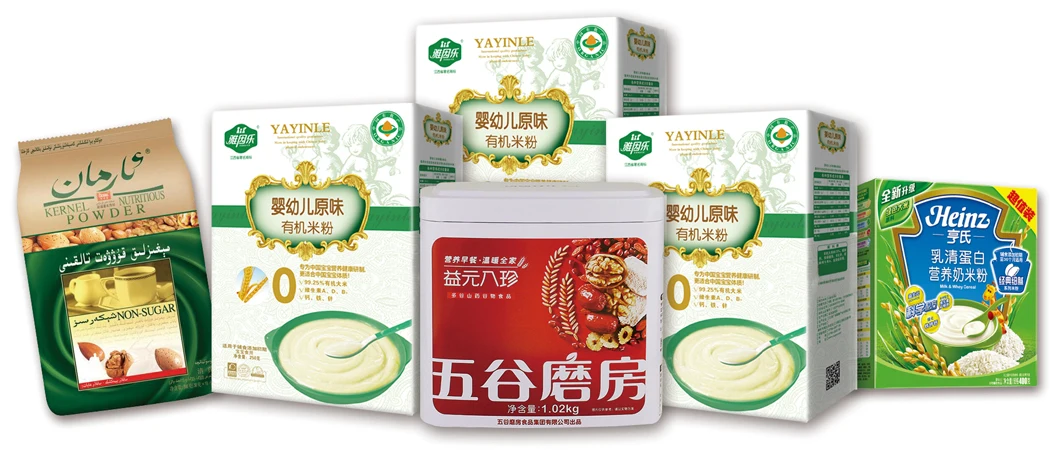
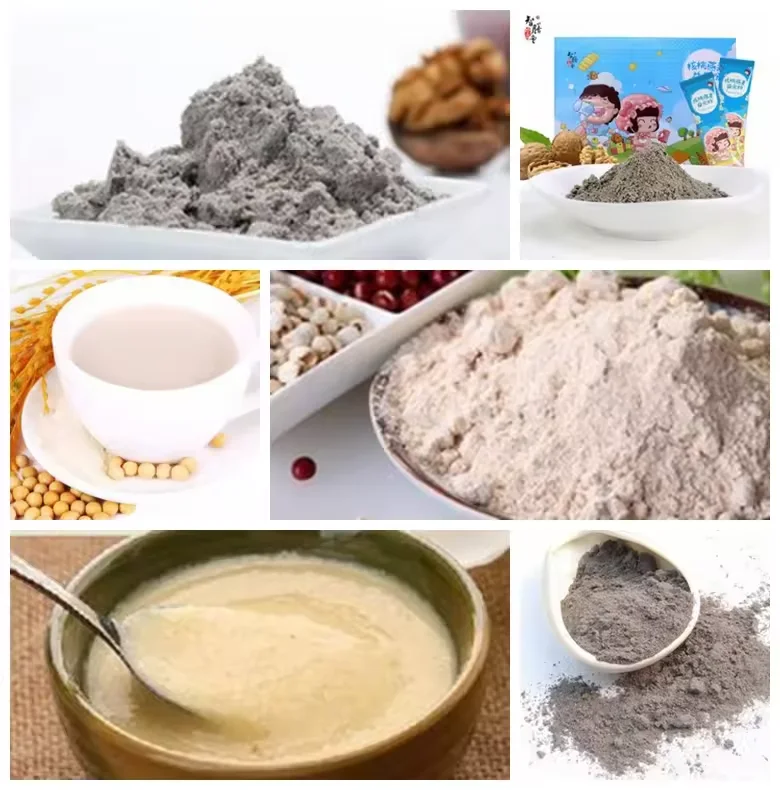
| Baby rice flour production | Rice flour with varying amylose content, pregelatinised for instant reconstitution |
| Infant nutrition powder | Grain-based blends with vitamin and mineral premixes |
| Modified starch processing | Corn, cassava, potato starch for industrial and food-grade use |
| Fortified nutrition powder | Maize, soy, millet blends for supplementary feeding programmes |
| Instant rice porridge powder | Pre-cooked rice and grain mixtures for quick-preparation meals |
| Texturized protein powder | Soy and legume-based protein concentrates |
What Nominal Capacity Figures Leave Out on a Nutritional Powder Processing Line Turnkey
Real throughput depends on your exact raw material formulation, not a catalogue number.
I watched a baby rice flour line perform without fault during factory testing, only to stall at the die when the customer’s locally sourced rice carried a higher amylose fraction than the test batch. The extruder barrel temperature profile, screw speed, and moisture injection all required on-site re-tuning over several days before the line ran within specification. A nutritional powder processing line turnkey project succeeds only when the supplier tests on your actual raw material and adjusts the screw configuration accordingly. [NEED_CITE: starch gelatinisation behaviour varies with amylose-amylopectin ratio] Without that verification step, the output capacity printed on a quotation becomes a theoretical maximum rather than a dependable daily figure.
Matching Barrel Zones to Raw Material Behaviour
Twin screw extrusion for nutritional powders demands that barrel temperature zones and screw pitch align with the gelatinisation point of the specific starch source being processed. A rice flour blend with higher amylose content requires a different thermal profile compared to a maize or cassava base, and the screw element arrangement must generate sufficient shear without degrading heat-sensitive vitamin premixes. The nutritional powder processing line turnkey package includes a screw configuration record that documents which element sequence was validated during the trial run, giving the buyer a repeatable baseline for future production.
Dryer Residence Time and Moisture Targets
The round-trip dryer on this line uses a double pitch roller chain drive to carry product through multiple passes, allowing residence time to be adjusted to the moisture specification of the target powder. Selecting the correct heating source — fuel, gas, or electricity — depends on local utility cost and available infrastructure, which varies considerably between facilities in different regions. [NEED_CITE: industrial drying energy source selection for food processing plants] If the dryer is undersized relative to extruder output, moisture content at the pulse grinder inlet rises, leading to inconsistent particle size and shortened screen life.
Interpreting the Power and Capacity Spread Across Models
The installed power ranges from 84 kW on the MT65 to 210 kW on the MT85, reflecting the increasing motor torque and barrel heating required for higher throughput models. Power consumption figures sit noticeably below installed capacity, indicating that the drives and heaters are not running at full load under normal operating conditions. The mixer options span three batch sizes — from 20–30 kg up to 170–180 kg — so the batching station can be sized to keep the extruder hopper continuously fed without material sitting long enough to absorb ambient moisture. The pulse crusher, rated at 11 kW with a 3000×900×2200 mm footprint, sits at the end of the line and must be matched to the dryer discharge rate so that neither station becomes a bottleneck. Overall line length stretches from 20 metres on the MT65 to 25 metres on the MT85, which directly affects the facility layout and utility routing decisions during installation planning.
When Downstream Stations Cannot Keep Up
An extruder that outpaces its dryer and grinder creates a cascade of problems: product accumulates on the air conveyor, moisture levels drift outside specification, and the pulse grinder produces an inconsistent mesh. In one facility I visited, the previous supplier had quoted a twin screw extruder on its maximum catalogue output without verifying that the drying section could handle the volume. The result was powder reaching the grinder with residual moisture that caused screen blinding and frequent unplanned stops. [NEED_CITE: effects of moisture content on grinding efficiency in starch-based powders] These imbalances are preventable when line capacity calculations account for every station from mixing through final grinding.
Why Procurement from a Single Line Integrator Matters
Complete line stations — mixing, screw conveying, extrusion, air conveying, drying, and pulse grinding — are configured under one supplier, so throughput is calculated end-to-end rather than assembled from disconnected quotes. The in-house testing workshop runs trial production on the buyer’s actual raw material before shipment, generating a test report that documents real throughput and product quality. Screw configuration and die design are specified to the buyer’s formulation, not copied from a generic build. Electrical schematics and voltage confirmation are completed during the design phase, matching the buyer’s local supply standard. Pre-sales consultation extends through on-site installation, commissioning, operator training, and ongoing wear parts support, ensuring the line performs after the engineering team leaves the facility.
Documentation & Verification
- Line layout drawing showing station spacing and utility connection points for the selected model
- Trial run report documenting throughput and product quality on buyer’s raw material
- Screw and die configuration record specific to the target powder formulation
- Electrical schematic with confirmed voltage and frequency for destination market
- CE declaration of conformity covering all line stations
- Factory test record with photographic evidence before crating
Installation, Commissioning & Support
- Facility floor must accommodate line lengths up to 25 m with adequate clearance for air conveyor routing
- Dedicated three-phase supply required matching confirmed voltage and frequency for the MT65 through MT85 range
- Equipment ships in modular sections for sequential assembly starting from the mixer station
- Commissioning includes barrel temperature profiling and screw speed calibration on site
- Operator training covers PLC or MCC interface, cleaning procedures, and safety interlocks
- Wear parts list provided covering screws, dies, and dryer chain components
Preparing Your Enquiry
To size the line accurately, share the specific raw materials and their proportions, the target particle size and moisture content of the finished powder, and the daily output requirement. Include your facility dimensions, available ceiling height, and local electrical supply specification so the layout and voltage configuration can be confirmed before production begins. If you are working with a raw material that has variable starch composition, request a trial run in the testing workshop to validate throughput and product quality before the line is shipped.
Frequently Asked Questions
Q: How is line capacity verified on my raw material before shipment?
A: The in-house testing workshop runs your specific formulation through the selected extruder and downstream stations. A trial run report is generated documenting actual throughput, moisture content, and particle size, so the capacity figure is based on your material rather than a generic benchmark.
Q: What does the phased installation schedule look like for a complete line?
A: Installation follows a station-by-station sequence starting from the mixer and screw conveyor, progressing through the extruder, dryer, and pulse grinder. Utility connections are routed as each section is positioned, and commissioning begins once all stations are mechanically and electrically linked.
Q: How is throughput balanced between the extruder, dryer, and grinder?
A: Capacity calculations cover every station so that the dryer residence time and pulse grinder feed rate match extruder discharge. The line layout document shows the matched throughput at each point, preventing bottlenecks that arise when equipment is sourced separately.
Q: What facility preparation is needed before equipment arrives?
A: The buyer receives a layout drawing specifying floor space, utility connection points, and electrical supply requirements. Floor load bearing must support the heaviest stations, and the three-phase supply must match the confirmed voltage and frequency for the destination market.
Q: What operator training and maintenance support is included?
A: On-site training covers machine operation, control system navigation, cleaning procedures, and daily inspection routines. A wear parts list is provided so replacements for screws, dies, and dryer components can be ordered before the first scheduled maintenance interval.
Related products
-

High Quality Automatic PLC Controlled 500kg/h Twin Screw Extruder Machine for Baby Rice Nutrition Powder
¥8,238.27 Add to cart -
Automatic Nutritional Powder Making Machine Safe Rice Cereal for Babies
¥30.00 Select options This product has multiple variants. The options may be chosen on the product page -

Automatic Instant Powder Production Line Nutritional Powder Extruder Machine
¥10,000.00 Select options This product has multiple variants. The options may be chosen on the product page -
Healthy Baby Food Production Line Nutritional Powder Equipment for Baby Food Supplements for Flour Processing Machinery
¥8,500.00 Select options This product has multiple variants. The options may be chosen on the product page