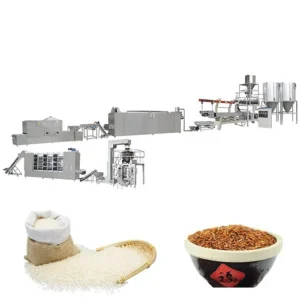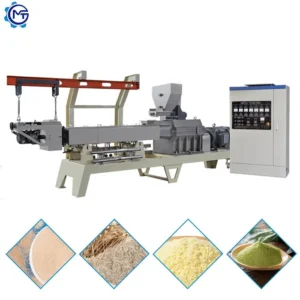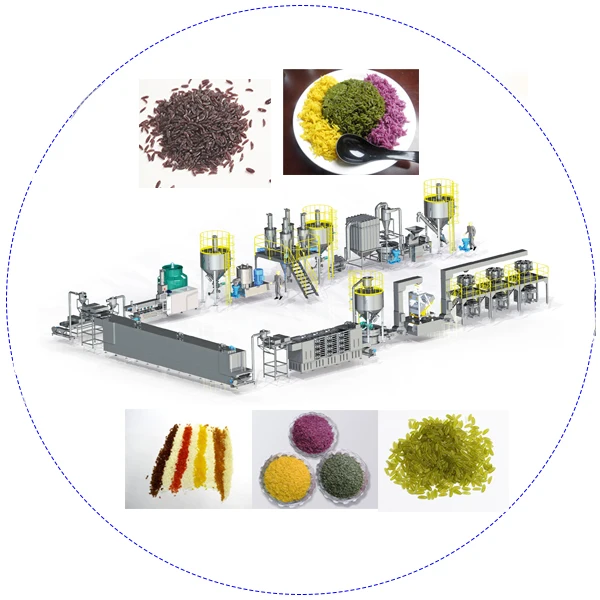


MT65 / MT70 / MT85 / MT75 / MT95 Artificial Fortified Rice Processing Line, Twin-Screw Extrusion, PLC Control — engineered as a complete turnkey project from batching to packing. Each station — mixing, extruding, vibrating, low-temperature drying, cooling, roasting, and packing — is throughput-matched to prevent bottlenecks on your actual raw material formulation.
- Screw and die configuration specified to your raw material and target kernel shape
- Circulation drying with frequency-controlled mesh belt for consistent moisture
- CE and ISO certified with on-site installation, commissioning, and operator training included
Description
Integrated Throughput Engineering — every station from mixing to packing is calculated as one continuous system, eliminating the bottleneck between extruder output and dryer capacity on this artificial fortified rice production line turnkey solution.
Technical Specifications
| Parameter | Value |
|---|---|
| Model | MT65 / MT70 / MT85 / MT75 / MT95 |
| Product Type | Artificial Fortified Rice Processing Line |
| Extruder Type | Twin-screw |
| Feeding System | Single or double screw feeding system (selected by material) |
| Control System | Frequency speed controlling, high automation |
| Lubrication | Automatic lubricating and cooling system |
| Heating Source (Dryer) | Electric or gas |
| Dryer Feature | Circulation drying process, frequency motor controls mesh belt speed |
| Line Stations | Mixing → Extruding → Vibrating → Low Temperature Drying → Cooling → High Temperature Roasting → Cooling → Packing |
| Basic Materials | Broken rice, rice, corn, millet, wheat, oats, buckwheat, bean, starch with vitamin and mineral premix |
| Final Products | Artificial rice, fortified rice kernels |
| Voltage & Frequency | Customizable to local electrical standards |
| Assembly State | Complete line turnkey solution |
| Standards | CE, ISO |
Model-Specific Data
| Model | Installed Power | Power Consumption | Capacity | Dimensions (L × W × H) |
|---|---|---|---|---|
| MT65 | 85 kW | 60 kW | 80–100 kg/h (basis to be confirmed) | 28 × 1.2 × 2.2 m |
| MT70 | 120 kW | 85 kW | 100–120 kg/h (basis to be confirmed) | 30 × 1.5 × 2.2 m |
| MT85 | 235 kW | 165 kW | 200–300 kg/h (basis to be confirmed) | 34 × 3.5 × 4.3 m |
| MT75 | 180 kW | 135 kW | 300–500 kg/h (basis to be confirmed) | 32 × 3.5 × 4.3 m |
| MT95 | 260 kW | 195 kW | 800–1000 kg/h (basis to be confirmed) | 36 × 3.5 × 4.3 m |
Application Suitability
| Application | Material or Output |
|---|---|
| Fortified food and nutrition programme supply | Vitamin- and mineral-enriched rice kernels from broken rice and starch with iron, zinc, and B-vitamin premix |
| Grain processing enterprise upcycling | Artificial rice kernels from broken rice, rice bran, and millet blends |
| Breakfast cereal and specialty food production | Fortified rice formats from corn, oats, buckwheat, and bean flour bases |
| Institutional feeding and school meal programmes | Nutritionally standardized rice kernels with controlled macro- and micronutrient profiles |
Why Nominal Capacity Figures Fail on Fortified Rice Formulations
A production line quoted on clean starch will underperform the moment your actual premix hits the barrel.
When a supplier quotes an artificial fortified rice production line turnkey capacity based on pure rice flour, that number rarely survives contact with real-world formulations. Iron sulfate, zinc oxide, calcium carbonate, and fiber additives each change the melt viscosity inside the extruder barrel. The gelatinisation window shifts. Expansion drops. Kernel density creeps upward until the product sinks in cooking water instead of holding its shape. I watched a South Asian nutrition programme lose four full commissioning days because the line was configured on standard rice flour while the client’s formula carried a heavy micronutrient premix. Parameters had to be rebuilt from scratch on-site. [NEED_CITE: impact of mineral fortificants on starch extrusion rheology]
Screw Configuration Matched to Your Fortification Load
The twin-screw extruder at the heart of this artificial fortified rice production line turnkey system is not shipped with a generic screw profile. Screw element arrangement — conveying sections, kneading blocks, and reverse elements — is specified after reviewing your exact raw material sheet and micronutrient premix ratio. A formulation heavy in calcium carbonate requires different shear distribution than one built around rice bran and iron pyrophosphate. The die plate is matched to the target kernel geometry and density specification so the extrudate exits with the correct cross-section and moisture profile entering the dryer.
Dryer and Extruder Throughput Balance
The most common failure in fortified rice line design is an extruder that outpaces its dryer. The circulation drying system on this line uses a frequency-controlled mesh belt, allowing belt speed to be tuned to the extruder output rate. Low-temperature drying removes surface moisture without case-hardening the kernel, while the subsequent high-temperature roasting stage develops the final internal structure. If the dryer cannot hold the extruder’s output volume, wet product piles up on the belt and moisture content becomes inconsistent kernel to kernel. [NEED_CITE: drying kinetics of extruded rice kernels at varying premix concentrations]
Reading the Power and Capacity Data Correctly
Installed power across the range spans from 85 kW on the MT65 to 260 kW on the MT95, but actual consumption during steady-state running sits lower — 60 kW to 195 kW respectively. The gap between installed and consumed power reflects start-up surges and the headroom needed when formulations shift. Capacity figures in the table are listed with the notation "basis to be confirmed" because output in kilograms per hour depends entirely on your raw material density, moisture content at the die face, and the specific vitamin-mineral premix ratio. A trial run on your actual formulation is the only reliable way to lock in real throughput. The automatic lubricating and cooling system on the gearbox reduces unplanned stops during extended runs, keeping the line running at its verified rate rather than losing hours to bearing overheating.
The Hidden Cost of Unmatched Line Stations
When upstream mixing capacity falls short of extruder intake, the screw runs starved and product density fluctuates batch to batch. When downstream cooling cannot handle the dryer discharge rate, hot kernels clump together before packing. These mismatches do not show up in a brochure — they surface during commissioning, when the contractor is already on your floor and daily penalties are accumulating. I have seen projects where the extruder ran fine but the roasting stage created a backlog that forced the entire line to throttle down. [NEED_CITE: throughput mismatch consequences in multi-stage food extrusion lines]
Why This Line Is Engineered as One Project
Every station on this artificial fortified rice production line turnkey system — mixing, extruding, vibrating, low-temperature drying, cooling, high-temperature roasting, second cooling, and packing — is sized against the same throughput calculation rather than sourced from separate vendors and bolted together. Screw configuration and die design are specified to your raw material before the extruder is built. An in-house testing workshop runs your actual formulation before shipment, generating a trial run report that confirms kernel shape, density, and moisture content. Voltage, frequency, and control language are confirmed against your local electrical standards before production begins. The CE and ISO documentation package accompanies every shipment, and the on-site commissioning includes operator training on parameter adjustment for formulation changes.
Documentation & Verification
- Line layout drawing showing throughput calculation across all eight stations
- Screw and die configuration record matched to your raw material and kernel target
- Trial run report produced on your actual fortified formulation before dispatch
- Electrical schematic with confirmed voltage, frequency, and control panel language
- Factory test record documenting steady-state run conditions and output samples
- Operation and maintenance manual with wear parts list and replacement intervals
Installation, Commissioning & Support
- Foundation and floor space planning based on line dimensions from 28 m to 36 m total length
- Dedicated electrical circuit sized to installed power ranging from 85 kW to 260 kW depending on model
- Full assembly and alignment of all eight stations on-site after container delivery
- First production run with parameter tuning on your raw material and premix formulation
- Operator training covering frequency drive adjustment, dryer belt speed, and temperature profiling
- Wear parts inventory including screw elements, die plates, and mesh belt sections for initial spares
What to Prepare Before Requesting a Quotation
To configure an artificial fortified rice production line turnkey system that holds its rated output on your actual product, share your base grain material and full micronutrient premix breakdown, your target daily output in kilograms, and the voltage and frequency standards at your facility. Include your workshop floor dimensions and ceiling height so the line layout can be drafted before the quotation stage. If you have an existing upstream milling system or downstream packing equipment, provide those specifications so interface points can be engineered into the proposal.
Frequently Asked Questions
Q: How is line capacity verified on my specific raw material and formulation?
A: Your raw material and full premix formulation are shipped to the testing workshop before the line is built. A trial run is conducted on the actual twin-screw extruder using your material, and a report is generated documenting kernel shape, density, moisture content, and verified throughput. This report becomes part of the shipment documentation and serves as the baseline for on-site commissioning.
Q: How are upstream and downstream stations matched to prevent bottlenecks?
A: Each station — from the batching mixer through extrusion, vibrating separation, low-temperature drying, cooling, high-temperature roasting, and packing — is calculated against the same throughput target. Dryer belt width and length, cooler airflow, and packing speed are all sized so no single station forces the rest of the line to throttle down during continuous production.
Q: What voltage, frequency, and control language options are confirmed before production?
A: Before the extruder and control panels are assembled, your local voltage and frequency specifications are confirmed and documented in the electrical schematic. Control panel labeling and PLC interface language are set to your operator requirements. This prevents commissioning delays caused by incompatible power supply or unreadable control screens.
Q: What does on-site installation, commissioning, and operator training include?
A: Engineers assemble and align all line stations at your facility, run the system on your raw material, and adjust screw speed, barrel temperature zones, and dryer belt speed until the fortified rice kernels meet your density and moisture specification. Operators are trained on daily parameter adjustment, routine maintenance intervals, and wear part replacement procedures.
Q: How is screw and die configuration selected for my target rice kernel shape and density?
A: The screw element arrangement — the sequence of conveying, kneading, and reverse elements — is designed around your specific grain base and fortification load. The die plate aperture and land length are chosen to produce the kernel cross-section and expansion ratio your market expects. Both are recorded in the configuration document shipped with the line.
Related products
-
Small Scale MT Brand Automatic Baby Food Nutrition Powder Rice Flour Making Machine with 500kg/h Production Capacity PLC Control
¥9,500.00 Add to cart -
Commercial Stainless Steel Baby Rice Powder Grinding Mixing Machine
¥8,238.27 Select options This product has multiple variants. The options may be chosen on the product page -
Full Automatic Complete Baby Food Nutrition Powder Porridge Processing Production Line for Infant Nutrition Factory
¥9,500.00 Add to cart -
High Productivity New Condition Nutritious Baby Food Meal Replacement Powder Production Line
¥30.00 Select options This product has multiple variants. The options may be chosen on the product page