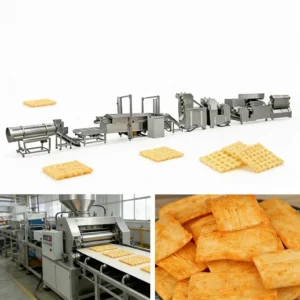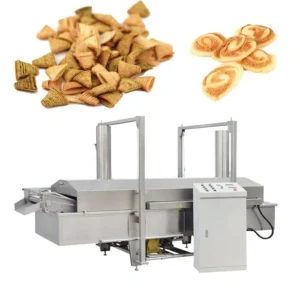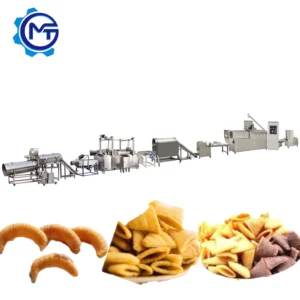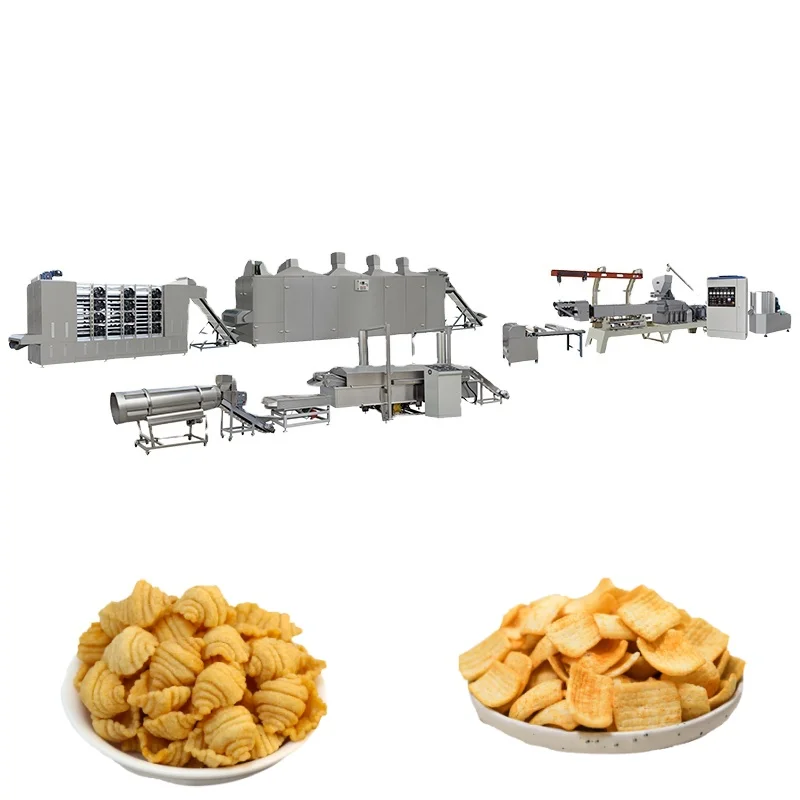


Automatic Frying Chips Production Line, Twin Screw Extrusion, 600mm Fryer Belt, CE Certified — engineered as one integrated turnkey project where mixer, extruder, cutter and fryer capacities are matched to eliminate throughput bottlenecks. Twin screw co-rotating sectional modules handle corn, wheat and potato starch formulations with precise gelatinisation, while die and cutting roller configurations produce bugles, rib chips, wave chips and other fried pellet formats. Delivered with line layout, screw configuration record, trial run report on your raw material and full on-site commissioning with operator training.
Description
Turnkey Line Integration — Throughput matched from mixing through frying so no single station dictates the pace of your snack line.
Technical Specifications
| Parameter | Value |
|---|---|
| Product Type | Frying Chips Making Machine |
| Models Available | MT-65 / MT-70 / MT-85 / MT-75 / MT-95 |
| Main Motor Power | 100 kW (MT-65) / 130 kW (MT-70) / 180 kW (MT-85) / 185 kW (MT-75) / 280 kW (MT-95) |
| Output Capacity | 120-150 kg/h to 800-1000 kg/h depending on model (basis not stated in source — confirm raw material formulation and moisture content) |
| Screw Type | Twin screw, co-rotating, sectional modules |
| Mixer Power | 4 kW / 7.5 kW / 15 kW (matched to extruder model) |
| Cutting Machine Power | 1.47 kW |
| Fryer Belt Width | 600 mm, stainless steel belt |
| Fryer Heating Options | Electricity / Fuel gas |
| Drying Method | Gas / Electric / Diesel heating |
| Voltage & Frequency | Customizable (e.g., 3ph 380V 50Hz, 3ph 415V 60Hz, 3ph 220V 60Hz) |
| Standards | CE, ISO |
| Assembly State | Complete production line (mixer → extruder → cutter → fryer) |
| Warranty | 1 year |
Application Suitability
| Application | Material or Output |
|---|---|
| Fried pellet snack production | Corn powder, wheat flour, potato starch, corn starch blends |
| Extruded chip formats | Bugles, sticks, square sheet rib chips, diamond chips, wavy chips |
| Pillow and wave shape snacks | Potato powder and starch-based formulations |
| Crisp pea and shell shapes | Corn and wheat composite raw materials |
| Tube and screw form chips | Modified starch and flour mixtures |
Why the Fryer Capacity Must Match the Extruder Output
A frying chips production line turnkey only performs when every station is sized to the same real-world throughput.
I worked on a salad stick and fry line not long ago where the fryer was quoted at its nominal belt capacity, but the buyer’s potato starch formulation ran higher in moisture than standard. The product came out dark and over-oiled, forcing the entire line to slow down. Four days of adjustments followed before the output stabilized. The root cause was not the fryer itself but the mismatch between extruder discharge rate and fryer residence time on that specific material. When building a frying chips production line turnkey, the calculation must start with the buyer’s actual raw material, not a catalog figure [NEED_CITE: typical moisture variance in starch-based snack formulations].
Line Layout as One Coordinated System
A frying chips production line turnkey involves more than placing an extruder upstream of a fryer. The mixer output must feed the extruder hopper at a consistent rate, the cutter must slice at a speed matched to extrudate velocity, and the fryer belt must carry product through the oil bath at a pace that achieves target moisture without scorching. Each station’s capacity is calculated against the others so that no single machine forces the rest to idle or surge.
Raw Material Behavior Dictates the Configuration
Different starch sources gelatinize at different barrel temperatures and expand differently at the die face. Potato starch tends to absorb more water and expand less than corn starch under identical screw configurations. The sectional screw modules on these twin-screw extruders allow the screw profile to be rearranged — adjusting kneading block count and pitch — so the mechanical energy input matches the material’s gelatinization window. This is why a trial run on the buyer’s actual formulation is necessary before the line ships [NEED_CITE: starch gelatinization temperature ranges across common snack raw materials].
Reading the Specification Sheet for What It Actually Means
The motor power spread across the model range — from 100 kW on the MT-65 to 280 kW on the MT-95 — reflects the mechanical energy required to drive the twin screws through viscous, partially gelatinized dough at increasing throughputs. Higher motor power does not simply mean more output; it means the screws can maintain stable shear and residence time under heavier load. The 600 mm stainless steel fryer belt width sets the maximum product layer depth, which together with oil temperature and belt speed determines how thoroughly moisture is driven off. If belt speed is too fast, the chip center stays soft; too slow, and surface color overshoots. Voltage customization — 380V 50Hz, 415V 60Hz, 220V 60Hz and others — is not optional in export projects. A motor wired for the wrong frequency will run at the wrong RPM, shifting extruder output and throwing off the throughput balance across the entire line.
The Hidden Cost of Sourcing Stations Separately
When the extruder comes from one vendor and the fryer from another, nobody owns the throughput calculation between them. The extruder supplier tests in isolation, the fryer supplier rates their belt on a generic product, and the gap between the two only surfaces during commissioning on your factory floor. I have seen lines where the cutter could not keep pace with a twin-screw extruder running at full screw speed, creating a pile-up that forced the operator to throttle back. Those lost hours of commissioning time, plus the raw material wasted during tuning, add up quickly [NEED_CITE: typical commissioning delays from mismatched line stations].
Why Procure the Full Line From One Source
Every station in this frying chips production line turnkey is configured under a single throughput calculation, so the mixer batch size, extruder screw speed, cutter cycle rate, and fryer belt speed are coordinated before the machines are built. The screw and die configuration is specified to the buyer’s raw material, not copied from a generic build. An in-house testing workshop runs the buyer’s actual formulation before shipment, catching density or color issues while adjustments still cost days instead of weeks. Electrical schematics confirm voltage, frequency, and control language for the destination market before wiring begins. Pre-sales layout engineering, on-site installation, commissioning, and operator training are handled by the same team that designed the line.
Documentation & Verification
- Line layout drawing showing station spacing and throughput balance across mixer, extruder, cutter, and fryer
- Screw and die configuration record matched to your raw material formulation and target chip shape
- Electrical schematic with confirmed voltage, frequency, and control panel language for your market
- Trial run report from testing workshop on your actual raw material before dispatch
- CE declaration of conformity and ISO certificate for customs and compliance filing
- Wear parts list specifying screw elements, die plates, and fryer belt sections for first-year spares
Installation, Commissioning & Support
- Foundation and floor space planning based on the line’s overall dimensions (up to 3000×1500×2800 mm for the MT-95 tier)
- Dedicated power circuit sized to the main motor rating (up to 280 kW) plus mixer and fryer heating loads
- Station-by-station assembly and alignment on site, from mixer discharge through fryer exit
- First-run parameter setting including barrel temperature zones, screw speed, and fryer belt speed calibration
- Operator training covering die changes, screw element swaps, and fryer oil filtration routines
- Spare screw modules, die plates, and cutter blades staged for the first replacement cycle
What to Include in Your Inquiry
Provide the specific raw material formulation you plan to run — including the starch source and approximate moisture content — along with the chip shapes you want to produce. Share your workshop floor dimensions and ceiling height so the layout can be drafted to fit. Confirm your local voltage and frequency, and let us know whether gas or electric fryer heating suits your facility.
Frequently Asked Questions
Q: How is throughput matched between extruder, cutter, and fryer to avoid line bottlenecks?
A: Every station is calculated against a single target output based on your raw material’s behavior. The extruder screw speed sets the discharge rate, the cutter is timed to that rate, and the fryer belt speed is set so residence time achieves target moisture. No station is spec’d in isolation.
Q: What utility planning is required for each model tier?
A: Each model has a different main motor power rating, from 100 kW to 280 kW, plus mixer, cutter, and fryer heating loads. A full utility schedule covering electrical draw, gas supply for the fryer, and ventilation requirements is provided with the line layout proposal for your selected model.
Q: How is phased installation structured for a complete line project?
A: Installation follows the material flow sequence — mixer and extruder first, then cutter, then fryer and downstream stations. Each section is commissioned independently before the full line is run together, allowing problems to be isolated and resolved without stopping the entire project.
Q: Can the line layout be adapted to an existing workshop footprint?
A: Yes. The layout is drafted after receiving your workshop dimensions and ceiling height. Station spacing, conveyor routing, and utility drop points are arranged to fit the available space while maintaining the throughput calculation across all stations.
Q: What operator training is included after on-site commissioning?
A: Training covers daily start-up and shutdown procedures, die and screw element changes for different chip shapes, fryer oil management and filtration, and routine maintenance intervals. Operators also learn to read the control panel indicators that signal throughput drift or temperature deviation.
Related products
-
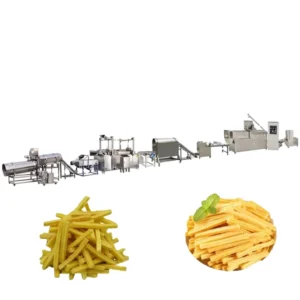
High-Yield Automated Fried Snack Production Line – Double Screw Salad Strips & Millet Crust Making Equipment
¥65.00 Select options This product has multiple variants. The options may be chosen on the product page -
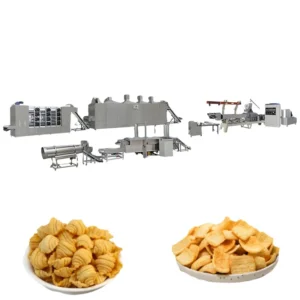
New Automatic Portable High Productivity Frying Salad Sticks Chips Snacks Food Production Line
¥100.00 Select options This product has multiple variants. The options may be chosen on the product page -
Fried Puffs Snack Food Making Machine Whole Line Solution Design by Factory Price Crispy Snack Machine
¥20.00 Select options This product has multiple variants. The options may be chosen on the product page -
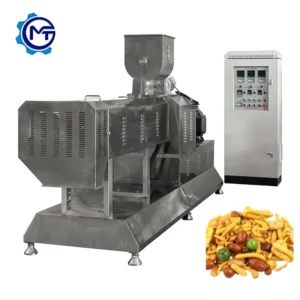
New Automatic Traditional Fried Nimko Making Machine High Productivity Large Capacity Stainless Steel Production Line
¥8,575.00 Select options This product has multiple variants. The options may be chosen on the product page