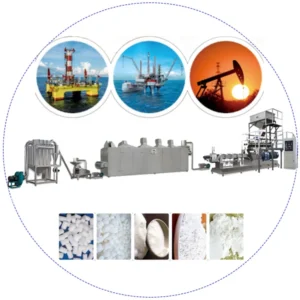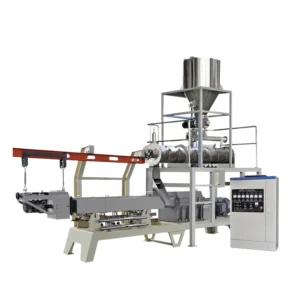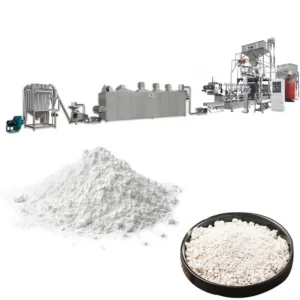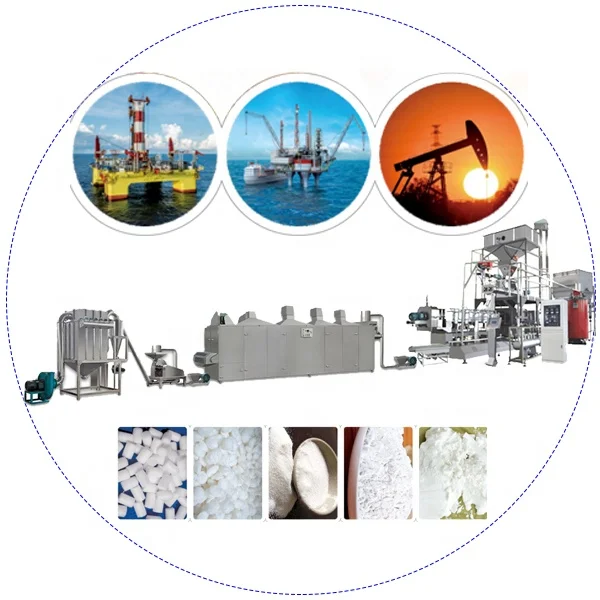


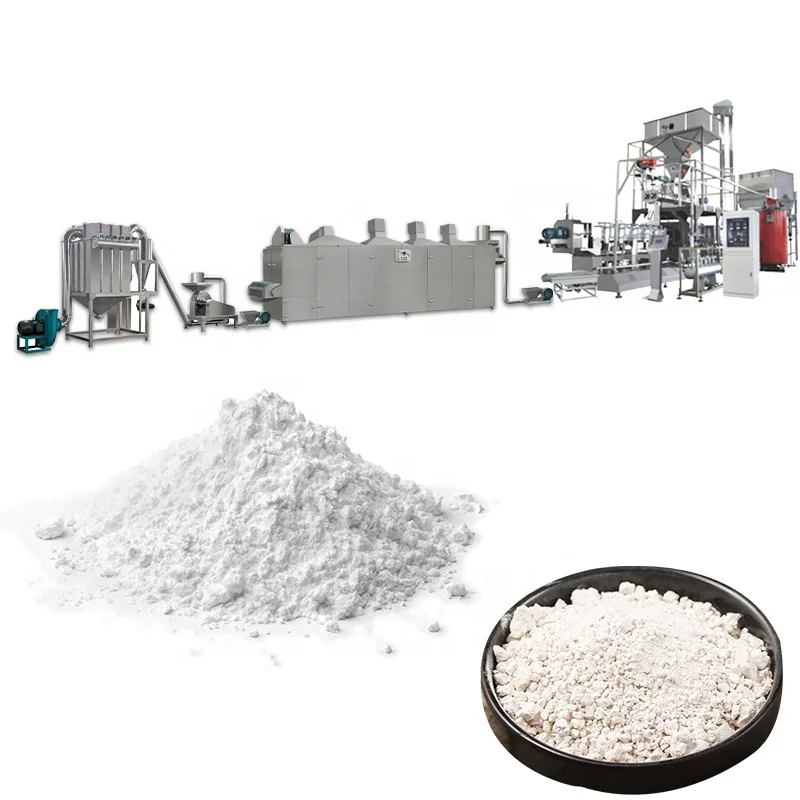
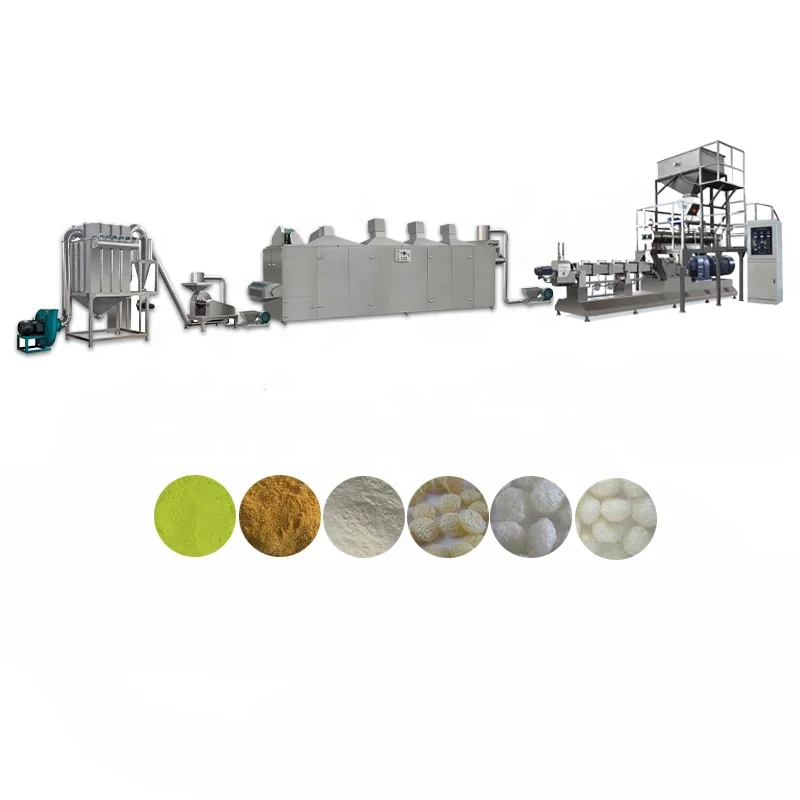

MT70 / MT85 / MT100 Modified Starch Production Line, Twin-Screw Extrusion, PLC Control — engineered for consistent gelatinisation across food, textile, and paper applications.
- Screw configuration and barrel temperature profile matched to starch type and target modification degree
- Throughput aligned from batching through drying under one supplier to eliminate bottlenecks
- Trial run on customer raw material in testing workshop before shipment, with documented output and product specification
Description
Screw Configuration Matched to Starch Type — Every MT70 / MT85 / MT100 build begins with a trial run on the buyer’s actual raw material to set the screw profile and barrel temperature curve before the line ships.
Technical Specifications
| Parameter | Value |
|---|---|
| Product Type | Modified Starch Production Line |
| Model | MT70 / MT85 / MT100 |
| Installed Power | MT70: 160 kW / MT85: 190 kW / MT100: 210 kW |
| Power Consumption | MT70: 120 kW / MT85: 140 kW / MT100: 150 kW |
| Output Capacity | MT70: 150–200 kg/h (basis not stated in source) / MT85: 300–400 kg/h (basis not stated in source) / MT100: 300–500 kg/h (basis not stated in source) |
| Overall Dimensions (L×W×H) | MT70: 41000×1500×2200 mm / MT85: 43000×1500×3200 mm / MT100: 45000×1500×3500 mm |
| Voltage & Frequency | 380V 50Hz Three Phase (configurable to 380V 60Hz, 415V 60Hz, 220V 60Hz) |
| Control System | PLC and MCC control |
| Screw Type | Twin-screw extruder |
| Screw Material | 38CrMoAl |
| Barrel Cooling | Integrated cooling system for temperature control |
| Line Stations | Starch hydrolysis, saccharification, denaturation treatment, drying |
| Fuel Options | Gas / diesel / electricity / steam (source value — verify against manufacturer catalog) |
| Contact Materials | Food-grade stainless steel (PVC conveyor belts noted as exception) |
| Standards | CE, ISO |
Application Suitability
| Application | Material or Output |
|---|---|
| Food-grade pregelatinised starch | Corn starch, wheat flour for bakery and instant food thickeners |
| Industrial denatured starch | Corn and tapioca starch for textile sizing and paper coating |
| Modified starch for adhesives | Wheat and potato starch sources for corrugated board and packaging |
| Nutritional starch derivatives | Rice and corn starch for infant formula and dietary supplement bases |
Why Nominal Capacity Figures Mislead Starch Buyers
A modified starch production line turnkey proposal must state the raw material, moisture level, and target gelatinisation degree behind every throughput number.
I once configured a line for a Southeast Asian processor who quoted their target output based on standard dent corn. When the first batch of high-amylose corn arrived, the gelatinisation temperature climbed well beyond the barrel profile we had set, and actual output dropped to roughly six tenths of the nameplate figure. The dryer was oversized for that reduced flow, the cooling conveyor ran half-empty, and the packing station waited on product. That mismatch rippled through every downstream station [NEED_CITE: starch gelatinisation temperature variation across amylose content levels]. A modified starch production line turnkey project only holds its schedule when each station is balanced around the buyer’s real feedstock, not a catalog average.
Barrel Temperature Profiling Across Starch Variants
Different starch sources demand distinct barrel temperature curves. Corn starch, wheat flour, and tapioca each reach peak viscosity at different shear and moisture combinations. The twin-screw extruder in this line allows independent heating zone control so the operator can shift the profile when the raw material changes. Barrel cooling circuits prevent overshoot in high-shear zones where mechanical energy alone can push paste temperature past the target window.
Throughput Matching Between Extrusion and Drying
A modified starch production line turnkey layout must balance the extruder output against dryer residence time. If the dryer cannot remove moisture fast enough, the product backs up and gelatinisation continues beyond specification. The PLC and MCC control architecture links extruder feed rate to dryer belt speed so that a throughput adjustment at the front end propagates automatically downstream, keeping moisture at the packing station within the target band [NEED_CITE: residence time and moisture removal rates in starch drying].
Screw Geometry and Gelatinisation Degree
The screw configuration determines how much mechanical energy the starch receives and for how long. A longer residence section gives amylose chains more time to align, which matters when the target product requires high paste stability for textile sizing. Swapping screw elements lets the same MT70, MT85, or MT100 platform serve both a food-grade pregelatinised starch and an industrial denatured starch without changing the barrel assembly. The 38CrMoAl screw material resists the abrasive wear that raw corn starch imposes over extended production campaigns.
Reading the Specs That Actually Matter
Installed power and power consumption figures reveal how much energy the line draws under load versus steady state. The MT100 draws 210 kW at peak but settles at 150 kW during continuous operation, indicating that start-up surges are manageable on a standard industrial supply. The integrated barrel cooling system means the heating rings do not work alone; cooling circuits modulate zone temperature to prevent hot spots that cause uneven gelatinisation. Voltage configurability from 380V 50Hz to 415V 60Hz covers most export markets without requiring a step-down transformer on site [NEED_CITE: industrial voltage standards across Southeast Asian and African grids]. Food-grade stainless steel contact surfaces meet hygiene requirements for starch destined for infant formula and bakery applications, while the twin-screw design ensures consistent mixing of starch slurry before it enters the die section.
The Cost of Skipping a Raw Material Trial
Processors who accept a line based solely on catalog capacity often discover the mismatch during commissioning. The extruder runs, but the product exits the dryer above the target moisture, forcing the packing station to reject batches. Reworking the screw configuration on site means unplanned downtime while new elements are machined and shipped. Electrical panels wired for the wrong frequency can trip breakers under the sustained load of a starch extrusion campaign, delaying start-up by weeks while replacement components arrive [NEED_CITE: frequency mismatch issues in exported food processing equipment]. These problems are avoidable when a trial run on the buyer’s actual starch source happens before the line leaves the factory.
Why Source This Line From a Single Supplier
Every station from starch hydrolysis through drying sits under one engineering responsibility, so throughput calculations are cross-checked rather than assembled from separate vendor quotes. The screw and die configuration is documented against the buyer’s specific starch type, creating a baseline record for future element reorders. An in-house testing workshop allows the buyer’s raw material to run on the exact extruder model before shipment, confirming that the target gelatinisation degree is achievable. PLC and MCC panels are programmed with the buyer’s preferred control language and wired to the confirmed voltage and frequency. On-site installation includes operator training on screw changeover procedures and daily maintenance routines specific to starch processing. Wear parts lists ship with the line so the first replacement set of screws and heating elements is already identified before the original set reaches end of life.
Documentation & Verification
- Line layout showing throughput balance between extruder, dryer, and packing station
- Trial run report on buyer’s starch source confirming gelatinisation degree and output
- Screw and die configuration record matched to specific raw material batch
- Electrical schematic with confirmed voltage, frequency, and control language
- CE declaration of conformity and ISO certificate for customs clearance
Installation, Commissioning & Support
- Foundation plan scaled to MT100 footprint of 45000×1500×3500 mm for workshop layout
- Dedicated power circuit sized to 210 kW installed load with surge allowance
- Extruder, dryer, and conveyors shipped in section modules for on-site assembly
- First-run parameter setting on buyer’s starch with PLC recipe storage
- Operator training covering screw element swap and barrel cooling calibration
- Wear parts list with reorder codes for 38CrMoAl screws and die plates
Preparing a Productive Inquiry
Share the starch source you plan to process — corn, wheat, tapioca, or a blend — along with the target modification type and expected daily output. Confirm your facility’s supply voltage, frequency, and the control language your operators prefer. If you have existing upstream mixers or downstream packing equipment, note their throughput so the line can be balanced around them. Requesting a pre-shipment trial on your raw material lets us verify gelatinisation performance before the line is crated.
Frequently Asked Questions
Q: How is output capacity verified on my specific starch raw material and moisture content?
A: We run your raw material through the testing workshop on the same extruder model you are ordering. The trial records throughput, gelatinisation degree, and moisture at the dryer exit. Those figures form the capacity basis in your quotation, replacing generic catalog numbers with data tied to your feedstock.
Q: What is the phased installation and commissioning schedule for a complete turnkey line?
A: Foundation and utility rough-in happens first, followed by mechanical assembly of extruder, dryer, and conveyors. Electrical connection and PLC programming come next. Commissioning runs begin with water trials, then progress to starch slurry under supervision, with operator training running in parallel through each phase.
Q: How is throughput matched between the extruder, dryer, and downstream stations?
A: The PLC links extruder feed rate to dryer belt speed and packing station cycle time. Capacity calculations for each station are cross-checked during layout design so no single section becomes a bottleneck. Adjustments made at the extruder propagate automatically to maintain consistent product moisture downstream.
Q: Can the line be configured for my facility’s voltage, frequency, and control language requirements?
A: Voltage and frequency are confirmed during the specification stage and built into the MCC panel. Standard options include 380V 50Hz, 380V 60Hz, 415V 60Hz, and 220V 60Hz. The PLC interface language is set to match your operators’ preference before the control cabinet leaves the factory.
Q: What spare wear parts are included and how is ongoing supply handled?
A: The wear parts list shipped with the line identifies screws, die plates, and heating elements by part number. A recommended first-order spare set covers the initial replacement cycle. Reorders are fulfilled against the documented screw and die configuration record so replacement elements match the original geometry.
Related products
-
Cassava Corn Potato Flour Starch Production Line – Industrial Pregelatinized & Modified Extrusion Machinery
¥65.00 Select options This product has multiple variants. The options may be chosen on the product page -
Cassava & Pregelatinized Corn Starch Extrusion Equipment – CE Certified Industrial Twin-Screw Modified Starch Line
¥65.00 Select options This product has multiple variants. The options may be chosen on the product page -
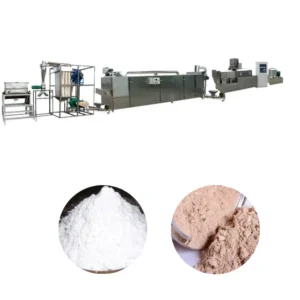
Modified Starch Production Line Modified Starch Processing Line Modified Starch Extruder
¥8,580.00 Select options This product has multiple variants. The options may be chosen on the product page -
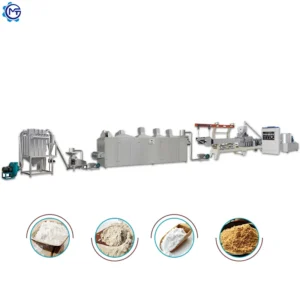
Twin-Screw Extrusion Line for Modified Starch. Producing Pregelatinized Adhesive & Food Grade Powder
¥65.00 Select options This product has multiple variants. The options may be chosen on the product page