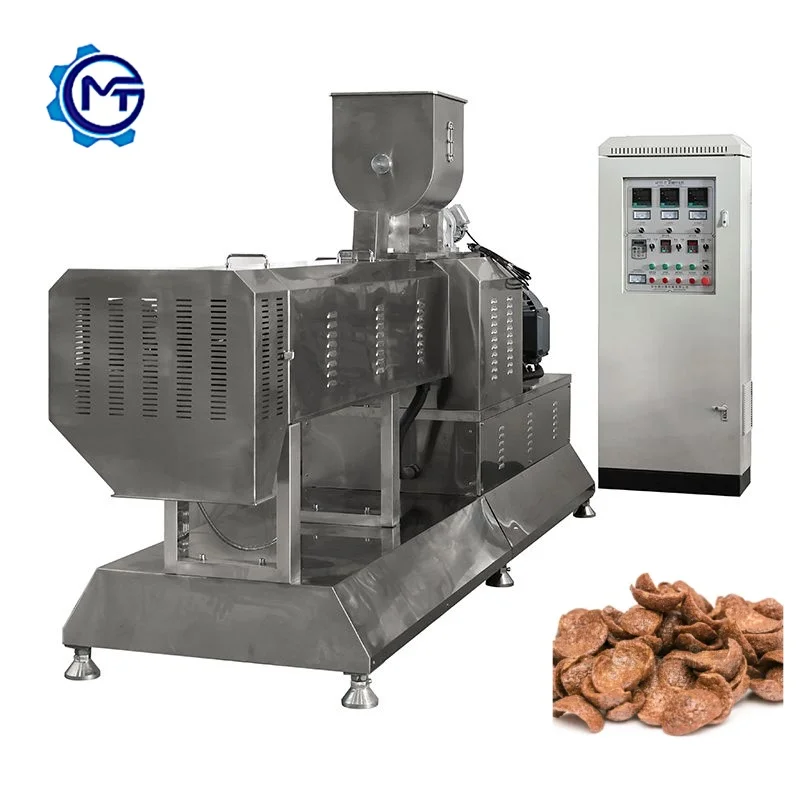
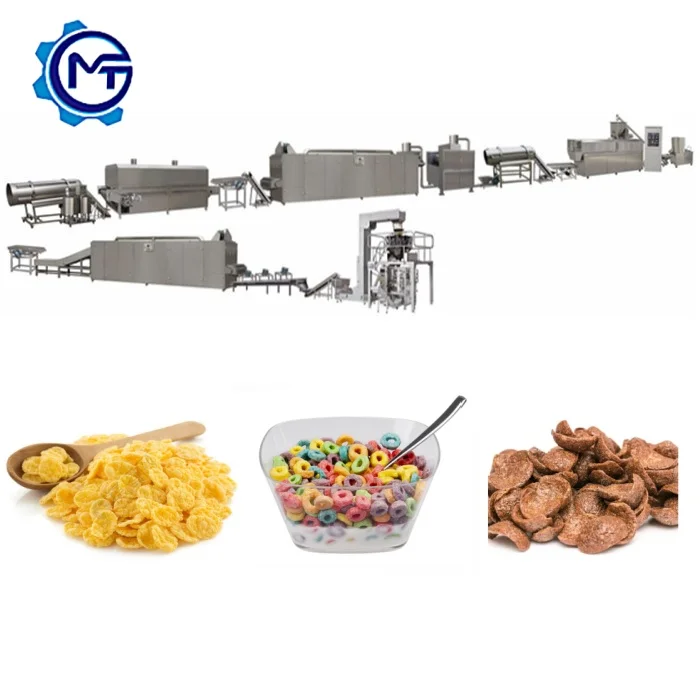
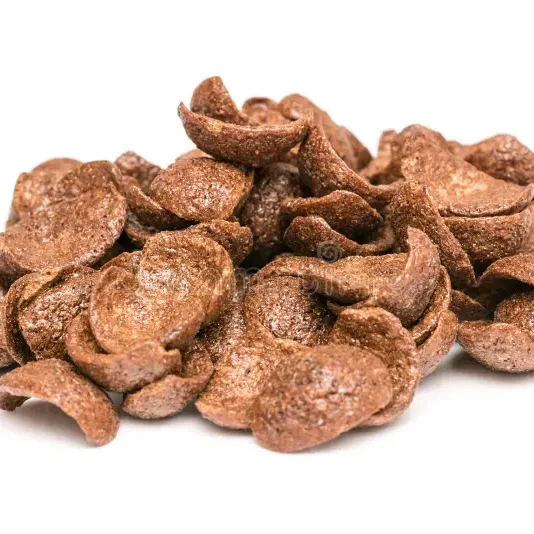
MT75 Corn Flakes Breakfast Cereal Production Line, Twin-Screw Extruder, PLC Flaking — complete turnkey layout from mixing through extrusion, flaking, roasting, coating to packing.
- Hydraulic double-roller flaking with infrared temperature control ensures consistent flake thickness across corn, rice, wheat, oat and barley blends
- Screw configuration and die design matched to raw material and target density, with in-house trial runs before shipment
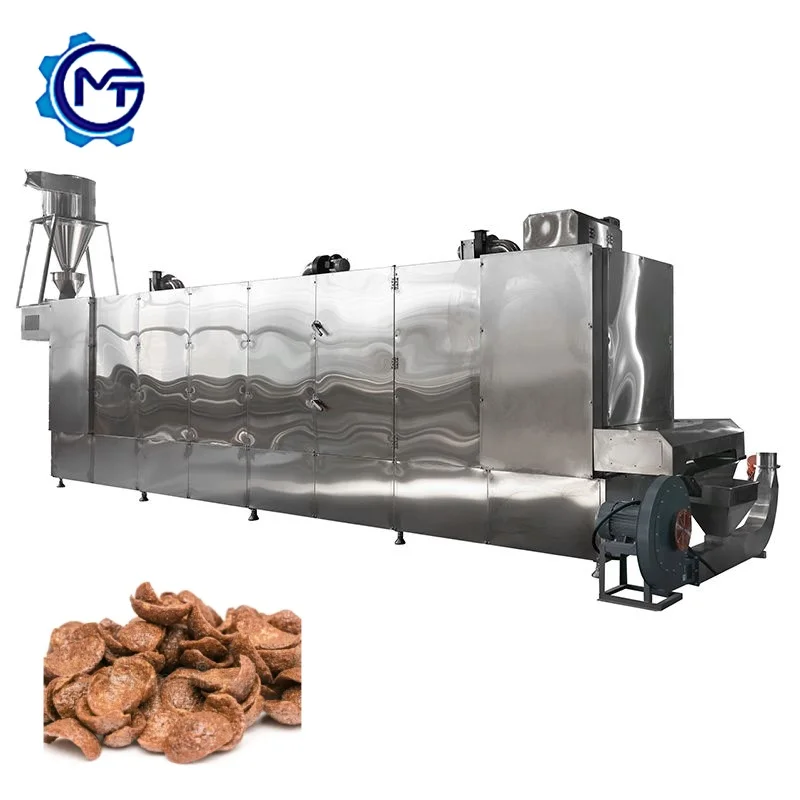
- Multi-fuel dryer and hot air roasting oven with dual circulating fans, throughput matched to extruder output to prevent bottlenecking
Every station sized and verified as one integrated project — line layout, capacity calculation, and trial run report delivered before shipment.
Description
Hydraulic Flaking Control — PLC-regulated double rollers with infrared temperature sensing keep corn flake thickness consistent, supported by in-house trial runs on your raw flour blend before the line ships.
Technical Specifications
| Parameter | Value |
|---|---|
| Product Type | Corn Flakes Breakfast Cereal Production Line |
| Extruder Type | Twin-screw |
| Available Models | MT70 / MT85 / MT75 |
| Installed Power (MT70 / MT85 / MT75) | 160 kW / 190 kW / 210 kW |
| Power Consumption (MT70 / MT85 / MT75) | 120 kW / 140 kW / 150 kW |
| Capacity (MT70) | 150–200 kg/h (basis not stated in source — confirm raw material type, moisture, and target flake specification) |
| Capacity (MT85) | 300–400 kg/h (basis not stated in source — confirm raw material type, moisture, and target flake specification) |
| Capacity (MT75) | 300–500 kg/h (basis not stated in source — confirm raw material type, moisture, and target flake specification) |
| Flaking Machinery Capacity | 200–300 kg/h (basis not stated in source — confirm pellet size and flake thickness target) |
| Overall Dimensions (MT70 / MT85 / MT75) | 41 × 1.5 × 2.2 m / 43 × 1.5 × 3.2 m / 45 × 1.5 × 3.5 m |
| Flaking System | PLC control, hydraulic double rollers, separate dual-motor drive, infrared temperature pipe |
| Dryer Heating Source | Gas or electric (configurable) |
| Hot Air Roasting Oven | Vibrating pan, dual circulating fans, cyclone dust removal |
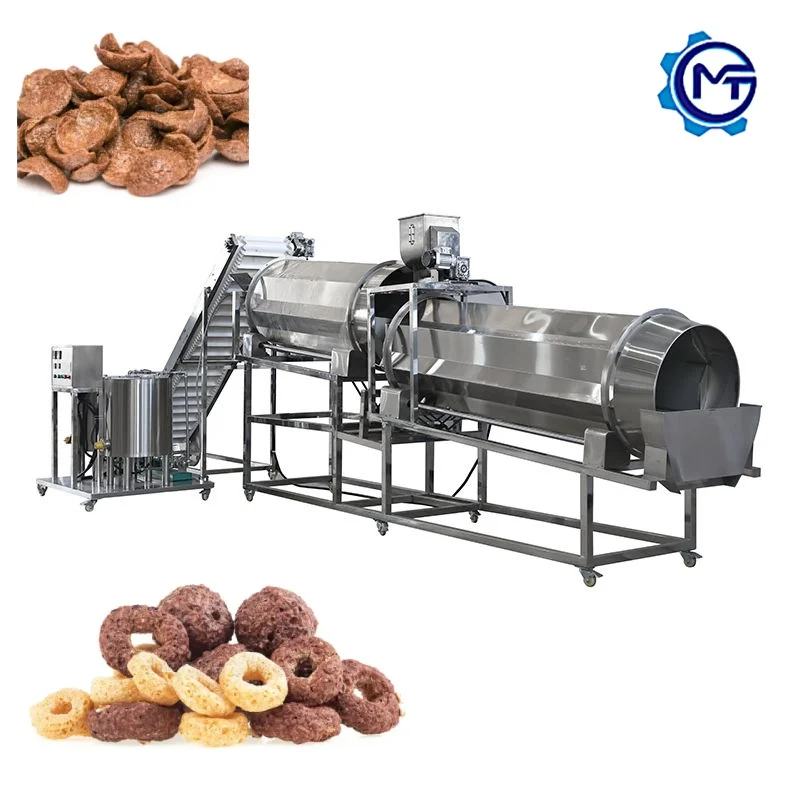
| Coating System | Double tumble sugar melting, elevator, coating drum, spraying nozzle |
| Raw Material Compatibility | Corn, rice, wheat, oat, barley powder |
| Screw Material | Special wear-resistant treatment |
| Key Features | Automatic lubricating and cooling, twin-screw extrusion, multi-fuel drying, PLC flaking control |
Application Suitability
| Application | Material or Output |
|---|---|
| Natural corn flakes for retail breakfast cereal packaging | Corn grits and corn flour |
| Sugar-coated corn flakes with syrup glazing | Corn base with sugar or honey coating |
| Multi-shape puffed breakfast cereals | Rice, wheat, oat, or barley powder — ring, ball, star, wheel shapes via die change |
| Fortified breakfast cereal for nutrition programmes | Grain flour blends with mineral or vitamin premix |
| Snack-format cereal production | Corn or rice grits in tube, stick, fruit loop, heart shapes |
Why Nominal Line Capacity Rarely Survives First Contact With Your Raw Flour
A quoted throughput number means nothing until it holds on your actual flour blend at your target moisture level.
Every buyer I meet at trade shows has the same story: the line ran beautifully during the factory acceptance test — on the supplier’s standard corn grits. Then it arrived on-site and choked on the locally sourced oat-barley blend the buyer actually intended to use. Output dropped, flake thickness drifted, and the roasting oven developed a backlog. A corn flakes production line turnkey project only earns that name when throughput is balanced across every station using your real material, not a generic benchmark [NEED_CITE: raw material variability in extrusion processing].
Extrusion Throughput Must Match Flaking and Roasting Downstream
A twin-screw extruder pushing pellets faster than the flaking rollers can press them creates a buffer pile-up. On one oat-corn project I worked on, a separately sourced flaker ran noticeably slower than the extruder output, causing warm pellets to clump in the transfer chute. With this corn flakes production line turnkey configuration, the extruder output, flaking roller speed, and roasting oven belt rate are calculated together during the layout stage — so material flows continuously without intermediate bottlenecks.
How Screw Configuration Decides Flake Texture Before the Roller Ever Touches It
The twin-screw extruder does more than cook the dough — it determines pellet density, surface porosity, and residual moisture entering the flaker. Screw elements are arranged to match the starch gelatinisation behaviour of your specific grain blend, whether that is pure corn or a multi-grain mix with oat and barley. The die opening size sets the pellet diameter, which directly controls the final flake area after pressing. Getting these variables wrong upstream means no amount of hydraulic pressure adjustment downstream will produce the crisp, flat flake the market expects.
Reading the Specs That Actually Matter on a Cereal Line
Installed power across the three available models ranges from 160 kW to 210 kW, but power consumption under load sits lower at 120 kW to 150 kW — the gap reflects motor start-up peaks and heating element warm-up cycles rather than continuous draw. The hydraulic flaking unit uses separate dual-motor drive for each roller, which means the two rollers can be adjusted independently to compensate for uneven feed distribution. Infrared temperature sensing on the flaking temperature pipe keeps the roller surface within a controlled band; if the rollers run cold, flakes crack instead of flatten, and if they run too hot, starch sticks and builds up on the surface [NEED_CITE: flaking roller temperature and starch adhesion in cereal processing]. The hot air roasting oven uses dual circulating fans and a cyclone dust removal device — the fans ensure even heat distribution across the vibrating pan, while the cyclone captures fine particulate before it can scorch and contaminate subsequent batches.
What Happens When Stations Are Sourced From Separate Vendors
I have watched a breakfast cereal line stall because the dryer capacity was specified independently from the extruder output. The result was a semi-wet pellet pile waiting for dryer space, losing surface moisture unevenly and producing flakes with hard centres and soft edges. When a roaster cannot keep pace with the flaker, the conveyor between them becomes an unplanned buffer zone where flakes cool below coating temperature, and sugar adhesion fails. These mismatches rarely show up in individual machine quotations — they only appear once the entire corn flakes production line turnkey installation is running under real conditions [NEED_CITE: throughput balancing across sequential food processing stations].
Why This Line Is Engineered as a Single Project
Throughput is calculated across mixing, extrusion, flaking, roasting, coating, and packing as one system — not as separate machines bolted together. Screw configuration and die design are selected against your specific grain blend and target flake density, not copied from a generic build. Every line goes through an in-house testing workshop where your raw material runs on the actual equipment before shipment, producing real samples and a documented trial report. Multi-fuel dryer options mean the heating source is configured to your site’s gas or electric supply before production starts, avoiding commissioning delays. Electrical schematics confirm voltage, frequency, and control language for your target market before the first panel is wired.
Documentation & Verification
- Line layout showing throughput matching from batching through packing for your target output
- Trial run report on your grain blend conducted in the testing workshop before dispatch
- Screw and die configuration record matched to your flake density and shape requirements
- Electrical schematic with voltage, frequency, and control language confirmed for your market
- Factory test record documenting run parameters on your raw material
- CE and ISO conformity documentation with packing photographs and customs support
Installation, Commissioning & Support
- Foundation layout accounts for the 41–45 m line length and utility connection points
- Dedicated power circuits sized to the 120–150 kW operating consumption of the selected model
- Equipment arrives in sectional modules for phased assembly inside your facility
- First-run parameter setting covers extruder barrel temperatures, flaker hydraulic pressure, and roaster airflow
- Operator training addresses screw configuration changes for different grain blends and flake shapes
- Wear parts list covers screws, dies, and flaking roller surfaces with recommended replacement intervals
What We Need to Configure Your Line
To size a corn flakes production line turnkey layout properly, share your primary grain blend and its typical moisture content, your target daily output in finished product weight, and the ceiling height and floor space available in your production hall. Let us also know your local voltage and frequency standard, the preferred control language for the PLC interface, and whether your facility uses gas or electric heating — these details shape the dryer and roaster specification before drawings begin.
Frequently Asked Questions
Q: How is line capacity verified on my specific raw material blend before shipment?
A: Your flour blend runs on the actual extruder and flaking unit in our in-house testing workshop. We document throughput, pellet density, flake thickness, and roasting behaviour in a trial report you receive before the equipment ships. This means capacity figures are based on your real material, not a generic benchmark.
Q: What voltage, frequency, and control language options are confirmed before production starts?
A: We confirm your site’s electrical supply standard and the operator’s preferred control language during the specification stage. The electrical schematic reflects these choices before the control panel is built, so there are no rewiring delays or translation issues when the line arrives for commissioning.
Q: How do you ensure the dryer and roaster throughput matches the extruder output?
A: Every station’s capacity is calculated against the extruder’s output rate on your raw material during the layout phase. The dryer belt speed, roaster pan volume, and coating drum cycle time are all set relative to the confirmed extrusion rate, preventing material pile-up between stages.
Q: Can the same extrusion platform produce both corn flakes and multi-shape puffed cereals?
A: Yes. By changing the die plate and adjusting the screw configuration, the twin-screw extruder can produce flat pellets for flaking as well as direct-expanded shapes such as rings, balls, stars, and tubes. The downstream flaker is bypassed for puffed shapes, and the product goes straight to the roasting oven.
Q: What does on-site installation, commissioning, and operator training include?
A: Our engineers assemble the line, set extruder barrel temperatures and flaker hydraulic pressure on your material, and train your operators on screw configuration changes, die swaps, and daily maintenance routines. We also provide a wear parts schedule so your first replacement order is placed before the original components reach end of life.
Related products
-
Automatic Instant Breakfast Cereals Snack Food Making Machine
¥10,000.00 Select options This product has multiple variants. The options may be chosen on the product page -
Sweet Corn Flakes Maize Breakfast Cereal Full-automatic Food Grade Stainless Steel Heat Exchanger Mixer Fryer Processing Line
¥8,000.00 Add to cart -
Stainless Steel Honey Small Corn Flake Breakfast Cereal Flakes Maker Making Machine Production Plant
¥30,000.00 Add to cart -

200kg/h Breakfast Cereal Extruder Making Machine Hot Sale Corn Flake Production Line
¥30,000.00 Select options This product has multiple variants. The options may be chosen on the product page