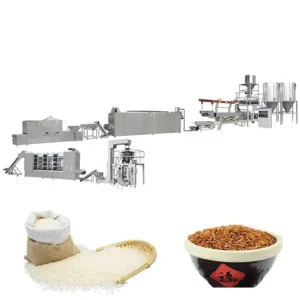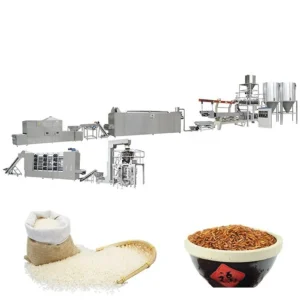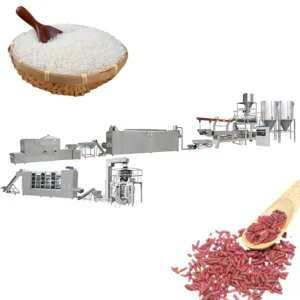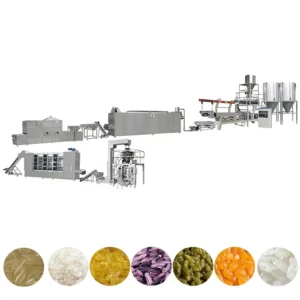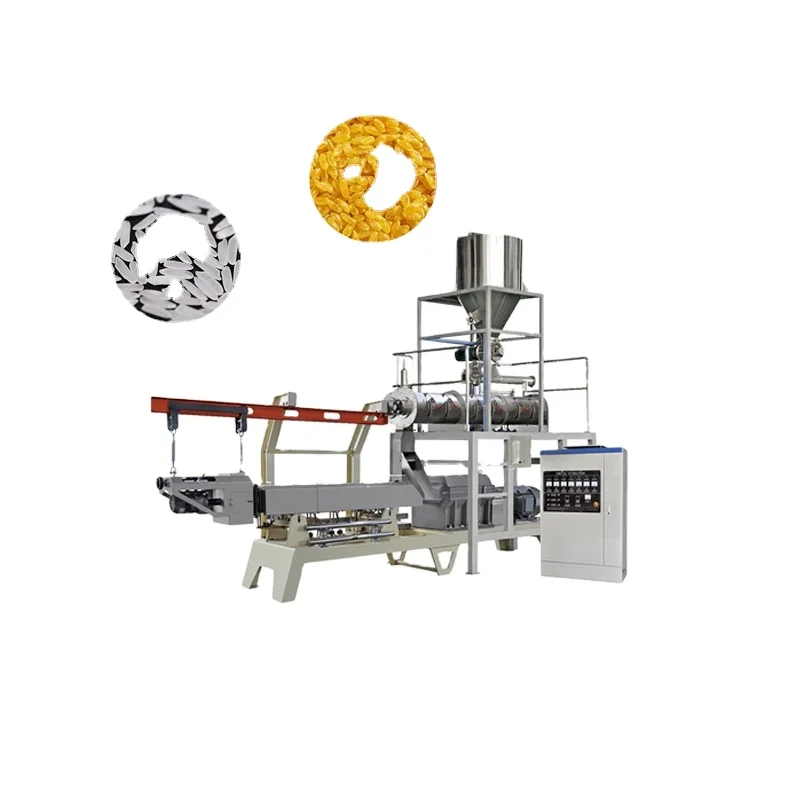
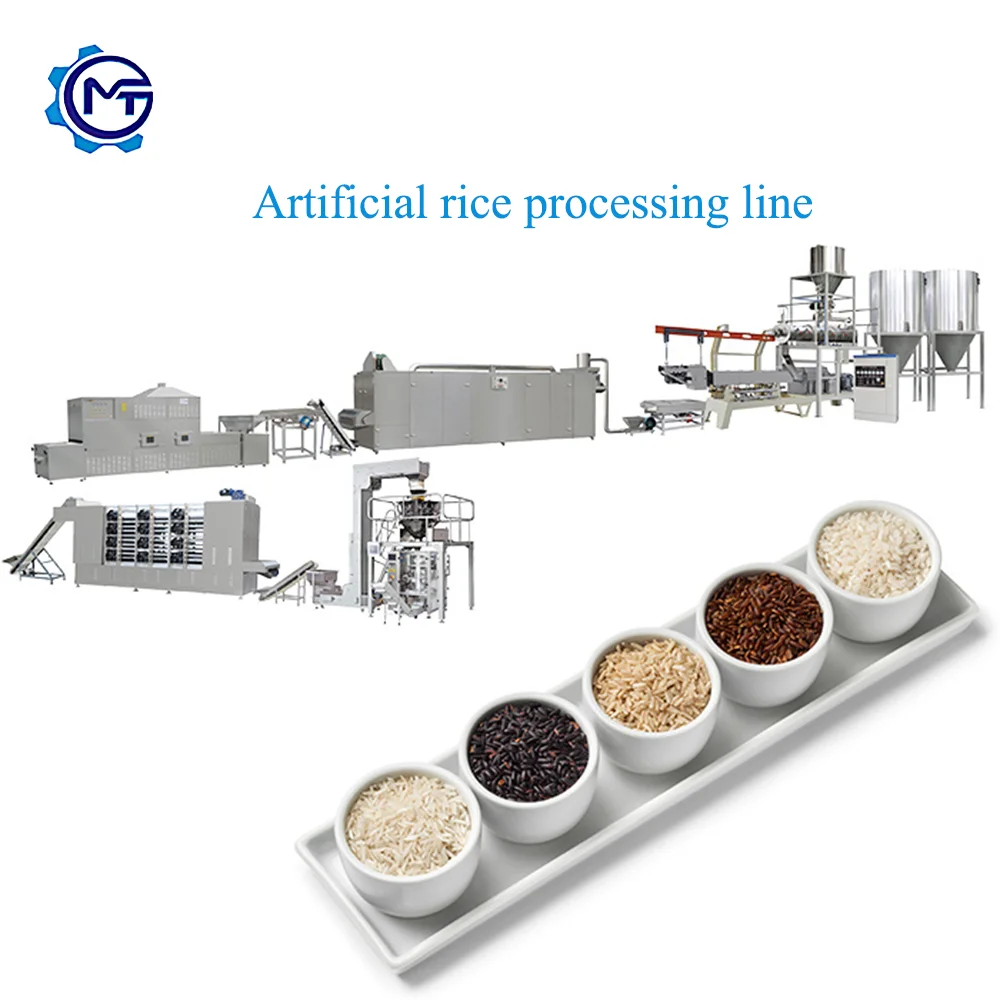

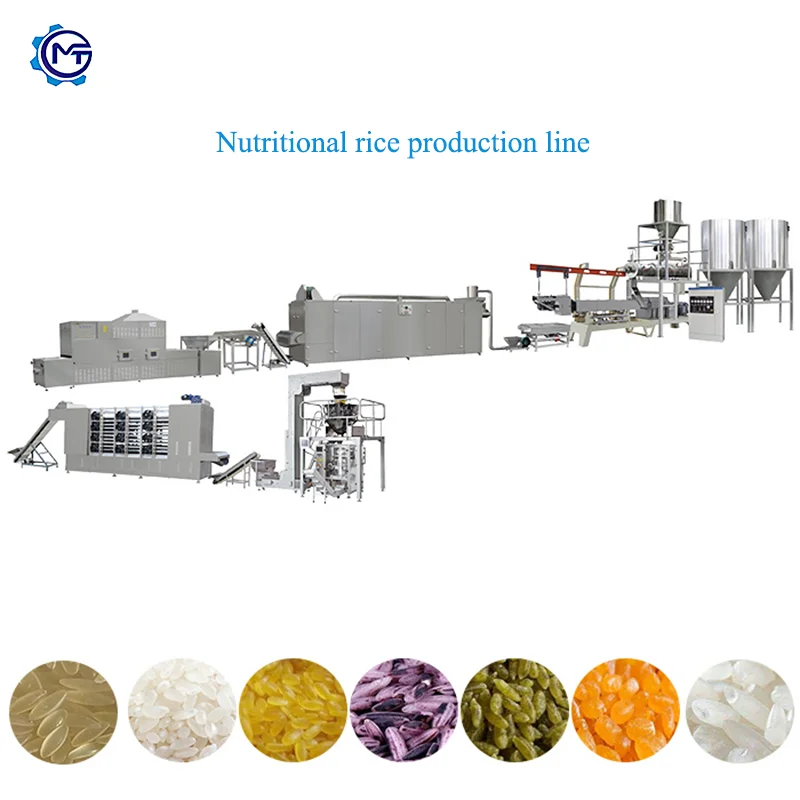
MT65 / MT70 / MT85 / MT75 / MT95 Fortified Rice Kernel Extrusion Line, Twin-Screw, CE Certified — engineered as a complete turnkey project from batching to packing, with every station throughput-matched under one supplier. Screw configuration and die design are specified to your raw material blend — broken rice, corn, millet, starch with vitamin and mineral additives — controlling gelatinisation, expansion and kernel density. Drying ovens use circulation heating with frequency-controlled mesh belt speed for consistent moisture.
- Trial runs on your actual formulation in our in-house testing workshop before shipment, with full documentation including layout drawings, electrical schematics, and screw configuration records
- Line capacity and station matching verified against your specific raw material blend and target product specification, not quoted on generic nominal output
- On-site installation, commissioning, and operator training included, with wear parts supply and ongoing maintenance support
Description
Turnkey Line Engineering — every station from batching to packing is throughput-matched under one supplier, eliminating the bottlenecks that arise when extruders, dryers, and packaging units are sourced separately for fortified rice kernel production.
Technical Specifications
| Parameter | Value |
|---|---|
| Product Type | Fortified Rice Kernel Extrusion Line |
| Models Available | MT65 / MT70 / MT85 / MT75 / MT95 |
| Screw Type | Twin-screw |
| Installed Power (MT65) | 85 kW |
| Installed Power (MT70) | 120 kW |
| Installed Power (MT85) | 235 kW |
| Installed Power (MT75) | 180 kW |
| Installed Power (MT95) | 260 kW |
| Power Consumption (MT65) | 60 kW |
| Power Consumption (MT70) | 85 kW |
| Power Consumption (MT85) | 165 kW |
| Power Consumption (MT75) | 135 kW |
| Power Consumption (MT95) | 195 kW |
| Output Capacity (MT65) | 80–100 kg/h (basis to be confirmed) |
| Output Capacity (MT70) | 100–120 kg/h (basis to be confirmed) |
| Output Capacity (MT85) | 200–300 kg/h (basis to be confirmed) |
| Output Capacity (MT75) | 300–500 kg/h (basis to be confirmed) |
| Output Capacity (MT95) | 800–1000 kg/h (basis to be confirmed) |
| Overall Dimensions (MT65) | 28 × 1.2 × 2.2 m |
| Overall Dimensions (MT70) | 30 × 1.5 × 2.2 m |
| Overall Dimensions (MT85) | 34 × 3.5 × 4.3 m |
| Overall Dimensions (MT75) | 32 × 3.5 × 4.3 m |
| Overall Dimensions (MT95) | 36 × 3.5 × 4.3 m |
| Control System | Frequency speed control with automated operation |
| Feeding System | Single or twin screw feeding, selectable by raw material type |
| Screw Material | Special wear-resistant alloy |
| Drying Oven Heating Source | Electric or gas |
| Drying Oven Feature | Circulation drying with frequency-controlled mesh belt speed |
| Lubrication & Cooling | Automatic lubrication and cooling system |
| Voltage & Frequency | Customized to buyer’s local standard |
| Certification | CE |
Application Suitability
| Application | Material or Output |
|---|---|
| Government nutritional fortification programs | Fortified rice kernels with standardized vitamin and mineral premix blends |
| Rice mill by-product valorization | Reconstituted rice from broken rice, rice bran, and milling residues |
| Artificial rice production | Corn, millet, wheat, oats, buckwheat, bean, and starch base materials |
| Instant rice processing | Pre-gelatinized rice kernels with controlled cooking reconstitution time |
| NGO and humanitarian nutrition programs | Micronutrient-fortified kernels blended with standard rice at defined ratios |
What "Rated Capacity" Means When Your Premix Density Shifts
A fortified rice kernel production line turnkey quoted on nominal throughput will underperform the moment your vitamin-mineral premix is heavier than the standard test blend.
I learned this the hard way. A South Asian client signed a contract based on catalog capacity figures for a nutritional powder processing line. On commissioning day, their vitamin premix had a noticeably higher bulk density than our standard trial material. Output dropped, and we spent two full days adjusting screw speed and feed ratio on-site before the line stabilized. Since then, my first move on every fortified rice project is requesting the buyer’s actual raw material for a physical trial. Catalog numbers only tell part of the story [NEED_CITE: raw material bulk density variance in micronutrient premixes]. A turnkey fortified rice kernel production line turnkey should be validated on your formulation before it leaves the factory floor.
Screw Configuration and Die Design for Grain-Starch-Premix Blends
The twin-screw extrusion platform across the MT65 through MT95 range handles the wide formulation window that fortified rice demands — from pure broken rice flour to multi-grain blends loaded with mineral salts. Screw element sequencing and die geometry are specified against the buyer’s actual recipe, not copied from a generic build. Starch gelatinization degree, kernel density, and surface finish all trace back to how the screw profile manages shear and residence time inside the barrel.
Throughput Matching Across Every Line Station
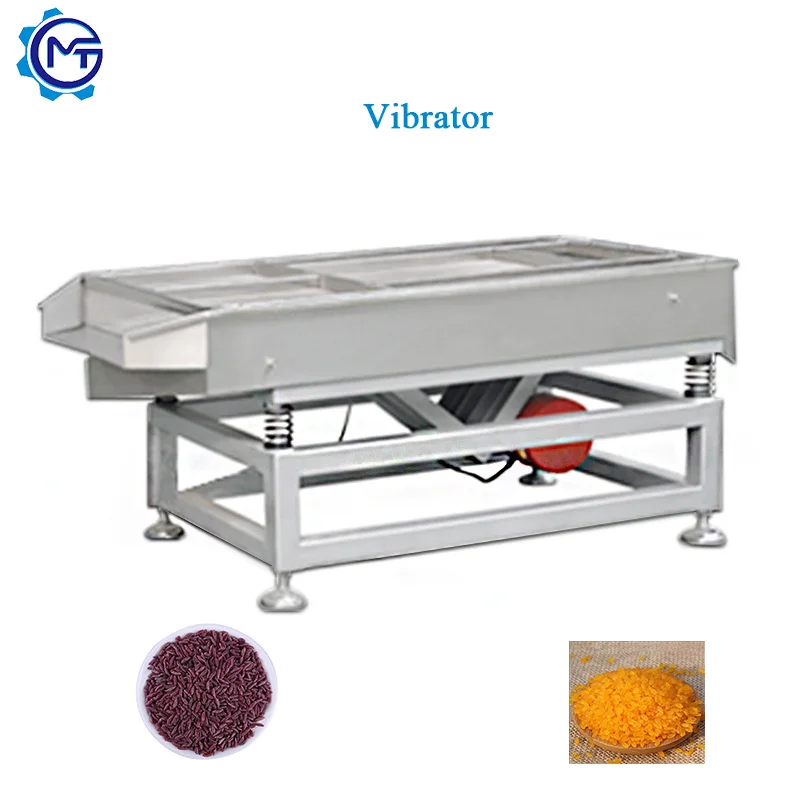
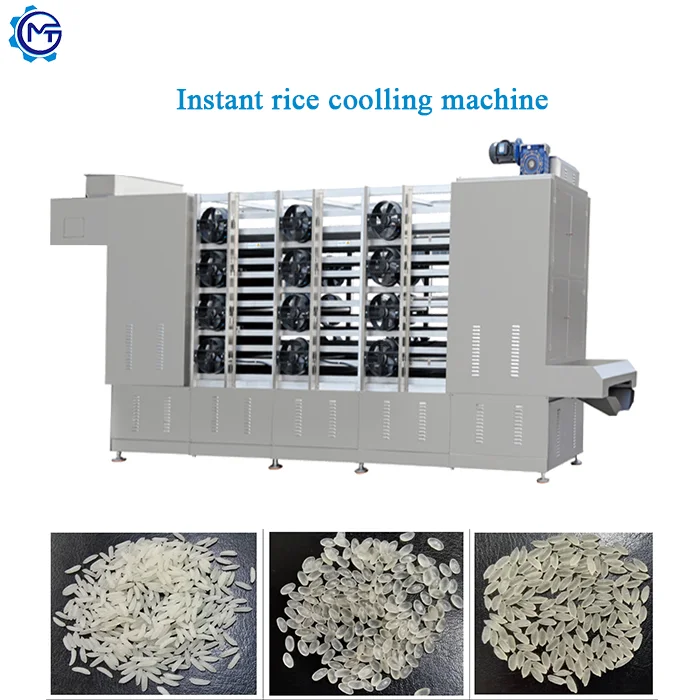
A complete fortified rice kernel production line turnkey integrates mixing, extruding, vibrating, low-temperature drying, cooling, high-temperature roasting, and packing into a single engineered workflow. When the dryer cannot match extruder output, product backs up and moisture content drifts. When the cooling conveyor runs faster than the roasting oven can deliver, kernel surface quality suffers. Every station is sized so throughput stays consistent end to end [NEED_CITE: throughput balancing methodology in multi-station extrusion lines].
How Power, Dimensions, and Control Shape the Project
The installed power range — from 85 kW on the MT65 to 260 kW on the MT95 — determines transformer sizing and dedicated circuit requirements at the buyer’s facility. Physical footprints stretch from 28 meters on the smallest line to 36 meters on the largest, which means factory floor planning must account for linear layout and maintenance access corridors before foundations are poured. The frequency-controlled feeding system, available in single or twin screw configuration, lets operators match feed rate to material behavior — lighter starch blends may need different screw feeding than dense mineral-loaded formulations. Automatic lubrication and cooling extend screw and barrel service intervals, reducing unplanned stops during continuous production runs.
The Hidden Cost of Generic Line Assembly
When an extruder, dryer, and packing unit arrive from three different vendors, nobody owns the throughput gap between them. I have walked into plants where the extruder ran fine but the drying oven was undersized, forcing the operator to slow the entire line and lose output that the contract promised. Electrical mismatches create another layer of frustration — arriving on-site to find the control panel wired for a voltage standard that does not match the local grid [NEED_CITE: voltage and frequency standards by export market]. These are not theoretical risks; they are the most common commissioning delays I see on turnkey grain processing projects.
Why Buyers Source the Full Line Here
The in-house testing workshop runs your specific grain blend and premix formulation before the line ships, so screw configuration and drying parameters are locked in advance rather than guessed on-site. Every station — mixer, extruder, dryer, roaster, cooler, packer — comes from one engineering team, which means throughput calculations are validated across the full chain rather than left to chance. The CE-certified build standard applies to mechanical safety and electrical compliance together, not just one subsystem. Screw and die configurations are documented per project, so reorders and wear part replacements match the original specification exactly. Layout drawings, electrical schematics, and trial reports ship with the machines, giving your installation contractor the reference material needed before the containers arrive.
Documentation & Verification
- Line layout drawing showing station spacing and utility connection points for your FRK floor plan
- Capacity calculation sheet matching extruder, dryer, and packing throughput to your target output
- Trial run report on your grain-premix blend conducted in the testing workshop before dispatch
- Screw and die configuration record specific to your formulation, not a generic template
- Electrical schematic with voltage and frequency confirmed against your facility supply
- CE declaration of conformity covering mechanical and electrical safety requirements
Installation, Commissioning & Support
- Floor space allocation based on line dimensions ranging from 28 m to 36 m depending on model tier
- Dedicated power circuit sized to installed load between 85 kW and 260 kW per selected model
- Frequency-controlled feeding system calibrated on-site against your actual premix bulk density
- Drying oven mesh belt speed tuned during commissioning to achieve target kernel moisture content
- Automatic lubrication system verified and maintenance intervals documented for your shift schedule
- Wear parts list covering screws, dies, and barrel liners with reorder part numbers included
What We Need to Build Your Line Proposal
To scope a fortified rice kernel extrusion project accurately, share your base grain formulation and the specific vitamin-mineral premix you plan to use, along with target hourly output and the moisture specification your market requires. We also need your facility voltage, frequency, and control language preference so the electrical package matches your grid from day one. If you have existing upstream milling or downstream packing equipment, tell us the interface points so the new line integrates without rework.
Frequently Asked Questions
Q: How is the output capacity verified on my specific raw material blend and formulation?
A: We run a physical trial using your grain base and vitamin-mineral premix in the in-house testing workshop before the line ships. Screw speed, feed rate, and barrel temperature are adjusted until the output matches your target, and the results are documented in a trial report that accompanies the shipment.
Q: Can the line layout be customized to fit my factory footprint and phased installation schedule?
A: Yes. Station spacing and conveyor routing are drawn to your building dimensions, and the layout document accounts for utility drop points, maintenance corridors, and future expansion zones. Phased commissioning can be planned so critical stations come online first while secondary units are installed later.
Q: How are the extruder, dryer, and packing stations throughput-matched so no single unit bottlenecks the line?
A: Each station is sized during the line design phase based on the extruder output verified in the trial run. Dryer belt length, roasting oven volume, and packing speed are all calculated against the same throughput figure, so no unit forces the others to run below capacity.
Q: What documentation is provided before shipment for my installation contractor?
A: You receive line layout drawings, electrical schematics with confirmed voltage and frequency, screw and die configuration records, the trial run report on your raw material, and the CE declaration of conformity. These documents let your contractor prepare foundations and utility connections before the machines arrive.
Q: What does on-site installation, commissioning, and operator training cover?
A: Our engineers supervise mechanical assembly, verify electrical connections against the schematic, calibrate the frequency-controlled feeding and drying systems on your material, and train your operators on daily procedures, screw and die changeover, and the automatic lubrication maintenance cycle.
Related products
-
Organic Gluten Free Baby Rice Nutrition Powder Automatic 500kg/h Production Processing Line
¥8,238.27 Add to cart -

Full Automatic Complete Baby Food Nutrition Powder Porridge Processing Production Line for Infant Nutrition Factory
¥9,500.00 Add to cart -
Automatic Iron Fortified Baby Rice Cereal Nutrition Powder Making Machine 500kg/h PLC Controlled
¥8,238.27 Add to cart -

Automatic Instant Powder Production Line Nutritional Powder Extruder Machine
¥10,000.00 Select options This product has multiple variants. The options may be chosen on the product page