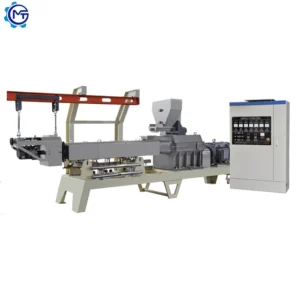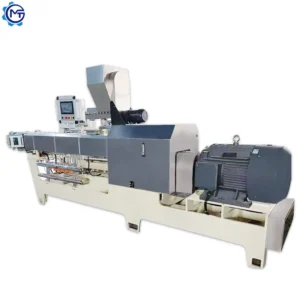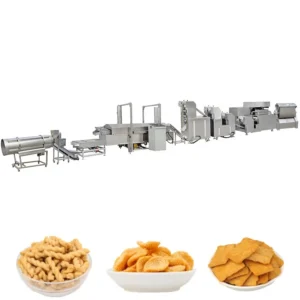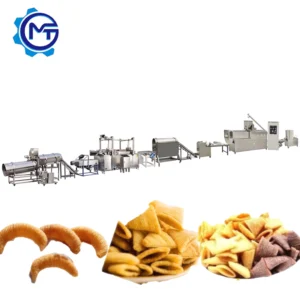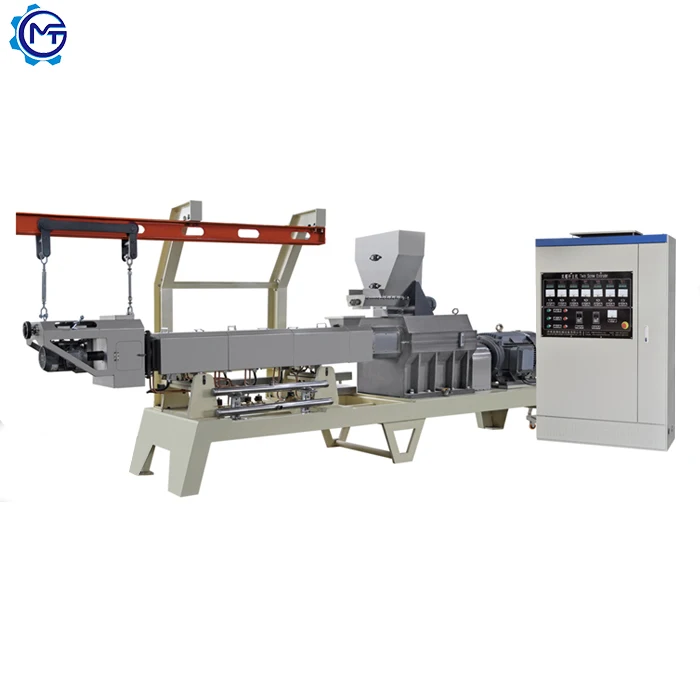
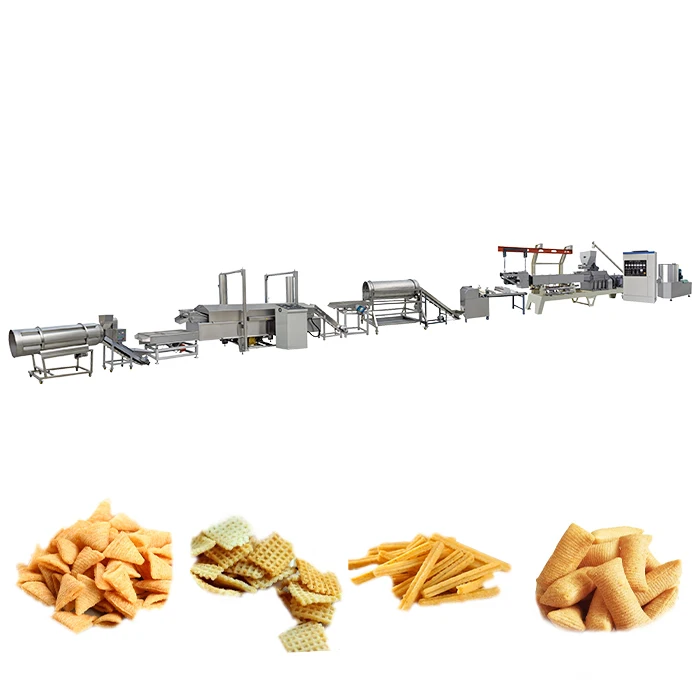
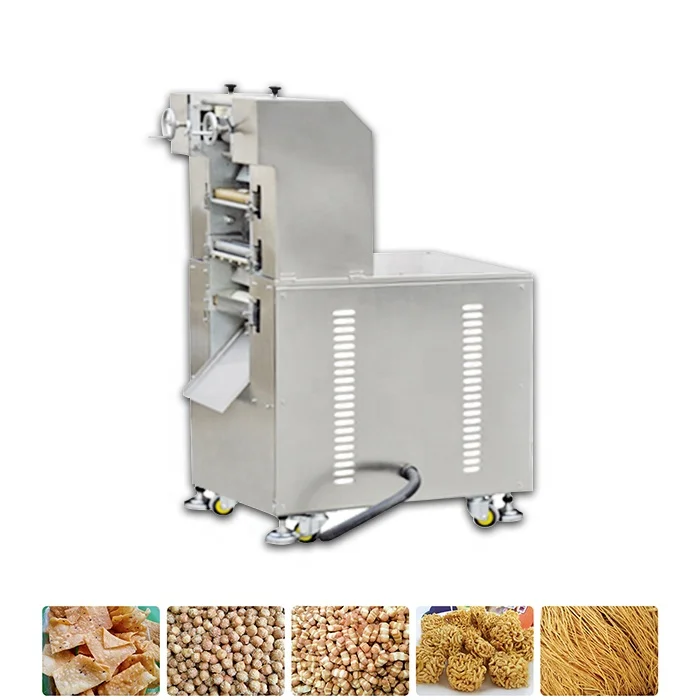
Wheat Flour Snacks Processing Equipment Fried Food Production Line, Single Screw Extruder, Food Grade Stainless Steel 201/304 — engineered for secondary puffing snack production from wheat flour, corn starch, and potato starch with versatile die configurations.
Screw configuration and barrel profile are matched to raw material behavior and target density, ensuring consistent expansion across shapes like golgappa, pani puri, screw shells, and tubes.
- Complete turnkey layout with throughput matched from extrusion through frying and flavoring
- Trial runs on customer raw material before shipment validate real output
- Pre-sales engineering through on-site commissioning and operator training
Description
Turnkey Line Integration — Every station on this fried snack food production line turnkey is throughput-matched from extrusion to flavoring, eliminating mid-line bottlenecks before the first bag is filled.
Technical Specifications
| Parameter | Value |
|---|---|
| Product Type | Fried Snack Food Production Line |
| Extruder Type | Single Screw Extruder |
| Screw Configuration | High and low pressure screw |
| Raw Materials | Wheat flour, corn starch, potato starch |
| Output Capacity | 120 kg/h (basis not stated in source — confirm raw material blend, moisture content, and product shape) |
| Rated Power | 50–70 kW (electricity); 50–60 kW (gas or diesel heating) |
| Voltage & Frequency | Three phase 380V/50Hz; Single phase 220V/50Hz (customizable to local voltage) |
| Overall Dimensions (L×W×H) | 12,000–26,000 × 1,200 × 2,200 mm |
| Material | Food grade stainless steel 201/304 |
| Energy Options | Electricity, gas, diesel, steam |
| Electrical Components | Siemens (China) or China top brand motors; Delixi or Delta inverters |
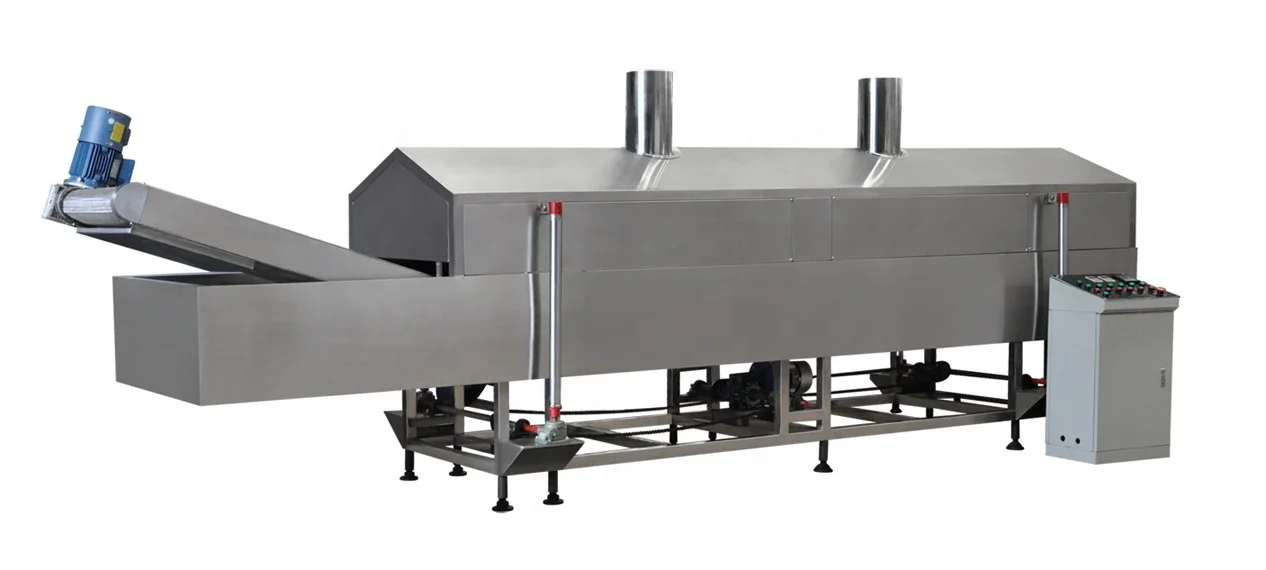
| Process Flow | Mixer → Screw Conveyor → Single Screw Extruder → Pulling and Cutting Machine → Automatic Fryer → Automatic Flavoring Line → Cooling |
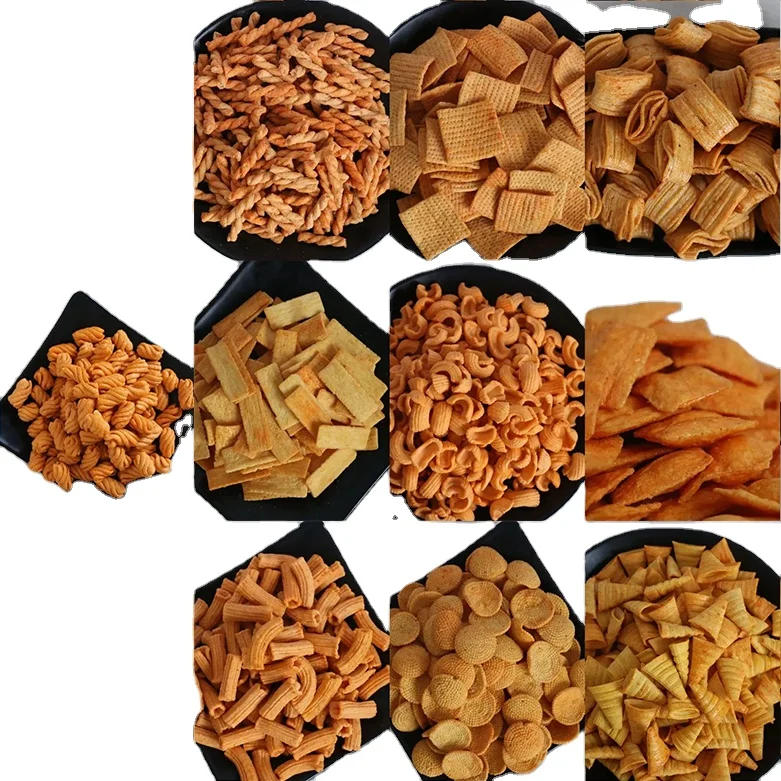
| Product Shapes | Screw shell, round tube, square tube, ring, cartoon shapes |
| Standards | CE, ISO 9001 |
Application Suitability
| Application | Material or Output |
|---|---|
| Golgappa / pani puri production | Wheat flour and starch blends for thin, crisp hollow shells |
| Secondary puffing snack formats | Corn starch and potato starch doughs extruded into tube and ring shapes before frying |
| Shaped fried snack chips | Wheat flour-based formulations for screw shell and cartoon shape dies |
| Fortified fried snacks | Blends incorporating nutritional additives compatible with single screw extrusion |
What a Nominal Capacity Figure Conceals on a Fried Snack Line
Real output on a fried snack food production line turnkey depends on the moisture content of your dough, the die geometry, and how fast the fryer can remove water without scorching.
A capacity number quoted in isolation ignores the slowest station. When the extruder pushes product faster than the fryer can handle, semi-finished pieces pile up on the conveyor between stations. In a humid plant environment, that exposed dough skin dries unevenly and cracks during frying, producing off-color pieces that get rejected at inspection. I have watched lines stall within the first week because the cutting speed and fryer belt speed were set independently, with no calculation linking the two [NEED_CITE: throughput matching methodology for continuous frying lines]. The solution is not a bigger extruder — it is a line where every motor, belt, and timer is specified against the same raw material and target piece weight.
How the Extrusion and Frying Stations Are Linked
On this fried snack food production line turnkey, the single screw extruder uses a high and low pressure screw profile that handles wheat flour and starch blends without requiring pre-conditioning at high moisture. The dough exits the die and moves directly into the pulling and cutting machine, which slices pieces to a fixed length. That fixed length, combined with the die opening diameter, determines the wet piece weight entering the fryer. If the fryer oil volume and heating capacity cannot evaporate the moisture from that throughput, the oil temperature drops and pieces absorb excess oil, resulting in a greasy mouthfeel. The line layout calculation accounts for this by matching the extruder screw speed to the fryer belt dwell time, so oil temperature stays within the range that produces the target color and crunch.
Die Geometry and Product Density Control
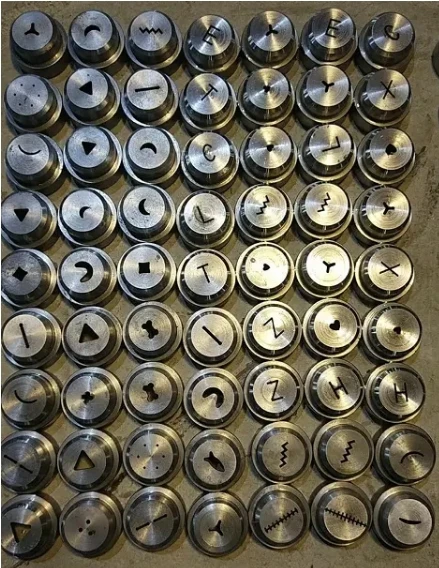
The available die set covers screw shell, round tube, square tube, ring, and cartoon shapes. Each die produces a different wall thickness and internal void ratio, which changes how much oil the piece absorbs and how much it expands during frying. A thin-walled ring puffs quickly and needs a shorter fryer dwell, while a thick-walled square tube requires more time at a slightly lower oil temperature to cook through without surface blistering. The screw configuration record documents which die and screw combination was tested for your specific raw material blend, so the line ships with the correct tooling rather than a generic build [NEED_CITE: die configuration impact on secondary puffing snacks]. This avoids the common situation where the extruder produces the right shape but the fryer output is either undercooked or over-browned.
Interpreting the Core Specifications for Plant Planning
The rated power range of 50–70 kW for electrical heating, or 50–60 kW for gas or diesel, determines your utility connection size and transformer specification. Plants in regions with unstable grid supply often choose gas or diesel heating for the fryer to avoid production stops during voltage sags. The overall dimensions of 12,000 to 26,000 mm in length reflect how many stations are included and the conveyor run between them — a longer line typically includes additional cooling and seasoning drums for higher-output configurations. Food grade stainless steel 201 is suitable for dry indoor environments, while 304 is specified where washdowns are frequent or ambient humidity is high. The Delixi or Delta inverters control motor speed at each station, allowing the operator to fine-tune belt speeds during commissioning without replacing pulleys.
The Cost of Mismatched Station Throughput
When the fryer cannot keep pace with the extruder, operators are forced to slow the entire line down, running the extruder below its designed screw speed. At reduced speed, the dough residence time inside the barrel increases, raising the temperature and altering the gelatinisation point. The result is a denser piece that does not puff correctly in the oil, increasing the reject rate [NEED_CITE: effects of extruder under-speed operation on starch gelatinisation]. Conversely, when the flavoring drum is too small for the fryer output, seasoned pieces exit the drum before the coating is evenly distributed, leading to customer complaints about inconsistent taste. These problems do not show up on a machine spec sheet — they appear only after the line is running at full speed on your raw material.
Why Source This Line as a Single Integrated Project
The extruder, fryer, and flavoring stations are specified together, so throughput calculations are based on one raw material and one target piece weight across every station. The in-house testing workshop runs your actual flour and starch blend through the extruder and cutter before shipment, producing a trial run report that documents the real output and piece dimensions. Screw and die configurations are selected for your target product shape, not copied from a generic catalog build. Voltage and frequency are confirmed against your plant supply before the electrical panel is wired, avoiding rewiring delays at commissioning. The line ships with a complete documentation set covering layout, capacity calculation, and wear parts, so your maintenance team has the reference material from day one.
Documentation & Verification
- Line layout drawing showing station spacing and conveyor lengths matched to your workshop dimensions
- Capacity calculation sheet documenting throughput at each station based on your raw material blend
- Screw and die configuration record linked to your target product shape and piece weight
- Trial run report produced on your actual flour and starch before dispatch
- Electrical schematic with confirmed voltage, frequency, and control language for your country
- CE declaration of conformity and ISO 9001 certificate for import clearance
Installation, Commissioning & Support
- Floor plan requirement based on the 12,000–26,000 mm line length and utility connection points
- Dedicated power circuit sized for the 50–70 kW electrical load or gas supply for fryer heating
- Station-by-station alignment and conveyor belt tensioning during on-site assembly
- First-run parameter setting including screw speed, oil temperature, and fryer belt dwell time
- Operator training covering die changeover and inverter speed adjustment at each station
- Wear parts list with reorder codes for screws, dies, and fryer belt segments
What to Include in Your Inquiry
To configure a fried snack food production line turnkey for your plant, provide the raw material formulation you plan to use, including flour type and any starch or additive percentages. Specify the product shapes you need from the available die set and the target piece weight after frying. Include your plant voltage and frequency, the available floor length and ceiling height, and whether you prefer electrical, gas, diesel, or steam heating for the fryer. If you have existing upstream mixers or downstream packing equipment, share the model and throughput so the line interfaces correctly.
Frequently Asked Questions
Q: How is output capacity verified on my specific raw material and product shape?
A: Before shipment, your raw material blend is run through the extruder and cutter in the testing workshop. The trial run report documents the actual output, piece dimensions, and product density. This ensures the capacity figure applies to your formulation, not just a generic starch test.
Q: How are extrusion, frying, and flavoring stations throughput-matched?
A: Each station motor and belt speed is calculated against the wet piece weight and the fryer oil evaporation rate. The line layout documents the matched throughput so no station becomes a bottleneck, and inverter controls allow fine-tuning during on-site commissioning.
Q: What voltage, frequency, and control language options are confirmed before shipment?
A: The electrical schematic is prepared after your plant voltage and frequency are confirmed. Control panel labels and inverter displays are set to your preferred language. This prevents rewiring and reprogramming delays when the line arrives at your facility.
Q: What product shapes and die configurations are available for fried snack formats?
A: The die set covers screw shell, round tube, square tube, ring, and custom cartoon shapes. Each die is matched with a specific screw configuration and tested on your raw material to confirm the correct wall thickness and expansion behavior during frying.
Q: How is the line phased for installation and commissioning on site?
A: Stations arrive in assembly order. The installation team levels and aligns each section, connects utilities, and runs a phased commissioning starting with the extruder before introducing the fryer and flavoring drum. Operator training covers daily settings and die changeover procedures.
Related products
-
Fried Puffs Snack Food Making Machine Whole Line Solution Design by Factory Price Crispy Snack Machine
¥20.00 Select options This product has multiple variants. The options may be chosen on the product page -
Frying Crispy 3D Corn Bugles Pellets Fried Chips Snacks Food Machine Production Line Bugles Making Extruder
¥100.00 Select options This product has multiple variants. The options may be chosen on the product page -
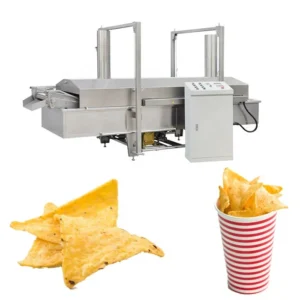
New Fully Automatic Large Capacity 304 Stainless Steel Savory Frying Snack Production Line Crisp Bugles Chips Processing Machine
¥30.00 Select options This product has multiple variants. The options may be chosen on the product page -
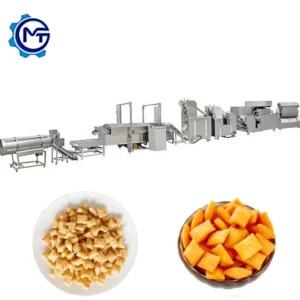
Hot Selling Full Automatic Fried Dough Wheat Flour Bugles Snacks Frying Machine Fried Puffed Food Bugles Snack Production Line
¥7,349.41 Select options This product has multiple variants. The options may be chosen on the product page