

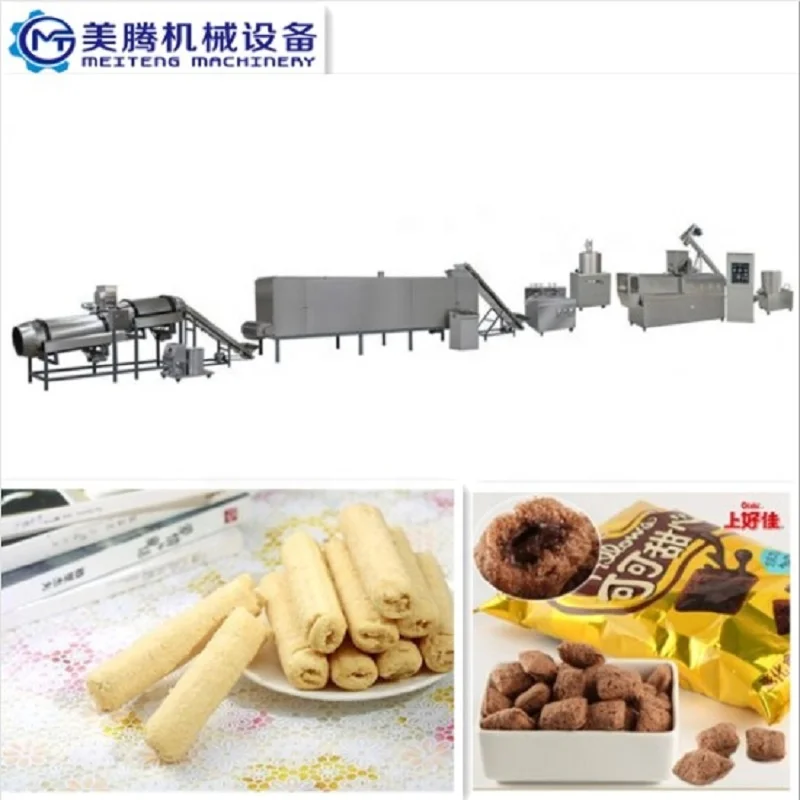
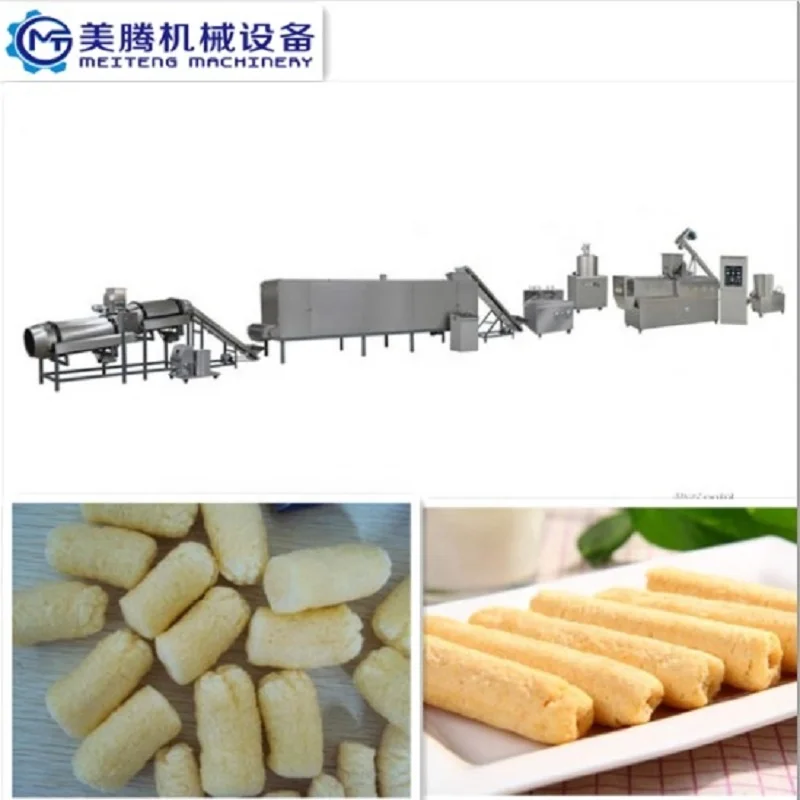
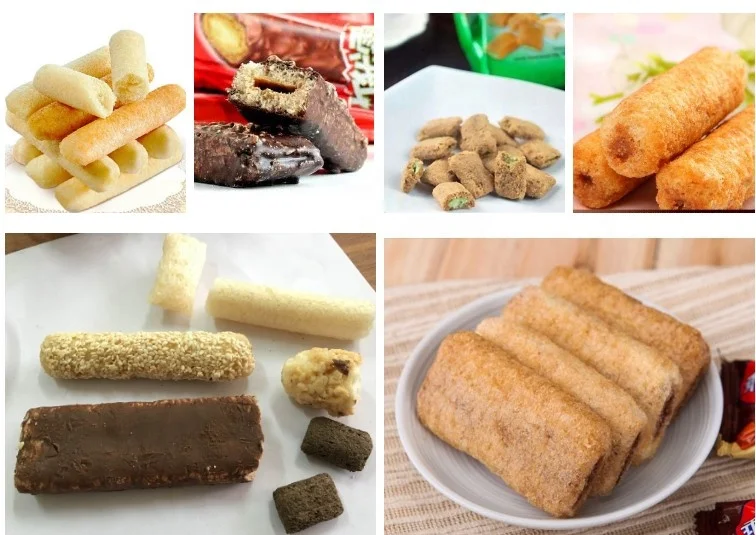
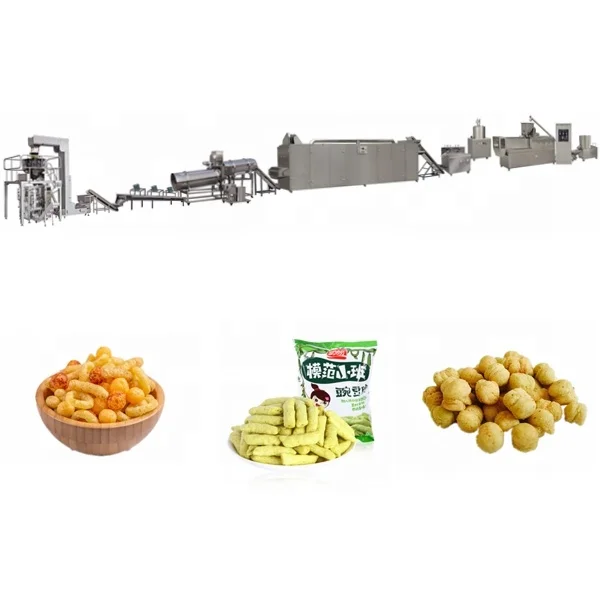
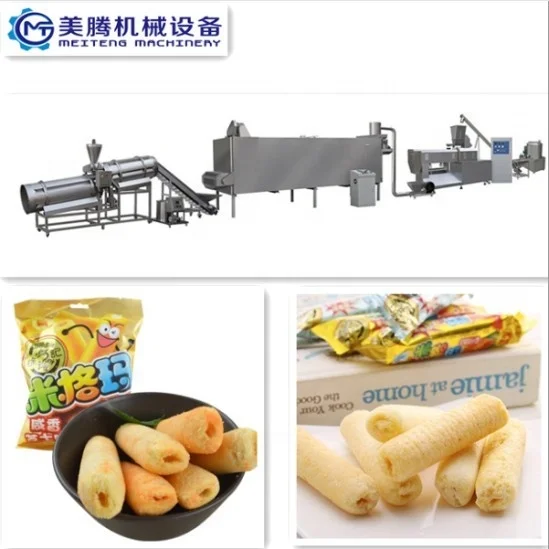
MT70 / MT85 / MT75 Twin Screw Extrusion Core-Filled Puffed Snacks Production Line, 130–220 kW Installed Power — configured as a complete turnkey system from batching to packing with matched throughput at every station.
- Interchangeable dies support ball, tube, stick, ring, fruit loop, star, wheel, flower, and heart shapes
- Screw and die combinations specified to your flour blend and target texture, with in-house trial runs on your raw material before shipment
Backed by full line layout design, pre-shipment factory testing, and on-site commissioning with operator training.
Description
Matched Throughput Across Every Station — The extruder, dryer, coating drum, and cooler are sized together so a 300–500 kg/h extrusion rate never waits on a bottleneck downstream.
Technical Specifications
| Parameter | Value |
|---|---|
| Product Type | Twin Screw Extrusion Core-Filled Puffed Snacks Production Line |
| Model Options | MT70 / MT85 / MT75 |
| Screw Configuration | Twin screw, wear-resistant treatment |
| MT70 Installed Power / Consumption | 130 kW / 95 kW |
| MT70 Output Capacity | 100–120 kg/h (basis not stated in source — confirm raw material / moisture / product shape) |
| MT70 Overall Dimensions | 21 × 1.5 × 2.2 m |
| MT85 Installed Power / Consumption | 180 kW / 120 kW |
| MT85 Output Capacity | 200–300 kg/h (basis not stated in source — confirm raw material / moisture / product shape) |
| MT85 Overall Dimensions | 25 × 1.5 × 2.2 m |
| MT75 Installed Power / Consumption | 220 kW / 130 kW |
| MT75 Output Capacity | 300–500 kg/h (basis not stated in source — confirm raw material / moisture / product shape) |
| MT75 Overall Dimensions | 28 × 1.5 × 2.2 m |
| Extruder Systems | Feeding, extruding, cutting, heating, gearing, controlling |
| Dryer Heating Source | Gas or Electric |
| Coating System | Double tumble sugar melter, elevator, coating drum, spraying nozzle |
| Die Shapes | Ball, tube, stick, ring, fruit loop, star, wheel, flower, heart |
| Raw Material Compatibility | Corn, rice, wheat, oat, barley flour |
| Line Sequence | Batching → Extruding → Drying → Coating / Flavoring → Cooling → Packing → Stacking |
| Certification | CE, ISO (verify per-model certificate availability) |
Application Suitability
| Application | Material or Output |
|---|---|
| Core-filled pillow snacks | Corn, rice, or wheat flour with cream or chocolate injection |
| Direct-expanded puffed shapes | Corn grits, oat, or barley flour in rings, stars, wheels |
| Sugar-coated cereal loops | Extruded fruit loops or balls with double-tumble glazing |
| Fortified nutritional snacks | Blended grain flours with vitamin or mineral premix |
| OEM snack formats | Custom die profiles for private-label contract packing |
Why Nominal Capacity Means Nothing Without the Raw Material
A line rated at 500 kg/h on one flour blend may deliver half that on another.
When a buyer signs a contract based on a brochure number, the first production week often tells a different story. Corn grits at one moisture level expand and convey differently than a rice-and-oat blend, and the extruder may hold throughput while the dryer falls behind. I have watched a snack line in a humid workshop pile up half-finished product at the coating drum because the dryer could not remove moisture fast enough [NEED_CITE: moisture removal rate and dryer sizing for extruded snacks]. The twin screw extrusion production line turnkey approach we follow starts by locking in the buyer’s actual flour blend and target shape before any station is sized.
Matching the Barrel Profile to the Flour Blend
The barrel temperature zones and screw element arrangement determine how completely the starch gelatinises before the die. A high-fat recipe needs a different shear profile than a lean corn flour, and swapping elements is far cheaper than replacing an entire screw set after commissioning. Every twin screw extrusion production line turnkey configuration here records the screw build and barrel settings used during the pre-shipment trial, so operators start with a known baseline rather than guessing on the factory floor.
Keeping the Dryer and Coater in Step
The dryer must remove enough moisture that the snacks reach the coating drum without sticking together, but over-drying wastes energy and makes the product brittle. The double-tumble coating system on this line melts sugar in a separate kettle and sprays it through nozzles inside the drum, which means the drum speed and spray rate must match the extruder output. If the extruder pushes product faster than the drum can coat, the surplus sits in a cooling conveyor and clumps [NEED_CITE: coating drum residence time and sugar crystallisation]. Sizing the dryer and coater to the extruder, rather than to a catalogue maximum, prevents that bottleneck.
Reading the Numbers Behind the Models
The three models span from the MT70 at 100–120 kg/h to the MT75 at 300–500 kg/h, but those ranges depend on the raw material and moisture content. Installed power rises from 130 kW to 220 kW across the range, while power consumption stays roughly sixty to seventy percent of installed capacity, reflecting the load profile of the extruder motor, barrel heaters, and cutter. The die plate accepts interchangeable inserts for nine standard shapes; switching from a ring die to a star die changes the expansion ratio, so the cutter speed and dryer belt speed must be adjusted together. Line lengths run from 21 to 28 metres, which dictates the utility trench and cable run planning before the equipment arrives.
The Cost of a Generic Screw Build
Copy-paste screw configurations cause the wrong texture: a snack that should be crisp comes out dense, or a core-filled pillow splits at the seam because the dough elasticity is off. Once the line is running, operators compensate by slowing the extruder, which then starves the downstream stations [NEED_CITE: screw element arrangement and dough rheology in twin-screw extrusion]. The rework cost in wasted flour, energy, and labour compounds every shift until the screw elements are reconfigured and the trial is repeated.
Evidence Instead of Promises
We specify the screw and die to the buyer’s flour blend, not to a generic snack template. The in-house testing workshop runs the buyer’s raw material before shipment and documents the throughput, expansion, and moisture at each station. The twin screw extrusion production line turnkey delivery includes a layout drawing that matches the buyer’s column spacing and utility drops, avoiding on-the-fly pipe rerouting. Electrical schematics confirm voltage, frequency, and control language for the destination market before the panels are wired. Wear parts lists itemise every screw element, die insert, and cutter blade so the first replacement order is already in the warehouse when the line starts production.
Documentation & Verification
- Line layout and capacity calculation based on your flour blend and moisture level
- Screw and die configuration record tied to your target shape and density
- Trial run report on your raw material measured before dispatch
- Electrical schematic with voltage, frequency, and control language confirmed
- CE declaration of conformity and ISO certificate per model
Installation, Commissioning & Support
- Foundation plan aligned to the 21–28 m line length and local seismic code
- Dedicated circuit sized to the MT75 peak draw of 220 kW with voltage confirmation
- Extruder, dryer, and coater arrive as separate skids for staged rigging
- First-run parameter set from the pre-shipment trial loaded into the controller
- Operator training covers die changes, screw element swaps, and coating drum speed
- Wear parts kit includes matched screw elements, die inserts, and cutter blades
What to Prepare Before You Enquire
Send the flour blend or recipe you intend to run, the target snack shape and filling type, and the daily output you need to meet purchase orders. Include your factory ceiling height, available floor length, and the local voltage and frequency so the electrical design matches the site. If you have existing packing or cooling equipment that the new line must tie into, note the conveyor height and control interface.
Frequently Asked Questions
Q: How is output capacity verified before the line ships?
A: We run your actual flour blend in the testing workshop, record the extruder throughput, dryer moisture drop, and coating drum speed, and issue a trial report. Capacity figures are only meaningful when tied to a specific material and moisture, so the report states those conditions alongside the measured kg/h.
Q: What happens if my recipe changes after installation?
A: The screw elements are modular, so we can reconfigure the shear profile and send a new die plate. We recommend a short remote-guided trial to re-establish the barrel temperature zones and cutter speed before you commit to a full production run.
Q: How do you prevent the dryer from becoming a bottleneck?
A: Dryer belt length and heating capacity are calculated from the extruder output and the moisture that must be removed. Gas or electric heat sources are selected based on your site utility costs, and the belt speed is interlocked with the extruder feed rate to prevent product pile-up.
Q: Which spare parts should I stock from day one?
A: The wear parts list identifies screw elements, die inserts, cutter blades, and spray nozzles that typically need replacement after the first production cycle. We ship a recommended first-kit with the line so you are not waiting on international freight during ramp-up.
Related products
-

Automatic High Productivity Puffed Corn Snacks Extruder Production Equipment New Condition Puff Snack Food Making Machine
¥11,050.00 Select options This product has multiple variants. The options may be chosen on the product page -

Corn Puff Processing Line with Mixer Fryer Baking Oven Automatic High Productivity Grain Products Snack Making Machine
¥8,300.00 Select options This product has multiple variants. The options may be chosen on the product page -

Hot Sale Corn Snack Extruder Puffed Snacks Production Machine Corn Puffs Making Machine
¥20,000.00 Select options This product has multiple variants. The options may be chosen on the product page -

Full Automatic Crispy Maize Chocos Corn Flakes Breakfast Cereals Processing Production Line Industrial Equipment
¥1,000.00 Select options This product has multiple variants. The options may be chosen on the product page


