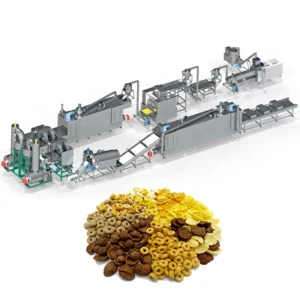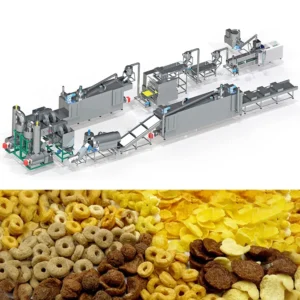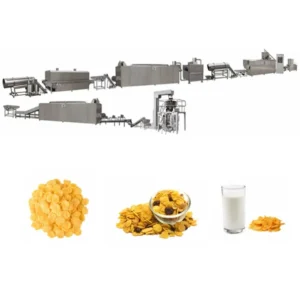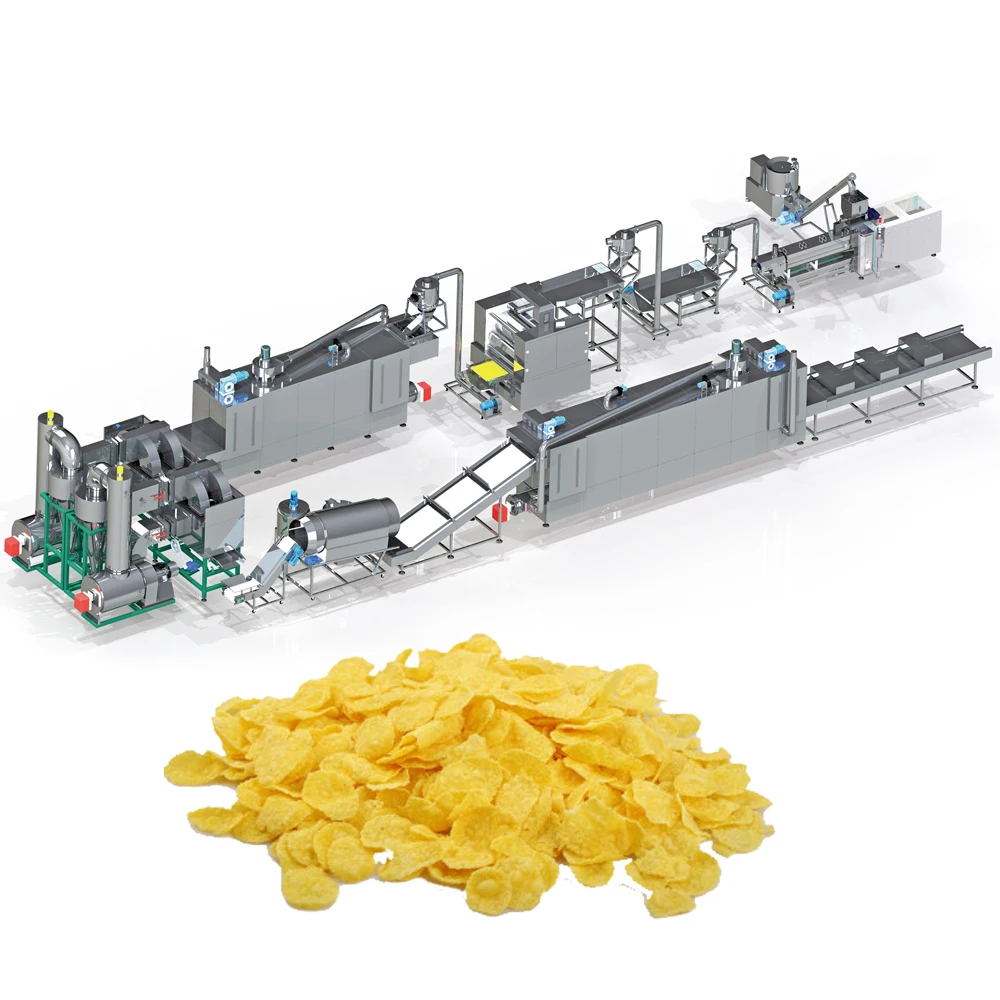
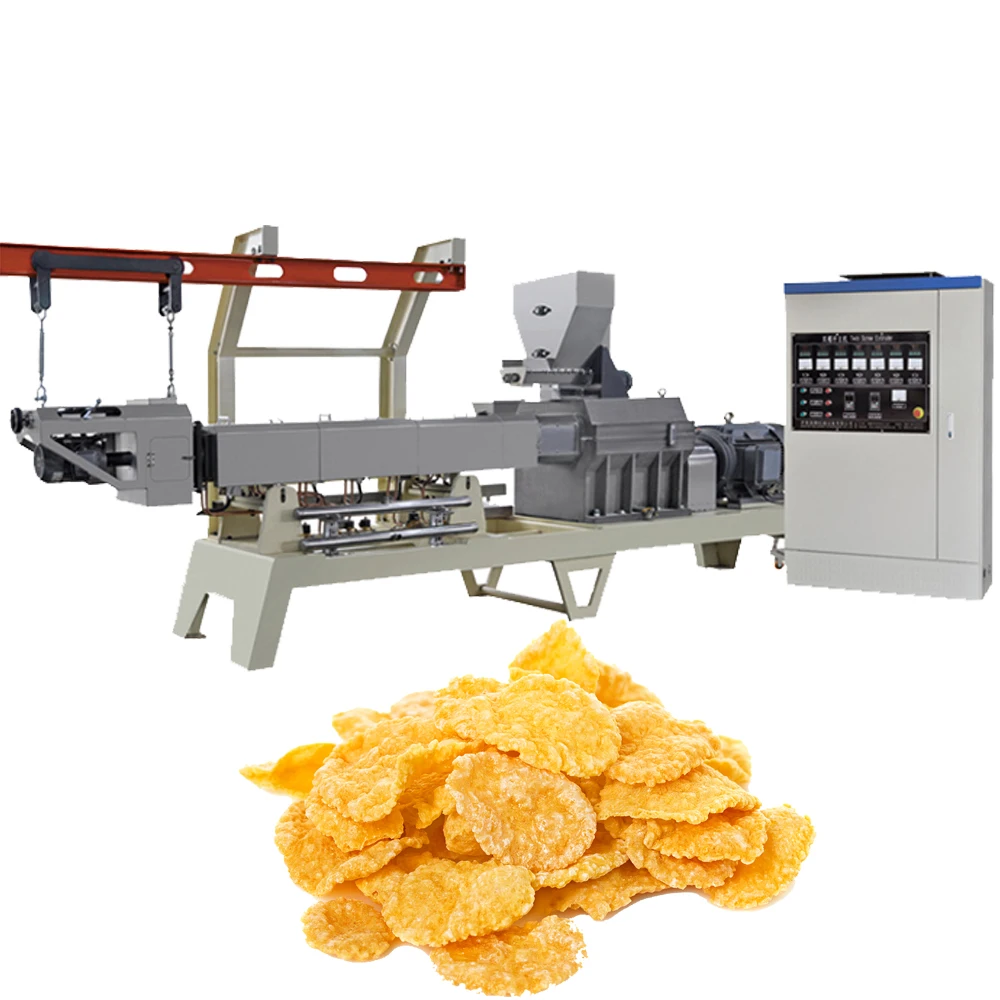
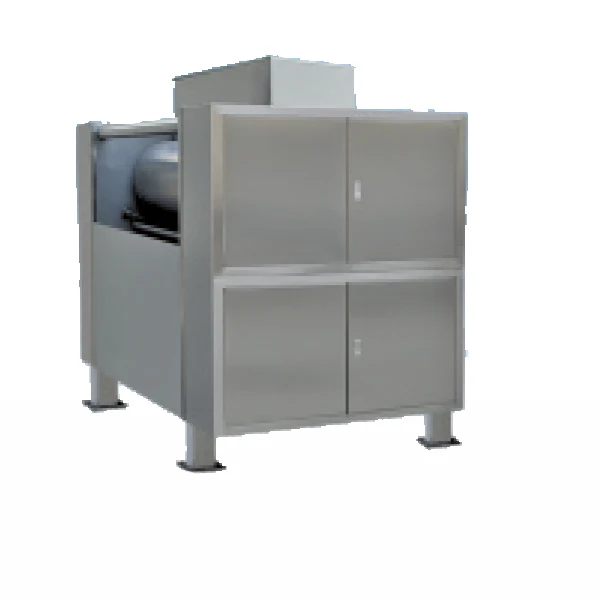


MT70 / MT85 / MT75 Corn Flakes Production Line, Twin Screw Extruder, PLC Control — configured for continuous cereal extrusion with automatic screw lubrication and cooling. The turnkey layout covers mixing through flaking, drying, roasting and packing, with throughput matched at every station to prevent bottlenecks. Interchangeable dies produce shapes from rings to fruit loops on a single extruder. Screw configuration and die design are specified to your raw material, with in-house trial runs on customer recipe before shipment.
Description
Throughput-Matched Line Design — every station from the twin-screw extruder through the flaker, dryer, roasting oven, and packing end is sized to the same output target so no single unit chokes the rest.
Technical Specifications
| Parameter | Value |
|---|---|
| Product Type | Corn Flakes Production Line with Twin Screw Extruder |
| Available Models | MT70, MT85, MT75 |
| Screw Configuration | Twin screw with automatic lubricating and cooling system |
| Control System | Available with PLC control |
| Line Sequence | Mixing → Extruding → Flaking → Drying → Hot Air Roasting → Sugar Coating (optional) → Cooling → Packing |
| MT70 Installed Power | 160 kW |
| MT70 Power Consumption | 120 kW |
| MT70 Output Capacity | 150–200 kg/h (basis not stated in source — confirm raw material, moisture and flake specification) |
| MT70 Overall Dimensions | 41 × 1.5 × 2.2 m |
| MT85 Installed Power | 190 kW |
| MT85 Power Consumption | 140 kW |
| MT85 Output Capacity | 300–400 kg/h (basis not stated in source — confirm raw material, moisture and flake specification) |
| MT85 Overall Dimensions | 43 × 1.5 × 3.2 m |
| MT75 Installed Power | 210 kW |
| MT75 Power Consumption | 150 kW |
| MT75 Output Capacity | 300–500 kg/h (basis not stated in source — confirm raw material, moisture and flake specification) |
| MT75 Overall Dimensions | 45 × 1.5 × 3.5 m |
| Flaking Unit Drive | Double motors with hydraulic roller system |
| Flaking Unit Monitoring | Infrared temperature sensor |
| Dryer Heating Source | Gas or electric (selectable) |
| Roasting Oven | Hot air with vibrating pan, dual circulating fans, cyclone dust removal |
| Coating System | Double tumble for sugar melting, elevator, coating drum, spray nozzle |
| Die Moulds | Interchangeable — ball, tube, stick, ring, fruit loop, star, wheel, flower, heart |
| Raw Materials | Corn, rice, wheat, oat, barley powder |
| Voltage & Frequency | Customised to local supply |
| Certification | CE, ISO |
Application Suitability
| Application | Material or Output |
|---|---|
| Natural corn flakes production | Maize grits, corn flour |
| Sugar-coated corn flakes | Corn base with sugar spray coating |
| Shaped breakfast cereals | Rice, wheat, oat, barley powder blends |
| Fortified morning cereals | Cereal grains with added vitamin and mineral premix |
| Multi-grain cereal flakes | Mixed grain powder formulations |
Why "Rated Capacity" Means Nothing Without the Recipe
A corn flakes production line turnkey proposal that quotes output without naming the raw material moisture, grit size, and target flake density is a proposal built on assumptions — and assumptions cost you commissioning days. I watched a client lose three full production days because the line was quoted on nominal throughput while nobody confirmed the actual maize grits moisture content. The first trial run produced flakes that were half-singed, half-raw. The barrel temperature profile had to be re-mapped and the die plate swapped on-site before expansion came into spec [NEED_CITE: moisture content effect on twin-screw extrusion output].
That gap between brochure capacity and real-world throughput is where most cereal line projects stall. The extruder may run at nameplate speed, but if the downstream flaker cannot press at the same rate, or the roasting oven cannot achieve consistent blistering at that feed volume, the entire line throttles back to the weakest station.
Barrel Profile and Screw Geometry for Flake Expansion
Corn flake extrusion demands precise control over starch gelatinisation inside the barrel. The twin-screw configuration provides the shear and residence time needed to fully cook the corn or multi-grain dough before it exits the die. Screw elements are arranged to manage moisture, temperature, and pressure in distinct barrel zones — feeding, compression, gelatinisation, and metering. The automatic lubricating and cooling function on these screws keeps barrel temperatures stable during extended runs, which matters when you are targeting the consistent sheet thickness that downstream flaking requires.
Die Design and the Shape Library
The interchangeable die moulds on this line let you move between ball, tube, stick, ring, fruit loop, star, wheel, flower, and heart profiles without changing the extruder itself. Each die geometry alters the expansion ratio and wall thickness of the extruded pellet, which in turn affects how the flaker compresses it and how the roasting oven browns it. For a plant that wants to offer both traditional flat flakes and shaped cereal varieties from a single corn flakes production line turnkey installation, this die flexibility reduces the capital needed for separate forming lines [NEED_CITE: die geometry influence on cereal expansion ratio].
What the Power Draw Tells You About Process Stability
Looking across the MT70, MT85, and MT75 models, the gap between installed power and actual power consumption sits in the 40–60 kW range. That margin reflects the headroom the motor needs when the extruder encounters density variation in the feed material — for instance, when a new batch of maize grits has slightly higher oil content or coarser particle size. A tight power envelope leaves no room for these fluctuations and causes torque spikes that interrupt continuous operation. The installed power figures also guide your electrical planning: each model requires dedicated circuit capacity with enough overhead for simultaneous operation of the flaker’s dual motors, the dryer heating elements, and the roasting oven’s circulating fans.
The Bottleneck You Cannot See Until Commissioning
When a flaking unit, dryer, or roasting oven is sourced separately from the extruder, throughput matching becomes the buyer’s problem. A flaker that cannot keep pace with extruder output creates a buffer pile of hot extrudate that cools and hardens before pressing — resulting in uneven flake thickness and surface cracking. A roasting oven undersized for the line rate forces slower conveyor speeds that reduce blistering consistency across the pan. These mismatches do not show up in individual machine specs; they only appear when the full line runs together under production conditions [NEED_CITE: throughput matching across extrusion line stations].
Why This Line Is Built as One System
The complete sequence — mixing, extruding, flaking, drying, hot air roasting, optional sugar coating, cooling, and packing — is configured under a single supplier so that every station’s throughput target matches. The screw configuration and die plate are specified against the buyer’s actual raw material and target flake density before the line ships. An in-house testing workshop runs trial production on the customer’s own corn grits or grain blend before dispatch, catching the kind of moisture and expansion issues that otherwise surface during on-site commissioning. The flaking unit uses PLC control with infrared monitoring to hold roller temperature and gap consistent. Voltage, frequency, and control language are confirmed against the destination market before electrical assembly begins [NEED_CITE: CE machinery directive requirements for food processing equipment].
Documentation & Verification
- Screw and die configuration record matched to your grain type and target flake density
- Trial run report produced on your raw material before the line leaves the factory
- Electrical schematic confirming voltage, frequency, and control language for your market
- Line layout drawing with capacity calculation for each station against your throughput target
- CE declaration of conformity and ISO certificate included in shipment documentation
- Operation and maintenance manual with wear parts list for extruder screws, die moulds, and flaker rollers
Installation, Commissioning & Support
- Foundation and utility layout provided for the 41–45 m line footprint depending on model selected
- Dedicated power circuit sizing guidance based on the 160–210 kW installed power range
- Full line arrives in modular sections for staged assembly in your facility
- On-site barrel temperature profiling and die adjustment during initial commissioning runs
- Operator training covering PLC interface, screw configuration changes, and flaker gap calibration
- Wear parts inventory list covering screws, dies, and roller surfaces with recommended replacement intervals
What We Need to Configure Your Line
To move from a general enquiry to a line layout and capacity calculation, we need your target raw material — corn grits, rice flour, multi-grain blend — along with its moisture content and particle size. Share your daily production target, the floor space and ceiling height available in your plant, and the local voltage and frequency standard. If you are producing both natural and sugar-coated flakes, let us know the coating ratio so the coating drum and sugar melting system can be sized correctly.
Frequently Asked Questions
Q: How is line capacity verified against my specific raw material and recipe?
A: Before the corn flakes production line turnkey system ships, we run a trial using your actual grain material in our testing workshop. We measure extruder throughput, flake thickness after pressing, and blistering quality from the roasting oven. If the results fall outside your specification, we re-profile barrel temperatures and adjust the die plate before dispatch, so the line arrives already tuned to your recipe.
Q: Can the line produce both natural and sugar-coated corn flakes with one extruder?
A: Yes. The line includes an optional sugar coating station with a double tumble melting system, elevator, coating drum, and spray nozzle. You run natural flakes straight through to cooling and packing, or divert them through the coating drum for sugar-glazed varieties. The extruder and die configuration remain the same for both products.
Q: What does the phased installation and commissioning schedule look like?
A: The line arrives in modular sections. Installation follows the sequence from mixing through packing, with each station levelled and connected before the next is set. Commissioning starts with the extruder barrel profile, then the flaker gap and temperature, then dryer and roasting oven calibration. Operator training runs alongside final production trials.
Q: How are throughput rates matched between stations to prevent bottlenecks?
A: Every station — extruder, flaker, dryer, roasting oven, cooler — is sized against the same output target during the layout phase. We calculate the required flaker press rate, dryer residence time, and roasting oven pan speed to match the extruder’s verified throughput on your material, so no single unit restricts the others.
Q: What operator training and spare parts support come with commissioning?
A: On-site training covers PLC operation, screw element inspection, die plate changes, flaker roller gap adjustment, and roasting oven temperature profiling. A wear parts list identifies screws, dies, and roller surfaces with replacement intervals, and initial spares can be included in the first shipment to cover your first year of production.
Related products
-
Best Price Corn Flakes Making Machine Breakfast Cereals Processing Line with Motor As Core Component
¥19,000.00 Select options This product has multiple variants. The options may be chosen on the product page -
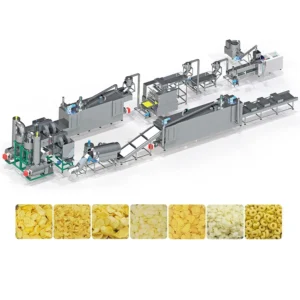
Automatic Cornflakes Making Machine Corn Flakes Breakfast Cereals Processing Production Line
¥500.00 Select options This product has multiple variants. The options may be chosen on the product page -
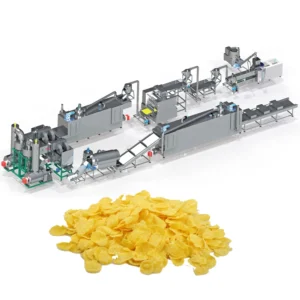
Intelligent Corn Flakes Production Line Twin Screw Extruder to Make Corn Flakes amd Morning Cereals
¥30.00 Select options This product has multiple variants. The options may be chosen on the product page -
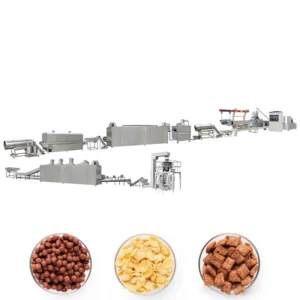
Kelloggs Corn Flakes Breakfast Cereal Normal Making Machine Breakfast Cereal Extruder Production Line
¥30,000.00 Select options This product has multiple variants. The options may be chosen on the product page