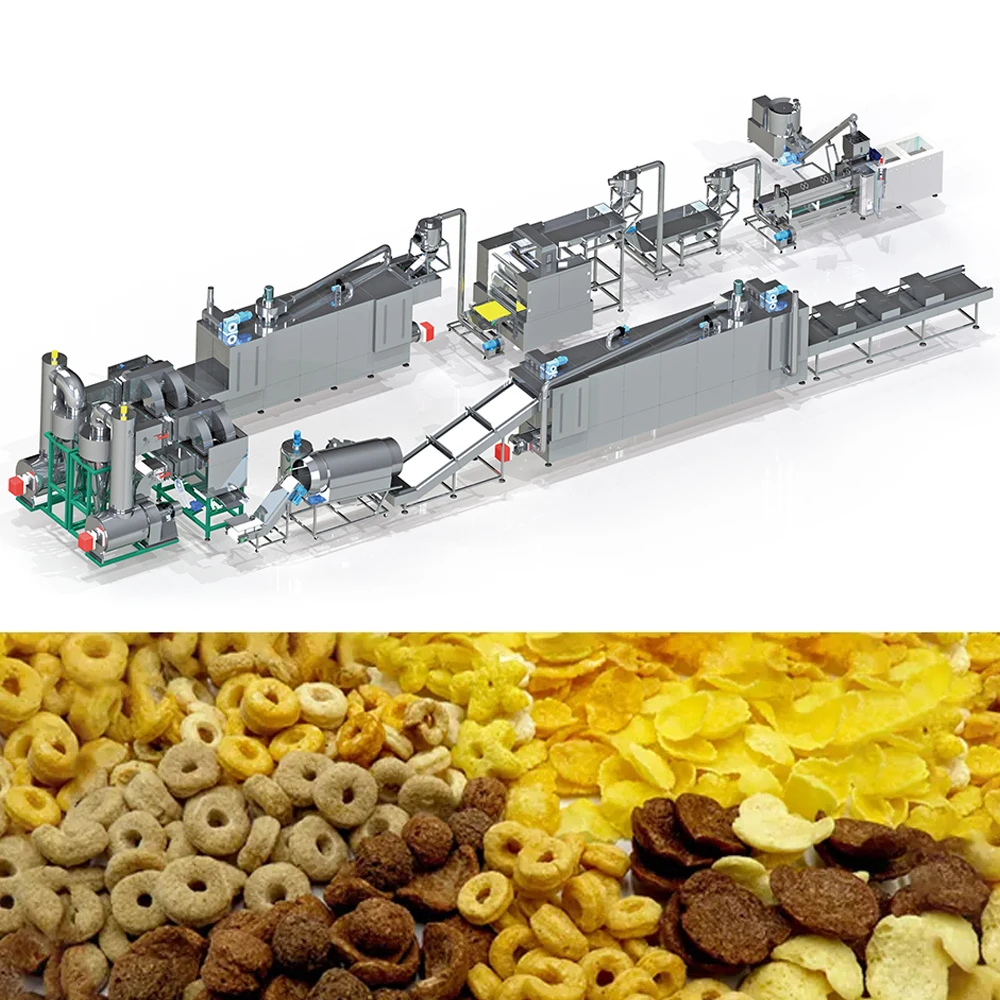


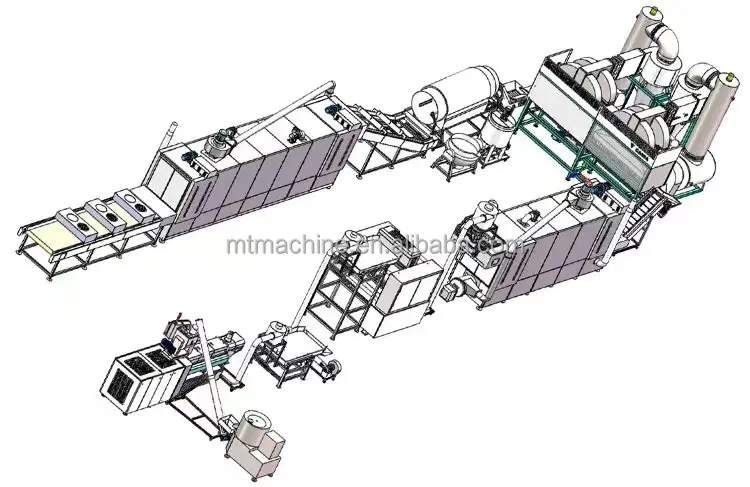
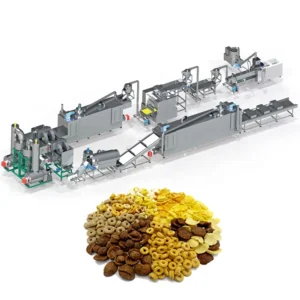
MT70 / MT85 / MT75 Corn Flakes Breakfast Cereal Production Line, Twin-Screw Extrusion, PLC & MCC Control — configured as a complete turnkey project from batching through extrusion, flaking, roasting, coating, and packing.
- Screw configuration and die design matched to your raw material and target flake density, with throughput balanced across every station to eliminate bottlenecks
- Flaking machinery features hydraulic double-roller system with infrared-sensor temperature control; hot air roasting oven delivers precise temperature profiling for consistent surface bubbles and crispness
Trial runs on your actual raw material are completed in our testing workshop before shipment, with full line layout, capacity calculation, and electrical documentation provided for your market.
Description
Throughput Matched at Every Station — a complete corn flakes line where extruder output, dryer capacity, flaking speed, and roasting throughput are calculated together so no single section bottlenecks the rest.
Technical Specifications
| Parameter | Value |
|---|---|
| Product Type | Corn Flakes Breakfast Cereal Production Line |
| Available Models | MT70 / MT85 / MT75 |
| Extruder Type | Twin-screw |
| Installed Power | MT70 — 160 kW; MT85 — 190 kW; MT75 — 210 kW |
| Power Consumption | MT70 — 120 kW; MT85 — 140 kW; MT75 — 150 kW |
| Output Capacity | MT70 — 150–200 kg/h (basis to be confirmed); MT85 — 300–400 kg/h (basis to be confirmed); MT75 — 300–500 kg/h (basis to be confirmed) |
| Overall Dimensions (L×W×H) | MT70 — 41 × 1.5 × 2.2 m; MT85 — 43 × 1.5 × 3.2 m; MT75 — 45 × 1.5 × 3.5 m |
| Control System | PLC and MCC |
| Flaking Machinery Drive | Hydraulic double-roller with dual-motor independent drive |
| Flaking Temperature Control | Infrared sensor regulated heating pipe |
| Dryer Heating Source | Gas or electric (configurable) |
| Roasting Oven Features | Vibrating pan, conciliation burner, dual circulating fans, cyclone dust removal |
| Coating System | Double tumble sugar melting, elevator, coating drum, spraying nozzle |
| Line Stations | Mixing → Extrusion → Molding/Cutting → Drying → Flaking → Roasting → Coating/Seasoning |
| Standards | CE, ISO |
| Warranty | 24 months, lifetime service |
Application Suitability
| Application | Material or Output |
|---|---|
| Classic corn flakes | Corn grits, maize flour, sugar, malt syrup |
| Chocolate-coated breakfast cereal | Corn or wheat base with cocoa coating |
| Fortified breakfast cereal | Grain blends with added vitamin and mineral premix |
| Multigrain flakes | Corn, rice, oat, or wheat blends |
| Puffed snack variants | Corn, rice, or mixed grain formulations |
Why Nominal Line Capacity Rarely Survives First Contact with Your Raw Material
Capacity is only meaningful when tied to your specific grain blend, moisture content, and target flake density.
A corn flakes production line turnkey is often quoted at a headline throughput figure that assumes ideal raw material and a clean, dry workshop. In practice, corn grits at higher moisture content behave differently inside the barrel, and a flaking stage rated at a certain volume may not keep pace when extruder output shifts due to seasonal grain variation. I have seen lines where the drying section fell short of the extruder’s actual output, leaving hot, moist pellets stacking up on the conveyor and bonding into unusable lumps before they ever reached the flaking rollers [NEED_CITE: grain moisture variability and extruder throughput correlation].
The only way to avoid this is to calculate every station’s capacity against the buyer’s exact formulation, then verify it with a trial run before the equipment leaves the factory.
Screw Configuration and Die Design Set the Flake Foundation
The twin-screw extruder sits at the heart of every corn flakes production line turnkey. The screw profile — pitch, kneading block arrangement, and reverse elements — determines how thoroughly the corn grits are cooked and gelatinized before the die. Die aperture size and land length then control the shape, density, and moisture level of the extrudate that enters the flaking rollers. A configuration that works for high-amylose corn may underperform on a softer, high-amylopectin variety, producing pellets that crack rather than flatten.
Matching the Dryer to the Extruder — Not the Other Way Around
The drying stage sits between extrusion and flaking, and it must handle the full output of the extruder without accumulation. Hot air temperature, belt speed, and dwell time inside the dryer are set so that the pellets arrive at the flaking machine with the exact residual moisture needed for a clean press. If the dryer is undersized, pellets cool unevenly and the flaking rollers produce irregular thickness or excessive breakage [NEED_CITE: moisture content target range for cereal flaking operations].
What the Power and Dimension Figures Mean for Your Workshop
The installed power range across available models — from 160 kW to 210 kW — reflects the combined load of the extruder drive, barrel heaters, cutting system, and auxiliary conveyors. Power consumption figures are lower because heaters cycle and the extruder motor rarely runs at full rated load during steady-state production. Line lengths stretching from 41 to 45 meters mean the workshop must accommodate not just the equipment footprint but also utility runs for gas or electric dryer supply, compressed air, and dust extraction ducting from the roasting oven’s cyclone system. The PLC and MCC control architecture centralizes every station — mixing timers, extruder barrel temperature zones, flaking roller pressure, and roasting oven setpoints — into one interface, which matters for batch-to-batch consistency when operators change over between corn flake and chocolate-coated cereal runs.
The Hidden Cost of Mismatched Coating Capacity
A roasting oven that produces perfectly blistered flakes means nothing if the downstream coating drum cannot keep up. Undersized coating drums force the roasting oven to idle, cooling flakes past the window where sugar or chocolate adheres properly. Oversized drums tumble product longer than necessary, breaking the very flakes the roasting oven shaped. The double-tumble coating system with dedicated sugar-melting kettle, elevator, and spray nozzle is sized to the extruder model so that throughput stays balanced from the first pellet to the last packed bag [NEED_CITE: sugar coating adhesion temperature window for breakfast cereals].
Why This Line Is Built as One Project, Not Assembled from Catalogs
Every station is specified together. The mixing system’s batch size is timed to the extruder’s continuous feed rate. The dryer length and airflow are calculated from the extruder’s actual moisture removal requirement. The flaking machinery’s hydraulic roller pressure and dual-motor drive are matched to the pellet dimensions that the die produces. The hot air roasting oven’s vibrating pan speed and burner profile are tuned to the flake thickness coming off the rollers. This means one layout document, one electrical schematic, and one commissioning schedule covers the entire line rather than forcing a contractor to reconcile documents from four different vendors.
Documentation & Verification
- Line layout and capacity calculation showing throughput at every station from mixer to coater
- Screw and die configuration record specified to your corn grit formulation and target flake density
- Trial run report on your actual raw material conducted in the testing workshop before shipment
- Electrical schematic with voltage, frequency, and control language confirmed for your facility
- CE declaration of conformity and ISO certificate included with shipping documentation
- Wear parts list covering screws, dies, and flaking roller surfaces
Installation, Commissioning & Support
- Foundation plan based on line dimensions up to 45 m length and station-specific point loads
- Dedicated power circuit sized to installed power up to 210 kW with MCC distribution
- Equipment shipped in sectional modules for assembly aligned to your workshop entry clearance
- On-site commissioning covering PLC parameter setup for your corn formulation and target output
- Operator training on screw configuration changes, flaking roller adjustment, and roasting oven tuning
- Spare screws, dies, and flaking roller segments stocked for first replacement cycle
What to Include in Your Inquiry
Provide your corn or grain blend formulation, target daily output, and the flake density or size your market expects. Include your workshop’s available voltage and frequency, ceiling height, and whether gas or electric heating is preferred for the dryer and roasting stages. If you have existing upstream or downstream equipment you intend to keep, note the interface points so the line layout accounts for them.
Frequently Asked Questions
Q: How is line capacity verified against my specific raw material and target corn flake density?
A: Before quotation, we collect your corn grit formulation, moisture content, and target flake density. The screw configuration and die design are set accordingly, then a trial run on your actual raw material is conducted in our testing workshop. The resulting capacity and product quality form the basis of the proposal rather than a generic catalog figure.
Q: How is throughput matched between the extruder, dryer, flaking machine, roasting oven, and coating drum?
A: Each station is calculated from the extruder’s actual output on your material. Dryer belt length and airflow, flaking roller feed rate, roasting oven pan speed, and coating drum volume are all derived from that number, so no single section accumulates product or forces the upstream machine to idle.
Q: What is the phased installation and commissioning schedule for a complete turnkey cereal line?
A: Installation typically begins with foundation preparation and utility rough-in, followed by mechanical assembly of each station in sequence from mixer to packer. Commissioning runs each section independently before integrating the full line. PLC parameters are then dialed in using your raw material during a supervised production trial.
Q: Can I conduct a trial run on my raw material at your testing workshop before shipment?
A: Yes. The in-house testing workshop runs the extruder, dryer, and flaking stages with your supplied raw material. You receive a trial run report documenting output rate, flake thickness, density, and surface appearance. Any screw or die adjustments are made before the line is packed for shipping.
Q: What operator training and ongoing maintenance support is included with the turnkey project?
A: On-site training covers PLC operation, screw and die changeover, flaking roller pressure adjustment, roasting oven burner tuning, and coating system setup. A wear parts list and maintenance schedule are provided, and lifetime technical service is available for troubleshooting and spare part supply beyond the 24-month warranty.
Related products
-
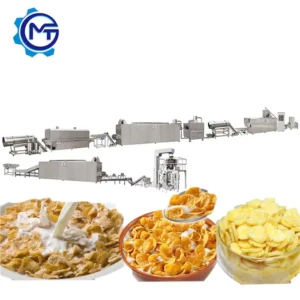
Automatic 500kg/h Corn Flakes Making Machine New Condition High Productivity Sweet Breakfast Cereal Processing Line From Factory
¥8,500.00 Select options This product has multiple variants. The options may be chosen on the product page -
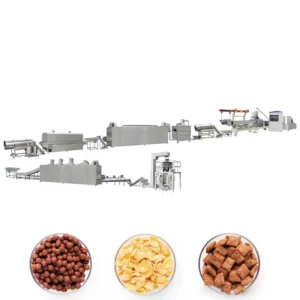
1000 Lbs Automatic Corn Flakes Production Line Mixer Breakfast Cereal Corn Flakes Production Line
¥45,000.00 Select options This product has multiple variants. The options may be chosen on the product page -
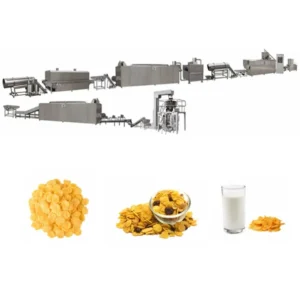
Cereals Corn Flakes with Sugar Corn Flakes Extrusion Food Machine Breakfast Cereal Production Line
¥23,000.00 Select options This product has multiple variants. The options may be chosen on the product page -
Corn Flakes Production Line Breakfast Cereal Production Machine Line Corn Flake Making Machinery
¥59,800.00 Select options This product has multiple variants. The options may be chosen on the product page