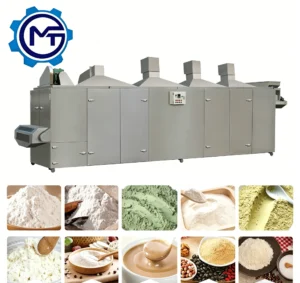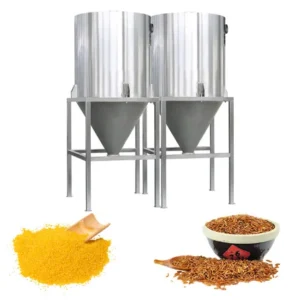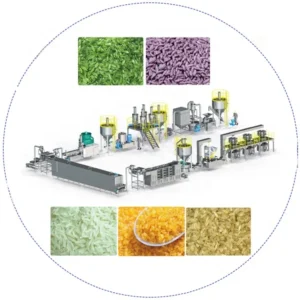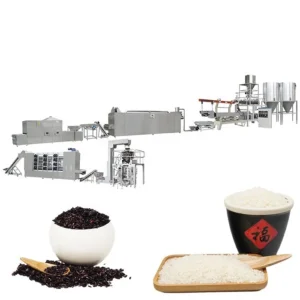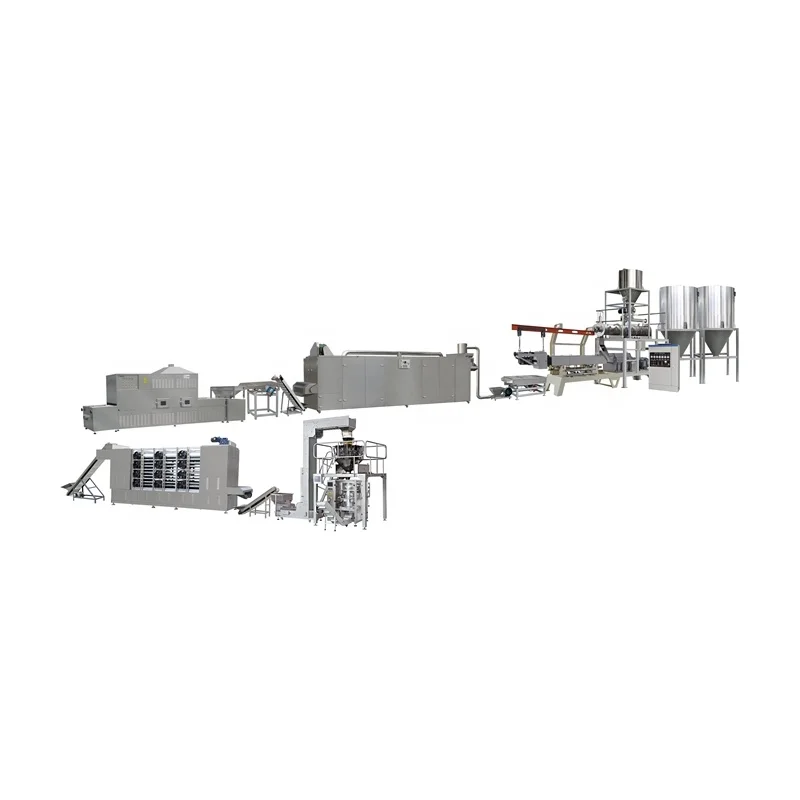
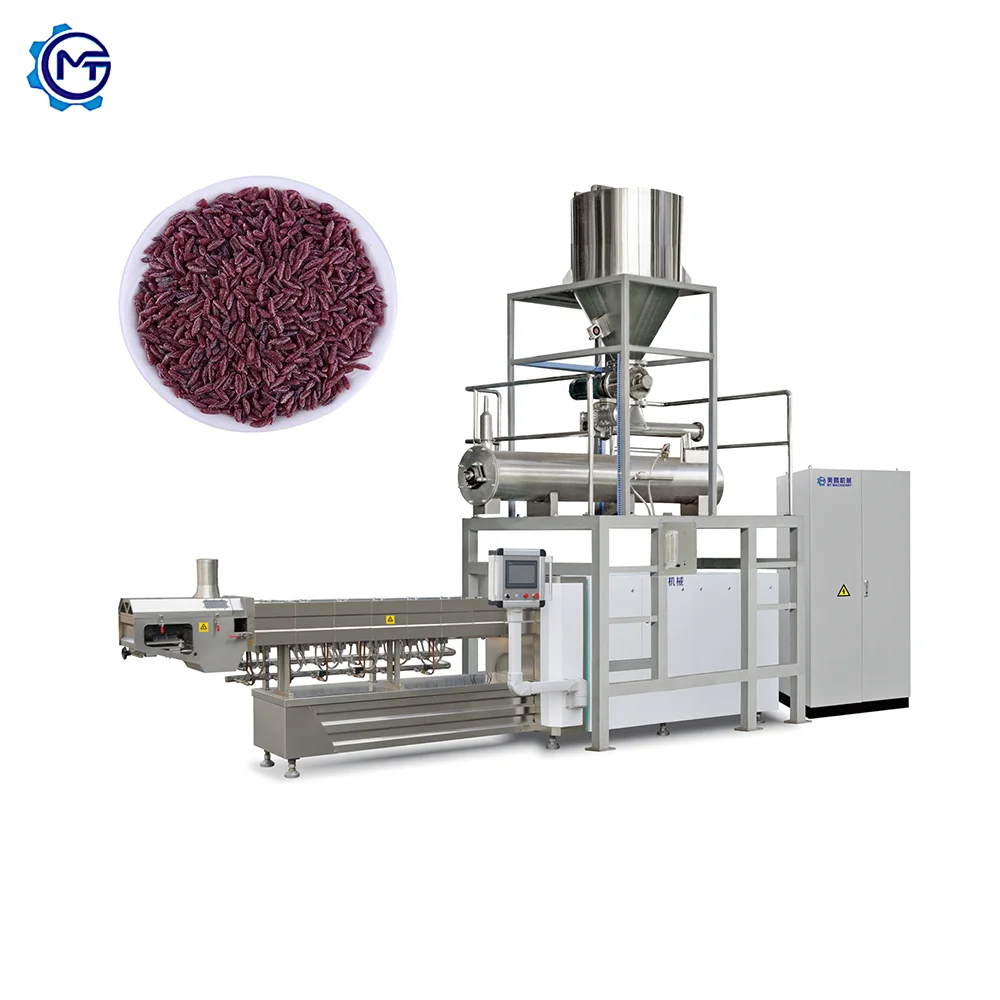


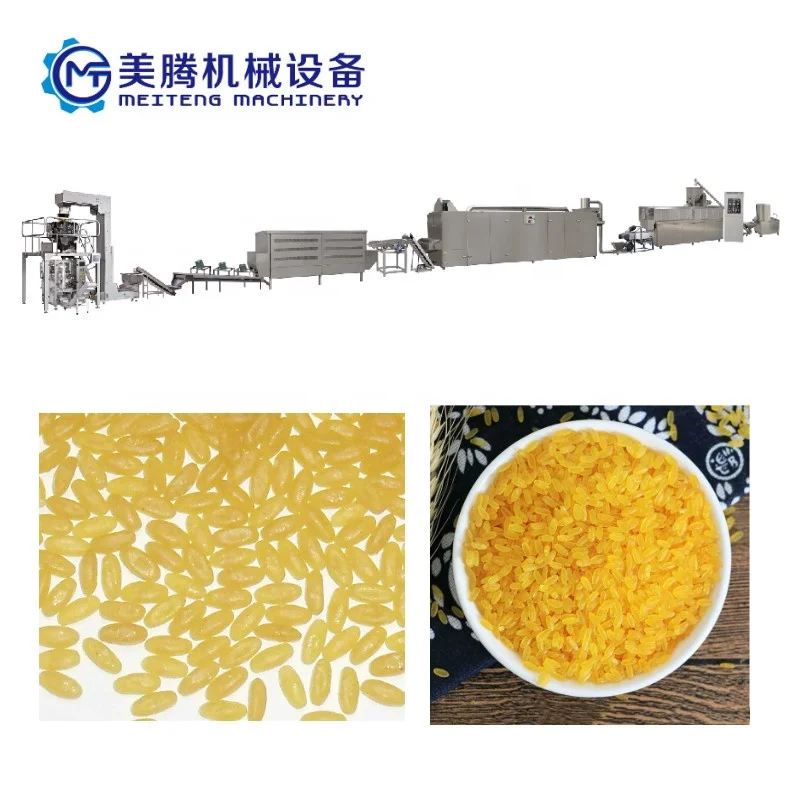

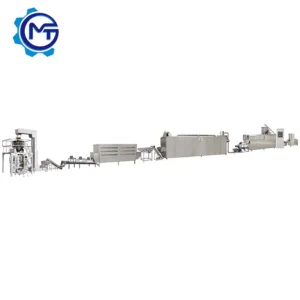
MT65, MT70, MT85, MT75, MT95 Fortified Rice Kernel Extrusion Line, Twin-Screw, 85–260 kW Installed Power — engineered as a complete turnkey project from batching through extrusion, drying, roasting and packing.
- Throughput matched across every station so no single machine bottlenecks the line, with screw configuration and die design specified to your raw material formulation
- Five capacity tiers enable phased scaling, validated by in-house trial runs on customer raw material before shipment
Description
Integrated Throughput Engineering — Every station in this fortified rice kernel production line turnkey is matched by calculation, not assembled from standalone vendors hoping capacities align.
Technical Specifications
| Parameter | Value |
|---|---|
| Product Type | Fortified Rice Kernel Extrusion Line |
| Models Available | MT65, MT70, MT85, MT75, MT95 |
| Installed Power | 85 kW (MT65); 120 kW (MT70); 235 kW (MT85); 180 kW (MT75); 260 kW (MT95) |
| Power Consumption | 60 kW (MT65); 85 kW (MT70); 165 kW (MT85); 135 kW (MT75); 195 kW (MT95) |
| Output Capacity | 80–100 kg/h (MT65) to 800–1000 kg/h (MT95) (basis not stated in source — confirm raw material formulation and moisture content) |
| Overall Dimensions | 28 × 1.2 × 2.2 m (MT65) up to 36 × 3.5 × 4.3 m (MT95) |
| Screw Type | Twin-screw |
| Feeding System | Single or double screw feeding, selectable based on material |
| Control System | Frequency speed control, automated operation |
| Screw Material | Special wear-resistant alloy |
| Lubrication & Cooling | Automatic lubricating and cooling system |
| Dryer Type | Multi-layer mesh belt with circulation drying |
| Dryer Heating Source | Electric or gas |
| Line Sequence | Mixing → Extruding → Vibrating → Low Temp Drying → Cooling → High Temp Roasting → Cooling → Packing |
Application Suitability
| Application | Material or Output |
|---|---|
| Fortified rice kernel production | Broken rice, rice flour, corn, millet blended with vitamin and mineral premixes |
| Artificial rice manufacturing | Rice, wheat, oats, buckwheat with added micronutrients |
| Nutritional grain reconstitution | Rice bran and broken rice reprocessed into uniform fortified kernels |
| Micronutrient-fortified food programmes | Starch and bean bases with iron, folic acid, and vitamin A formulations |
| Instant rice processing | Corn and wheat blends formulated for quick-cooking end products |
What "Nominal Capacity" Leaves Out About Your Actual Formulation
The capacity number on the quotation means nothing until it has been validated against the specific viscosity, protein content, and moisture level of your raw material blend.
I have stood on factory floors in West Africa watching a brand-new fortified rice kernel production line turnkey stall within the first hour of commissioning. The extruder was rated for a certain throughput on standard rice flour, but the buyer’s formulation included a heavy whey protein concentrate that raised torque demand past the motor’s safe operating range. Output dropped to a fraction of the nameplate figure, and every downstream station — the dryer, the roaster, the cooling conveyor — was suddenly oversized for the trickle of material reaching it. Fixing that line took over a week of reconfiguring screw elements and rebuilding the temperature profile section by section [NEED_CITE: torque loading behaviour of high-protein extrusion feeds].
How Station Throughput Matching Prevents Line Bottlenecks
When a fortified rice kernel production line turnkey is quoted as a collection of standalone machines, each vendor optimises for their own station. The extruder supplier quotes maximum barrel output; the dryer supplier quotes maximum evaporation rate. Those two numbers rarely align once your actual formulation enters the barrel. The sequencing from mixing through extruding, vibrating, low-temperature drying, cooling, high-temperature roasting, a second cooling stage, and finally packing must be calculated as a single continuous mass-flow equation. If the extruder pushes material faster than the mesh belt dryer can reduce moisture to a stable level, kernels accumulate, case-harden on the outside while remaining wet inside, and crack during roasting.
Utility Mapping Before the Foundation Is Poured
A complete fortified rice kernel production line turnkey drawing electrical power up to 260 kW on the largest model and running gas or electric dryers simultaneously demands a utility plan that accounts for peak simultaneous load, not just individual machine nameplates [NEED_CITE: industrial electrical load diversity factors for food processing plants]. Voltage and frequency must be locked to the destination market before the control panel is wired. Frequency speed control on every drive motor means the line can ramp between models, but only if the incoming supply matches the transformer and VFD specifications. I have seen commissioning delayed by days because a 50 Hz line was shipped to a 60 Hz site with no prior confirmation.
Reading the Screw, Die, and Dryer Specifications Together
The twin-screw extruder in this line uses a special wear-resistant alloy screw set with automatic lubricating and cooling, which matters directly when processing abrasive mineral premixes common in fortified rice programmes. The selectable single or double screw feeding system addresses a real material-handling problem: fine vitamin premixes bridge in single-screw feeders, while coarse broken rice flows freely. The multi-layer mesh belt dryer with circulation drying reduces moisture variance across the bed depth — a critical factor because unevenly dried kernels shatter during the high-temperature roasting stage. Overall dimensions ranging up to 36 × 3.5 × 4.3 m on the MT95 mean the building must accommodate not just floor area but also the vertical clearance for the multi-layer dryer and the roasting oven’s exhaust ductwork.
The Hidden Cost of Mismatched Line Stations
When the extruder is specified without matching dryer or roasting capacity, the line does not fail outright — it produces inconsistent product that passes visual inspection but fails moisture and shelf-life testing weeks later. Kernels that leave the dryer at slightly elevated moisture develop internal mould during storage. Kernels roasted at too high a throughput lose surface integrity and generate excess fines in the packing station. These problems do not show up during the factory acceptance test because the test runs on a standard formulation for a short duration [NEED_CITE: shelf-life failure modes in fortified rice kernel storage].
Why This Line Is Planned as One Project
Every station from batching to packing is supplied under a single responsibility, so throughput calculations are not passed between vendors who each optimise their own margin. Screw configuration and die design are specified to the buyer’s actual raw material formulation, not copied from a generic build. An in-house testing workshop runs trial production on customer-supplied raw material before the line ships, catching torque and moisture issues before they surface on a live factory floor. The five model ranges — MT65 through MT95 — allow phased capacity scaling so a buyer can start at 80–100 kg/h and add larger models later without replacing the downstream drying and roasting infrastructure. On-site installation includes operator training on the specific control system and frequency speed parameters of the delivered line.
Documentation & Verification
- Line layout and capacity calculation showing mass-flow balance across every station
- Screw and die configuration record matched to your raw material formulation
- Trial run report on customer-supplied raw material conducted before shipment
- Electrical schematic with voltage and frequency confirmed for destination market
- Operation and maintenance manual covering each station in the line sequence
Installation, Commissioning & Support
- Foundation plan sized to the MT95 footprint of 36 × 3.5 m with clearance for dryer height at 4.3 m
- Dedicated electrical circuit planned for peak simultaneous load up to 260 kW installed power
- Frequency speed control parameters set on-site to match local voltage and frequency supply
- First-run commissioning includes screw configuration validation on buyer’s actual raw material
- Operator training covers automated control system, lubrication system, and mesh belt speed adjustment
- Wear parts list provided for twin-screw elements and die plates with recommended replacement intervals
What We Need to Plan Your Line
To size the line correctly, provide your raw material formulation including the percentage of protein, starch, and micronutrient premix in the blend. Confirm the target daily output in kilograms of finished fortified kernels and the number of production shifts planned. Share the available floor area and ceiling height at the installation site, along with the local voltage, phase, and frequency specification so the control panel and heating elements can be configured before fabrication.
Frequently Asked Questions
Q: How is line capacity verified against my specific raw material formulation?
A: We run a trial production using your actual raw material in our in-house testing workshop before the line ships. Screw configuration, barrel temperature profile, and die selection are adjusted during the trial until output and kernel quality meet specification. A trial run report documenting throughput and product parameters is provided before dispatch.
Q: What utility planning is required for a complete fortified rice kernel line?
A: The line requires a dedicated electrical supply matching the installed power of the selected model, up to 260 kW on the MT95, plus gas or electric supply for the dryer and roaster. Voltage, phase, and frequency must be confirmed before the control panel is wired. We provide a utility requirement sheet with the line layout proposal.
Q: How is throughput matched between the extruder, dryer, and downstream stations?
A: Each station is calculated as part of a continuous mass-flow balance. The extruder output determines the moisture load entering the multi-layer mesh belt dryer, which in turn sets the throughput of the roasting and cooling stages. No station is specified in isolation — every capacity figure is cross-referenced against the others.
Q: What does the phased installation and commissioning schedule look like?
A: Equipment arrives in sections matching the line sequence. Mechanical installation proceeds from mixing through packing, followed by electrical connection and control system configuration. Commissioning begins with individual station dry runs, then progresses to full-line production on your raw material, with operator training conducted throughout.
Q: What operator training is included during on-site commissioning?
A: Training covers the automated frequency speed control system, screw and die changeover procedures, dryer mesh belt speed adjustment, and the automatic lubricating and cooling system maintenance schedule. Operators learn to read the control panel indicators for each station and to adjust parameters for different raw material formulations.
Related products
-
150-500kg/h Twin Screw Extruder Baby Rice Flour Making Machine
¥9,500.00 Select options This product has multiple variants. The options may be chosen on the product page -
Automatic Nutritional Powder Making Machine Safe Rice Cereal for Babies
¥30.00 Select options This product has multiple variants. The options may be chosen on the product page -

High Precision Automatic 500kg/h Baby Food Nutrition Powder Rice Extrusion Processing Line
¥8,238.27 Add to cart -

Hygienic Stainless Steel Infant Rice Powder Processing Line Automatic 500kg/h Capacity PLC Controlled
¥9,500.00 Add to cart