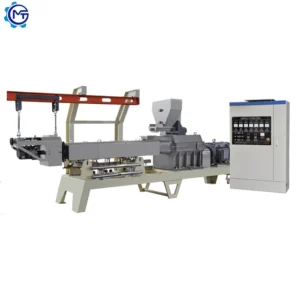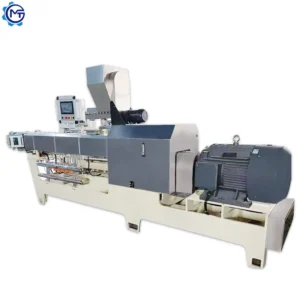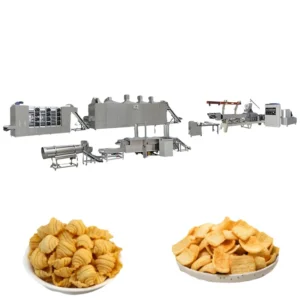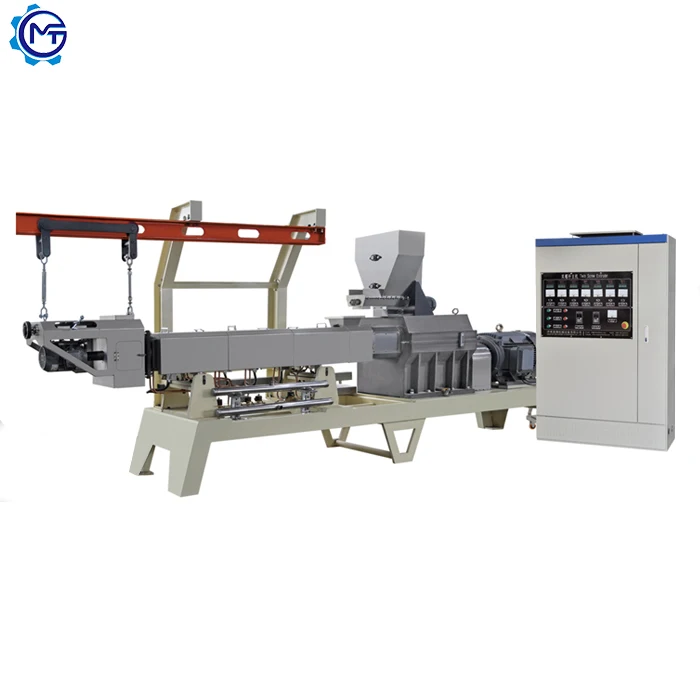
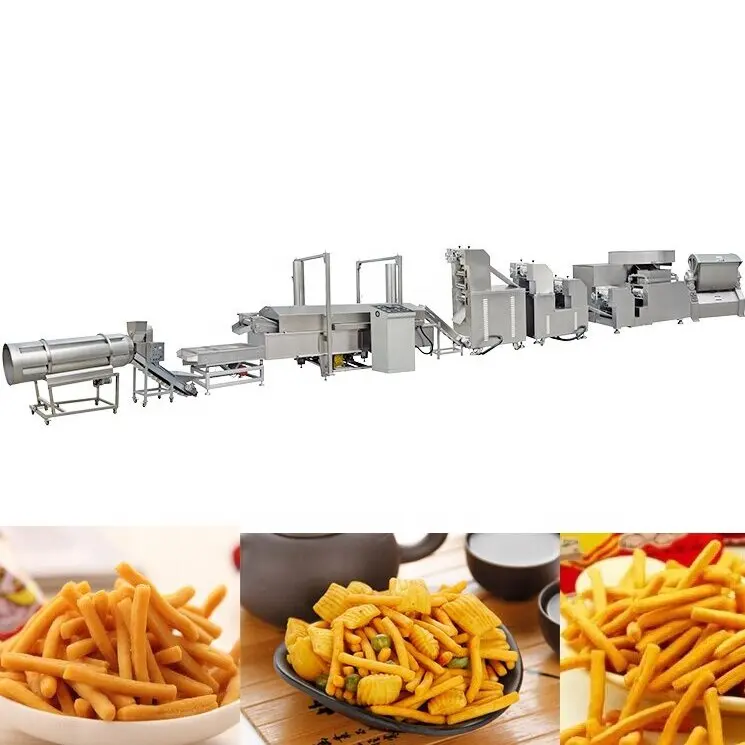

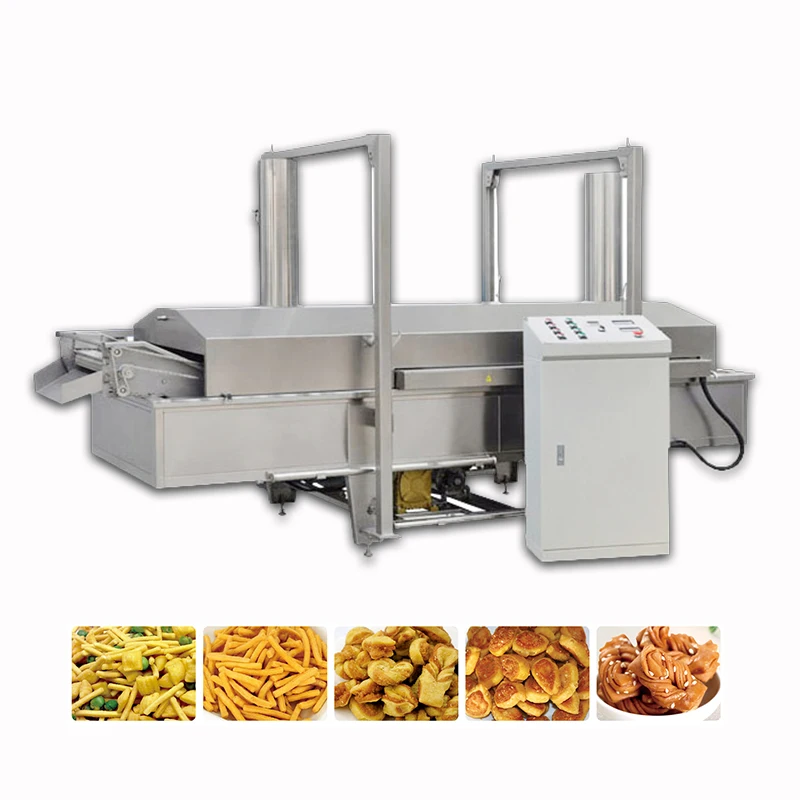


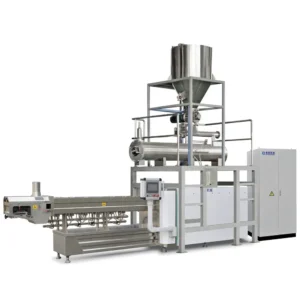
MT100/MT120 Single Screw Extruder Snack Production Line, 50-70 kW, Food-Grade SS 304 — designed for fried puffed snacks, vegetable rolls and secondary puffing formats using potato starch, corn starch or wheat flour.
- Die-adjustable shapes — screw shell, round tube, square tube, ring and cartoon profiles without changing the extruder
- Single screw with high/low pressure configuration expands raw material scope while controlling expansion and density through moisture and barrel temperature profiling
Trial runs on your exact formulation are completed in our in-house testing workshop before shipment, with screw configuration and die design matched to your target product texture and market specification.
Description
Throughput-Matched Line Design — Every station from mixer to cooling conveyor is capacity-balanced on this snack production line turnkey, preventing the bottlenecks that happen when extruders are paired with undersized fryers.
Technical Specifications
| Parameter | Value |
|---|---|
| Model | MT100/MT120 |
| Product Type | Single Screw Extruder Snack Production Line |
| Extruder Type | Single screw extruder (high and low pressure screw equipped) |
| Output Capacity | 120 kg/h (basis not stated in source — confirm raw material / moisture / product shape) |
| Rated Power | 50-70 kW (electricity); 50-60 kW (gas/diesel) |
| Voltage & Frequency | Three phases 380V/50Hz, Single phase 220V/50Hz (customizable to local voltage) |
| Overall Dimensions (L×W×H) | 12000-26000 × 1200 × 2200 mm |
| Energy Options | Electricity / gas / diesel / steam |
| Motor & Electrical | Siemens (China) or China top brand motor; Delixi or Delta inverter |
| Material of Construction | Food grade stainless steel 201/304 |
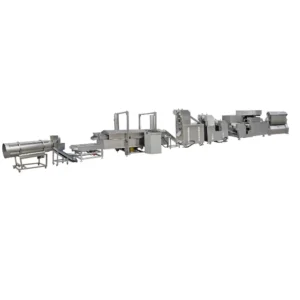
| Line Stations | Mixer → Screw conveyor → Single screw extruder → Pulling and cutting machine → Automatic fryer → Automatic flavoring line → Cooling |
| Product Shapes | Screw shell, round tube, square tube, ring, cartoon shapes (adjustable via dies) |
| Raw Materials | Potato starch, corn starch, wheat flour |
| Certification | CE / ISO 9001 |
| Warranty | One year |
Application Suitability
| Application | Material or Output |
|---|---|
| Fried puffed salad strips and vegetable rolls | Potato starch and vegetable powder blends |
| Secondary puffing snacks (golgappa / pani puri) | Corn starch and wheat flour formulations |
| Extruded snack shapes before frying | Potato starch, corn starch, wheat flour |
| Coated and flavored fried puffed snacks | Finished extrudates requiring oil and seasoning application |
What a Rated Capacity Figure Hides on a Snack Production Line Turnkey
A stated output only matters if it was measured on your raw material at your moisture level.
I once watched a line stall for three days because the trial ran on a standard starch blend while the buyer’s formulation carried a much higher vegetable powder ratio. The moisture balance shifted completely, the extrudate collapsed after cutting, and the fryer could not recover the structure. The snack production line turnkey you evaluate on paper behaves differently when your actual recipe enters the barrel. [NEED_CITE: impact of raw material moisture on single screw extrusion output]
Barrel and Screw Configuration for Starch-Based Extrusion
Single screw extruders rely heavily on the screw profile and barrel temperature gradient to gelatinise starch without burning it. The MT100/MT120 equips both high and low pressure screw options, which broadens the range of starch ratios the machine can process. This matters when a snack production line turnkey must switch between potato starch-heavy recipes and wheat flour blends across production runs.
Die Selection and Shape Changeover
The die plate determines whether you produce screw shells, round tubes, square tubes, rings, or cartoon shapes. Changing the die does not require swapping the extruder barrel or altering the screw. For buyers running multiple SKUs on one snack production line turnkey, this keeps changeover to a pulling and cutting adjustment rather than a full mechanical teardown. [NEED_CITE: die geometry influence on extrudate expansion and density]
Reading the Power and Voltage Table Correctly
The rated power spans 50-70 kW for electric heating and 50-60 kW for gas or diesel options. These figures cover the full line, not just the extruder motor. Buyers must confirm local three-phase voltage and frequency before production starts — a 380V/50Hz motor rewound for a 440V/60Hz market will run at different RPM, altering screw speed and residence time inside the barrel. The Delixi or Delta inverter provides speed control, but only within the frequency range the motor was wound for.
The Hidden Cost of Mismatched Station Capacity
When the fryer is sized below the extruder output, semi-finished product piles up on the cutting table, loses moisture, and enters the oil at inconsistent temperature. The result is uneven puffing and colour variation across batches. The same applies downstream: a flavoring drum that cannot keep pace forces the line to run below its extruder capacity. [NEED_CITE: throughput matching between extruder and downstream frying equipment]
Why Source the Complete Line from One Supplier
The MT100/MT120 line is designed as one system. Throughput between the mixer, screw conveyor, extruder, fryer, flavoring drum, and cooling conveyor is calculated together, so no single station throttles the others. The single-screw configuration with high and low pressure options means the extruder handles a wider formulation range without needing a second machine. Trial runs on your specific raw material take place in the testing workshop before shipment, so screw speed, barrel temperature, and die selection are set before the line reaches your floor. Stainless steel 201/304 contact surfaces throughout the line meet food-grade requirements and simplify washdown. Electrical schematics and voltage are confirmed against your facility supply before production begins, avoiding commissioning delays from incorrect motor winding or control language.
Documentation & Verification
- Line layout showing station spacing and throughput balance for MT100/MT120
- Trial run report on your starch formulation from the in-house testing workshop
- Screw and die configuration record matched to your target snack shape
- Electrical schematic confirming voltage, frequency, and inverter specification
- CE declaration of conformity and ISO 9001 certificate for the complete line
- Wear parts list covering screws, dies, and fryer baskets
Installation, Commissioning & Support
- Floor plan review accounting for the 12-26 m line length and 2.2 m height clearance
- Dedicated circuit provision for the 50-70 kW total power draw at confirmed voltage
- Extruder barrel alignment and screw insertion supervised on site during first assembly
- Barrel temperature profile and screw speed tuned to your raw material during commissioning
- Operator training covering die changeover, fryer temperature control, and daily washdown
- Spare screw and die sets identified from the wear parts list before first production run
What We Need to Prepare a Line Proposal
Share your raw material formulation, including starch type and any vegetable or protein powder ratios, along with the moisture content you typically mix to. Confirm your facility voltage, frequency, and available floor length for a 12-26 metre line. Let us know which product shapes you plan to run and whether you need a trial on your own material before shipment.
Frequently Asked Questions
Q: How is the 120 kg/h capacity verified, and on which raw material?
A: That figure is listed by the manufacturer without a stated basis for raw material, moisture content, or product shape. Before confirming the line, we run your actual formulation through the single screw extruder in our testing workshop and document the measured output. This trial report becomes the capacity baseline for your project, replacing the generic figure.
Q: How do you match fryer and flavoring drum capacity to the extruder?
A: Each station is selected so its maximum throughput equals or slightly exceeds the extruder output on your verified recipe. The fryer must handle the cut extrudate volume without product accumulation, and the flavoring drum must tumble the full batch within the cycle time. The line layout document shows these matched values before production begins.
Q: What voltage and control language are confirmed before production?
A: We request your facility electrical specification — phase, voltage, and frequency — and confirm it on the electrical schematic before the motor and inverter are sourced. The control language on the inverter interface is set to your preference at the factory, so operators read instructions in their working language from the first day of commissioning.
Q: Can I send my raw material for a trial before shipment?
A: Yes. You ship a sample of your starch blend to our testing workshop, and we run the MT100/MT120 on your exact formulation. The trial covers screw speed, barrel temperature, die selection, and cutting parameters. You receive a trial report with the output data and product samples before the line ships, so adjustments are made at the factory, not on your floor.
Related products
-
Automatic Fried Crispy Bugles Snacks Food Making Machines Wheat Flour Sala Food Extruder
¥100.00 Select options This product has multiple variants. The options may be chosen on the product page -
New Automatic Portable High Productivity Frying Salad Sticks Chips Snacks Food Production Line
¥100.00 Select options This product has multiple variants. The options may be chosen on the product page -
New Automatic 150-200kg/h Nimko Fried Pasta Snacks & Kurkure Making Machine Food Grade Stainless Steel High Productivity
¥8,585.00 Select options This product has multiple variants. The options may be chosen on the product page -
Frying Crispy 3D Corn Bugles Pellets Fried Chips Snacks Food Machine Production Line Bugles Making Extruder
¥100.00 Select options This product has multiple variants. The options may be chosen on the product page