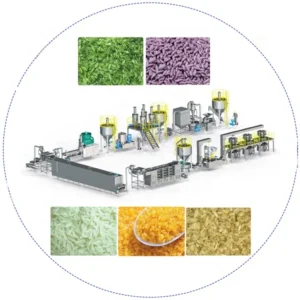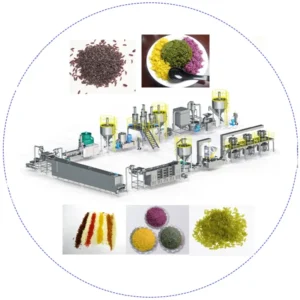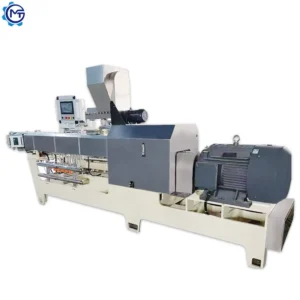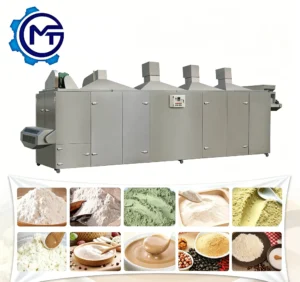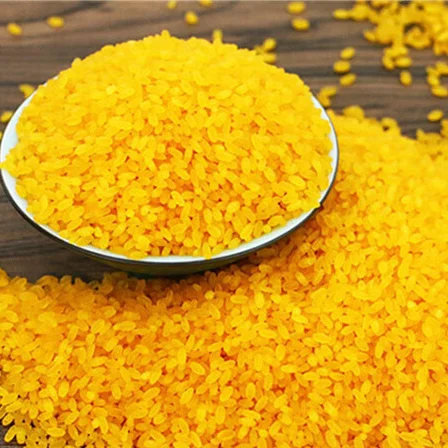
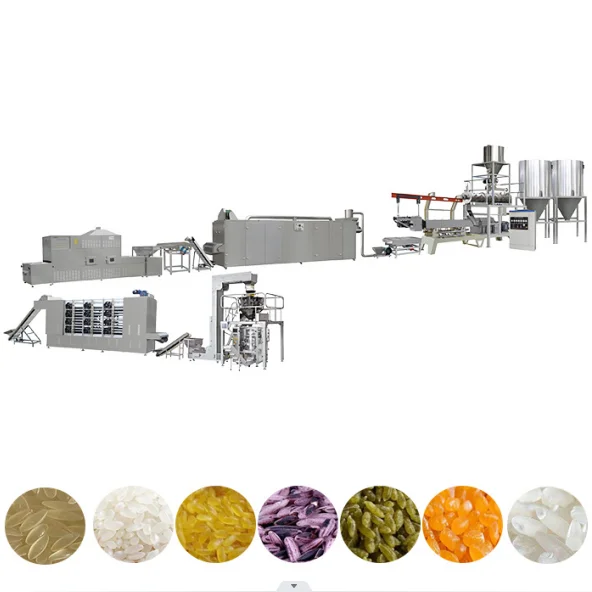

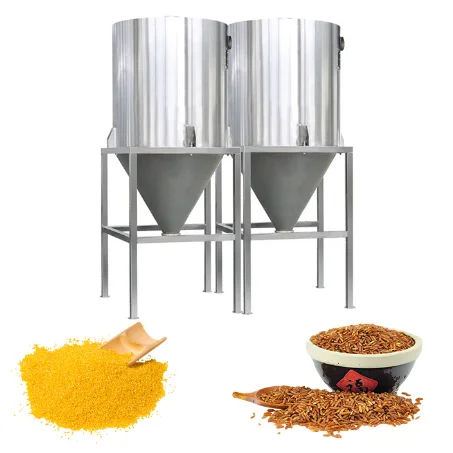
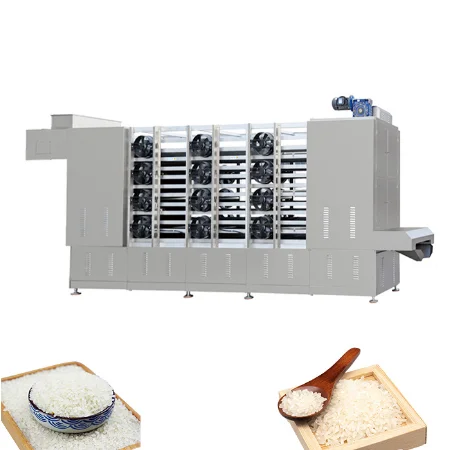

MT65, MT70, MT85, MT75, MT95 Fortified Artificial Rice Production Line, Twin-Screw Extrusion, CE Certified — complete turnkey system from batching through extruding, mesh belt drying, roasting and packing. Screw configuration and die design are matched to your grain blend and target kernel density, with throughput balanced across every station to prevent bottlenecks. Trial runs on your raw material are conducted in our testing workshop before shipment, with a full report provided for verification.
Description
Integrated Line Throughput — Every station from batching to packing is sized so the extruder output never waits on the dryer or roasting oven, verified during in-house trial runs on your actual grain formulation.
Technical Specifications
| Parameter | Value |
|---|---|
| Product Type | Nutritional Fortified Artificial Rice Production Line |
| Extruder Type | Twin-screw |
| Feeding System | Single or double screw feeding (selected per material) |
| Speed Control | Frequency inverter |
| Lubrication | Automatic |
| Cooling System | Integrated |
| Drying Oven Heating Source | Electric or gas |
| Drying Method | Circulation mesh belt drying |
| Production Procedure | Mixing → Extruding → Vibrating → Low temperature drying → Cooling → High temperature roasting → Cooling → Packing |
| Basic Materials | Broken rice, rice, corn, millet, wheat, oats, buckwheat, bean, starch, with vitamin and mineral additives |
| Final Products | Artificial rice, fortified rice kernels |
| Assembly State | Complete line (batching to packing) |
| Certification | CE |
Application Suitability
| Application | Material or Output |
|---|---|
| Fortified rice programmes | Broken rice and rice bran reprocessed with vitamin and mineral premixes |
| Artificial rice kernel production for retail | Corn, millet, wheat, oats or buckwheat reconstituted into rice-shaped kernels |
| Institutional nutrition supply | Grain blends fortified with micronutrients for school feeding and relief programmes |
| Value-added grain processing | Starch-rich raw materials converted into shelf-stable, quick-cooking rice formats |
What "Rated Capacity" Leaves Out About Your Grain Blend
A production rate on paper means nothing when your actual millet-to-rice ratio shifts the extrusion window.
I spent five days on a site in Vietnam watching a nutritional powder processing line struggle because the trial ran on standard rice flour while the customer’s real formula used a high-fibre buckwheat blend. The screw speed, feed rate and barrel temperatures all had to be reworked from scratch. With a Fortified Artificial Rice Production Line Turnkey, the mismatch shows up as uneven kernel density — some grains sink during cooking while others float, and the nutritional premix distributes unevenly across the batch [NEED_CITE: extrusion behaviour variation across grain starch profiles]. That is why we run your exact formulation in our testing workshop before the line leaves the factory.
Screw Configuration and Die Design for Grain-Specific Extrusion
The twin-screw extruder at the heart of this Fortified Artificial Rice Production Line Turnkey is configured after we analyse your raw material blend. Starch gelatinisation temperature, protein content and fibre ratio all change how the material behaves inside the barrel. Screw element arrangement — kneading blocks, reverse elements and conveying sections — is specified to hold the correct residence time and shear profile for your formulation. The die plate opening diameter and land length are matched to produce a kernel that holds its shape through drying and roasting without cracking or collapsing.
Throughput Matching Across Every Station
An extruder running at full output is worthless if the downstream dryer cannot remove moisture fast enough. Each station on this line — mixer, feeder, extruder, vibrating conveyor, low-temperature dryer, cooler, high-temperature roasting oven, second cooler and packing station — is sized so material flows without accumulation or starvation [NEED_CITE: line balancing principles in continuous food extrusion]. The circulation mesh belt dryer uses adjustable belt speed and zone temperature to bring kernel moisture down uniformly before roasting. If the roasting oven falls behind, kernels over-dry in the dryer and fracture during handling.
Reading the Specifications Against Your Production Target
The available extruder models — MT65, MT70, MT85, MT75 and MT95 — span from small-batch pilot runs to high-volume production. Installed power ranges from 85 kW on the MT65 to 260 kW on the MT95, and overall line length extends from 28 m to 36 m. Output capacity values in the specification sheet are recorded without a stated raw material or moisture basis, so they must be confirmed against your specific grain blend before the line is configured. The frequency inverter on the main drive lets operators fine-tune screw speed during commissioning, and the automatic lubrication system supports extended production runs without manual greasing intervals that interrupt output.
The Hidden Cost of Skipping the Trial Run
Lines shipped without a formulation-specific trial often require weeks of on-site adjustment. Operators change screw speed, feed rate and barrel temperature zones one variable at a time, burning raw material and producing off-spec kernels that cannot be sold. In humid climates, moisture content in the incoming grain may differ from the supplier’s assumption, pushing the gelatinisation point higher and leaving kernels undercooked inside [NEED_CITE: moisture variation in tropical grain storage and its effect on extrusion]. The cost is not only wasted material — it is delayed market entry and lost contract fulfilment windows.
Why Source This Line From One Supplier
Every station is engineered under one roof, so the extruder output, dryer capacity and roasting oven dwell time are calculated together rather than assembled from separate vendors. Screw configuration and die design are specified to your grain formulation, not copied from a generic build. The in-house testing workshop runs your actual raw material before shipment, producing a trial report that documents the parameters your operators will use on day one. Electrical schematics confirm voltage, frequency and control language for the destination country before production begins. CE-certified construction meets machinery directive requirements for international project sites [NEED_CITE: CE machinery directive compliance for food processing equipment].
Documentation & Verification
- Line layout and capacity calculation showing throughput at each station from mixer to packer
- Trial run report on your grain blend conducted in our testing workshop before dispatch
- Screw and die configuration record matched to your raw material and kernel density target
- Electrical schematic with voltage, frequency and control language confirmed for your facility
- Operation and maintenance manual covering daily checks, lubrication intervals and wear part replacement
- Packing photographs and customs documentation support for international shipment
Installation, Commissioning & Support
- Foundation plan accounts for the full line footprint up to 36 × 3.5 × 4.3 m and utility routing
- Power supply sized to installed capacity up to 260 kW with dedicated circuit breakers per station
- Equipment arrives in sectioned modules for staged assembly inside existing factory buildings
- Commissioning engineers set screw speed, barrel zones and dryer belt speed using your trial run parameters
- Operator training covers start-up sequence, emergency stop procedures and daily cleaning protocol
- Wear parts list identifies screws, dies and mesh belt sections with recommended replacement intervals
What We Need to Configure Your Line
Provide the grain types and blending ratios you plan to run, along with the target kernel size and cooking behaviour. Confirm your facility voltage, frequency and preferred control panel language. Share your available floor space and ceiling height so the layout can be drafted to fit, and let us know whether you need electric or gas heating for the drying and roasting ovens.
Frequently Asked Questions
Q: How is line capacity verified against my specific grain blend and moisture level?
A: We run your exact raw material formulation in our testing workshop before the line ships. The trial records screw speed, feed rate, barrel temperature profile and drying time needed to produce kernels that meet your density and cooking specifications. You receive a full trial report, and those parameters become the baseline for on-site commissioning.
Q: What voltage, frequency and control language options are confirmed before production?
A: We confirm your facility’s voltage and frequency during the specification stage and design the electrical system accordingly. Control panel language is set to match your operators’ preference. Electrical schematics are reviewed and approved before the line enters production, preventing commissioning delays caused by mismatched power supply or unreadable HMI screens.
Q: How are screw configuration and die design matched to my raw material?
A: Our engineers review your grain blend composition — starch type, protein content, fibre ratio and moisture — then select screw element arrangement and die geometry to achieve the correct gelatinisation, expansion and kernel shape. This configuration is documented and shipped with the line so replacements can be ordered identically when wear parts are due.
Q: How is throughput balanced between the extruder, dryer and roasting stations?
A: Each station is sized based on the extruder’s verified output on your material. Dryer belt length, zone temperature and airflow are calculated to remove moisture at the rate the extruder delivers product. The roasting oven dwell time is matched so kernels reach target colour and texture without queueing, eliminating bottlenecks that force the extruder to idle.
Related products
-
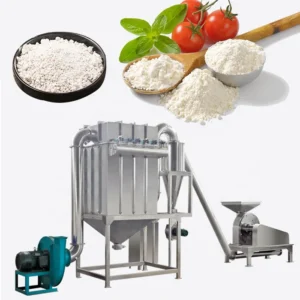
New Automatic Nutritional Powder Making Machine for Baby Food Production Line
¥20.00 Select options This product has multiple variants. The options may be chosen on the product page -
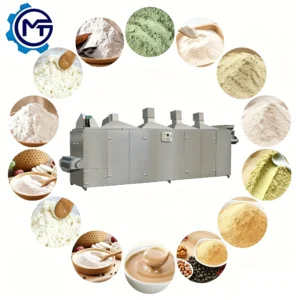
Commercial Stainless Steel Baby Rice Powder Grinding Mixing Machine
¥8,238.27 Select options This product has multiple variants. The options may be chosen on the product page -

High Quality Automatic PLC Controlled 500kg/h Twin Screw Extruder Machine for Baby Rice Nutrition Powder
¥8,238.27 Add to cart -
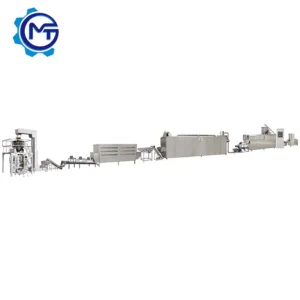
Automatic Nutritional Powder Making Machine Safe Rice Cereal for Babies
¥30.00 Select options This product has multiple variants. The options may be chosen on the product page