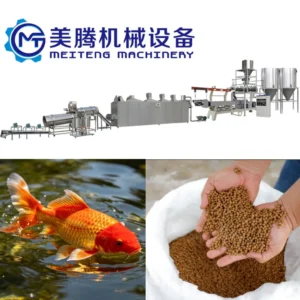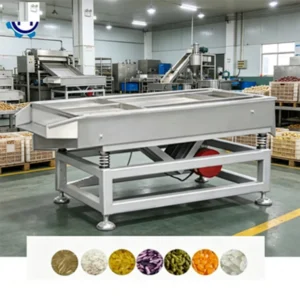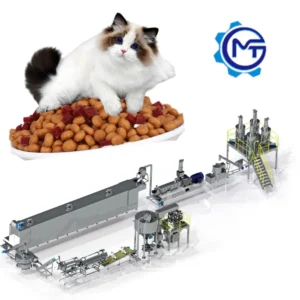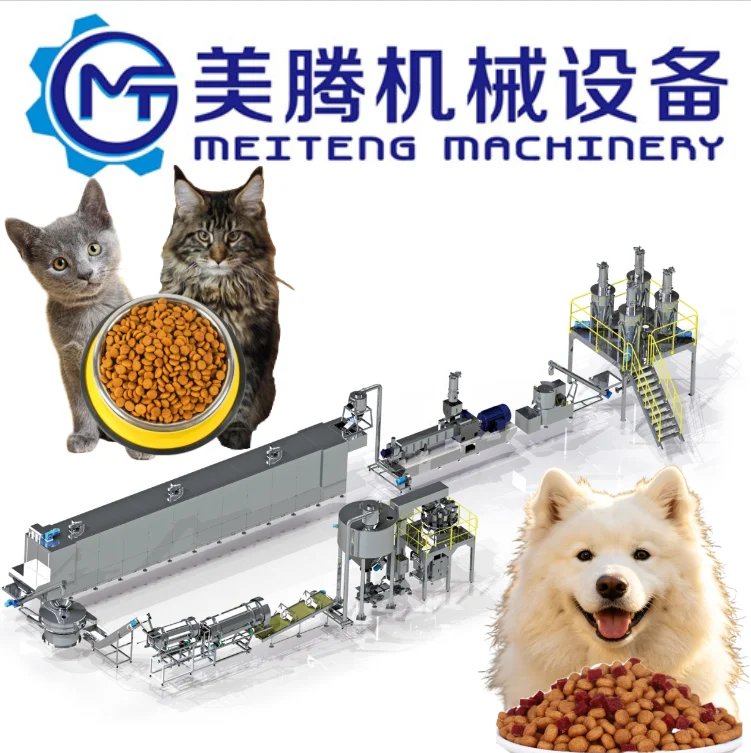

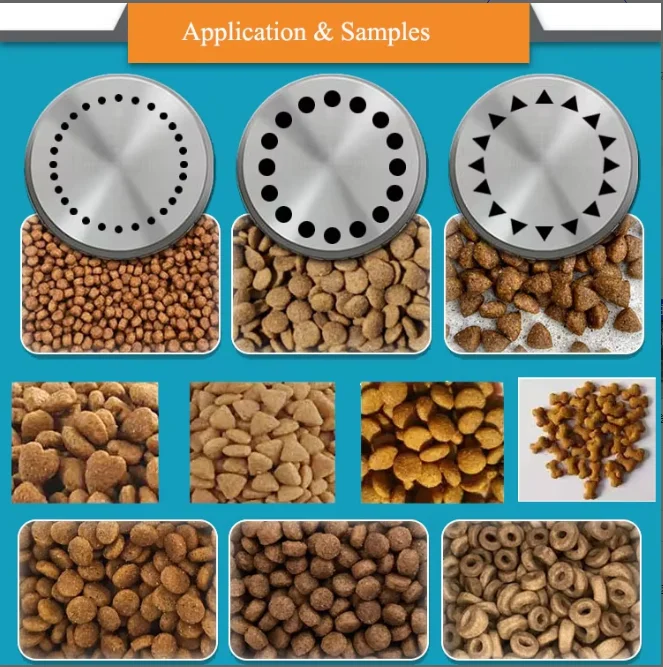


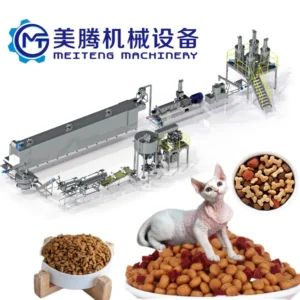
Pet Food Extrusion Production Line, 150 kg/h – 3 T/h Output, Fully Automated — configured for dry kibble, semi-moist, and treat formats across dogs, cats, birds, fish, and cattle feed applications.
Designed as a single-responsibility turnkey project, this line integrates batching, extrusion, drying, and packaging with throughput matched at every station. Screw configuration and die design are specified to your raw material formulation, ensuring target density and texture from the first production run.
Each project includes an in-house trial run on your actual raw material before shipment, complete with layout documentation and capacity verification across all stations.
Description
Integrated Turnkey Line Engineering — Single-source responsibility for throughput matching from batching through packaging, verified on your raw material before dispatch.
Technical Specifications
| Parameter | Value |
|---|---|
| Product Type | Pet Food Extrusion Production Line |
| Output Capacity | 150 kg/h – 3 T/h (basis not stated in source — confirm raw material formulation, moisture content and kibble size) |
| Automation Level | Fully automated from mixing, extrusion, drying to packaging |
| Control System | Advanced sensors and precision controls (PLC / MCC options available) |
| Line Stations | Mixing, extrusion, drying, packaging |
| Recipe Adaptability | Dry kibble, semi-moist pet food, treats |
| Energy Design | Energy-saving technologies integrated |
| Maintenance Design | Modular components for quick cleaning |
| Material Standard | Food-grade materials throughout contact zones |
| Configuration Flexibility | Customizable capacity and layout |
| Certification | CE, FDA compliant |
Application Suitability
| Application | Material or Output |
|---|---|
| Dry kibble for dogs and cats | Corn, poultry meal, fish meal, grain blends |
| Semi-moist pet food formulations | High-moisture meat slurries with starch binders |
| Extruded treats and bites | Protein concentrates, flavoring compounds |
| Bird feed pellets | Seed meals, millet, vitamin-fortified blends |
| Aquatic feed for fish | Floating or sinking formulations with fish meal and soy |
| Cattle supplement pellets | Grain-based nutritional concentrates |
What "Nominal Capacity" Actually Means on a Pet Food Line
A rated throughput figure means nothing until it is validated against the protein, fat, and starch ratios in your specific recipe.
I remember standing at a trade show in Frankfurt when a buyer from Eastern Europe showed me photos of his extruder sitting idle. The machine was rated for a certain hourly output, but his recipe used a high-fat meat meal blend that the standard screw configuration could not handle. The barrel temperatures spiked, the die clogged every few hours, and the kibble came out half-expanded. The supplier had quoted capacity based on a generic corn-starch test, not the buyer’s actual formulation. This happens far more often than buyers expect when sourcing a pet food extrusion production line turnkey from suppliers who skip pre-shipment trials [NEED_CITE: common causes of extruder downtime in pet food plants].
Throughput Matching Across Every Station
A complete pet food extrusion production line turnkey is only as fast as its slowest station. When the extruder pushes product faster than the dryer can reduce moisture to shelf-stable levels, kibble piles up, cools unevenly, and invites mold growth downstream. Our approach maps the dryer residence time, cooler airflow, and packaging speed against the extruder output under your actual recipe conditions, so no single station becomes a bottleneck. Each segment is sized as part of the overall system rather than selected from a standalone catalog.
Layout Planning for Real Factory Footprints
Factory floors rarely match the idealized rectangles in brochure drawings. Columns, drain trenches, existing conveyors, and ceiling heights all constrain where a pet food extrusion production line turnkey can sit. We work from your actual building dimensions to arrange the mixing, extrusion, drying, and packaging stations in a continuous flow that respects operator walkways and maintenance access. Phased installation schedules allow partial commissioning so existing production does not stop while new sections come online [NEED_CITE: industrial plant layout standards for food processing facilities].
Reading the Specs That Matter Most
Screw type and configuration determine how your raw material is sheared, heated, and expanded inside the barrel. A twin-screw setup handles high-fat, high-moisture recipes that would stall a single-screw design, while the length-to-diameter ratio controls how long the material stays under heat and pressure — directly affecting starch gelatinization and final kibble density. Die design governs shape, size, and expansion ratio at the exit point. The control system maintains barrel temperature zones and screw speed within tight bands so that batch-to-batch texture stays consistent. Voltage and frequency must match the installation site; a machine wired for 380 V / 50 Hz will not start on a 440 V / 60 Hz supply without transformer intervention, a detail that still catches buyers off guard during commissioning.
The Hidden Cost of Mismatched Line Components
When extruder output exceeds dryer capacity, semi-moist kibble enters the packaging stage above safe moisture thresholds, leading to spoilage claims weeks after shipment. I have seen coaters sized for a lower throughput leave flavoring unevenly distributed, producing off-spec product that the buyer’s retail partner rejects. These mismatches rarely appear in a quotation until the line runs under real load, which is why we verify each station against the full recipe before the equipment leaves our workshop [NEED_CITE: quality rejection causes in finished pet food products].
Why Source the Full Line from One Supplier
Throughput matching is calculated across every station — mixer output, extruder capacity, dryer residence time, and packaging speed — under one engineering scope rather than split among separate vendors pointing blame at each other. Screw and die configurations are specified against your raw material and target kibble density before production begins. Every line undergoes a trial run in our in-house testing workshop using your actual formulation, so product development happens before shipment, not during commissioning. We handle layout design, utility planning, installation supervision, and operator training as a single project timeline. Documentation — from electrical schematics to wear parts lists — is issued as one coordinated package tied to your line configuration [NEED_CITE: turnkey project delivery standards for food processing lines].
Documentation & Verification
- Line layout drawing with station throughput calculations matched to your recipe
- Trial run report generated on your raw material in our testing workshop
- Screw and die configuration record tied to your target kibble density
- Electrical schematic with voltage and frequency confirmed for your site
- Operation and maintenance manual covering all line stations
- Wear parts list with replacement intervals for screws, dies, and seals
Installation, Commissioning & Support
- Foundation plan aligned to extruder weight and vibration isolation requirements
- Dedicated power circuit sized for full-line motor load and control system
- Modular station design allowing phased assembly in constrained factory spaces
- First-run parameter tuning on your raw material with our commissioning engineer on site
- Operator training covering recipe changeover, screw swaps, and safety interlocks
- Wear parts kit supplied for the initial replacement cycle of screws and dies
What We Need from You to Start
To configure a line that fits your production target, share your raw material formulation with moisture and protein percentages, the kibble shapes and sizes you plan to run, and your daily output goal. We also need your factory floor dimensions, ceiling height, local voltage and frequency, and the preferred language for the control interface. If you are replacing or extending an existing line, tell us which upstream or downstream equipment will remain so we can match connection points.
Frequently Asked Questions
Q: How is line capacity verified against my specific raw material formulation?
A: We conduct a trial run in our in-house testing workshop using your actual raw material and target recipe. The results — including extruder screw speed, barrel temperature profile, and kibble density measurements — are documented in a trial run report shared with you before shipment, confirming achievable throughput under your conditions.
Q: What does the installation and commissioning schedule look like?
A: After the line arrives on site, our engineer supervises station-by-station assembly, utility connections, and initial dry runs. Commissioning then proceeds through wet runs with your raw material, parameter tuning, and operator training. The schedule is phased so that existing production areas remain operational where possible.
Q: How do you prevent bottlenecks between the extruder, dryer, and coater?
A: Each station is sized based on the extruder output validated during the trial run on your recipe. Dryer belt length, airflow volume, and coater drum capacity are all calculated to handle peak throughput without product backlog, ensuring the line runs as a balanced system.
Q: What training and documentation are included at handover?
A: Operators receive hands-on training covering daily startup, recipe changeover procedures, screw and die replacement, and safety protocols. You receive an operation manual, electrical schematics, a wear parts list, and the full trial run report for your records.
Q: How are spare wear parts handled for the first replacement cycle?
A: A wear parts kit covering screws, dies, and seals is supplied with the initial shipment. The wear parts list specifies replacement intervals based on your recipe abrasiveness, and we keep matched tooling on file so reorder lead times stay short.
Related products
-
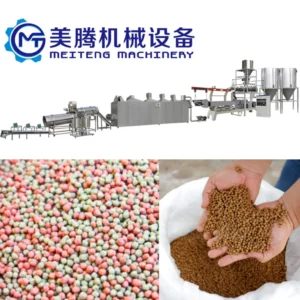
2-3t/h High Capacity Multi-Species Fish Feed Processing Line to Produce Fish Food
¥55,000.00 Select options This product has multiple variants. The options may be chosen on the product page -
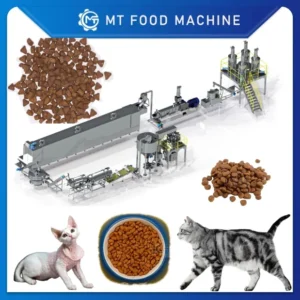
MT100 Brand 1.5-2.0t/h PLC Controlled Multi-Species Cat Food Processing Line
¥45,000.00 Select options This product has multiple variants. The options may be chosen on the product page -
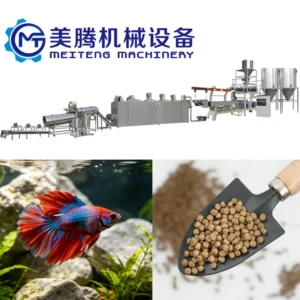
1.0-1.2t/h High Capacity Multi-Species Fish Feed Processing Line to Produce Fish Food
¥45,000.00 Select options This product has multiple variants. The options may be chosen on the product page -
MT70 100-200kg/h Dog & Cat Pet Food Processing Line with 380V 50Hz Three Phase Power
¥35,000.00 Select options This product has multiple variants. The options may be chosen on the product page