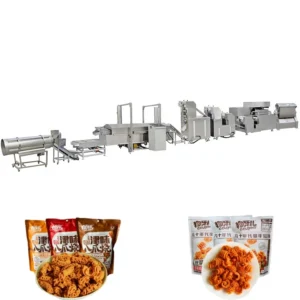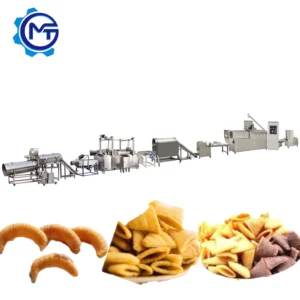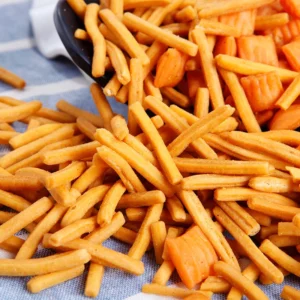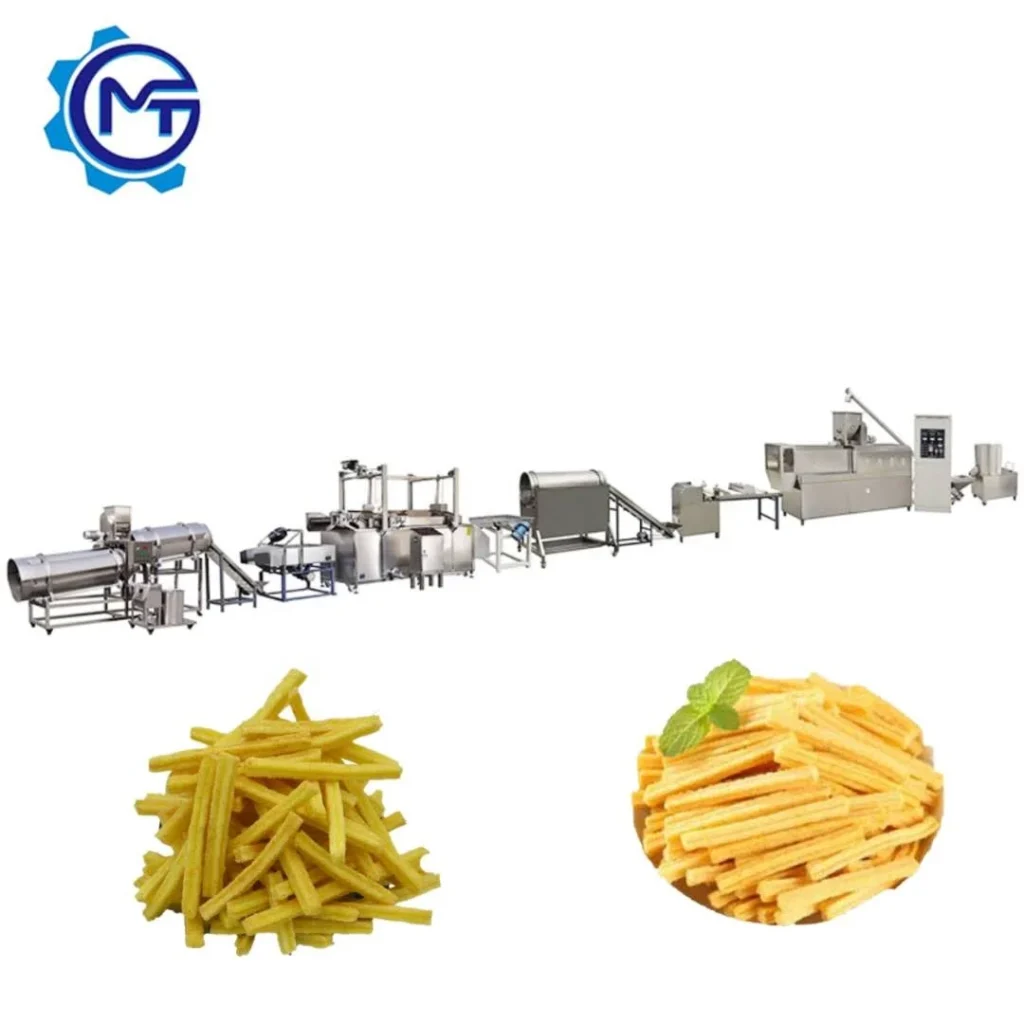
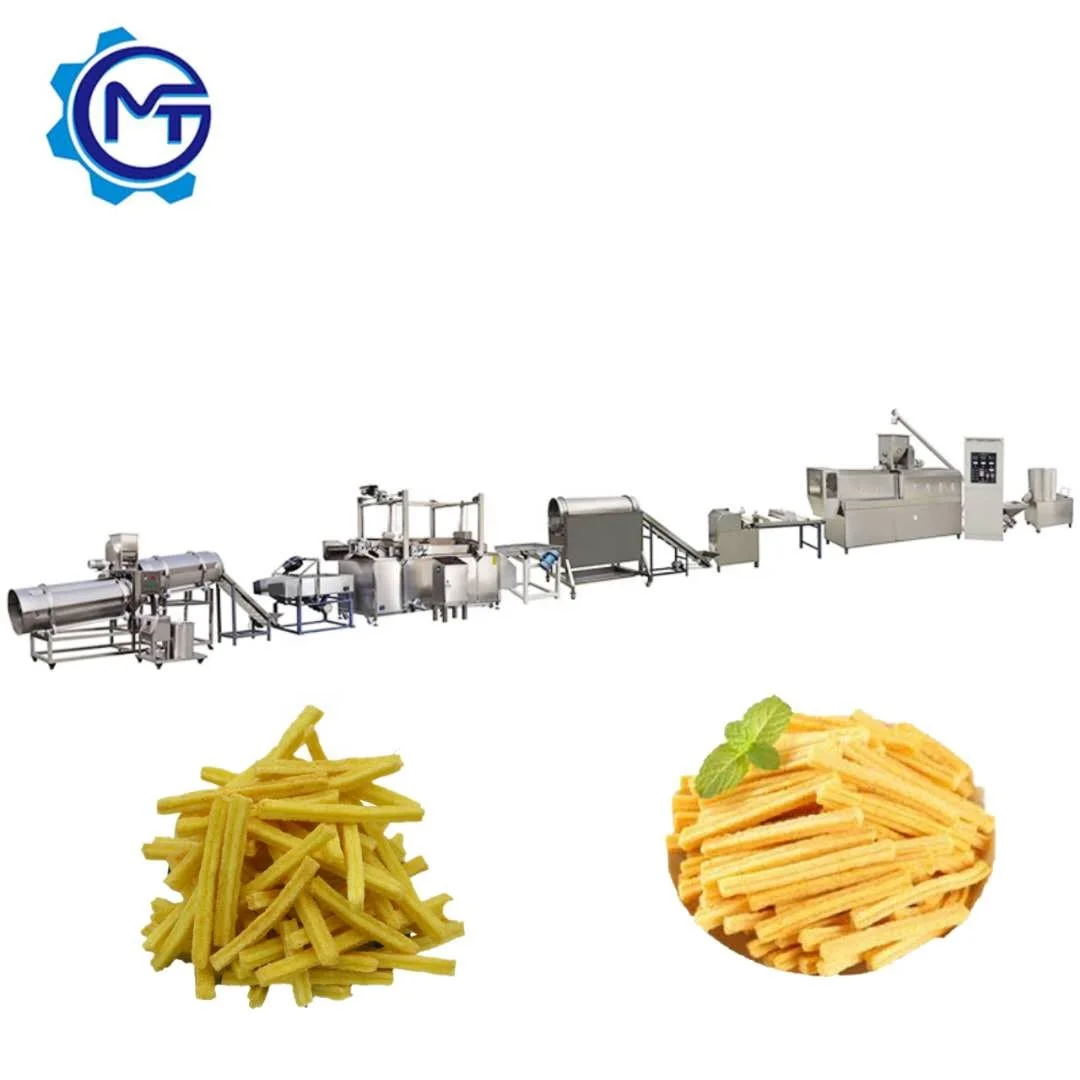

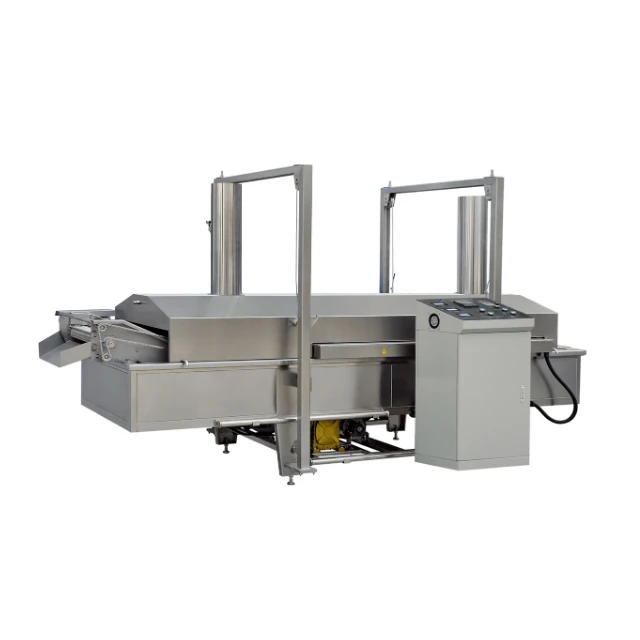

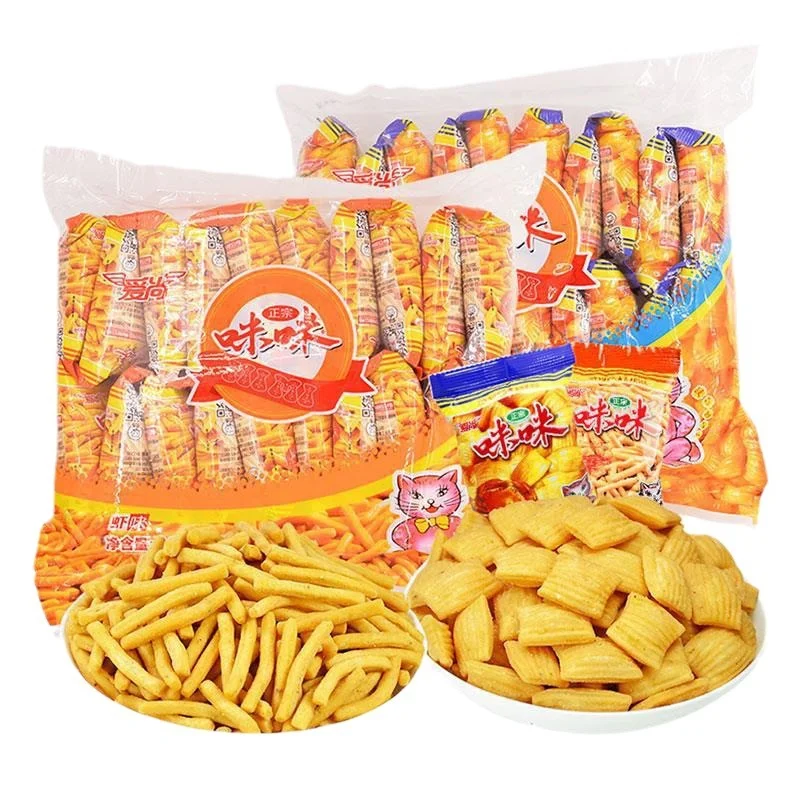

Fried Snack Food Processing Line, Twin-Screw Extrusion, 380V/50Hz, PLC Control — integrated from mixing through extrusion, cutting, frying and flavoring with every station throughput-matched as one turnkey project. Screw configuration and die design are specified to your raw material and target product texture, while voltage, frequency and control language are confirmed before production begins.
- Line layout, capacity calculation and trial run on your raw material conducted before shipment, with matched throughput at each station
Description
Integrated Throughput Matching — Every station from mixer to flavoring drum is sized to the same line capacity, so the fryer never waits on the extruder and the seasoning drum never overflows.
Technical Specifications
| Parameter | Value |
|---|---|
| Product Type | Fried Snack Food Extrusion and Frying Production Line |
| Screw Type | Twin-screw (extrusion stage) |
| Voltage & Frequency | Three phases 380V/50Hz; Single phase 220V/50Hz (customizable to local voltage) |
| Control System | Available with PLC or MCC control (configuration to be confirmed) |
| Line Sequence | Mixer → Extruder → Cutting Machine → Fryer → Flavoring Machine |
| Fryer Rated Power | 60 kW |
| Flavoring Drum Power | 0.37 kW |
| Output Capacity | Basis not stated in source — throughput to be confirmed against raw material and product format |
| Assembly State | Complete multi-station line |
| Certification | CE (electronic edition available on request) |
Application Suitability
| Application | Material or Output |
|---|---|
| Rice crust chips | Wheat flour, rice flour blends |
| Bugles and horn-shaped snacks | Corn grits, corn flour |
| Pillow-shaped puffed snacks | Wheat-corn composite flour |
| Mini fried puffed snacks | Grain-based raw materials with adjustable moisture |
What "Turnkey" Actually Means for Your Fried Snack Food Production Line Turnkey
A turnkey project is not a bundle of machines shipped together — it is a line where every station arrives already matched to the same throughput target.
I have stood on factory floors in Guadalajara watching an undersized flavoring drum choke on output that a perfectly capable extruder pushed through without effort. The extruder ran fine; the drum could not keep up. The operator had to slow the entire line down, and the daily output fell far below the number on the quotation. That kind of mismatch is exactly what a properly scoped fried snack food production line turnkey project eliminates before the first container leaves the workshop [NEED_CITE: throughput balancing methodology for multi-station snack lines].
Layout and Station-by-Station Capacity Planning
The sequence runs from raw material mixing through twin-screw extrusion, precision cutting, continuous frying, and rotating-drum flavoring. Each station is specified not as a standalone unit but as a node in a single throughput calculation. When the extruder is configured for a given screw speed and die opening, the downstream fryer belt speed and the flavoring drum rotation rate are set to absorb that exact output. No buffer pile-ups, no idle stations.
Electrical and Control Integration Across Stations
Voltage and frequency are confirmed for the destination country before production begins. Whether the factory runs on 380V/50Hz three-phase or a different local standard, every motor, heating element, and control panel on the fried snack food production line turnkey project is wound and wired to match. The PLC or MCC cabinet ties all stations into a single control point so operators start, stop, and monitor the line from one interface rather than walking to each machine [NEED_CITE: industrial voltage and frequency standards by export market].
Twin-Screw Extrusion and Die Design for Fried Snack Textures
The twin-screw extruder is the stage where product identity is formed. Screw element arrangement — conveying, kneading, and reverse-flight sections — controls shear and residence time inside the barrel. For a rice crust chip that needs a dense, crisp bite after frying, the screw profile keeps expansion moderate and moisture uniform. For a Bugle that must hollow out and curl, the die geometry and post-die cutting work together to set wall thickness before the product ever reaches the fryer. Getting this wrong means the oil absorption rate shifts and the final texture misses the market benchmark.
Fryer Sizing and Oil Management for Consistent Color and Crunch
The 60 kW fryer is rated to handle the line’s peak output while maintaining oil temperature within a narrow band. Recovery rate matters: when cold, cut dough pieces enter the oil, they pull heat out fast. If the heating capacity is too low, oil temperature drops and the snacks absorb excess oil instead of forming a crisp shell. Adequate kW rating and proper oil circulation keep the frying cycle stable, so color and crunch stay consistent from the first batch to the last [NEED_CITE: oil temperature recovery requirements for continuous snack fryers].
The Cost of Skipping the Raw-Material Trial Run
I once spent an extra week at a plant in central Mexico because the customer switched from standard wheat flour to a local corn-meal blend after the line was built. The extrusion expansion collapsed, and the frying curve had to be rebuilt from scratch. Running the buyer’s actual raw material in the testing workshop before shipment catches these mismatches early. Screw configuration, barrel temperature profile, and die selection can all be adjusted while changes are still cheap — on the workshop floor, not on the customer’s floor with a commissioning clock ticking.
Why Source the Entire Fried Snack Line from One Project Supplier
Screw configuration and die design are specified to the buyer’s raw material and target product, not copied from a generic template. Line layout and capacity calculations are delivered as a single document covering every station, so contractors can plan utility drops and floor space without guessing. An in-house testing workshop allows trial runs on the buyer’s actual grain blend before any equipment is crated. Pre-sales engineering, phased installation, on-site commissioning, and operator training are scheduled as one continuous project timeline rather than disconnected service calls. Electrical schematics and voltage confirmations are documented before production, preventing the kind of wiring delays that stall startups.
Documentation & Verification
- Line layout drawing with matched throughput at every station
- Screw and die configuration record for your grain blend
- Trial run report on your raw material before dispatch
- Electrical schematic confirming local voltage and frequency
- CE declaration of conformity for the complete line
- Operation and maintenance manual with wear parts list
Installation, Commissioning & Support
- Foundation plan showing floor load and drainage for the 60 kW fryer section
- Dedicated circuit schedule matching confirmed voltage and frequency at each station
- Modular shipment with reassembly sequence for mixer, extruder, and downstream units
- First-run parameter logging across PLC or MCC during on-site commissioning
- Operator training on screw changeover and die cleaning procedures
- Wear parts list covering screws, dies, and fryer belt segments for initial stocking
What to Include in Your Inquiry
To scope the fried snack food production line turnkey project accurately, share your target product format (rice crust chip, Bugle, pillow snack, or other), the grain-based raw material you plan to use, and your local voltage and frequency. Include the daily output you need and the available floor space with ceiling height. If you already have upstream batching or downstream packing equipment, list those so the line layout can integrate around them.
Frequently Asked Questions
Q: How is throughput matched across extrusion, frying, and flavoring stations?
A: Each station is sized during the line design phase using a single capacity calculation. Extruder screw speed and die output set the baseline; fryer belt speed and flavoring drum rotation are then calculated to absorb that output without buffering or starving any stage.
Q: What voltage and control options are confirmed before the line ships?
A: Voltage, frequency, and control language are documented in the electrical schematic before production. The line can be configured for 380V/50Hz three-phase, 220V/50Hz single-phase, or a custom local standard, with PLC or MCC control depending on buyer preference.
Q: How does the raw-material trial run work?
A: Your grain blend is shipped to the testing workshop where the extruder runs it with the proposed screw and die setup. The resulting trial report covers expansion rate, density, and frying behavior so adjustments are made before the line is built.
Q: What does the installation timeline look like for a complete fried snack line?
A: After site preparation is verified, equipment arrives in phased shipments. Mechanical assembly comes first, followed by electrical tie-in, then dry runs and product trials. The schedule is coordinated as one project rather than separate vendor visits.
Related products
-
Hot Selling Full Automatic Fried Dough Wheat Flour Bugles Snacks Frying Machine Fried Puffed Food Bugles Snack Production Line
¥7,349.41 Select options This product has multiple variants. The options may be chosen on the product page -
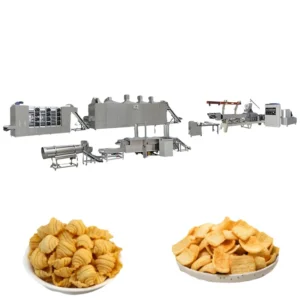
New Doritos Chips Frying Equipment Machine Automatic Tortilla Corn Chips Making Line Portable High Productivity
¥100.00 Select options This product has multiple variants. The options may be chosen on the product page -
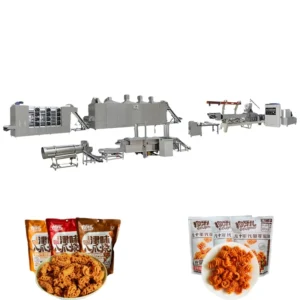
Fried Flour Corn Bugles Extruded Chips Pellets Doritos Snacks Food Machine Production Line Extruder
¥100.00 Select options This product has multiple variants. The options may be chosen on the product page -
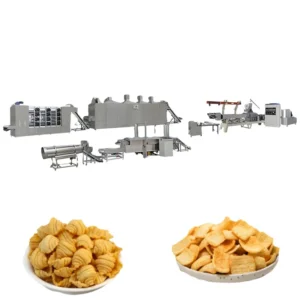
Automatic Fried Crispy Bugles Snacks Food Making Machines Wheat Flour Sala Food Extruder
¥100.00 Select options This product has multiple variants. The options may be chosen on the product page