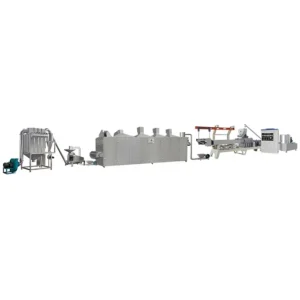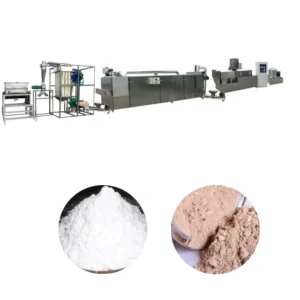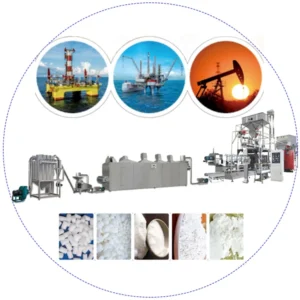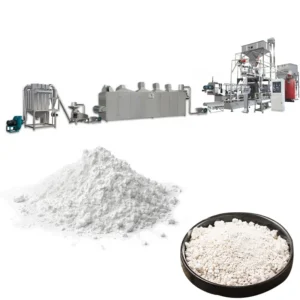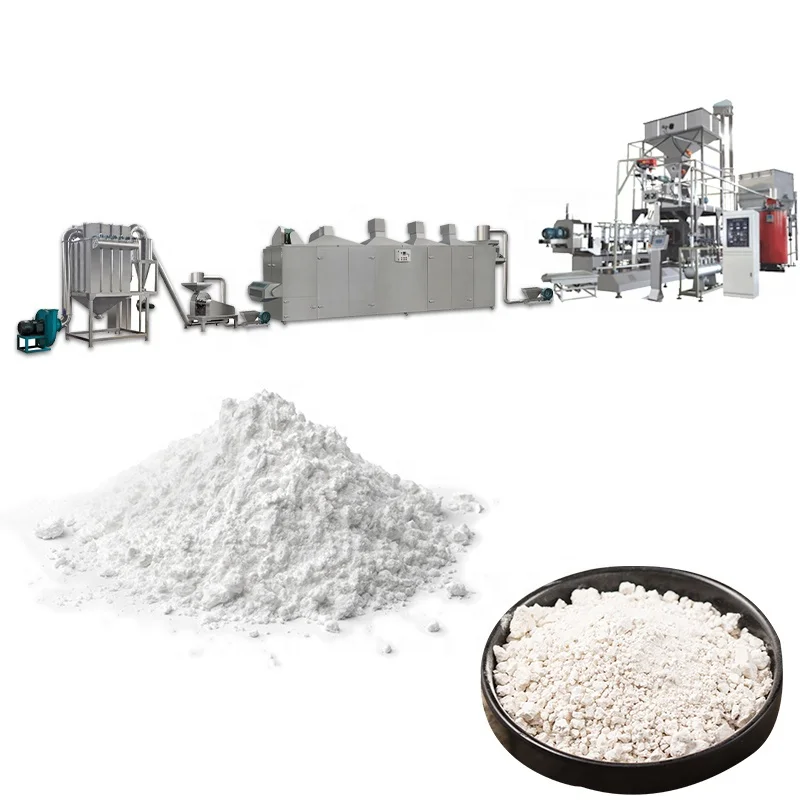

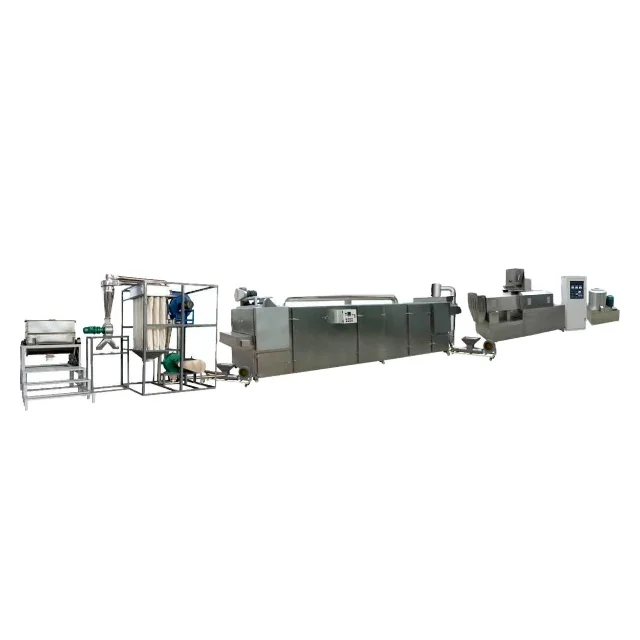


Modified Starch Processing Line, Twin-Screw Extrusion, MT65/MT70/MT85, Automated PLC Control — from mixing through extrusion, drying, grinding, blending to packing under one supplier. Screw configuration and die design matched to corn, cassava, potato or tapioca starch for targeted gelatinisation degree, with barrel temperature and moisture profile managed by twin-screw extrusion. Trial runs on buyer’s raw material before shipment confirm real throughput and modification quality.
Description
Matched line throughput — Every station from batching to packing is sized together, so the extruder never waits on the dryer or the grinder holds up the packing end.
Technical Specifications
| Parameter | Value |
|---|---|
| Product Type | Modified Starch Processing Line |
| Line Models Available | MT65 / MT70 / MT85 |
| Screw Type | Twin-screw extruder |
| Line Stations | Mixing → Extrusion → Drying → Grinding → Blending → Packing |
| MT65 Output Capacity | 100–150 kg/h (basis to be confirmed — raw material type and moisture content) |
| MT70 Output Capacity | 200–250 kg/h (basis to be confirmed — raw material type and moisture content) |
| MT85 Output Capacity | 300–500 kg/h (basis to be confirmed — raw material type and moisture content) |
| MT65 Line Dimensions (L×W×H) | 24000 × 1200 × 2200 mm |
| MT70 Line Dimensions (L×W×H) | 26000 × 1500 × 2200 mm |
| MT85 Line Dimensions (L×W×H) | 29000 × 3500 × 4300 mm |
| Control System | Automated PLC and MCC |
| Certification | CE |
Application Suitability
| Application | Material or Output |
|---|---|
| Pre-gelatinized starch for food processing | Corn starch, cassava starch, potato starch |
| Modified starch for textile sizing | Tapioca starch, maize starch |
| Modified starch for paper making and oil drilling | Corn starch, potato starch |
| Nutritional and fortified powder production | Rice flour, corn flour, soybean flour, grain blends |
Why "Nominal Capacity" Fails on Modified Starch Lines
Real output depends on your starch source and moisture profile, not a catalog number.
A modified starch production line turnkey package quoted at a round capacity figure often cannot sustain that throughput once the buyer’s actual raw material enters the extruder. Cassava starch behaves differently from corn starch under shear — gelatinisation temperature, moisture absorption rate, and viscosity all shift the effective throughput. I have watched lines stall at well below the nameplate rating because the screw configuration was copied from a generic maize build and never tested on the buyer’s specific material [NEED_CITE: starch gelatinisation behaviour under twin-screw extrusion].
Screw and Die Configuration Stays With Your Starch Type
The extrusion stage is where modified starch either meets specification or misses it. Twin-screw geometry controls residence time and shear intensity, which directly determine the degree of starch modification. A screw profile designed for corn starch at moderate moisture will under-process cassava starch, leaving incomplete gelatinisation. Die design governs expansion ratio and pellet density entering the dryer. On this modified starch production line turnkey system, screw and die combinations are specified against the buyer’s raw material and target modification level rather than pulled from a standard library.
Throughput Matching Across Every Station
An extruder running at full output means nothing if the dryer cannot remove moisture fast enough or the grinder creates a bottleneck downstream. Each station — mixing, extrusion, drying, grinding, blending, packing — is sized so that throughput stays balanced from start to finish [NEED_CITE: throughput balancing principles in continuous food processing lines]. This eliminates the common failure where one supplier provides the extruder and another provides the dryer, leaving the buyer to discover the mismatch during commissioning. The line layout document confirms capacity at every transfer point before production begins.
Reading the Specs That Actually Matter
Rated power across the three line sizes — MT65, MT70, and MT85 — reflects the mechanical energy available for starch conversion inside the barrel. Higher motor rating supports greater shear force, which is necessary when processing high-amylose corn starch or achieving deeper modification in industrial-grade products. Overall line dimensions indicate floor space and ceiling height requirements; the MT85 configuration at 29 metres long and 4.3 metres high demands substantial workshop clearance. The PLC and MCC control system maintains barrel temperature zones and moisture dosing within tight bands, keeping modification degree consistent across production runs. Mixer output should be verified against extruder intake rate to prevent starving or flooding the barrel.
What Happens When Configuration Is Wrong
A screw set copied from a generic build produces modified starch with inconsistent viscosity and incomplete gelatinisation. Downstream, textile or paper-making buyers reject batches that fall outside their viscosity tolerance. If the dryer is undersized relative to extruder output, moisture remains trapped in the starch pellets, causing caking during storage and grinding problems at the milling station. These failures do not show up on the quotation — they appear three months into production when rejection rates climb and the buyer starts troubleshooting alone [NEED_CITE: modified starch quality rejection causes in industrial applications].
What This Supplier Brings to Your Modified Starch Project
Screw configuration and die design are specified to your starch raw material and target modification degree, not copied from a catalogue build. An in-house testing workshop runs your actual cassava, corn, or potato starch through the extruder before shipment, producing a trial report that documents real output and product quality. Every station from the mixer to the packing end is supplied and capacity-matched under one contract, so throughput gaps surface during engineering rather than installation. Electrical schematics confirm voltage, frequency, and control language for your facility before fabrication starts. Spare wear parts — screws, dies, barrel liners — are itemised and shipped with the line so the first replacement does not mean an emergency air freight order.
Documentation & Verification
- Line layout and capacity calculation matching every station’s throughput for your starch type
- Screw and die configuration record specific to your raw material and modification target
- Trial run report on your actual starch raw material before dispatch
- Electrical schematic with voltage, frequency, and control language confirmed for your market
- CE declaration of conformity covering the complete line
- Wear parts list with recommended spare stock for continuous operation
Installation, Commissioning & Support
- MT85 line requires 29-metre floor length and 4.3-metre ceiling clearance for full assembly
- Power supply must match confirmed voltage and frequency before extruder motor energisation
- PLC control language set to operator preference during commissioning and training
- First production run supervised on-site with parameter adjustment for your starch material
- Screw and die wear parts included with initial shipment to cover early replacement cycles
- Barrel temperature zones calibrated against your raw material’s gelatinisation profile during startup
Before You Send an Inquiry
Specify your starch source — corn, cassava, potato, tapioca — and the modification degree or end-use application you are targeting. Confirm your workshop’s available floor length and ceiling height, along with local voltage and frequency standards. If you have existing upstream batching or downstream packing equipment that must integrate, note the connection points and throughput expectations so the line layout accounts for them from the start.
Frequently Asked Questions
Q: How is output capacity verified on my specific starch raw material before shipment?
A: Your raw material is processed in the in-house testing workshop using the specified screw and die configuration. A trial report documents actual throughput, gelatinisation degree, and product texture achieved during the run. This report ships with the line so you know what to expect before installation begins.
Q: How are screw configuration and die design selected for different starch types?
A: Corn, cassava, potato, and tapioca starches differ in gelatinisation temperature, amylose content, and shear response. Screw element arrangement and die geometry are matched to these properties and your target modification degree, then validated during the pre-shipment trial run on your actual material.
Q: What voltage, frequency, and control language options are confirmed before production?
A: Electrical schematics are prepared after confirming your facility’s supply voltage, frequency, and preferred control interface language. The PLC and MCC panels are wired and labelled accordingly before the line leaves the factory, avoiding commissioning delays caused by mismatched electrical standards.
Q: How is throughput balanced between extrusion, drying, grinding, and packing stations?
A: Each station’s capacity is calculated against the extruder’s verified output on your raw material. The line layout document shows matched throughput at every transfer point, preventing situations where one station bottlenecks the rest and limits overall production.
Related products
-
Pregelatinized Low-Cost Modified Starch Line – High-Efficiency Automated Starch Processing Machine
¥65.00 Select options This product has multiple variants. The options may be chosen on the product page -
Automatic Modified Starch Making Machine Oil Drilling Starch Processing Production Line
¥30.00 Select options This product has multiple variants. The options may be chosen on the product page -
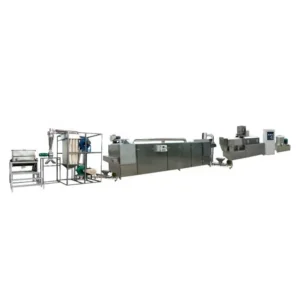
Automatic Modified Corn Starch Making Machine 304 Stainless Steel Gearbox High Efficiency Starch Processing Production Line
¥30.00 Select options This product has multiple variants. The options may be chosen on the product page -
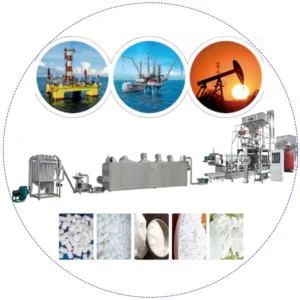
Cassava & Pregelatinized Corn Starch Extrusion Equipment – CE Certified Industrial Twin-Screw Modified Starch Line
¥65.00 Select options This product has multiple variants. The options may be chosen on the product page