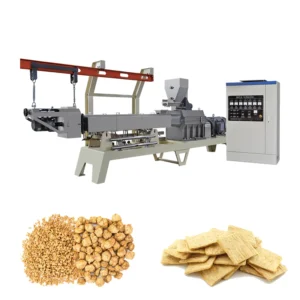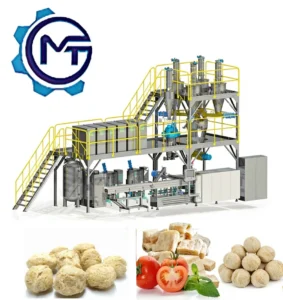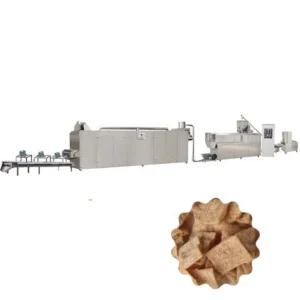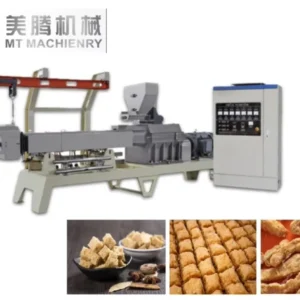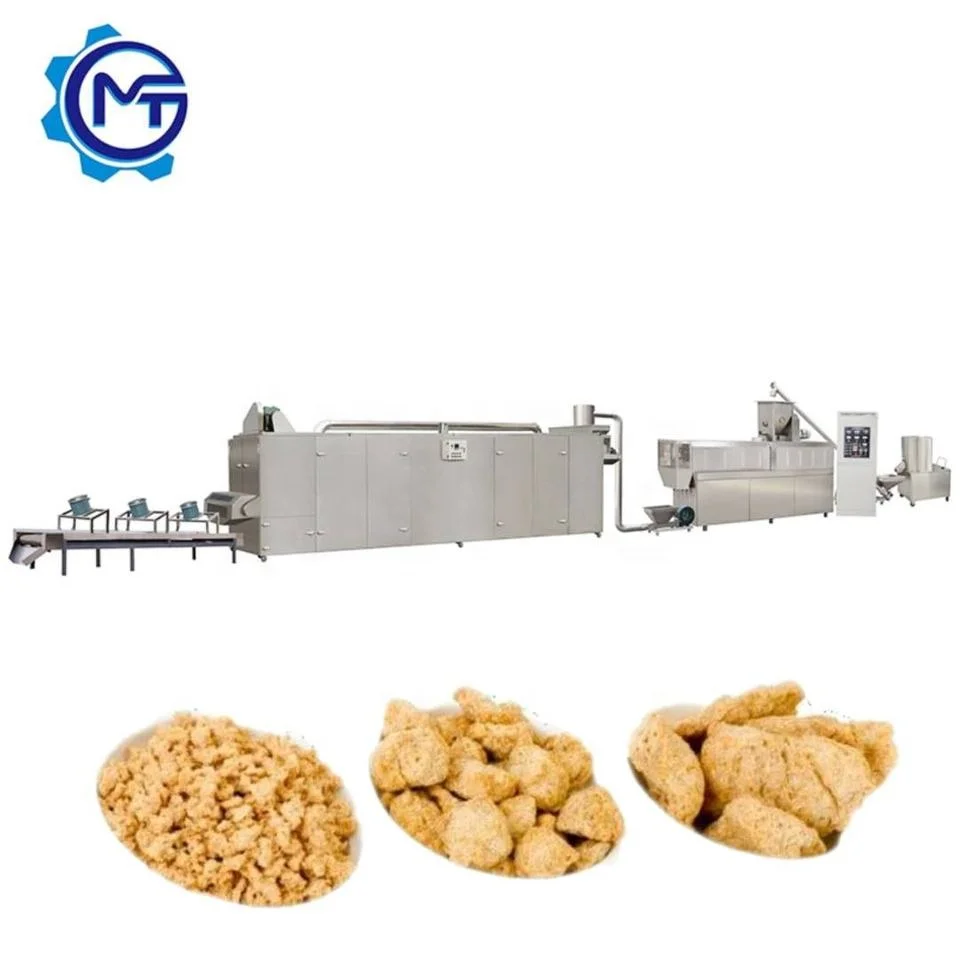

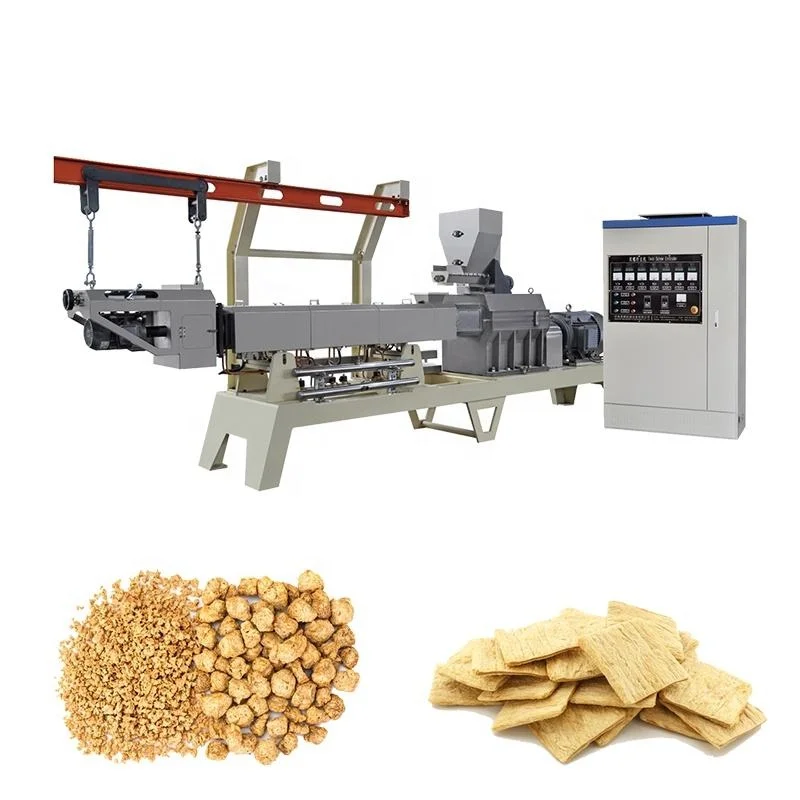

Textured Soy Protein Production Line, Twin-Screw Extrusion, MT65/MT70/MT85 Models — engineered for plant-based meat and TVP processing from raw material preparation through mixing, extrusion, drying, cooling and packing.
- Screw configuration and die design matched to soybean meal, peanut meal or custom protein blends for target fiber density
- Line stations throughput-matched to eliminate bottlenecks between extruder, roaster and cooler
- Stainless steel food-grade contact surfaces throughout
Complete turnkey layout with in-house trial runs on your raw material before shipment, ensuring verified fiber structure and real output on your formulation.
Description
Matched Throughput Across Every Station — Mixer, extruder, roaster, and cooler are sized to the same capacity range so no single machine creates a bottleneck on your textured soy protein production line turnkey project.
Technical Specifications
| Parameter | Value |
|---|---|
| Product Type | Textured Soy Protein Production Line |
| Line Models Available | MT65 / MT70 / MT85 |
| Extruder Type | Twin-screw |
| MT65 Line Output | 150-200 kg/h (basis to be confirmed: depends on raw material formulation, die configuration and target product format) |
| MT70 Line Output | 200-300 kg/h (basis to be confirmed: depends on raw material formulation, die configuration and target product format) |
| MT85 Line Output | 600-800 kg/h (basis to be confirmed: depends on raw material formulation, die configuration and target product format) |
| MT65 Installed / Real Power | 85 kW / 65 kW |
| MT70 Installed / Real Power | 120 kW / 90 kW |
| MT85 Installed / Real Power | 195 kW / 165 kW |
| MT65 Dimension | 18000 × 1300 × 2300 mm |
| MT70 Dimension | 20000 × 1500 × 2400 mm |
| MT85 Dimension | 24000 × 3500 × 4300 mm |
| Powder Mixer Tank Volume | 150 kg |
| Powder Mixer Mixing Time | 10 min per batch |
| Powder Mixer Power | 4 kW |
| Double Screw Extruder Main Motor | 30 kW |
| High-temperature Roaster Effective Belt Length | 3.5 m |
| High-temperature Roaster Far Infrared Heater | 3.9 kW × 24 |
| High-temperature Roaster Gas Consumption | 6.8 m³/h |
| Construction Material | Stainless steel (food-grade contact parts) |
| Control System | PLC / MCC options (confirm before order) |
| Voltage & Frequency | Configurable to site supply (confirm before order) |
| Warranty | 1 year complete warranty, life-time maintenance service |
Application Suitability
| Application | Material or Output |
|---|---|
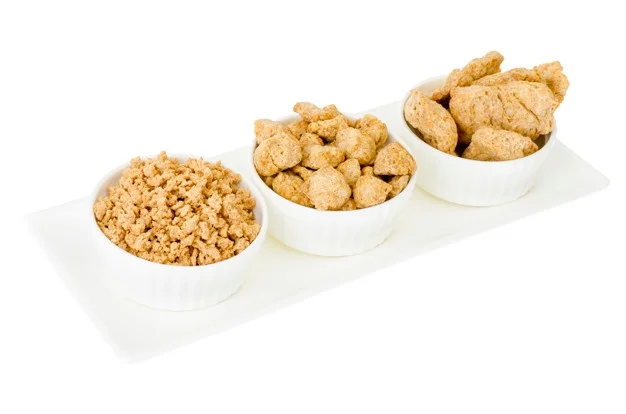
| Textured vegetable protein (TVP) production | Low-temperature soybean meal and peanut meal |
| Vegetarian meat cutlet and plant-based meat analogues | Soy protein formulations requiring fibrous, meat-like texture |
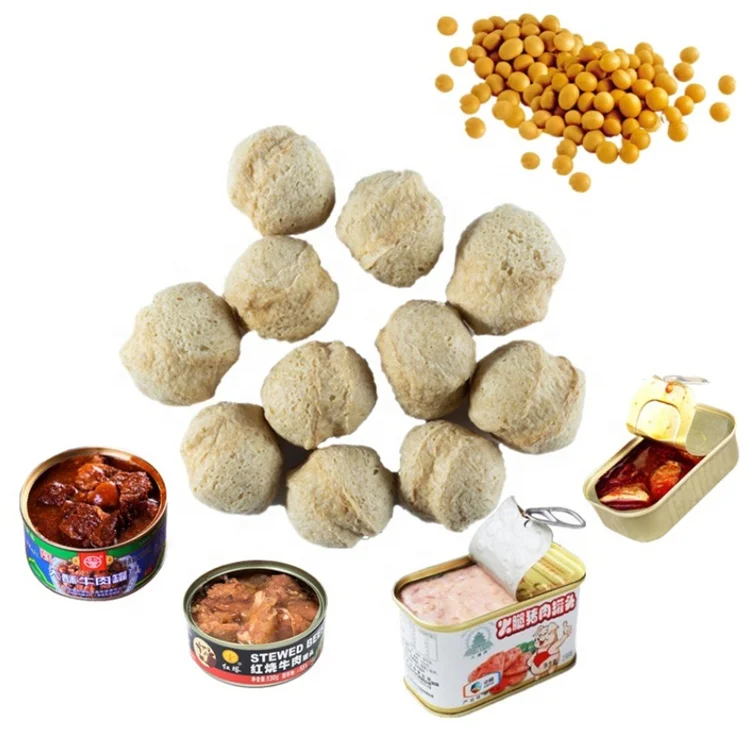
| Protein ingredient for ham, sausage and canned food | Defatted soybean meal converted into high-protein meat analogues |
| Ingredient for quick-frozen and fast food applications | Tissue-drawing protein from soybean and peanut meal blends |
| Small to medium-scale soy protein processing | Batch sizes matching MT65 through MT85 throughput ranges |
Why "Rated Capacity" Misses the Point on a Textured Soy Protein Production Line Turnkey
Real output depends on your exact meal formulation, moisture content, and die configuration — not a catalog number.
When I first started running soy protein trials, we fed our workshop extruder standard low-fat soybean meal and pulled out perfect fibrous strands. A Middle Eastern client then arrived with high-fat soybean cake from a local crusher. The same screw setup could not generate enough shear; the protein fibers collapsed and the entire batch was scrapped. That textured soy protein production line turnkey project stalled until we reconfigured the screw elements and die geometry for their actual material [NEED_CITE: effect of fat content on twin-screw extrusion shear and protein fiber formation]. Buyers who quote only on nameplate capacity frequently discover that their real throughput falls short once production begins on local feedstock.
How Twin-Screw Shear Opens Protein Molecules
The twin-screw extruder applies high temperature, high pressure, and intense mechanical shear to raw soybean or peanut meal. Spherical protein molecules unfold under these conditions and reorganize into elongated chain structures. As the material exits the die, rapid pressure drop locks the fibrous network into a meat-like texture. This textured soy protein production line turnkey solution relies on precise screw element sequencing to control residence time and shear intensity across each barrel zone.
Matching Every Station to Eliminate Bottlenecks
A common failure mode on assembled lines is a mixer that cannot feed the extruder fast enough, or a dryer that cannot handle peak extruder output. Each station on this line — from the powder mixer through the high-temperature roaster to the cooling machine — is specified to the same throughput band. The MT70 extruder, for example, pairs with a roaster whose 3.5-meter belt and 24 far-infrared heaters are sized for the same material flow. This matching prevents material pile-up and keeps fiber structure consistent from first kilogram to last [NEED_CITE: importance of throughput matching in continuous food extrusion lines].
Reading the Specs That Actually Matter
The main motor on the double screw extruder is rated at 30 kW, with actual running power between 30 and 35 kW depending on formulation viscosity and screw load. That gap tells you how much headroom the drive has when processing higher-density blends. The high-temperature roaster burns 6.8 m³/h of gas alongside its electric infrared array, giving operators a dual heat source to manage surface drying versus core moisture removal. Stainless steel construction across all food-contact surfaces meets food-grade requirements and withstands the acidic residues that soybean meal can leave after prolonged runs. Line dimensions scale from the MT65 at 18 meters long to the MT85 at 24 meters, so workshop length and ceiling height must be confirmed before layout finalization.
The Hidden Cost of a Generic Screw Setup
Copy-paste screw configurations treat soybean meal and peanut meal as interchangeable. They are not. Peanut meal has a different fat profile and gelatinization temperature, so a screw sequence optimized for soy will under-shear peanut protein, producing a crumbly output with no visible fiber [NEED_CITE: differences in extrusion behavior between soybean meal and peanut meal]. Buyers who skip the trial run often spend months adjusting parameters on-site, wasting raw material and delaying market launch. A configuration record tailored to your specific protein source and target fiber density avoids this entirely.
Why Sourcing the Complete Line From One Supplier Matters
Every station from batching to packing is designed under one engineering roof, so throughput calculations are verified across the full chain rather than assumed between separate vendors. Screw elements and die plates are selected against your raw material sample, not pulled from a generic build library. The in-house testing workshop runs your actual soybean meal or peanut meal formulation before the line ships, generating a trial report that documents real output and fiber quality. Pre-sales consultation covers line layout, utility planning, and phased installation scheduling. On-site commissioning includes operator training on your specific control language and voltage supply, with wear parts lists provided for long-term maintenance planning.
Documentation & Verification
- Line layout drawing with throughput matched at each station for your target product
- Screw and die configuration record specified to your soybean or peanut meal formulation
- Trial run report on your actual raw material conducted before shipment
- Electrical schematic with voltage, frequency, and control language confirmed before production
- CE declaration of conformity and ISO certificate included with shipping documentation
Installation, Commissioning & Support
- MT85 line requires a minimum 24-meter clear workshop length with adequate ceiling height for the 4.3-meter frame
- Dedicated power circuit sized for up to 195 kW installed capacity on the MT85 configuration
- Twin-screw extruder shipped with barrel sections and screw elements pre-assembled for faster on-site positioning
- First production run supervised by an engineer who sets barrel temperature profile and die pressure for your material
- Operator training covers PLC or MCC interface in your chosen control language
- Wear parts list with screw elements, die plates, and mixer blades for first replacement cycle
Before You Send an Inquiry
Prepare your raw material specification — whether low-temperature soybean meal, peanut meal, or a custom blend — along with your target daily output and the fiber density your market expects. Confirm your workshop dimensions, local voltage and frequency, and the control language your operators need. If you want a trial run on your actual material before the line ships, state that upfront so the testing workshop can schedule accordingly.
Frequently Asked Questions
Q: How is real output capacity verified before I commit to a line size?
A: Output depends on your raw material formulation, moisture content, and die configuration. We run your actual soybean meal or peanut meal in our in-house testing workshop and document throughput, fiber structure, and product density in a trial report. That report becomes the baseline for selecting MT65, MT70, or MT85, rather than relying on catalog numbers alone.
Q: How do you match the screw and die to my specific protein source?
A: Screw element sequencing and die geometry are specified after reviewing your material data sheet and target fiber structure. Low-temperature soybean meal, high-fat soybean cake, and peanut meal each require different compression ratios and shear zones. The configuration record is finalized after the trial run confirms the correct texture and density.
Q: What happens if one station cannot keep up with the extruder?
A: That scenario is eliminated during line design. The powder mixer batch cycle, extruder throughput, roaster belt speed, and cooler capacity are all calculated to the same output band. The line layout document shows matched throughput at every station so no single machine creates a production bottleneck.
Q: Can I visit the factory and see a trial run on my material?
A: The in-house machine testing workshop is open for buyer visits. You can send your raw material in advance or bring it with you. Engineers configure the screw and die, run the textured soy protein production line turnkey setup, and walk you through the output quality and parameter settings before the machine is packed for shipment.
Q: What does on-site commissioning include?
A: An engineer arrives at your facility to supervise installation, wire the control panel to your confirmed voltage and frequency, and run the first production batches. Operator training covers daily startup, screw and die changeover, roaster temperature adjustment, and routine maintenance. A wear parts list is provided for your procurement team to plan future replacements.
Related products
-
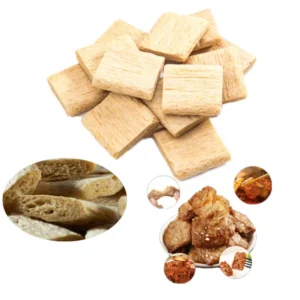
High-yield Soybean Protein Automated Production Line Single Screw Extruder for TVP
Price range: ¥20.00 through ¥30.00 Select options This product has multiple variants. The options may be chosen on the product page -
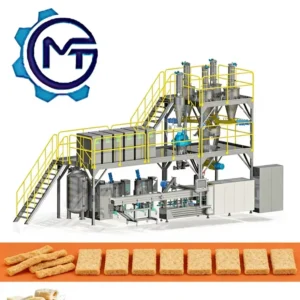
High Capacity Soy Protein Vegetarian Meat Processing Line
¥9,500.00 Select options This product has multiple variants. The options may be chosen on the product page -
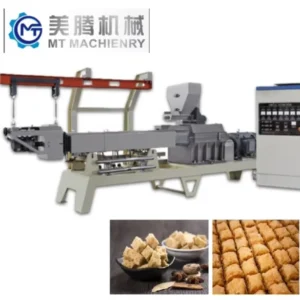
Vegetarian Beef Substitute Making Machine with Twin Screw Extruder
¥9,500.00 Select options This product has multiple variants. The options may be chosen on the product page -
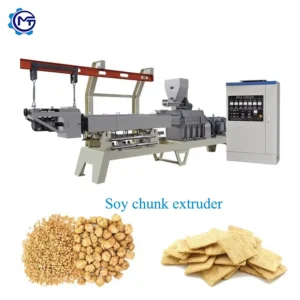
Textured Soybean Protein Extruder Plant Protein Processing Production Line TVP Making Machine
¥30.00 Select options This product has multiple variants. The options may be chosen on the product page