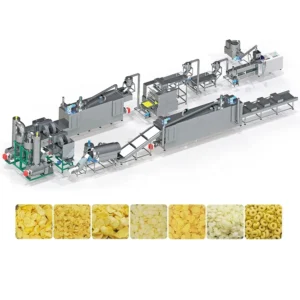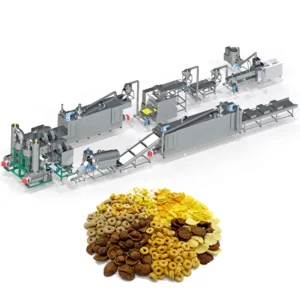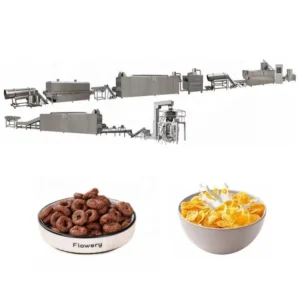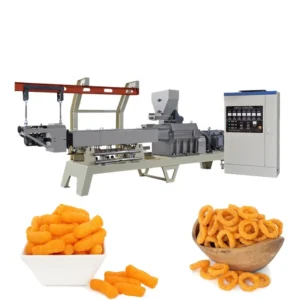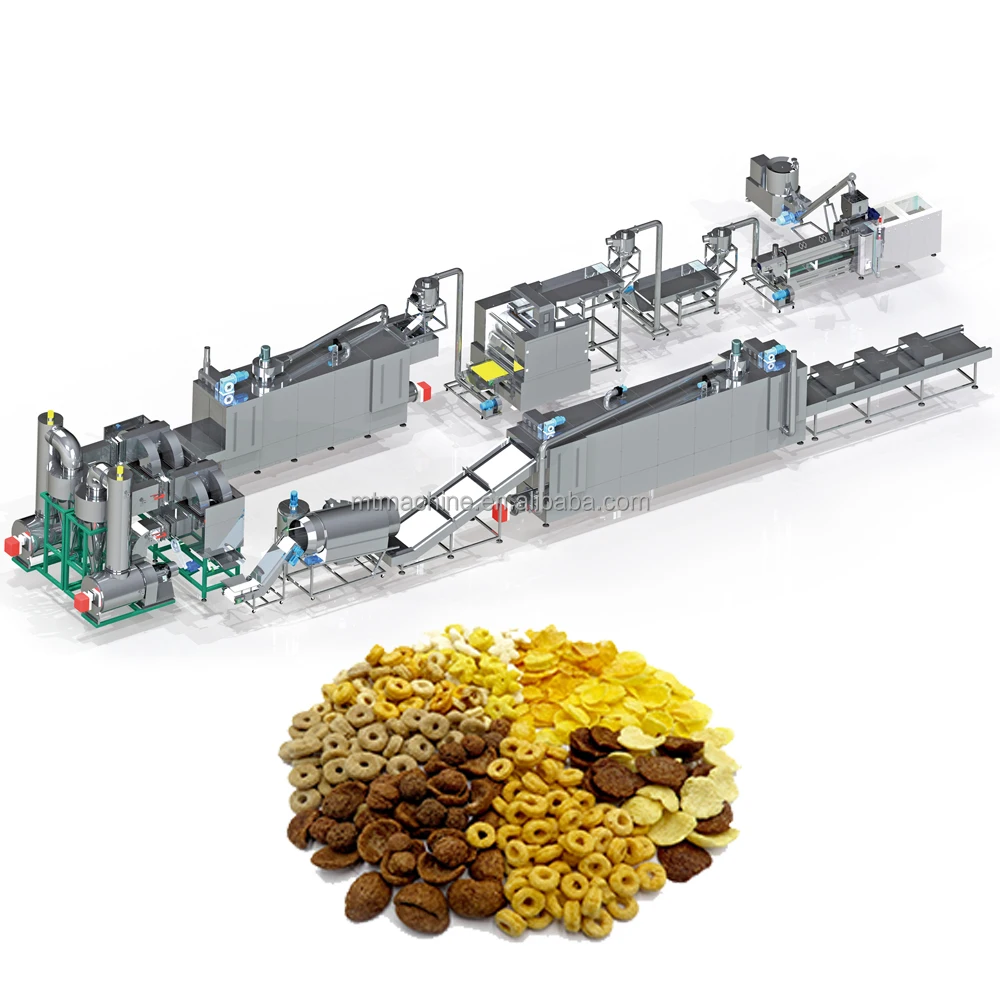


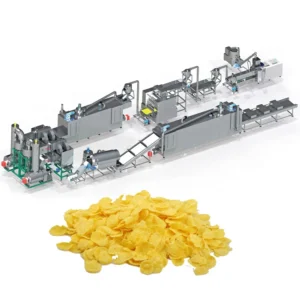
MT75 Corn Flakes Breakfast Cereal Production Line, Twin-Screw Extruder, PLC Control — engineered as a complete turnkey plant from mixing and extrusion through flaking, drying, hot air roasting, coating and packing. Screw configuration and die design are specified to your raw material formulation and target flake density, with hydraulic double-roller flaking and infrared temperature monitoring for consistent thickness across every batch.
- Line layout and throughput matching across every station verified before shipment
- Trial run on your raw material conducted in our in-house testing workshop
- Electrical schematics, voltage confirmation and operation manuals delivered with full documentation package11296
Description
Throughput-Matched Engineering — Every station on this corn flakes breakfast cereal production line is sized against the extruder’s actual output on your specific grain formulation, preventing downstream bottlenecks that typically emerge after commissioning.
Technical Specifications
| Parameter | Value |
|---|---|
| Product Type | Corn Flakes Breakfast Cereal Production Line |
| Model | MT70 / MT85 / MT75 |
| Installed Power | 160 kW (MT70) / 190 kW (MT85) / 210 kW (MT75) |
| Power Consumption | 120 kW (MT70) / 140 kW (MT85) / 150 kW (MT75) |
| Capacity | 150–200 kg/h (MT70, basis to be confirmed) / 300–400 kg/h (MT85, basis to be confirmed) / 300–500 kg/h (MT75, basis to be confirmed) |
| Overall Dimensions (L×W×H) | 41×1.5×2.2 m (MT70) / 43×1.5×3.2 m (MT85) / 45×1.5×3.5 m (MT75) |
| Screw Type | Twin-screw |
| Control System | PLC control (flaking machinery); MCC and PLC (extruder line) |
| Extruder System | Feeding, extruding, cutting, heating, gearing, controlling systems |
| Flaking Machinery | Hydraulic double-roller system; double motors for separate roller driving; infrared sensor temperature control |
| Dryer Heating Source | Gas / Electric (configurable) |
| Roasting Oven | Vibrating pan with high-temperature spraying tubes; conciliation burner; two circulating fans; cyclone dust removal |
| Coating System | Double tumble for sugar melting, elevator, coating drum, spraying nozzle |
| Final Product Shapes | Ball, tube, stick, ring, fruit loop, star, wheel, flower, heart (via extruder mould adjustment) |
| Raw Materials | Corn, rice, wheat, oat, barley powder |
| Lubrication | Automatic lubricating and cooling function |
| Assembly State | Complete turnkey production line |
| Layout | Customizable per factory size |
| Standards | CE certified; ISO certified |
Application Suitability
| Application | Material or Output |
|---|---|
| Natural corn flakes production | Corn powder, rice flour, wheat flour |
| Sugar-coated and honey-coated corn flakes | Corn base with sugar or honey spray coating |
| Breakfast cereal shapes diversification | Oat, barley, and mixed grain powders formed into rings, balls, stars, fruit loops |
| Cereal snack processing for retail and bulk packing | Multi-grain formulations across all supported shapes |
Why Nominal Extruder Capacity Rarely Survives Contact With Your Actual Raw Material
A cereal line quoted at peak extruder output will underperform the moment your specific corn flour formulation and moisture content enter the barrel.
When factory planners evaluate a corn flakes breakfast cereal production line turnkey proposal, the number that anchors the entire investment decision is usually the extruder’s nominal capacity. That figure is typically derived from a standard test material under controlled conditions. Once your actual grain blend — with its particular particle size, starch composition, and incoming moisture level — runs through the barrel, the real throughput often diverges. If the downstream flaking rollers, dryer, and roasting oven were sized to the brochure number rather than the verified output, material piles up between stations and the entire line rhythm collapses [NEED_CITE: extrusion throughput variance across grain formulations]. Planning a turnkey project means recalculating every station’s throughput against your specific material profile before any steel is cut.
Phased Installation and Utility Planning for the Full Line
A corn flakes breakfast cereal production line turnkey deployment requires coordinating utility drops — electrical circuits for the extruder motors, gas or electric supply for the dryer, compressed air for the hydraulic flaking system — across a facility floor that may still be under construction. The layout engineering phase maps each station’s footprint against ceiling height constraints, material flow direction, and maintenance access corridors. When the extruder section demands 210 kW at peak load and the roasting oven pulls separate gas lines, the electrical room and utility routing must be finalized before equipment arrives on site.
Throughput Matching Between Extrusion, Flaking, and Coating Stations
The hydraulic double-roller flaking machinery must process every kilogram that exits the extruder without creating a queue. If the extruder delivers a continuous ribbon of cooked dough at a rate that exceeds the flaker’s roller gap throughput, product accumulates on the conveyor and cools below the temperature required for clean compression. Downstream, the roasting oven’s vibrating pan and dual circulating fans must move flakes through the high-temperature zone at a pace that matches the dryer’s discharge rate. When the sugar coating drum is added for honey-coated variants, its tumble cycle and spraying nozzle volume must align with the cooled flakes arriving from the upstream cooling conveyor [NEED_CITE: cereal line station synchronization principles]. Mismatched tempos at any junction force operators to throttle the extruder, leaving paid-for capacity idle.
Reading the Specs That Actually Determine Line Performance
The twin-screw extruder configuration — including screw pitch, barrel segment arrangement, and die geometry — dictates how thoroughly starch gelatinizes within the residence time available. Different grain blends require different screw profiles; a setup optimized for corn may under-process an oat-heavy formulation, resulting in incomplete cooking and inconsistent flake texture. The hydraulic flaking system’s infrared temperature monitoring ensures the rollers compress the dough at the correct thermal window, directly influencing final flake thickness and surface integrity. The roasting oven’s cyclone dust removal device is not merely an environmental feature — it prevents fine particulate recirculation that can scorch onto flake surfaces and create off-color product. The PLC and MCC control architecture allows operators to store recipe parameters for each grain blend, reducing the trial-and-error window when switching between natural and sugar-coated production runs.
The Hidden Cost of Undersized Downstream Equipment
When a dryer is specified to match nominal extruder output rather than verified throughput on a buyer’s actual material, moisture content in the flakes entering the roasting oven drifts above target. The oven then requires extended residence time to achieve the correct surface bubbling and crispness, which slows the entire line. Similarly, a coating drum with insufficient tumble volume forces the sugar spraying nozzle to over-apply in an attempt to achieve uniform coverage, increasing raw material waste and creating clumping that jams the packing station [NEED_CITE: downstream bottleneck consequences in cereal processing]. These compounding inefficiencies rarely show up in a single metric but erode the line’s effective capacity across every shift.
Why Project Contractors Source the Entire Line From One Supplier
Every station from the batching system through extrusion, flaking, drying, roasting, coating, and packing is engineered under a single responsibility, so throughput calculations account for real material behavior rather than individual machine brochures. Screw configuration and die design are specified against the buyer’s grain formulation and target flake density before production begins. An in-house testing workshop runs trial production on the customer’s own raw material, generating a verified throughput baseline that informs every downstream equipment selection. Pre-sales layout engineering covers utility planning, phased installation sequencing, and commissioning scheduling so that facility contractors know exactly when each station arrives and what infrastructure must be ready. Operator training extends beyond button-pushing to cover recipe parameter management across the PLC and MCC systems for consistent batch-to-batch output.
Documentation & Verification
- Line layout and capacity calculation showing throughput matching across mixing, extruding, flaking, drying, roasting, and packing stations
- Screw and die configuration record matched to your specific corn, rice, wheat, or oat formulation
- Trial run report generated on your raw material in the testing workshop before equipment dispatch
- Electrical schematic with voltage and frequency confirmation matching your facility’s power supply specifications
- Operation and maintenance manual covering PLC parameter storage and hydraulic flaking system servicing
- Wear parts list identifying extruder screws, flaking rollers, and spraying nozzles with replacement intervals
Installation, Commissioning & Support
- Foundation planning accounts for the 41–45 m line length and vibrating roasting oven isolation requirements
- Dedicated electrical circuits sized for 160–210 kW extruder peak load plus dryer and roasting oven gas or electric supply
- Equipment ships in modular sections for phased installation matching your facility construction timeline
- First-run commissioning verifies throughput on your grain formulation and calibrates infrared flaking temperature sensors
- Operator training covers PLC recipe management for switching between natural and sugar-coated production
- Spare extruder screws, flaking roller segments, and coating drum spraying nozzles supplied with initial wear parts package
What We Need to Engineer Your Line Layout
To prepare an accurate line configuration and capacity proposal, share your target grain formulation and incoming moisture content, the daily production volume your market requires, and your facility floor dimensions including ceiling height. Specify your local voltage, frequency, and preferred control language for the PLC interface. If you plan to produce both natural and sugar-coated variants on the same line, indicate the expected production ratio so the coating drum and additional drying capacity are sized correctly from the start.
Frequently Asked Questions
Q: How is line capacity verified against my specific corn flour formulation and moisture content?
A: Before shipment, your raw material runs through the extruder and downstream stations in the in-house testing workshop. The trial generates a verified throughput record that accounts for your grain’s starch behavior, particle size, and moisture level, ensuring every station is correctly sized for actual production conditions rather than standard test benchmarks.
Q: What layout and phased installation planning is provided for a complete cereal production line?
A: The engineering team produces a detailed floor plan mapping each station’s footprint, utility connection points, material flow paths, and maintenance access zones. Installation is sequenced to align with your facility construction milestones, with equipment arriving in modular sections so foundation work and utility drops can proceed in parallel.
Q: How are screw configuration and die design matched to my target flake density and texture?
A: The screw profile — including pitch, flight depth, and barrel segment arrangement — is selected based on your grain blend’s gelatinization requirements. Die geometry is then matched to the target pellet shape and size, which directly determines flake dimensions after hydraulic roller compression.
Q: What documentation is delivered before shipment?
A: You receive a line layout with capacity calculations, screw and die configuration records, electrical schematics with confirmed voltage specifications, a trial run report on your raw material, CE and ISO compliance documentation, and a complete operation manual with maintenance schedules.
Q: What operator training and ongoing maintenance support is included after commissioning?
A: On-site training covers PLC recipe management for different grain formulations, hydraulic flaking system calibration, roasting oven temperature profiling, and coating drum operation. A wear parts list with replacement intervals is provided, and ongoing technical support addresses parameter adjustments as you refine your product specifications.
Related products
-
Corn Flakes Machine Breakfast Cereal Corn Flakes Production Line Cornflakes Making Machine
¥85,800.00 Select options This product has multiple variants. The options may be chosen on the product page -
Small Scale Breakfast Cereal Manufacturing Machine for Corn Flakes Process Line
¥45,000.00 Select options This product has multiple variants. The options may be chosen on the product page -
New Automatic Cornflakes Making Machine Oats Snack Food Chips Extruder Processing Line
¥30.00 Select options This product has multiple variants. The options may be chosen on the product page -
Best Price Corn Flakes Making Machine Breakfast Cereals Processing Line with Motor As Core Component
¥19,000.00 Select options This product has multiple variants. The options may be chosen on the product page