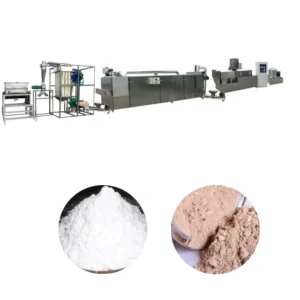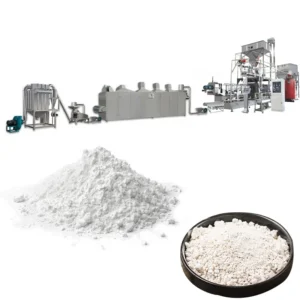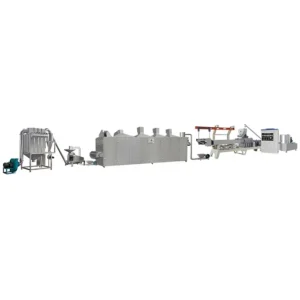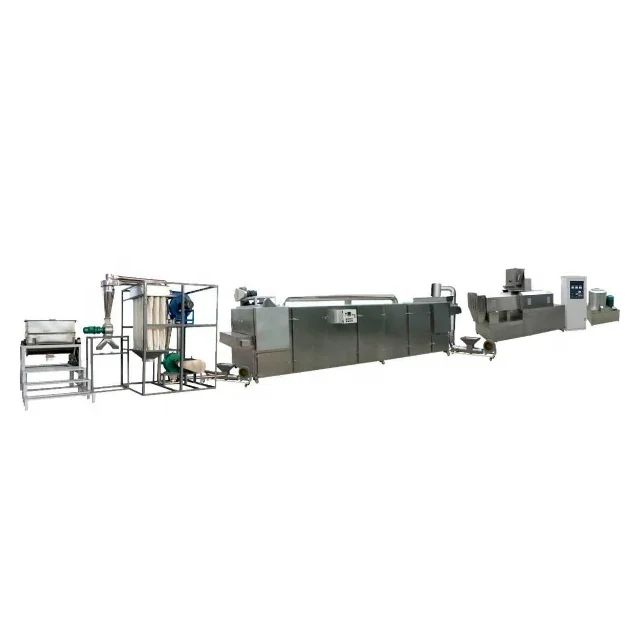


Modified Starch Processing Line, 45-200 kW, Twin-Screw, PLC Control — engineered for food-grade and industrial starch modification with screw configuration matched to gelatinization, dextrinization, or cross-linking targets.
- Complete turnkey layout from batching through extrusion, cooling, grinding, and packing — throughput balanced at every station to prevent bottlenecks
- Barrel temperature profile and die design specified to raw material behavior and required modification degree
Trial runs on your starch formulation completed in our in-house testing workshop before shipment, with full configuration records provided.
Description
Verified Throughput Across Every Station — Our turnkey modified starch processing line matches extruder output with cooling, grinding, and packing capacity, preventing bottlenecks that generic builds create when raw material behavior shifts.
Technical Specifications
| Parameter | Value |
|---|---|
| Product Type | Modified Starch Processing Production Line |
| Output Capacity | 100–1500 kg/h (basis not stated in source — confirm raw material type, moisture content, modification degree) |
| Rated Power | 45–200 kW |
| Equipment Weight | 1000–5000 kg (source value — verify against specific line configuration) |
| Voltage & Frequency | 220–440 V, tri-phase (frequency to be confirmed per target market) |
| Control System | PLC and MCC control |
| Extrusion Type | Twin-screw extruder |
| Contact Material | Food-grade 304 stainless steel |
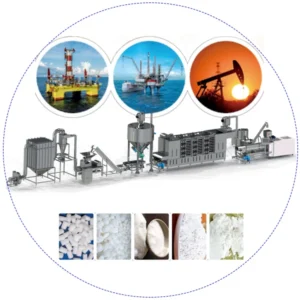
| Line Stations | Mixing/batching, twin-screw extrusion, cooling conveyor, pulse grinding, packing |
| Raw Materials | Corn starch, wheat flour, rice flour, soybean flour, potato starch, additive materials |
| Fuel Options | Gas, diesel, electricity, steam |
| Assembly State | Complete line with supporting equipment |
| Standards | CE, ISO certified |
Application Suitability
| Application | Material or Output |
|---|---|
| Food-grade thickeners and stabilizers | Corn starch, potato starch with cross-linking or esterification agents |
| Pre-gelatinized starch for instant food | Wheat flour, rice flour for nutritional and infant formula powders |
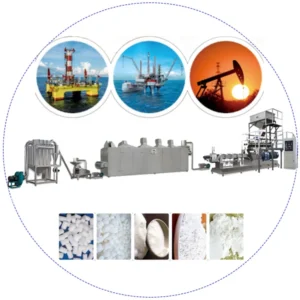
| Oil drilling fluid additives | Modified corn starch with specific viscosity and thermal stability targets |
| Paper-making industry starch | Cationic or oxidized starch from corn or wheat base |
| Industrial adhesives and coatings | Dextrinized starch from corn or tapioca base |
Why "Nominal Capacity" Can Cut Your Real Output in Half on a Modified Starch Processing Line Turnkey
The rated number on the proposal only holds if your raw material matches the test material used at the factory.
I have watched a food plant in the Yangtze Delta region commission a modified starch line that produced barely half of its quoted throughput on day one. The corn starch batch they sourced locally had a gelatinization temperature over ten degrees higher than the material used during factory testing. Every parameter — screw speed, barrel steam pressure, feed rate — needed recalibration on site, costing weeks of lost production. [NEED_CITE: starch gelatinization temperature variance by crop origin and harvest year] When sourcing a modified starch processing line turnkey, the trial run must happen on your actual raw material formulation before the equipment leaves the factory floor.
Barrel Temperature Profiling and Screw Geometry for Starch Modification
The degree of modification — whether gelatinization, dextrinization, or cross-linking — depends on precise thermal and shear history inside the barrel. A modified starch processing line turnkey must specify screw element arrangement and barrel heating zones to match your target modification profile. Twin-screw configuration allows operators to adjust residence time distribution and shear intensity by reordering screw elements without replacing the entire shaft assembly.
Throughput Balancing Between Extrusion, Cooling, and Grinding
The extruder is only one station in the chain. If the cooling conveyor cannot remove moisture fast enough, or the pulse grinder cannot handle the extrudate volume, the entire modified starch processing line turnkey stalls at its weakest link. We calculate mass and energy balance at every station during layout design, confirming that the rated extruder output has a verified path through cooling, grinding, and packing without accumulation or starvation at transfer points. [NEED_CITE: mass balance calculation methods for continuous food processing lines]
Reading the Specification Sheet for What It Actually Controls
The rated power range of 45 to 200 kW reflects the motor sizing needed across different capacity tiers and modification intensities — higher cross-linking or dextrinization demands more specific mechanical energy input per kilogram of starch. The PLC and MCC control system manages barrel temperature zones, screw speed, and feed rate simultaneously, storing recipe parameters so that batch-to-batch modification degree stays consistent. Food-grade 304 stainless steel contact surfaces resist corrosion from acidic or alkaline modification agents and allow sanitary washdown between formulation changeovers. The fuel option selection — gas, diesel, electricity, or steam — determines how barrel heating and dryer sections are configured for local utility availability.
The Hidden Cost of Skipping Raw Material Verification
When the screw and die configuration is copied from a generic starch build rather than matched to your specific raw material and modification target, the extrudate arrives at the grinder with the wrong density or moisture content. The grinder then either chokes on material that is too dense or passes oversized particles when the feed is too light. Downstream packing stations receive product outside the particle size specification your market requires. [NEED_CITE: particle size distribution requirements for modified starch in food and industrial applications] These problems surface after installation, when the supplier’s technicians have already left the site and remote troubleshooting begins.
Why This Line Stands Apart in Project Execution
Capacity matching across every station — from batching through extrusion, cooling, grinding, and packing — comes from one supplier engineering the entire chain rather than assembling machines from separate vendors. Screw configuration and die design are specified to your raw material sample and target modification profile, not pulled from a standard library. An in-house testing workshop runs your formulation before shipment, generating a trial report that documents actual throughput, barrel settings, and product quality on your material. Pre-sales engineering covers line layout, utility planning, and phased installation scheduling so that commissioning follows a documented sequence rather than improvised field adjustments. Post-installation support includes operator training on the PLC recipe system, a wear parts list specific to your screw and die configuration, and ongoing maintenance guidance tied to your production schedule.
Documentation & Verification
- Line layout and capacity calculation showing throughput at every station from batching to packing
- Screw and die configuration record matched to your starch formulation and modification target
- Trial run report on your supplied raw material conducted in the testing workshop before dispatch
- Electrical schematic with voltage and frequency confirmation for your facility grid
- CE declaration of conformity and ISO certificate for export compliance
- Operation and maintenance manual with recipe management instructions for the PLC system
Installation, Commissioning & Support
- Foundation planning accounts for the 1000–5000 kg equipment weight distributed across extruder, cooling, and grinding stations
- Power supply design confirms 220–440 V tri-phase connection with dedicated circuit sizing for 45–200 kW total load
- Line arrives in modular sections with assembly sequence documented in the installation manual
- First-run commissioning includes barrel temperature calibration and PLC recipe loading for your specific starch formulation
- Operator training covers screw element reordering procedures and MCC fault diagnosis on the control panel
- Wear parts list specifies screw sections, die plates, and grinder screens with replacement intervals tied to your production volume
Preparing Your Inquiry for Accurate Line Configuration
To size the extruder, cooling conveyor, and grinder correctly, we need your target raw material type — whether corn, wheat, potato, or a blend — along with the specific modification degree your end product requires. Share your facility voltage and frequency, available fuel source for heating, and the daily output volume your market demands. If you have an existing upstream batching system or downstream packing line, tell us the interface points so the new stations integrate without throughput mismatch.
Frequently Asked Questions
Q: How is output capacity verified on my specific raw material and modification formula before shipment?
A: We run your supplied raw material sample through the extruder in our in-house testing workshop, recording actual throughput, barrel temperature profile, screw speed, and product quality. The trial report documents these parameters so you know the line performs on your formulation before it ships.
Q: What screw configuration and barrel temperature profile is used for my target starch modification type?
A: Screw element arrangement and heating zone settings are selected based on whether your target is gelatinization, dextrinization, or cross-linking. The configuration is recorded in your project documentation and can be adjusted by reordering elements on the shaft.
Q: How is throughput balanced between the extruder, cooling conveyor, and grinding station across the line?
A: We calculate mass and energy balance at each station during layout design, confirming that the cooling conveyor removes moisture at a rate matching extruder output and that the pulse grinder handles the resulting feed volume without accumulation.
Q: What voltage, frequency, and control language options are confirmed before production begins?
A: Your facility electrical specifications are confirmed during the proposal stage, and the electrical schematic reflects your local grid. PLC interface language is set to your operator preference before the control cabinet leaves the factory.
Q: What installation, commissioning, and operator training support is included with the turnkey line delivery?
A: On-site engineers guide assembly, calibrate barrel zones, load your starch recipes into the PLC, and train operators on screw configuration changes, MCC troubleshooting, and routine maintenance tied to your production schedule.
Related products
-
Automatic Deep Processing Machine – Food Grade Modified & Pregelatinized Starch Manufacturing Line
¥65.00 Select options This product has multiple variants. The options may be chosen on the product page -
Modified Starch Production Line Modified Starch Processing Line Modified Starch Extruder
¥8,580.00 Select options This product has multiple variants. The options may be chosen on the product page -
Corn Cassava Modified Starch Powder Production Line Electric-powered Motor Automatic 400kg/h Processing Equipment New Condition
¥65.00 Select options This product has multiple variants. The options may be chosen on the product page -
Modified Starch Production Line for Industrial Drilling Twin Screw Extruder Large Output Modified Starch Manufacturing Machine
¥50.00 Select options This product has multiple variants. The options may be chosen on the product page