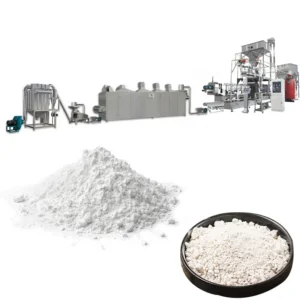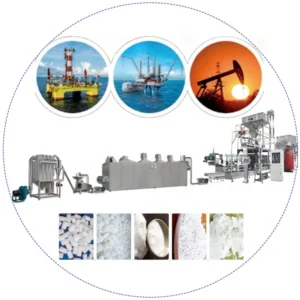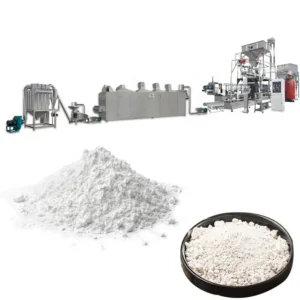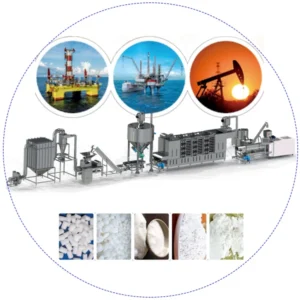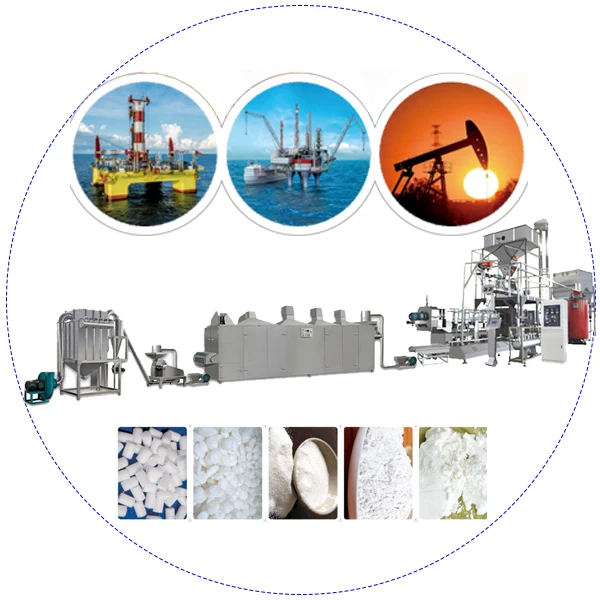


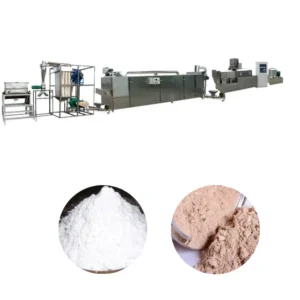
Modified Starch Extrusion Processing Line, Twin Screw, 380V/50Hz, 100 kW — engineered as a complete turnkey project from batching through extrusion, drying, conditioning and grinding, with throughput matched across every station to prevent bottlenecks.
- Screw configuration and die design specified to your raw starch type (corn, wheat, potato) and target gelatinization degree, ensuring precise expansion and density control
- Energy options across electricity, gas, diesel and steam; food-grade SS304 contact materials throughout
- CE certified line with in-house trial runs on your raw material before shipment, full layout documentation and operator training included
Record ID: 8058
Description
Engineered Throughput Balance — Every station in this modified starch processing line is capacity-matched from mixer through grinder, eliminating the bottleneck effect that plagues lines assembled from mismatched vendors.
Technical Specifications
| Parameter | Value |
|---|---|
| Product Type | Modified Starch Extrusion Processing Line |
| Screw Type | Twin screw |
| Output Capacity | 80–500 kg/h (basis not stated in source — confirm raw material type, moisture content, starch variety) |
| Main Extruder Power | approx. 100 kW (electric heating); approx. 50–60 kW (gas or diesel heating) |
| Mixer Motor | 4.0 kW |
| Mixer Dimensions | 1.2 × 0.9 × 1.4 m |
| Mixer Batch Output | 3.0–4.0 kg/batch (basis not stated in source — confirm cycle time) |
| Screw Conveyor Motor | 1.1 kW |
| Screw Conveyor Dimensions | 2.5 × 0.6 × 2.3 m |
| Screw Conveyor Throughput | 0–150 kg/h (basis not stated in source — confirm bulk density) |
| Frame Material | Stainless steel 201 |
| Contact Material | Food-grade stainless steel 304 |
| Energy Options | Electricity / Gas / Diesel / Steam |
| Electrical Standard | Siemens motor (China-made) or equivalent China top brand; Delixi or Delta inverter |
| Voltage & Frequency | Three-phase 380V/50Hz; Single-phase 220V/50Hz (configurable to local supply) |
| Process Flow | Mixer → Screw Conveyor → Twin Screw Extruder → Shift → Air Conveyor → Dryer → Air Conveyor → Conditioning → Conveyor → Grinder |
| Assembly State | Complete line with all supporting equipment |
| Certification | CE |
Application Suitability
| Application | Material or Output |
|---|---|
| Food-grade modified starch production | Wheat flour, corn starch, potato starch for bakery, sauce and meat processing ingredients |
| Pregelatinized starch for industrial use | Corn and potato starch processed for paper coating, textile sizing and construction additives |
| Expansion of existing milling operations | Gelatinization line integrated downstream of starch refining or flour milling |
| Nutritional powder base processing | Pre-cooked starch intermediates for infant formula and fortified food blending |
What "80–500 kg/h" Actually Means on Your Starch
Capacity is only real when measured against your exact raw material and moisture condition.
I have watched lines ship out with a nameplate rating that looked solid on paper, then underperform by a wide margin once the buyer’s actual corn starch — with its particular amylose ratio and incoming moisture — hit the barrel. The gap between a generic capacity figure and what the line actually holds on your material is where projects stall. A modified starch processing line turnkey must be validated against your specific formulation before the extruder leaves the factory floor, not after it arrives and your production schedule is already burning days. [NEED_CITE: starch gelatinization behavior differences across corn wheat and potato sources]
Screw Configuration Matched to Starch Source
The twin-screw extruder at the heart of this modified starch processing line turnkey is not fitted with a default screw profile. The screw elements and die geometry are selected based on whether you are running corn starch with high amylose content, wheat flour with gluten interference, or potato starch with larger granule size. Each source demands a different shear intensity and residence time inside the barrel to reach target gelatinization without scorching or under-processing the material.
Barrel Temperature and Moisture Precision
Starch gelatinization depends on hitting a narrow temperature window while maintaining controlled moisture injection. The barrel zones on this extruder are managed independently, allowing operators to build a temperature profile that ramps gradually rather than shocking the material. Combined with pre-conditioning in the mixer, this approach keeps the starch granules swelling uniformly — which directly determines whether your pregelatinized output rehydrates cleanly or forms lumps when your customer dissolves it. [NEED_CITE: barrel temperature profiling for starch gelatinization in twin screw extruders]
Reading the Power and Heating Specs
The main extruder draws approximately 100 kW under electric heating, dropping to 50–60 kW when gas or diesel heating is selected. This difference matters for facilities where electrical capacity is constrained or where local fuel costs make thermal energy more economical. The mixer motor at 4.0 kW and screw conveyor at 1.1 kW represent relatively small draws, but the combined connected load across the full line — extruder, dryer, air conveyors, conditioner, grinder — requires a dedicated circuit with proper headroom. The Delixi or Delta inverter specification protects motors from surge damage during startup and allows speed adjustment on the conveyor to pace material flow between stations.
When Stations Are Mismatched
An extruder running at full output means nothing if the dryer cannot remove moisture fast enough, or if the grinder chokes on volume. I have seen lines where the extruder was sized correctly but the dryer was one model too small — the material piled up on the belt, residence time dropped, and the final moisture content drifted outside specification. On this modified starch processing line turnkey, every station from the mixer batch cycle through the grinder throughput is calculated together so that material flows continuously without queuing at any transfer point. [NEED_CITE: throughput balancing methodology across extrusion drying and grinding stations]
Why Procurement Consolidation Matters Here
The line is engineered and supplied as a single package rather than sourced from multiple equipment vendors. Throughput is calculated across all stations simultaneously, not quoted per machine in isolation. Screw and die configurations are documented against your specific starch variety and target gelatinization degree. An in-house testing workshop runs your raw material before shipment, producing a trial report that becomes the baseline for commissioning. Electrical schematics confirm voltage, frequency and control language for your facility before production begins. CE-certified construction with food-grade 304 stainless steel contact surfaces meets the hygiene requirements that starch ingredient buyers demand from their suppliers.
Documentation & Verification
- Line layout drawing showing station-by-station throughput calculation for your target capacity
- Screw and die configuration record tied to your starch source and gelatinization target
- Trial run report generated on your raw material in the testing workshop before dispatch
- Electrical schematic confirming voltage, frequency and control interface language for your market
- CE declaration of conformity covering the complete assembled line
- Wear parts list identifying screws, dies and seals with replacement intervals
Installation, Commissioning & Support
- Foundation plan accounts for the full line footprint including mixer, extruder, dryer and grinder spacing
- Power supply verification covers the three-phase 380V/50Hz configuration or your local equivalent before energizing
- Assembly sequence addresses the screw conveyor’s 2.5-meter length and dryer module rigging requirements
- First-run parameter setting establishes barrel temperatures, screw speed and moisture targets from trial run data
- Operator training covers inverter adjustment on the Delixi or Delta drives for conveyor pacing
- Wear parts inventory includes spare screw elements and die plates matched to your configuration
Preparing Your Inquiry
To move from a general specification to a line layout that fits your facility, share your starch source — corn, wheat, potato or a blend — along with incoming moisture content and target gelatinization degree. Confirm your local voltage and frequency so the electrical package is built correctly from the start. If you have existing upstream milling or downstream packaging equipment, provide the interface points so the conveyor transfers align with your current floor layout.
Frequently Asked Questions
Q: How is line capacity verified against my specific starch raw material?
A: The 80–500 kg/h range depends on starch type, moisture content and target gelatinization degree. Before shipment, your raw material runs through the in-house testing workshop where extruder parameters are adjusted until the output meets specification. The resulting trial report documents actual throughput on your material and becomes the commissioning baseline.
Q: How are screw and barrel settings adjusted for different starch sources?
A: Corn starch, wheat flour and potato starch each require distinct screw element arrangements, die geometries and barrel temperature profiles. High-amylose corn starch needs longer residence and higher shear, while potato starch with larger granules requires gentler handling. Configuration is documented per your material before the extruder is assembled.
Q: How is throughput balanced between extruder, dryer and grinder?
A: Each station is sized against the extruder’s actual output on your material, not a generic nameplate figure. The dryer belt speed and length are matched to remove the required moisture within the available residence time, and the grinder is selected to handle peak output without choking or overheating.
Q: What electrical details are confirmed before the line ships?
A: Voltage, frequency, plug type and control panel language are all confirmed during the specification phase. The electrical schematic is reviewed with you before production so that the Siemens or equivalent motors, Delixi or Delta inverters and all wiring match your facility’s supply and your operators’ language requirements.
Q: What does the pre-shipment trial run actually cover?
A: Your raw material is processed through the extruder at the testing workshop. The trial documents barrel temperature settings, screw speed, moisture addition rate, gelatinization degree achieved and output rate. This report ships with the line and serves as the starting point for on-site commissioning rather than beginning parameter development from scratch.
Related products
-
Automatic Modified Starch Making Machine Oil Drilling Starch Processing Production Line
¥30.00 Select options This product has multiple variants. The options may be chosen on the product page -
Twin-Screw Extrusion Line for Modified Starch. Producing Pregelatinized Adhesive & Food Grade Powder
¥65.00 Select options This product has multiple variants. The options may be chosen on the product page -
Modified Starch Production Line Industrial Drilling Twin Screw Extruder 304 Stainless Steel High Efficiency Flour Mill CE
¥50.00 Select options This product has multiple variants. The options may be chosen on the product page -
Modified Starch Production Line Modified Starch Processing Line Modified Starch Extruder
¥8,580.00 Select options This product has multiple variants. The options may be chosen on the product page