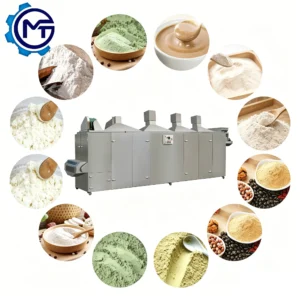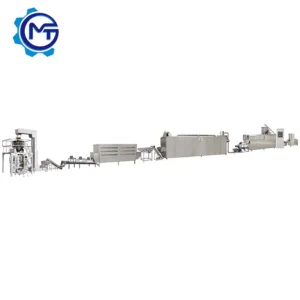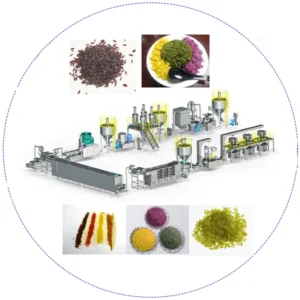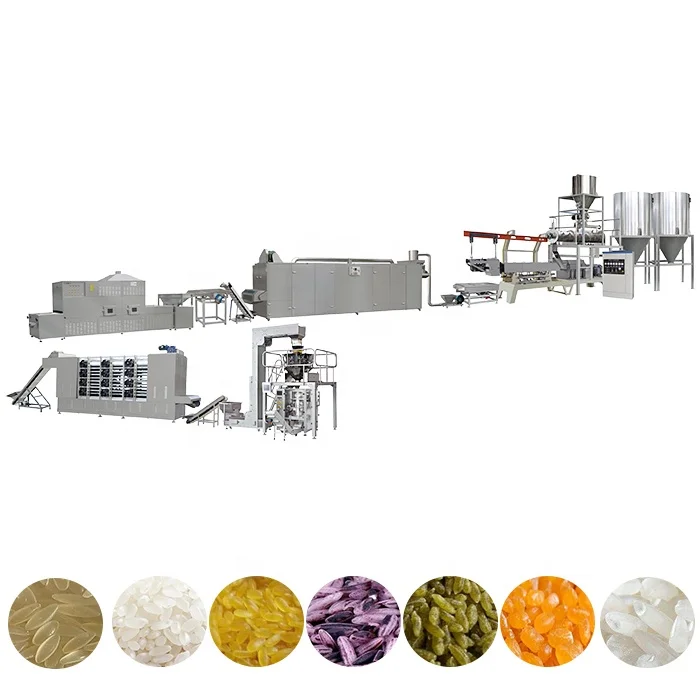



Nutritional Instant Rice Porridge Production Line, Twin-Screw Extruder, 7-Layer Dryer — engineered as a complete turnkey project where every station from mixing through extrusion, drying, and cooling is throughput-matched under one supplier to eliminate bottlenecks.
- Twin-screw extrusion with screw and die configuration specified to raw material blend (rice, buckwheat, broken rice, nutrient additives) for precise granule density and shape control
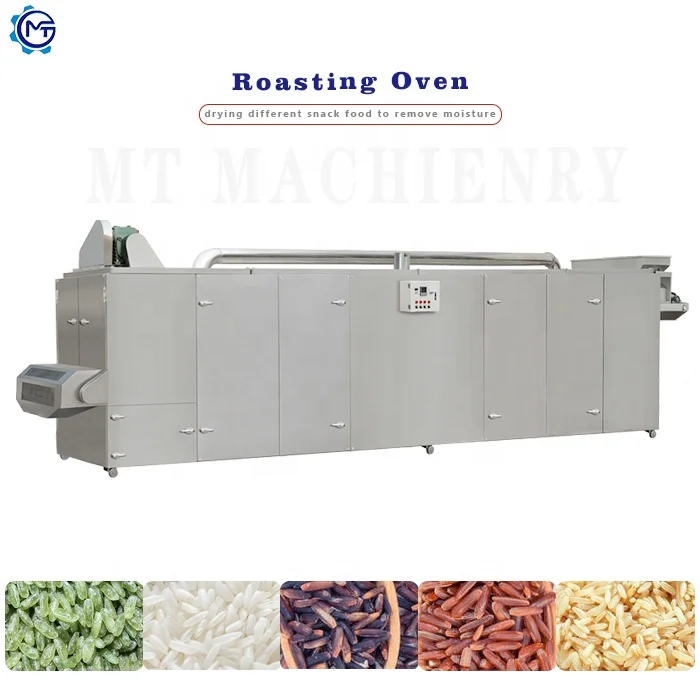
- Seven-layer, 8-meter dryer with 0–200 °C adjustable temperature and food-grade stainless steel mesh belt, capacity matched to extruder output
- Full line integration: mixing → screw conveying → extrusion → vibrating screen → air conveying → drying → cooling
Trial runs on buyer’s actual raw material are conducted in-house before shipment, with layout, electrical schematic, and screw configuration documented for every project.
Description
Throughput-Matched Line Design — Every station from the batching system through the twin-screw extruder to the seven-layer dryer is calculated as one integrated project, so no single unit silently caps your real output below the quoted line capacity.
Technical Specifications
| Parameter | Value |
|---|---|
| Product Type | Nutritional Instant Rice Porridge Production Line |
| Machine Type | Double screw extruder machine (twin-screw) |
| Construction Material | Food grade stainless steel 201/304 |
| Energy Source Options | Electricity / Gas / Diesel / Steam |
| Electrical Components | Siemens motors (China) or top Chinese brand; Delixi or Delta inverter |
| Control System | Dedicated control cabinet for extruder; separate control cabinet for oven temperature |
| Oven Type | Multi-layer electric oven, temperature range 0–200 °C adjustable |
| Oven Construction | Stainless steel double-layer mesh belt |
| Drying Configuration | Seven-layer, 8-meter dryer (basis to be confirmed) |
| Line Stations | Mixing machine → Screw conveyor → Twin-screw extruder → Vibrating screen → Blower/Elevator → Multi-layer oven → Cooling conveyor |
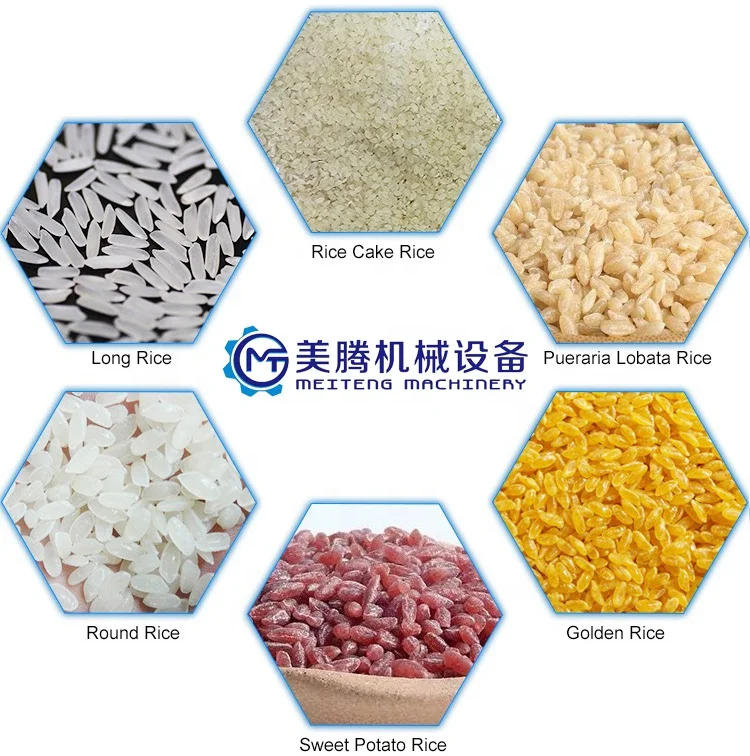
| Raw Material Compatibility | Rice, black rice, buckwheat, broken rice, rice bran, other grains, added vitamins and minerals |
| Standards | CE, ISO |
Application Suitability
| Application | Material or Output |
|---|---|
| Fortified instant rice porridge for nutrition programmes | Rice and broken rice blended with vitamins and minerals |
| Value-added products from milling by-products | Broken rice and rice bran reprocessed into instant porridge granules |
| Engineered nutritional rice | Cereals, fruits, vegetables, and seafood-based raw material blends |
| Breakfast cereal and instant porridge expansion | Buckwheat, black rice, and multi-grain formulations |
Why Quoted Capacity Rarely Survives the First Production Run
A line rated on paper often delivers less on the buyer’s actual grain blend because throughput depends on raw material behaviour, not nameplate figures.
In projects across the Middle East and North Africa, I have watched nutritional instant rice porridge production line installations stall within the first week — not because the extruder failed, but because the formula used on-site had a higher starch viscosity than the one used for the original capacity quote. The extruder choked on feed, and the dryer sat half-empty. Capacity claims only hold when they are tied to a specific raw material, moisture content, and target granule density [NEED_CITE: starch gelatinisation behaviour across rice cultivars]. Without a documented trial on the buyer’s real blend, every throughput number remains an estimate.
How the Turnkey Layout Prevents Station-Level Bottlenecks
A nutritional instant rice porridge production line designed as a single turnkey project treats every station — mixing, screw conveying, extrusion, vibrating screening, air conveying, drying, and cooling — as a linked chain rather than a set of independent machines. When the twin-screw extruder pushes output at a certain rate, the seven-layer, 8-meter dryer must have enough belt area and residence time to handle that exact volume. If one station is undersized, the entire line throttles down. Matching throughput at the design stage removes this hidden ceiling.
Raw Material Testing Before the Line Leaves the Factory
The in-house testing workshop runs the buyer’s actual rice, buckwheat, or broken rice blend through a twin-screw extruder before the production line is finalised. Screw configuration, die geometry, barrel temperature profile, and moisture addition are all adjusted during this trial. The result is a documented trial run report showing real output, granule shape, and density on the specific formula the buyer will use — not a generic benchmark [NEED_CITE: food extrusion trial protocols for grain-based products].
Reading the Specs That Actually Matter
The twin-screw configuration is central to this line because it handles the wide variation in starch content and fibre levels found across rice, broken rice, buckwheat, and nutrient-fortified blends. Single-screw extruders struggle when viscosity shifts between batches. The food-grade stainless steel 201/304 contact surfaces meet hygiene requirements for nutritional and infant-adjacent products. Energy source flexibility — electricity, gas, diesel, or steam — lets the dryer adapt to local utility costs and availability. The dedicated extruder control cabinet and separate oven temperature cabinet keep operator adjustments isolated, reducing the chance that a drying parameter change accidentally alters extrusion screw speed.
What Happens When the Dryer Is Undersized
An undersized dryer forces the extruder to slow down so that granules do not exit the belt still wet, leading to clumping, microbial risk, and shelf-life failures. In one project I supported, a line ran at barely half its expected output for three months before the buyer realised the dryer belt length was the constraint, not the extruder motor. Correcting the mismatch required a longer dryer and reconfigured air conveying ducts [NEED_CITE: drying capacity matching in grain extrusion lines]. These retrofits cost far more than specifying the right dryer at the quotation stage.
Why Buyers Source This Line From One Supplier
Sourcing the full nutritional instant rice porridge production line from a single supplier means throughput calculations cover every station, not just the extruder. Screw configuration and die design are specified to the buyer’s raw material and target granule shape rather than copied from a generic build. The in-house testing workshop validates the formula before shipment, so product development does not start only after installation. Pre-sales consultation extends through layout engineering, on-site installation, commissioning, and operator training. CE and ISO certification underpin the build quality for export markets with strict machinery directives [NEED_CITE: CE machinery directive requirements for food processing equipment].
Documentation & Verification
- Line layout and capacity calculation showing throughput matching across extruder, dryer, and cooling stations
- Trial run report on your specific rice, buckwheat, or broken rice blend before dispatch
- Electrical schematic with voltage, frequency, and control language confirmed for your market
- Screw and die configuration record matched to your target granule density and shape
- Factory test record and packing photographs for customs and receiving inspection
Installation, Commissioning & Support
- Foundation and floor space planning based on the seven-layer, 8-meter dryer footprint and extruder weight
- Dedicated electrical circuit sized to the line’s rated power and local voltage and frequency
- On-site assembly of air conveying ducts and mesh belt alignment for the multi-layer oven
- First-run parameter setting for barrel temperature, screw speed, and die selection on your raw material
- Operator training covering control cabinet operation, die changes, and daily cleaning procedures
- Wear parts list including screws, dies, and mesh belt sections with recommended replacement intervals
What We Need to Configure Your Line
To prepare an accurate layout and quotation, share your raw material formula including the ratio of rice, broken rice, buckwheat, or other grains, along with any vitamin or mineral additives. Specify your target daily output, workshop dimensions, and ceiling height. Confirm the local voltage, frequency, and preferred control language so the electrical cabinets are built to match from the start.
Frequently Asked Questions
Q: How is line capacity verified on my specific raw material blend?
A: Your actual rice, broken rice, buckwheat, or nutrient blend is run through a twin-screw extruder in the in-house testing workshop before the line is finalised. Screw configuration, barrel temperature, and moisture levels are adjusted during this trial. A documented report records real output, granule shape, and density on your formula.
Q: How is throughput matched between the extruder and the seven-layer dryer?
A: The dryer belt area, residence time, and temperature profile are calculated against the extruder’s verified output on your raw material. This ensures wet granules are fully dried without forcing the extruder to slow down, eliminating the most common bottleneck in grain-based extrusion lines.
Q: What voltage and control language configurations are confirmed before production?
A: The electrical schematic, motor ratings, inverter settings, and HMI language are confirmed against your local voltage, frequency, and operator requirements before the control cabinets are assembled. This prevents commissioning delays caused by mismatched power supply or unreadable interfaces.
Q: Can I run a trial on my raw material before the line ships?
A: Yes. The testing workshop conducts a full trial using your raw material blend, recording extruder behaviour, granule output, and drying results. You receive the trial run report before shipment, so formula adjustments are made at the factory rather than during on-site commissioning.
Related products
-

High Quality Automatic PLC Controlled 500kg/h Twin Screw Extruder Machine for Baby Rice Nutrition Powder
¥8,238.27 Add to cart -
CE cerelac Instant Baby Food Porridge Making Machine Production Line
¥35,000.00 Select options This product has multiple variants. The options may be chosen on the product page -

New Automatic Nutritional Powder Making Machine for Baby Food Production Line
¥20.00 Select options This product has multiple variants. The options may be chosen on the product page -

Full Automatic Complete Baby Food Nutrition Powder Porridge Processing Production Line for Infant Nutrition Factory
¥9,500.00 Add to cart