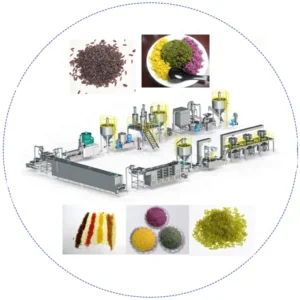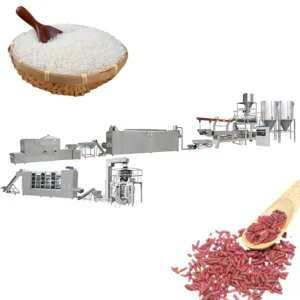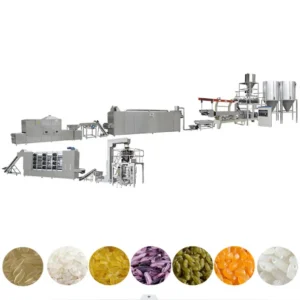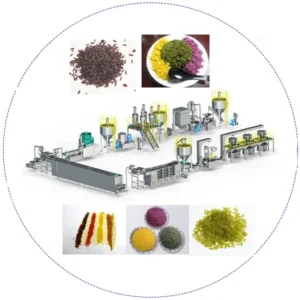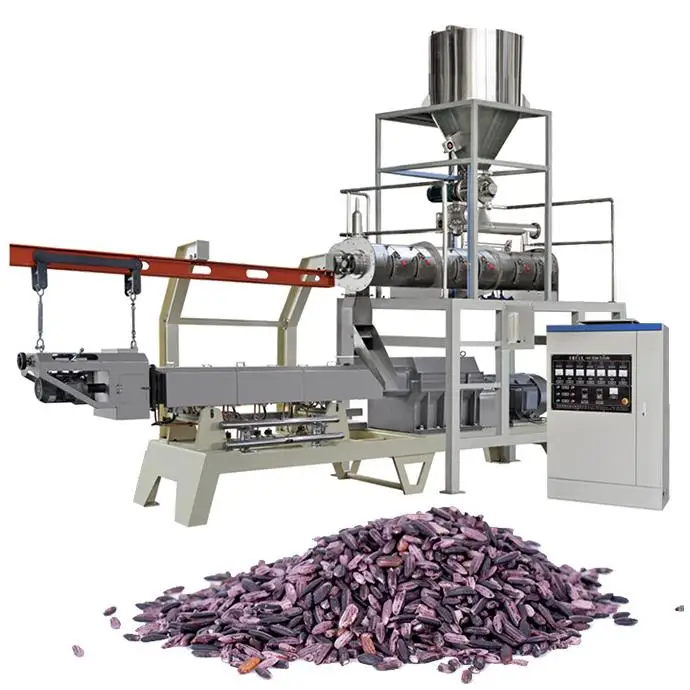


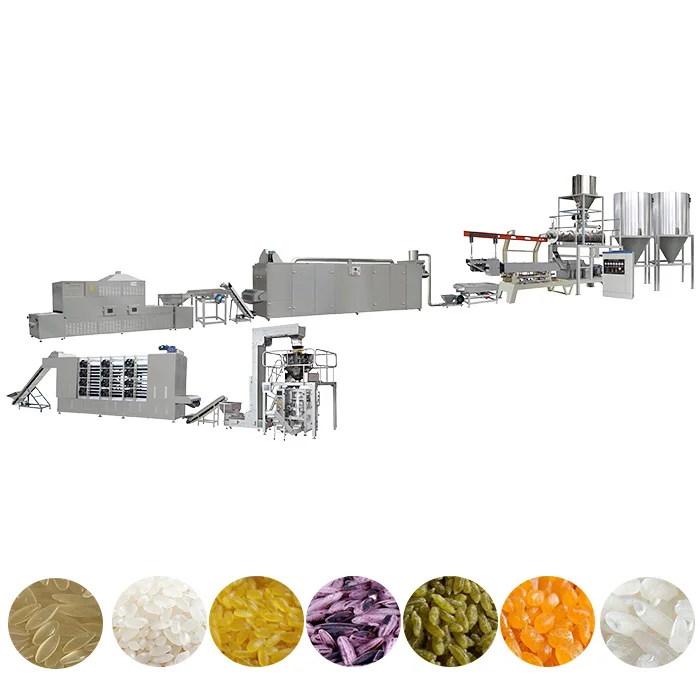
Nutritional Fortified Rice Production Line, Twin-Screw Extrusion, PLC Control — engineered as a complete turnkey project from batching through extrusion, drying, roasting, cooling and packing. Every station is throughput-matched under one supplier, with screw configuration and die design specified to your ingredient blend and target kernel density. In-house trial runs on your actual raw material are completed before shipment to confirm product parameters.
- Line sequence: mixing → extruding → vibrating → low-temperature drying → cooling → high-temperature roasting → cooling → packing
- Circulation drying oven with frequency-controlled mesh belt minimizes moisture differential
- Single or double screw feeding system selected per material uniformity
- CE and ISO certified, supporting fortified food and nutrition programme supply
Description
End-to-end throughput matching — every station from batching to packing is calculated against the same target output, so the extruder never outruns the dryer or the cooler on a nutritional fortified rice production line turnkey project.
Technical Specifications
| Parameter | Value |
|---|---|
| Product Type | Nutritional Fortified Rice Extrusion Line |
| Screw Type | Twin-screw configuration |
| Installed Power Range | 85 kW to 260 kW depending on model selected |
| Power Consumption Range | 60 kW to 195 kW depending on model selected |
| Output Capacity | 80–100 kg/h (basis to be confirmed against raw material and moisture) |
| Output Capacity | 100–120 kg/h (basis to be confirmed against raw material and moisture) |
| Output Capacity | 200–300 kg/h (basis to be confirmed against raw material and moisture) |
| Output Capacity | 300–500 kg/h (basis to be confirmed against raw material and moisture) |
| Output Capacity | 800–1000 kg/h (basis to be confirmed against raw material and moisture) |
| Overall Dimensions (L×W×H) | 28×1.2×2.2 m to 36×3.5×4.3 m depending on model |
| Control System | Frequency speed control with high automation level |
| Speed Regulation | Frequency inverter for stable extrusion performance |
| Lubrication System | Automatic lubricating and cooling circuit |
| Feeding System | Single or double screw feeding, selected per material uniformity requirement |
| Screw Material | Special wear-resistant alloy |
| Dryer Heating Source | Electric or gas, configured to site utility availability |
| Dryer Type | Circulation mesh-belt drying oven with frequency motor speed control |
| Line Station Sequence | Mixing → Extruding → Vibrating → Low Temperature Drying → Cooling → High Temperature Roasting → Cooling → Packing |
| Certification | CE compliant, ISO certified manufacturing |
Application Suitability
| Application | Material or Output |
|---|---|
| Nutritional fortified rice kernel production | Broken rice, rice bran, corn, millet, wheat, oats, buckwheat blended with vitamins and minerals |
| Artificial rice manufacturing | Starch-based formulations with micro-nutrient fortification additives |
| Purple sweet potato rice processing | Purple sweet potato flour blended with rice and grain bases |
| Fortified food and nutrition programme supply | Government or NGO specification rice kernels with defined vitamin and mineral profiles |
| Reconstituted multi-grain rice kernels | Multi-grain blends including bean, oat, and buckwheat with added nutritional premix |
Why Nominal Line Capacity Fails on Actual Raw Material
A nutritional fortified rice production line turnkey quoted at a single throughput figure often cannot sustain that rate when the buyer’s specific grain blend and moisture content enter the extruder. The only capacity number that matters is the one proven on your exact formulation under controlled test conditions.
I spent two days on a Southeast Asian site watching extruded rice pile up on a conveyor because the drying section could not keep pace with the extruder running at full speed. The supplier had matched stations by catalogue ratings, not by material behaviour. When the rice bran ratio in the blend increased, extrusion output climbed but drying time needed to increase as well — and the mesh-belt oven had no headroom left [NEED_CITE: material moisture migration rates during multi-stage drying of extruded rice kernels]. That line sat idle while we recalculated every station.
Matching Every Station to the Material, Not the Brochure
A complete nutritional fortified rice production line turnkey project requires throughput calculation at each station based on the buyer’s actual ingredient blend, target kernel density, and final moisture specification. The extruder, vibrating conveyor, low-temperature dryer, high-temperature roaster, cooling belt, and packing station must each handle the same mass flow — adjusted for moisture loss at the drying and roasting stages.
When a buyer specifies a blend containing rice bran, buckwheat, and a vitamin premix, the extrusion behaviour changes compared to pure broken rice. The screw configuration must account for the fibre content and gelatinisation temperature of each component. This is where the nutritional fortified rice production line turnkey approach pays off: one supplier calculates the entire line, not separate vendors each optimising their own station in isolation.
Trial Runs Before Shipment Eliminate Guesswork
Running the buyer’s raw material through the extruder in a dedicated testing workshop confirms whether the screw geometry, die design, and barrel temperature profile produce the target kernel shape and density. Moisture content at the die exit, expansion ratio, and kernel integrity after drying are all measured before the line is approved for dispatch [NEED_CITE: twin-screw extrusion parameters affecting rice kernel expansion and density].
This pre-shipment trial also validates that the drying oven residence time and temperature profile match the extruder output rate. If the trial reveals that a particular grain blend requires longer low-temperature drying to prevent surface cracking, the oven length or belt speed is adjusted before the equipment leaves the factory.
How Screw Configuration and Power Rating Shape the Kernel
The twin-screw extruder in this line uses wear-resistant alloy screws with geometry specified to the buyer’s grain formulation. The screw profile controls residence time and shear intensity inside the barrel, which directly determines starch gelatinisation degree and final kernel texture. A blend high in rice bran requires different screw pitch and compression ratio compared to a pure starch formulation.
Installed power ranges from 85 kW to 260 kW across the model range, with actual power consumption between 60 kW and 195 kW. The frequency inverter allows the operator to adjust screw speed within a stable operating window, maintaining consistent kernel density across production runs. The automatic lubricating and cooling system protects the screw shaft bearings during extended runs at high torque. The choice between single and double screw feeding depends on material uniformity — a vitamin-mineral premix blended with milled grains typically requires double screw feeding to ensure even ingredient distribution into the extruder barrel.
What Happens When Stations Are Mismatched
When the extruder pushes material faster than the mesh-belt dryer can handle, semi-dried kernels accumulate and begin sticking together. The result is uneven moisture distribution — some kernels over-dry and crack while others remain too wet for the roasting stage. Downstream, the packing station receives product outside specification, and the rejection rate climbs without any single machine showing a fault code [NEED_CITE: consequences of throughput mismatch in multi-stage food extrusion lines].
The buyer then faces a choice: slow the entire line to match the bottleneck station, or invest in additional drying capacity after the fact. Neither option was in the original project budget. This is why station-by-station throughput calculation based on actual material behaviour is not optional — it is the foundation of a working line.
Why Procure This Line From a Single Source
Every station from mixing through packing is engineered by one team, so throughput matching is calculated internally rather than negotiated between vendors. The screw and die configuration is specified to the buyer’s grain blend and target kernel shape, not copied from a generic build file. An in-house testing workshop runs the buyer’s raw material before shipment, confirming extrusion parameters, drying profile, and kernel integrity. The line supports applications from standard fortified rice to purple sweet potato and multi-grain formulations. Pre-sales engineering, installation supervision, commissioning, and operator training are delivered under a single project scope, reducing coordination risk on site.
Documentation & Verification
- Line layout showing throughput calculation at every station for your target output
- Trial run report on your grain blend completed in the workshop before dispatch
- Screw and die configuration record matched to your ingredient formulation
- Electrical schematic with voltage and frequency confirmed for your destination market
- Operation and maintenance manual with wear parts list specific to your line configuration
- Factory test record documenting run parameters and kernel quality measurements
Installation, Commissioning & Support
- Foundation requirements sized to the line footprint of up to 36 m length and 4.3 m height
- Dedicated power circuit sized to installed load of up to 260 kW at confirmed voltage and frequency
- Equipment shipped in modular sections for assembly and alignment on site
- First-run parameter setting including barrel temperature profile, screw speed, and dryer belt speed
- Operator training covering feeding rate adjustment, die changeover, and moisture monitoring
- Wear parts inventory including replacement screws, dies, and mesh-belt sections
- Scheduled maintenance intervals for lubrication system checks and bearing inspection
What to Prepare Before Requesting a Quotation
To scope a nutritional fortified rice production line turnkey project accurately, provide the grain blend formulation with percentage breakdown, target daily output in finished kernel weight, available workshop floor area and ceiling height, local power supply voltage and frequency, and preferred dryer heating source. If you have an existing upstream milling system or downstream packing equipment, specify the interface requirements so the line layout accounts for connection points.
Frequently Asked Questions
Q: How is line capacity verified against my actual raw material blend and moisture content?
A: Before shipment, your grain formulation is run through the extruder in the testing workshop. Extrusion parameters, drying time, and kernel quality are measured at target throughput. The trial run report documents these results and confirms which model and screw configuration suits your blend.
Q: What is the phased installation and commissioning schedule for a complete line?
A: The line arrives in modular sections. Installation proceeds from the mixing station through extrusion, drying, roasting, cooling, and packing in sequence. Each station is commissioned individually before the full line runs continuously. Operator training runs in parallel with the commissioning phase.
Q: How is throughput matched between the extruder, dryer, roaster and packing station?
A: Each station is sized to handle the same mass flow, adjusted for moisture loss at drying and roasting stages. The calculation uses your target output and grain blend characteristics. The mesh-belt dryer speed and oven length are specified to match extruder output without material accumulation.
Q: Can the screw configuration be adapted for different fortified rice formulations?
A: Yes. Screw geometry and die design are specified to your ingredient blend, whether it is broken rice with vitamin premix, purple sweet potato flour, or multi-grain mixtures. Different formulations may require changes in screw pitch, compression ratio, and die aperture to achieve the target kernel shape and density.
Q: What utility planning is required for the full production line layout?
A: You need a power supply matching the confirmed voltage and frequency for installed loads up to 260 kW, a gas or electric supply for the dryer heating source, compressed air for pneumatic controls, and water for the extruder cooling circuit. The line layout document specifies connection points and consumption rates for each utility.
Related products
-
Commercial Stainless Steel Baby Rice Powder Grinding Mixing Machine
¥8,238.27 Select options This product has multiple variants. The options may be chosen on the product page -

High Precision Automatic 500kg/h Baby Food Nutrition Powder Rice Extrusion Processing Line
¥8,238.27 Add to cart -
High Productivity New Condition Nutritious Baby Food Meal Replacement Powder Production Line
¥30.00 Select options This product has multiple variants. The options may be chosen on the product page -
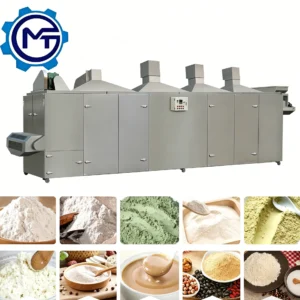
CE Approved MT Brand Organic Baby Rice Nutrition Powder Extrusion Production Line with 500kg/h Capacity and Automatic Grade
¥9,500.00 Add to cart