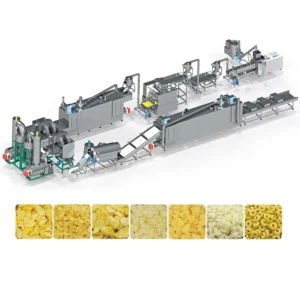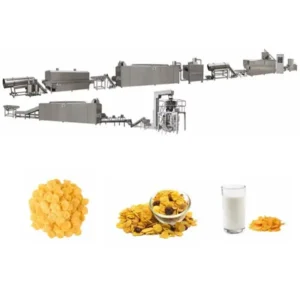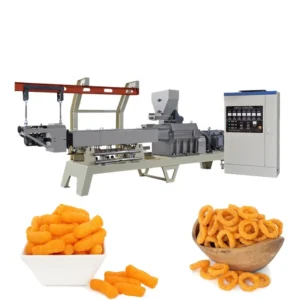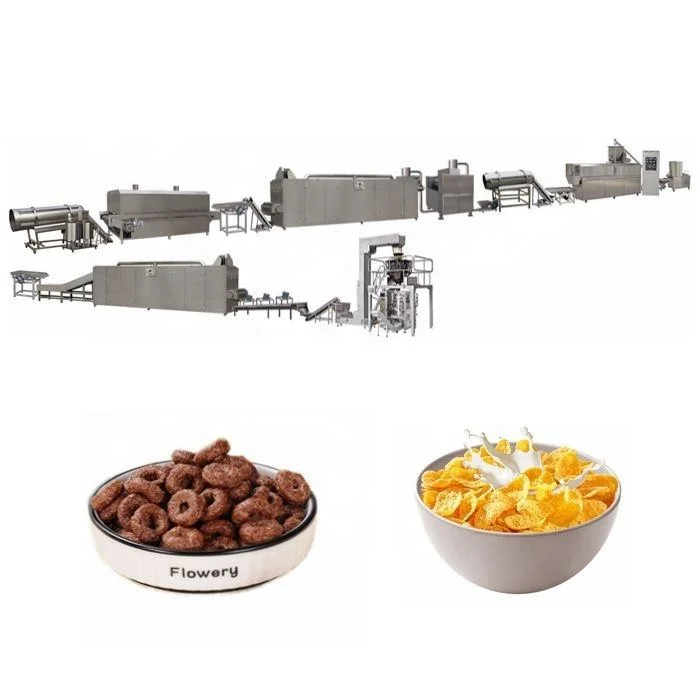


MT70 Corn Flakes Breakfast Cereal Production Line, Twin-Screw Extrusion, PLC Control — engineered as a complete turnkey project from batching through packing, with every station throughput-matched to eliminate bottlenecks at the flaker, dryer or coating drum.
- Twin-screw extruder paired with hydraulic flaking rollers and infrared temperature control for consistent flake density and thickness
- Hot air roasting oven with dual circulating fans and cyclone dust removal ensures uniform surface blistering
- Layout and capacity calculation designed to your factory footprint before production begins, with trial runs on your actual raw material confirmed prior to shipment
Description
Throughput-matched engineering — every station from the twin-screw extruder through the flaker, dryer, roasting oven and coating drum is specified so the weakest link never chokes the line.
Technical Specifications
| Parameter | Value |
|---|---|
| Model | MT70 |
| Product Type | Corn Flakes Breakfast Cereal Production Line |
| Screw Type | Twin-screw |
| Installed Power | 160 kW |
| Power Consumption | 120 kW |
| Output Capacity | 150–200 kg/h (basis not stated in source — confirm raw material and moisture content) |
| Overall Dimensions | 41 × 1.5 × 2.2 m |
| Control System | PLC |
| Flaking Machinery | Hydraulic double rollers, separate motor drive, infrared sensor temperature control |
| Dryer Heating Source | Gas or electric (configurable) |
| Hot Air Roasting Oven | Vibrating pan, high-temperature spray tubes, reconciliation burner, dual circulating fans, cyclone dust removal |
| Coating System (optional) | Double tumble sugar melter, elevator, coating drum, spray nozzle |
| Raw Materials | Corn, rice, wheat, oat, barley powder |
| Final Product Shapes | Ball, tube, stick, ring, fruit loop, star, wheel, flower, heart (via die change) |
| Extruder Features | Automatic lubrication, integrated cooling function |
| Assembly State | Complete turnkey line |
Application Suitability
| Application | Material or Output |
|---|---|
| Natural corn flakes production | Corn grits and corn flour, toasted to uniform crispness without coating |
| Sugar-coated or glazed corn flakes | Corn-based extrudate with sugar syrup sprayed and tumbled in coating drum |
| Multi-shape extruded breakfast cereals | Rice, wheat, oat or barley blends formed into rings, loops, stars and wheels by die adjustment |
| Puffed snack variants on same extruder platform | Grain-based formulations redirected to snack line downstream stations |
Why Quoted Line Capacity Rarely Survives Contact with Your Raw Material
A corn flakes production line turnkey only holds its rated output when every station is matched to the buyer’s actual grain source, particle size and moisture.
I once watched a line stall at barely half its nameplate capacity because the corn flour the buyer sourced locally was milled finer than what the supplier had tested with. The twin-screw extruder choked on feed, gelatinisation dropped off, and the flakes came out dense instead of blistered. Four days on the shop floor adjusting screw speed, barrel temperatures and feed rate finally stabilised it [NEED_CITE: effect of raw material particle size on twin-screw extrusion stability]. That is the gap between a quoted number and a running line. A corn flakes production line turnkey that skips raw material verification before shipment will always leave that gap for the buyer to close on their own time and budget.
How Throughput Matching Prevents Downstream Bottlenecks
The extruder is only the starting point. If the flaker cannot press the extrudate fast enough, material backs up in the conveyor. If the roasting oven lacks the circulating fan volume to blister flakes at the rate the dryer delivers them, moisture stays trapped and shelf life shortens. On this line, the MT70 extruder, the PLC-controlled hydraulic flaker, the dual-fan roasting oven and the optional coating drum are each specified against a shared throughput target so the corn flakes production line turnkey runs as one continuous flow rather than a chain of independent machines fighting each other.
What the Flaking and Roasting Stations Actually Control
Flake thickness is not cosmetic — it determines how quickly moisture leaves during roasting and how the final product feels in the mouth. The hydraulic double-roller flaker here uses separate motors for each roller and infrared sensors to hold surface temperature steady, which keeps thickness consistent across the belt width. Downstream, the hot air roasting oven uses a vibrating pan and high-temperature spray tubes with a reconciliation burner, so flakes receive even heat exposure rather than scorching at the edges while staying underdone in the centre [NEED_CITE: hot air roasting parameters for corn flake surface blistering].
Reading the Specs That Matter for Corn Flake Quality
The twin-screw configuration is chosen over single-screw for corn flake work because it handles the relatively high moisture content needed for proper starch gelatinisation without surging. The 160 kW installed power on the MT70 gives the screws enough torque to maintain stable pressure through the barrel zones even when feed moisture fluctuates. Automatic lubrication and integrated cooling keep the gearbox and barrel sections within operating temperature during long runs. The PLC control ties screw speed, barrel heating zones and feed rate together, which is what allows an operator to dial in a recipe once and reproduce it across shifts without guessing at individual settings.
The Cost of Skipping the Trial Run
Buyers who accept shipment without a factory trial on their own raw material inherit every adjustment problem at their own site, where spare screws, die blanks and engineering time are harder to source. A corn grits formulation that behaves well in the supplier’s workshop may gelatinise differently when the local corn variety has a higher fat content or a different starch ratio. Without that trial data in hand, commissioning stretches from days into weeks [NEED_CITE: commissioning delays caused by untested raw material substitutions].
What This Supplier Brings to the Project
Every station is sourced from one supplier, which means throughput accountability sits with one party rather than scattered across an extruder vendor, a dryer vendor and a coater vendor who each point at the other when output falls short. The screw configuration and die design are matched to the buyer’s stated raw material and target flake density, not copied from a generic build. The in-house testing workshop runs the buyer’s actual grain before the line ships, producing a documented trial report. Pre-sales engineering covers the line layout and utility plan, and on-site commissioning includes operator training so the crew knows how to adjust when raw material batches drift.
Documentation & Verification
- Line layout and capacity calculation showing station-by-station throughput matching for your corn flake target
- Trial run report on your specific corn, rice or wheat flour before dispatch
- Screw and die configuration record matched to your raw material and flake density specification
- Electrical schematic with voltage and frequency confirmed to your local grid standard
- Factory test record covering every station from mixer through packing
- Operation and maintenance manual with wear parts list for screws, dies and flaker rollers
Installation, Commissioning & Support
- Floor plan review against the 41 × 1.5 × 2.2 m line footprint to confirm utility drops and access clearance
- Dedicated circuit planning for the 160 kW installed load with voltage and frequency matched to site supply
- Mechanical assembly of flaker hydraulic system and roasting oven vibrating pan on arrival
- PLC parameter setup including barrel zone temperatures, screw speed and infrared sensor calibration
- Operator training covering recipe dial-in, die changeover and daily lubrication of the twin-screw extruder
- Wear parts schedule for screws, dies and flaker roller surfaces with recommended replacement intervals
What We Need to Scope Your Line Accurately
Send the specific grain type and milling specification you plan to run, your target daily output in kilograms, and the available floor area and ceiling height in your production hall. Confirm the local voltage, frequency and any control language requirements for your operators. If you have existing upstream batching or downstream packing equipment, share the interface details so the line layout accounts for them from the start.
Frequently Asked Questions
Q: How is the line capacity verified on my raw material, and what is the documented basis for the quoted output?
A: Before shipment, your actual corn, rice or wheat flour runs through the twin-screw extruder and flaking stations in the testing workshop. The resulting trial report documents output rate, flake thickness and moisture at each stage, so the quoted capacity reflects your material rather than a generic benchmark.
Q: How do you match throughput between the extruder, flaker, dryer and coating drum so no station bottlenecks the line?
A: Each station is specified against a shared throughput target during the layout phase. The MT70 extruder output is cross-referenced with flaker roller speed, dryer belt residence time and roasting oven fan volume to confirm no single machine restricts the flow upstream or downstream.
Q: Can the same extruder produce both natural and sugar-coated corn flakes, as well as other cereal shapes?
A: Yes. The twin-screw extruder handles both natural and coated formulations. Adding the sugar coating system — double tumble melter, elevator and spray drum — extends the product range. Changing the die produces rings, loops, stars and other shapes on the same platform.
Q: What factory layout and utility planning is provided before the equipment ships?
A: A line layout drawing is prepared against your factory footprint showing every station position, utility connection point and material flow path. Voltage, frequency and control language are confirmed before production begins so the electrical schematic matches your site supply.
Q: What does on-site installation, commissioning and operator training cover?
A: Engineers assemble and align every station, calibrate the PLC parameters and infrared sensors, and run production trials with your raw material. Operators are trained on recipe setup, die changeover, daily lubrication routines and the wear parts replacement schedule.
Related products
-
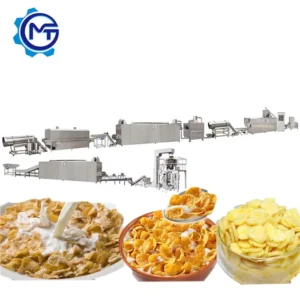
Sweet Corn Flakes Maize Breakfast Cereal Full-automatic Food Grade Stainless Steel Heat Exchanger Mixer Fryer Processing Line
¥8,000.00 Add to cart -

Small Scale Breakfast Cereal Manufacturing Machine for Corn Flakes Process Line
¥45,000.00 Select options This product has multiple variants. The options may be chosen on the product page -

200kg/h Breakfast Cereal Extruder Making Machine Hot Sale Corn Flake Production Line
¥30,000.00 Select options This product has multiple variants. The options may be chosen on the product page -
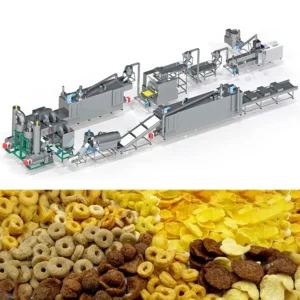
Corn Flakes Breakfast Cereal Production Line Making Machine Automatic
¥8,000.00 Select options This product has multiple variants. The options may be chosen on the product page