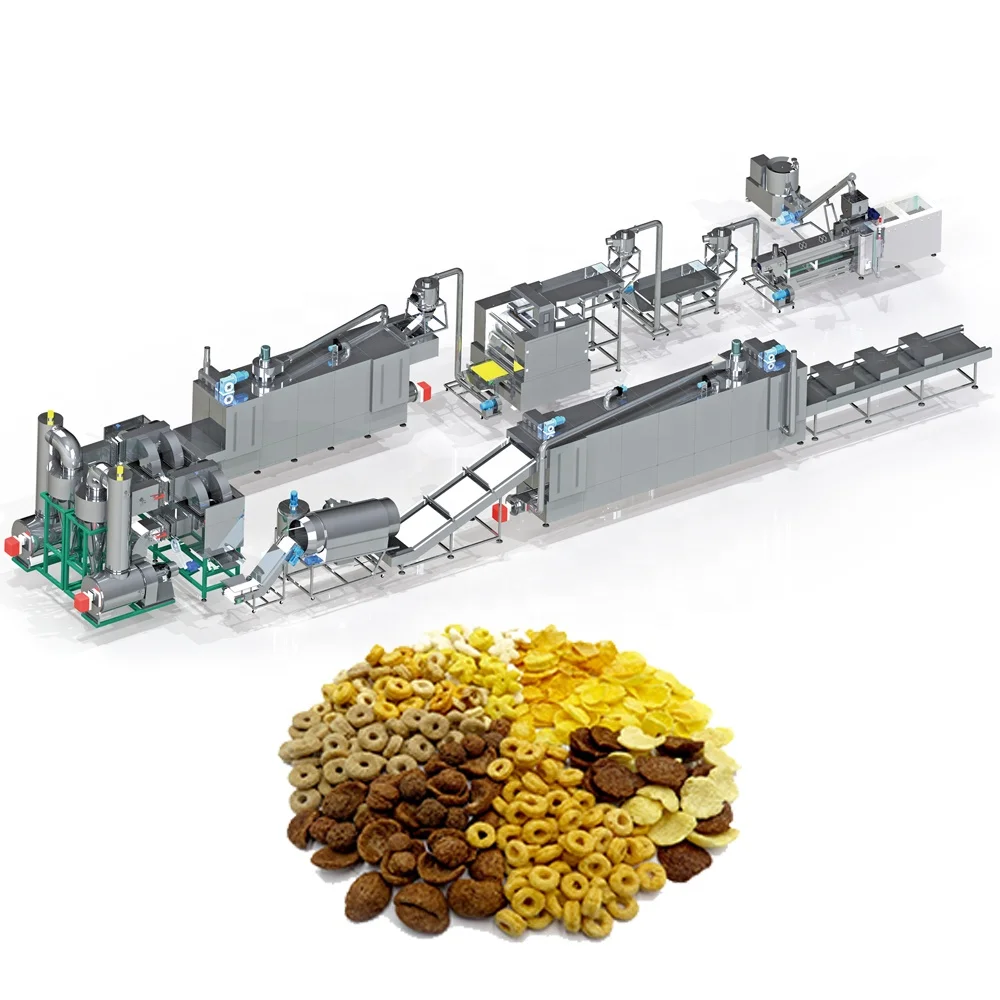

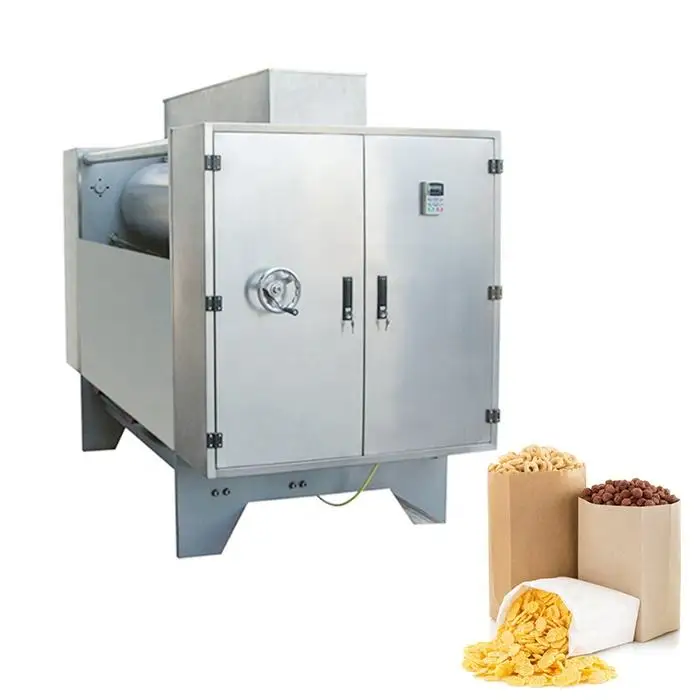



MT75 Corn Flakes Breakfast Cereal Production Line, Twin Screw, PLC Control — complete turnkey system from mixing through extruding, flaking, drying, roasting, coating, cooling to packing. Hydraulic double-roller flaking with infrared temperature sensing delivers consistent flake thickness, while hot air roasting with cyclone dust removal controls surface blistering for target crispness across natural and sugar-coated formats. Every station throughput-matched in layout calculation, with in-house trial run on customer raw material before shipment to verify output on actual formulation.
Description
Throughput-Matched Line Engineering — Every station from extruder to packer is calculated against your actual raw material so the corn flakes production line turnkey project runs without bottlenecks.
Technical Specifications
| Parameter | Value |
|---|---|
| Model | MT75 |
| Product Type | Corn Flakes Breakfast Cereal Production Line |
| Screw Type | Twin Screw |
| Installed Power | 210 kW |
| Power Consumption | 150 kW |
| Output Capacity | 300–500 kg/h (basis not stated in source — confirm raw material, moisture content and product format) |
| Overall Dimensions | 45 × 1.5 × 3.5 m |
| Control System | PLC control system (flaking machinery); MCC and PLC available for line |
| Flaking Drive | Double motors for separate roller driving; hydraulic system for double rollers |
| Flaking Temperature Control | Infrared sensor for even temperature pipe control |
| Dryer Heating Source | Gas or Electric |
| Roasting Oven | Hot air roasting with conciliation burner, two circulating fans, cyclone dust removal |
| Coating System | Double tumble for sugar melting, elevator, coating drum, spraying nozzle |
| Line Stations (Natural) | Mixing → Extruding → Flaking → Drying → Hot Air Roasting → Cooling → Packing |
| Line Stations (Sugar-Coated) | Mixing → Extruding → Flaking → Drying → Hot Air Roasting → Sugar Spraying → Coating → Drying → Cooling → Packing |
| Raw Materials | Corn, rice, wheat, oat, barley powder |
| Final Product Shapes | Ball, tube, stick, ring, fruit loop, star, wheel, flower, heart |
| Assembly State | Complete turnkey line |
| Standards | CE, ISO |
Application Suitability
| Application | Material or Output |
|---|---|
| Natural corn flakes for breakfast cereal packaging | Corn grits and corn flour |
| Sugar-coated flakes for retail cereal boxes | Corn, rice, or wheat base with sugar spray |
| Multigrain flakes with oat or barley blend | Oat, barley, wheat, rice powder blends |
| Puffed cereal shapes on shared extrusion front-end | Corn and rice blends for ball, ring, loop formats |
| Fortified breakfast cereal for nutrition programs | Grain base with added vitamin and mineral premix |
What a Nominal Capacity Figure Hides About Your Corn Flakes Production Line Turnkey
Real throughput only matters when measured on your exact formulation at your target moisture content.
I spent years in the testing workshop watching lines perform perfectly on standard corn grits, then lose half their output the moment a buyer switched to an oat-heavy blend. The extruder might push material through, but if gelatinisation drops because the starch profile changed, the flaking rollers produce crumbs instead of intact flakes. Downstream, the dryer runs empty while the roaster waits for product that never arrives in spec. The entire corn flakes production line turnkey project stalls because one station was sized for a different material. [NEED_CITE: starch gelatinisation requirements vary by grain type and moisture content]
Matching Extruder Output to Flaking and Drying Capacity
A corn flakes production line turnkey succeeds only when the extruder output rate, the flaker throughput, and the dryer residence time all align on the same material. The MT75 twin-screw extruder is rated at 300–500 kg/h depending on raw material and moisture, and every downstream station — hydraulic double-roller flaker, dryer, hot air roaster — must handle that same flow without accumulation or starvation. We calculate each station against your specific grain blend before the layout is finalized.
Layout Sequencing for Natural and Sugar-Coated Formats
The line supports both natural and sugar-coated configurations from a single front-end. Adding sugar spraying, coating drum, and a second drying stage extends the station count, which changes utility loads and floor space. We map both routes on one layout so you can switch formats without repositioning equipment. The PLC control system on the flaking machinery coordinates roller speed and temperature to maintain flake consistency across either path. [NEED_CITE: cereal line layout standards for multi-format production]
Reading the Specs That Actually Affect Flake Quality
The twin-screw configuration on the MT75 gives longer residence time and higher shear than a single-screw extruder, which matters when processing blends with oat or barley that gelatinise at different temperatures. The hydraulic double-roller flaking system with separate motor drives lets each roller be adjusted independently, controlling flake thickness down to the fraction of a millimeter. Infrared temperature sensing on the flaking station keeps the material at the right plasticity so flakes emerge intact rather than shattering. The roasting oven uses a conciliation burner with two circulating fans and cyclone dust removal to achieve even surface blistering — the characteristic crispness buyers expect in a breakfast cereal.
The Cost of Skipping Raw Material Trials Before Shipment
When a line ships without trial runs on your actual grain blend, the first production week becomes an expensive experiment. Screw configuration tuned for standard corn grits will under-process an oat-heavy mix, leaving starch partially ungelatinised. Flakes come off the rollers brittle, generating excess fines that clog the dryer airflow. The roaster then receives inconsistent feed, producing uneven color batch after batch. Correcting these issues on-site costs far more than adjusting the screw profile in the testing workshop before the equipment ever leaves the factory. [NEED_CITE: extrusion screw configuration matched to raw material starch composition]
Why Buyers Source This Line From a Single Supplier
Every station in the MT75 corn flakes line is specified under one layout calculation, so extruder output, flaker speed, dryer capacity, and roaster throughput are matched from the start rather than assembled from mismatched vendors. The in-house testing workshop runs your raw material through the extruder and flaker before shipment, confirming flake integrity and throughput. Screw and die configurations are documented and recorded against your specific blend. Electrical schematics confirm voltage, frequency, and control language before production begins, avoiding commissioning delays. Post-installation, wear parts lists ensure screw segments and die plates are available when first replacement is due.
Documentation & Verification
- Line layout and capacity calculation showing throughput at each station matched to your grain blend
- Trial run report on your specific corn, oat, or barley formulation before dispatch
- Screw and die configuration record tied to your raw material and target flake thickness
- Electrical schematic with voltage and frequency confirmed against your site supply
- Factory test record documenting extruder, flaker, and roaster performance on your material
- Operation and maintenance manual covering PLC parameters and hydraulic roller adjustment
Installation, Commissioning & Support
- Foundation planning accounts for the 45 m line length and roaster exhaust requirements
- Power supply must accommodate 210 kW installed load with dedicated circuits for extruder and flaker drives
- Line arrives in sectional assemblies for staged installation across mixing through packing stations
- Commissioning includes PLC parameter tuning and hydraulic roller pressure calibration on your material
- Operator training covers screw configuration changes for different grain blends and product shapes
- Wear parts inventory with first-replacement schedule for twin-screw segments and flaking rollers
What We Need to Configure Your Line
To build an accurate layout and capacity calculation, share your primary grain blend ratios, target moisture content at extrusion, and whether you plan to run natural, sugar-coated, or both formats. Confirm your site voltage and frequency, preferred control language for the PLC interface, and available floor dimensions. If you have existing upstream batching or downstream packing equipment, include those specifications so we can integrate the new line without interface gaps.
Frequently Asked Questions
Q: How is line capacity verified on my specific raw material and moisture content before shipment?
A: We run your exact grain formulation through the extruder and flaker in our in-house testing workshop. The trial records throughput, gelatinisation level, and flake integrity under controlled conditions. You receive a trial run report documenting actual performance, so the capacity figure you plan around reflects your material, not a generic benchmark.
Q: How do you match throughput across every station so nothing bottlenecks the corn flakes line?
A: Each station — extruder, flaker, dryer, roaster, coater, cooler — is calculated against the same target output on your raw material. If the extruder delivers a given flow rate, the dryer belt speed and roaster air volume are sized to handle that same rate without accumulation or idle time, keeping the entire line balanced.
Q: What does the phased installation and commissioning schedule look like?
A: The 45-meter line installs in stages, starting with the extrusion and flaking section, then dryer and roaster, followed by cooling and packing. Each phase includes mechanical assembly, electrical connection, and functional testing before the next section begins. Commissioning covers PLC parameter setup, hydraulic roller calibration, and production trials on your material.
Q: How are voltage, frequency, and PLC language confirmed before production starts?
A: During the specification stage, we collect your site electrical supply details and preferred interface language. The electrical schematic is drawn to match, and control components are sourced accordingly. This confirmation happens before the machine enters production, so no rewiring or reprogramming is needed during on-site commissioning.
Q: What operator training and wear parts support comes with the line?
A: On-site training covers PLC operation, screw configuration changes for different grain blends, hydraulic roller adjustment, and daily maintenance routines. A wear parts list identifies screw segments, die plates, and flaker roller surfaces with recommended replacement intervals. First-replacement parts can be included in the initial shipment to avoid downtime.
Related products
-

Hot Selling Automatic Corn Flakes Breakfast Cereal Production Line Making Machine
¥20,000.00 Select options This product has multiple variants. The options may be chosen on the product page -

Corn Flakes Production Line Breakfast Cereal Production Machine Line Corn Flake Making Machinery
¥59,800.00 Select options This product has multiple variants. The options may be chosen on the product page -

200kg/h Breakfast Cereal Extruder Making Machine Hot Sale Corn Flake Production Line
¥30,000.00 Select options This product has multiple variants. The options may be chosen on the product page -
Corn Flakes Breakfast Cereal Production Line Making Machine Automatic
¥8,000.00 Select options This product has multiple variants. The options may be chosen on the product page