

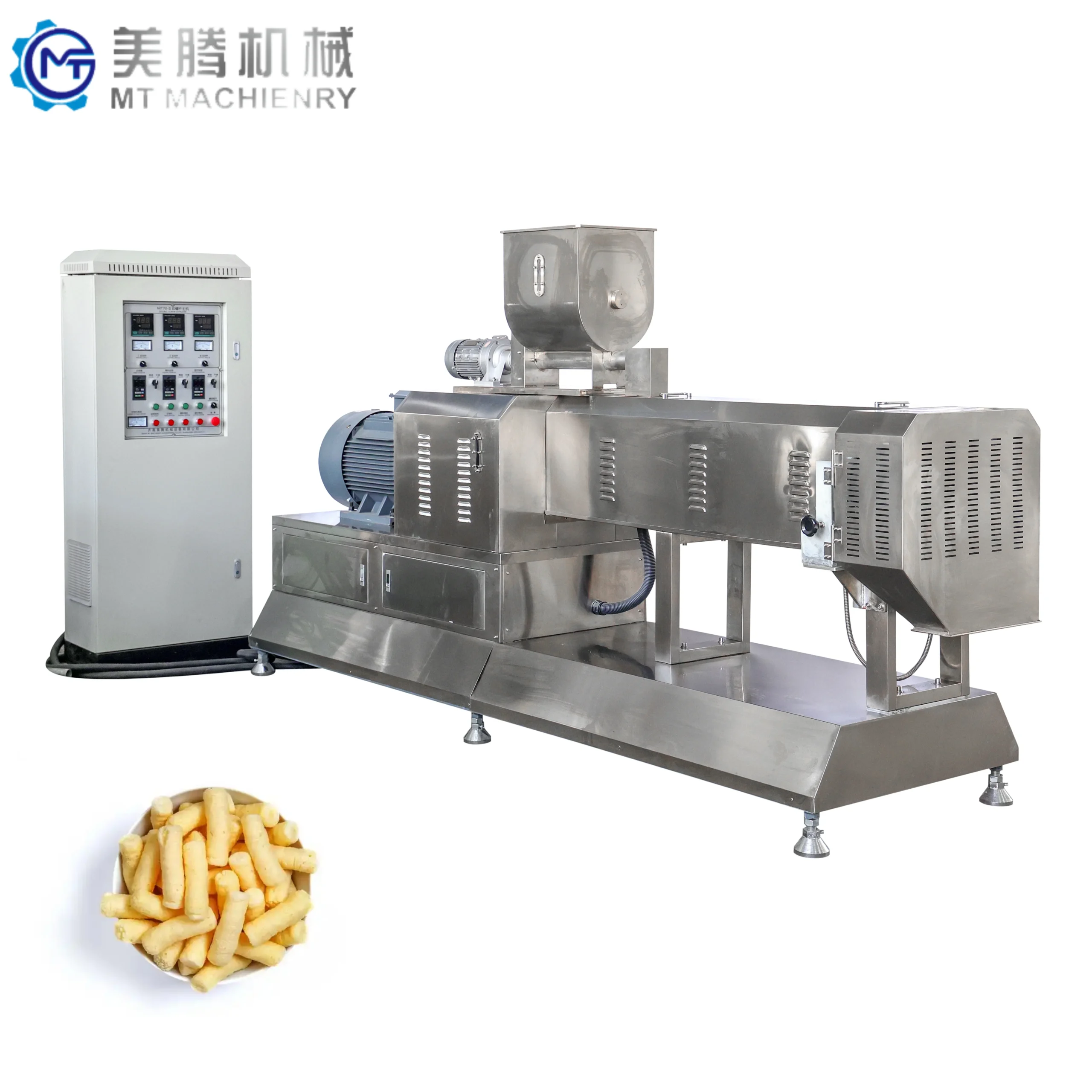
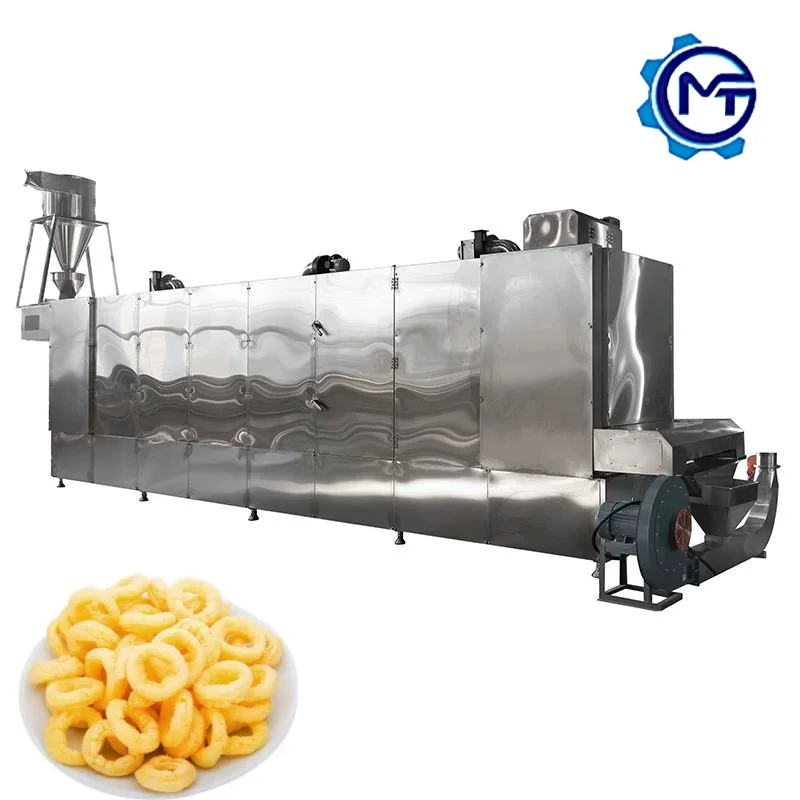
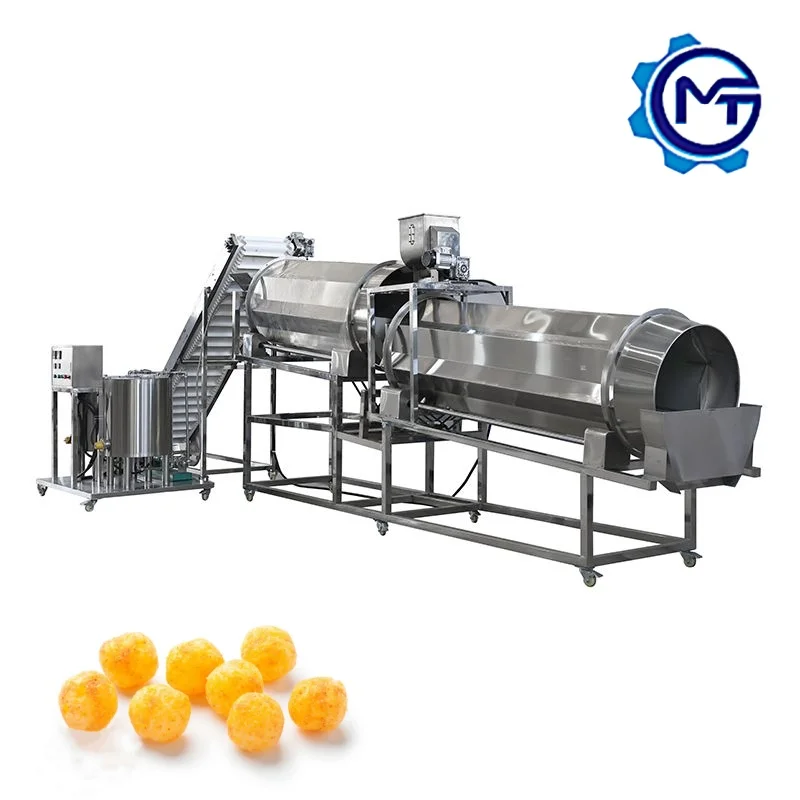
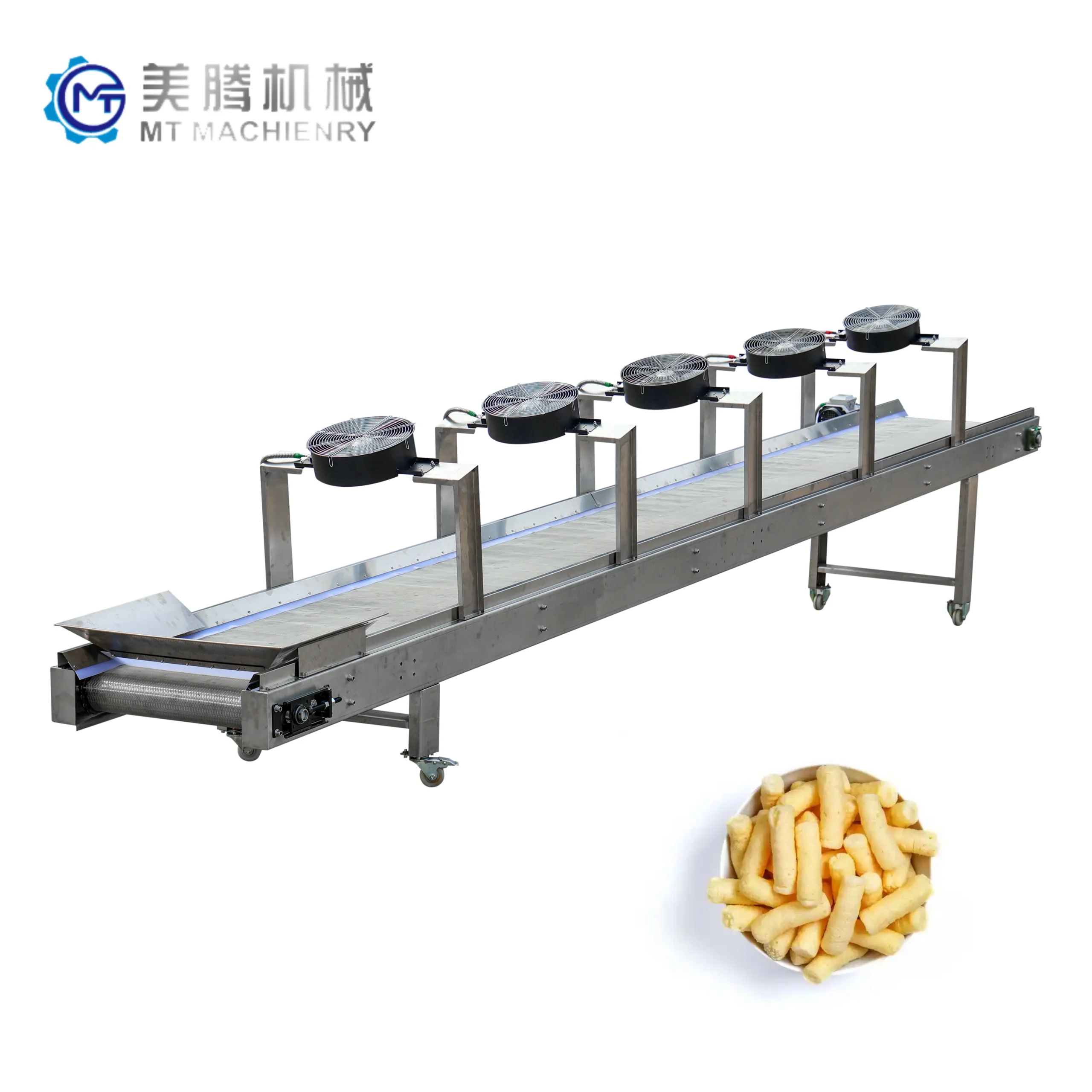
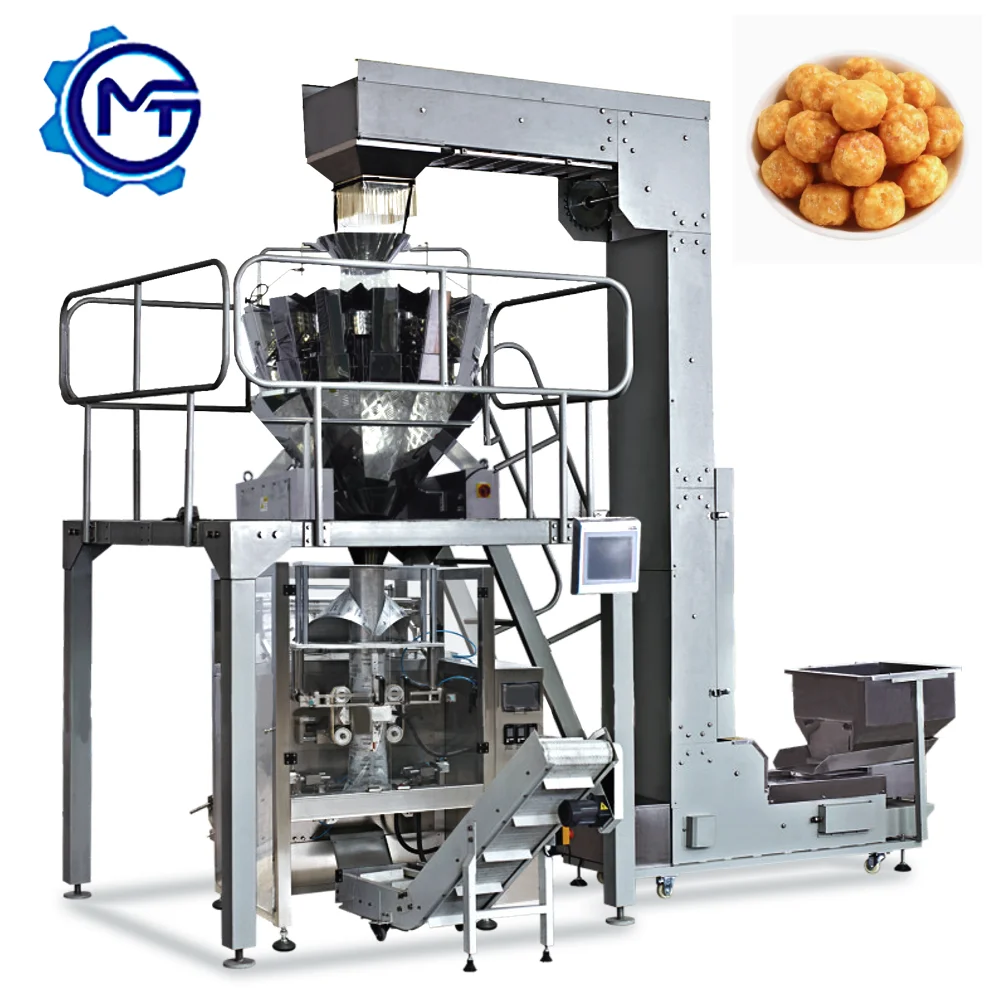
MT65, MT70, MT85, MT100 Corn Puff Extrusion Processing Line, Twin-Screw, 130–240 kW Installed Power — configured as a turnkey project from batching through packing.
- Screw and die configuration matched to raw material moisture and target puff density, with interchangeable dies for ring, stick, ball and fruit loop shapes
- Double drum flavoring line and drying station (electric, steam or gas) sized to match extruder throughput, preventing station-level bottlenecks
- Throughput verified across every station — layout, utility planning and operator training delivered under one project scope
In-house trial runs on customer raw material before shipment ensure the line produces to specification from day one.
Description
Integrated Line Engineering — Every station from material batching through extrusion, drying, flavoring, and packing is capacity-matched on a single layout drawing, preventing the bottleneck failures that occur when assembling a corn puff extrusion processing line turnkey from separate vendors.
Technical Specifications
| Parameter | Value |
|---|---|
| Product Type | Corn Puff Extrusion Processing Line |
| Models Available | MT65 / MT70 / MT85 / MT100 |
| Screw Type | Twin-screw |
| Installed Power (MT65) | 130 kW |
| Real Consumption (MT65) | 95 kW |
| Output Capacity (MT65) | 120–150 kg/h (basis not stated in source — confirm raw material type, moisture content and die shape) |
| Installed Power (MT70) | 180 kW |
| Real Consumption (MT70) | 120 kW |
| Output Capacity (MT70) | 200–300 kg/h (basis not stated in source — confirm raw material type, moisture content and die shape) |
| Installed Power (MT85) | 220 kW |
| Real Consumption (MT85) | 130 kW |
| Output Capacity (MT85) | 300–500 kg/h (basis not stated in source — confirm raw material type, moisture content and die shape) |
| Installed Power (MT100) | 240 kW |
| Real Consumption (MT100) | 160 kW |
| Output Capacity (MT100) | 600–800 kg/h (basis not stated in source — confirm raw material type, moisture content and die shape) |
| Control System | Frequency speed controlling system |
| Drying Heat Source | Electric / Steam / Gas (source value — verify against manufacturer catalog) |
| Die Shapes | Cheese ball, ball, tube, stick, ring, fruit loop, star, wheel, flower, heart |
| Flavoring System | Double drum with sugar melting and spraying nozzle |
| Core Filling | Optional add-on with cutting machine |
| Lubrication | Automatic lubricating and cooling system |
| Line Stations | Batching → Extruding → Drying → Coating/Flavoring → Cooling → Packing → Stacking |
| Certification | CE |
| Warranty | 1 year |
Application Suitability
| Application | Material or Output |
|---|---|
| Puffed corn snacks and cheese balls | Corn flour, corn grits at varying moisture levels |
| Extruded tubes, sticks, and rings | Rice flour, wheat flour blends |
| Fruit loops and star-shaped cereal pieces | Oat and barley flour formulations |
| Core-filled snack products | Grain-based outer shell with cream or jam filling |
| Multi-grain puffed snacks | Blended cereal formulations requiring twin-screw shear |
What "Rated Capacity" Actually Means on Your Shop Floor
A line only holds its quoted throughput when every station — extruder, dryer, flavoring drum, cooling conveyor — is balanced against the same raw material recipe.
I once spent a week in a Vietnamese snack factory watching an extruder push product faster than the dryer could handle it. Moisture content at the coating drum was still too high, and the sugar spray turned to clumps. The extruder was doing its job; the rest of the corn puff extrusion processing line turnkey was not. That mismatch happens when buyers source each station separately and assume the vendor will coordinate. [NEED_CITE: throughput imbalance between extrusion and downstream drying stations]
The capacity figures in any specification sheet depend entirely on raw material type, moisture content, and die geometry. A corn grits recipe at one moisture level behaves differently from a cassava starch blend at another, and screw configuration must be adjusted accordingly before the numbers on paper translate to actual output on the floor.
Layout and Throughput Matching Across Every Station
When we configure a corn puff extrusion processing line turnkey project, the layout drawing shows every station — batching, extruding, drying, flavoring, cooling, packing — with matched throughput values calculated for your specific raw material. The MT85 model, for instance, might extrude at a rate that requires a dryer of corresponding belt length and heat input. If the dryer is undersized, product backs up; if oversized, you waste energy and floor space.
The double drum flavoring line with sugar melting and spraying nozzle is sized so that coating coverage stays consistent at the extruder’s actual output rate. This is where a turnkey approach differs fundamentally from assembling individual machines: each station is selected based on the one before and after it, not on a generic catalog page.
Utility Planning Before the First Bolt Goes Down
Voltage, frequency, and heat source configuration must be confirmed before production begins. The drying station supports electric, steam, or gas heat, but switching between these after installation involves rewiring, piping, and ductwork that delays commissioning by weeks. [NEED_CITE: voltage and frequency standards by export market]
On a Southeast Asian project I supported, the buyer’s facility had 380V/50Hz three-phase power, but the control panel had been wired for a different standard. The frequency speed controlling system would not communicate correctly with the motor drives until we replaced the VFD units. Confirming these details during the quotation stage eliminates that category of on-site failure entirely.
Screw Configuration, Die Geometry, and Product Density
The twin-screw design allows operators to adjust screw element arrangement — conveying, kneading, and reverse elements — to control residence time and shear intensity inside the barrel. For a light, high-expansion cheese ball, the screw profile emphasizes shear and rapid pressure drop at the die. For a denser tube or stick, the configuration shifts toward longer residence time at lower shear.
The installed power ranges from 130 kW on the MT65 to 240 kW on the MT100, but real consumption is notably lower — 95 kW to 160 kW respectively. This gap matters for utility planning: the peak draw during startup differs from steady-state operation, and the facility’s transformer capacity must account for both. The automatic lubricating and cooling system reduces barrel wear during extended runs, keeping screw-to-barrel clearance within tolerance over time.
Interchangeable dies — cheese ball, tube, ring, fruit loop, star, and others — let a single extruder produce multiple product formats. Switching dies changes the die-face pressure, which affects expansion ratio and final bulk density. Each die change should be accompanied by a screw speed and barrel temperature adjustment to maintain product consistency across shapes.
The Hidden Cost of Ignoring Raw Material Behavior
I worked with a snack producer who ran successful trials on corn flour, then switched to a cassava starch blend for commercial production without re-testing. The expansion collapsed, and an entire batch was scrapped. The extruder was operating within specification; the material simply required a different moisture target and screw profile. [NEED_CITE: starch gelatinisation differences between corn and cassava in twin-screw extrusion]
This is not a machine defect — it is a process mismatch that can be avoided by running a trial on the buyer’s actual raw material before shipment. When the screw configuration and barrel temperature curve are tuned to the real recipe, the line arrives on site with parameters that work from the first hour rather than requiring weeks of trial and error.
Why Source the Full Line From One Project Supplier
The layout and capacity calculation document shows throughput values at every station, so you can verify that the dryer, flavoring drum, and cooling conveyor are not the limiting factor. This document is specific to your raw material and target product, not a generic template.
Screw and die configuration records are generated during the in-house trial run and shipped with the machine. If your operator needs to reproduce a result six months later, the reference data is already on file. The trial run report, conducted on your actual raw material in the testing workshop, provides the baseline parameters that commissioning engineers use during on-site startup.
The CE declaration confirms conformity with European machinery directive requirements for industrial equipment, which matters for import clearance and insurance compliance in many markets. [NEED_CITE: CE machinery directive requirements for industrial equipment]
Documentation & Verification
- Line layout drawing with capacity calculation matched to your raw material and target product shape
- Screw and die configuration record generated during pre-shipment trial on your actual recipe
- Electrical schematic with voltage and frequency confirmed against your facility supply before production
- Factory test record documenting extruder, dryer, and flavoring station performance together
- CE declaration of conformity for import clearance and local compliance
- Operation and maintenance manual with wear parts list for the specific screw and barrel set supplied
Installation, Commissioning & Support
- Foundation and floor space planning based on the complete line layout from batching to stacking stations
- Dedicated circuit sizing for the MT85’s 220 kW installed power with frequency speed controlling system
- Phased assembly sequence so extruder, dryer, and flavoring drums come online in coordinated stages
- First-run parameter setting using pre-shipment trial data as the commissioning baseline
- Operator training covering die changes, screw speed adjustment, and automatic lubricating system checks
- Wear parts list specifying screws, dies, and barrel liners for reorder planning
What to Prepare Before Requesting a Quotation
To configure a corn puff extrusion processing line turnkey project that fits your facility, we need your target product shapes, raw material type and moisture content, daily production target, available floor space and ceiling height, local voltage and frequency, and whether your plant uses steam, gas, or electric heat for drying. If you plan to run core-filled products alongside standard puffed shapes, mention that so the optional core filling and cutting unit is included in the initial layout.
Frequently Asked Questions
Q: How is output capacity verified against my specific raw material and recipe before the line ships?
A: We run a trial in our in-house testing workshop using your actual raw material and target moisture content. The screw configuration, barrel temperature profile, and die selection are adjusted until the product meets your density and expansion specifications. A trial run report with these parameters ships with the line.
Q: How do you ensure dryer and flavoring station throughput matches the extruder to prevent line bottlenecks?
A: Every station on the layout drawing carries a calculated throughput value based on the extruder’s verified output on your recipe. The dryer belt length, heat input, and drum flavoring capacity are all selected to handle that rate without product backlog or moisture issues downstream.
Q: What utility planning is confirmed before production begins?
A: We confirm your facility voltage, frequency, and available heat source — electric, steam, or gas — during the quotation stage. The electrical schematic and control panel wiring are built to match your supply, and the drying station is configured for your available utility before the line enters production.
Q: What does on-site installation, commissioning, and operator training include?
A: Our engineers oversee phased assembly, connect stations in sequence, and use the pre-shipment trial parameters as the starting point for first-run commissioning. Operators are trained on die changes, screw speed adjustment, lubrication system maintenance, and the frequency speed controlling system interface.
Q: How are die changes and screw configurations managed when switching between product shapes?
A: Each die shape requires a specific screw element arrangement and barrel temperature curve to maintain consistent expansion and density. The configuration record from your trial run documents the settings for each product, so operators can switch formats with reference data rather than starting from scratch.
Related products
-

Sweet Puffed Rice Making Machine Stainless Steel Extruded Puff Snacks Ball Food Produce Machinery
¥7,580.00 Select options This product has multiple variants. The options may be chosen on the product page -

Automatic Puff Corn Snack Stick Production Line Equipment New Condition Machines
¥100.00 Select options This product has multiple variants. The options may be chosen on the product page -

Corn Puff Processing Line with Mixer Fryer Baking Oven Automatic High Productivity Grain Products Snack Making Machine
¥8,300.00 Select options This product has multiple variants. The options may be chosen on the product page -

Hot Sale Corn Snack Extruder Puffed Snacks Production Machine Corn Puffs Making Machine
¥20,000.00 Select options This product has multiple variants. The options may be chosen on the product page


