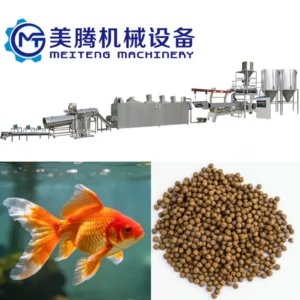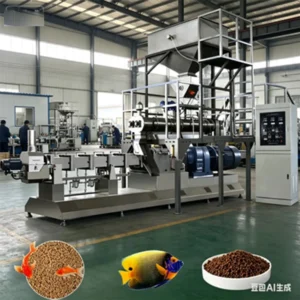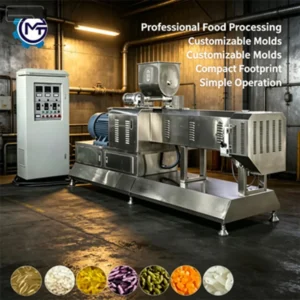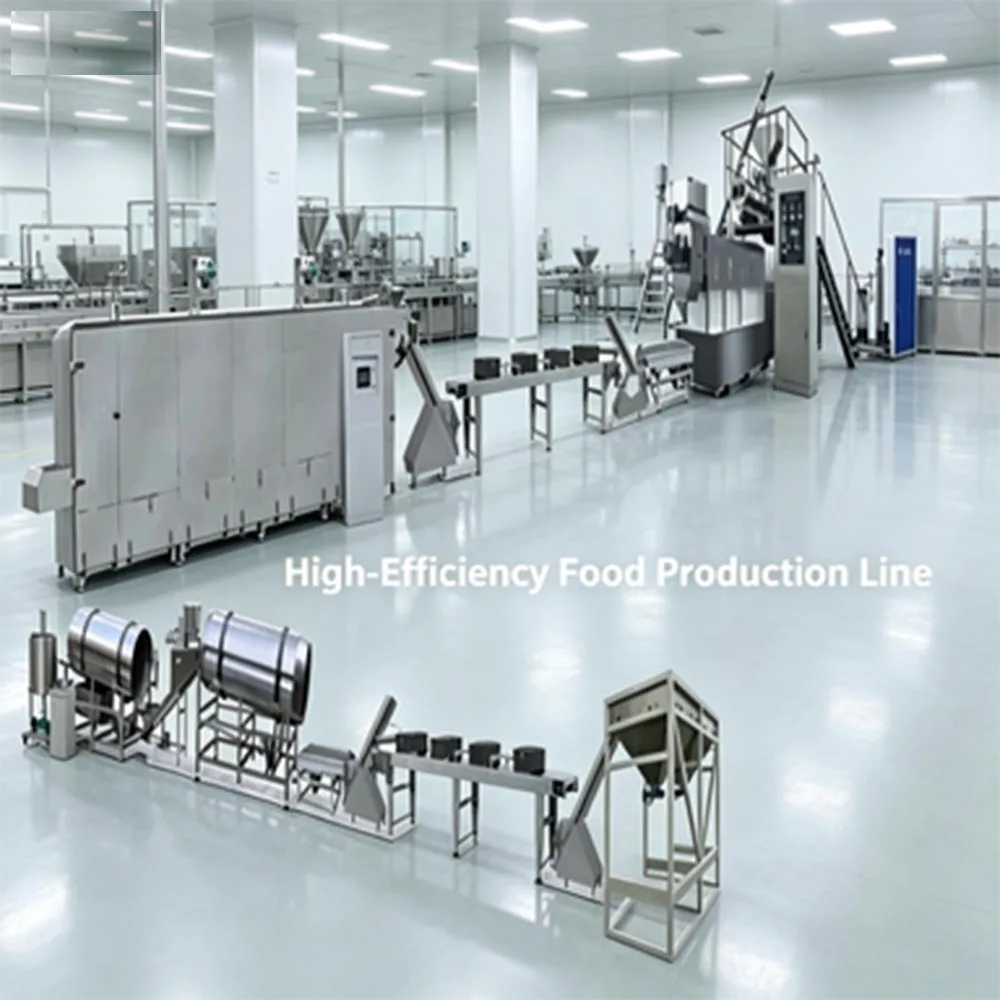


Floating Fish Feed Production Line, Twin Screw, 0.5–12 mm Pellet Size — configured for ornamental goldfish and koi with throughput-matched stations from feeding through pelletizing.
- Twin-screw extrusion with screw configuration and die design specified to your raw material, controlling expansion and density so pellets float as the market expects
- Stainless steel contact parts and fully automatic continuous operation across integrated line stations
Supported by in-house trial runs on your raw material before shipment, line layout with capacity matched at every station, and on-site commissioning with operator training.
Description
Turnkey Line Integration — Every station from batching to packing is throughput-matched under one supplier, eliminating the bottleneck risk of assembling a Floating Fish Feed Production Line turnkey from separate vendors.
Technical Specifications
| Parameter | Value |
|---|---|
| Product Type | Floating Fish Feed Production Line |
| Extrusion System | Twin Screw |
| Output Capacity | 500 kg/h (basis not stated in source — confirm raw material formulation, moisture content and pellet diameter) |
| Pellet Diameter Range | 0.5 mm – 12 mm (adjustable) |
| Line Stations | Feeding, mixing, extruding, pelletizing, drying, cooling, packing |
| Control System | Simple control panel (PLC / MCC options to be confirmed) |
| Construction Material | Stainless Steel (main contact parts) |
| Automation Level | Fully automatic, continuous operation |
| Voltage & Frequency | Configurable (basis to be confirmed before ordering) |
Application Suitability
| Application | Material or Output |
|---|---|
| Ornamental goldfish and koi feed | Fish meal, wheat flour, starch blends for floating pellets |
| Small-scale aquaculture feed production | Soy protein, corn flour, vitamin premix for 0.5–4 mm starter crumbles |
| Medium-scale diversified feed factory | Multi-ingredient formulations producing 6–12 mm grower pellets |
| Tropical freshwater species feed | Rice bran, fish meal, oil coatings for slow-sinking and floating variants |
What "500 kg/h" Leaves Out About Floating Feed Capacity
A rated capacity only becomes real once your exact raw material formulation and pellet diameter are confirmed on the extruder.
I spent two weeks in our Jinan trial workshop adjusting screw elements for a Southeast Asian client whose fish meal protein ran significantly higher than standard reference material. The extruder kept producing dense, sinking pellets despite the line being quoted at full nominal output. The floating rate climbed past acceptable levels only after we rebuilt the screw configuration and switched to a stepped die geometry. Until a trial run happens on your actual formulation, any Floating Fish Feed Production Line turnkey capacity figure remains a starting assumption rather than a guaranteed throughput [NEED_CITE: extrusion trial run protocols for aquatic feed].
Screw Geometry and Floating Density Control
Floating pellets depend on the starch gelatinisation window inside the barrel. The twin-screw extrusion system provides controlled shear and residence time so that moisture flashes into steam at the die face, creating the micro-void structure that keeps pellets above water. A Floating Fish Feed Production Line turnkey must pair the screw profile with a die land length matched to your starch-to-protein ratio, otherwise the expansion collapses before the pellet skin sets.
Throughput Matching Across Dryer and Cooler Stations
An extruder that pushes material faster than the dryer can handle will leave pellets with residual moisture high enough to cause mould during bagging. The cooling conveyor must then bring pellet temperature down to near-ambient before the flavouring drum applies oil coatings. When one supplier designs every station, belt widths and dwell times are calculated from the same mass-balance rather than patched together from catalogue defaults [NEED_CITE: thermal mass balance in extruded pellet drying].
Reading the Pellet Size Range Against Your Production Plan
The 0.5 mm to 12 mm adjustable range covers fry crumbles through adult koi sticks, but each extreme pulls the line in a different direction. Running 0.5 mm pellets means high die-hole count and lower per-hole throughput, demanding a slower screw speed to maintain expansion. Moving to 12 mm pellets reduces die resistance but requires more barrel heating zones to gelatinise the thicker strand before cutting. Stainless steel contact parts across the barrel and die resist the corrosive effect of fish oils that would otherwise pit carbon steel surfaces within months.
The Cost of Skipping Pre-Shipment Trial Runs
Lines shipped without formulation-specific trial runs arrive at the buyer’s floor as engineering experiments rather than production assets. Screw combinations copied from a generic build produce pellets that sink, crumble during conveying, or absorb oil unevenly in the coating drum. Correcting these issues on-site adds weeks of downtime while replacement screw elements and dies are manufactured and shipped from the original factory [NEED_CITE: post-installation extruder reconfiguration costs].
Why Sourcing the Complete Line from One Supplier Matters
When feeding, mixing, extruding, drying, cooling and packing all come from one engineering team, conveyor transfer heights and mass flow rates are calculated before metal is cut. The stainless steel contact surfaces across every wetted station mean sanitation protocols do not change between zones. A documented screw and die configuration record travels with your line, so future screw replacements match the original geometry instead of reverting to a default build. Pre-shipment trial runs on your raw material confirm pellet density, expansion and float rate before the line is crated. Electrical schematics and voltage confirmation are locked in against your facility utility supply, preventing commissioning delays caused by mismatched frequency or motor rotation [NEED_CITE: electrical specification verification for export machinery].
Documentation & Verification
- Line layout drawing showing throughput-matched station spacing for your pellet diameter range
- Screw and die configuration record matched to your fish meal and starch formulation
- Factory trial run report on your raw material confirming float rate and pellet density
- Electrical schematic with voltage and frequency locked to your local utility standard
- Operation and maintenance manual with wear parts list for screws, dies and dryer seals
Installation, Commissioning & Support
- Foundation plan showing load points for the twin-screw extruder and multi-layer dryer footprint
- Dedicated power circuit sizing based on confirmed motor kW rating and starting current
- Assembly sequence from modular skid delivery through belt alignment and barrel heating zone commissioning
- First-run parameter log covering barrel temperature profile, screw speed and moisture injection rate
- Operator training on die changeover procedure across the 0.5 mm to 12 mm pellet range
- Scheduled wear parts shipment covering screw elements, die plates and dryer belt tensioning seals
What We Need Before Quoting Your Line
Send us your raw material formulation with protein, starch and moisture percentages, plus the pellet diameter range your market requires. We also need your facility voltage and frequency, available workshop length and ceiling height, and whether you need the control panel in a specific operating language. If your target output is tied to a seasonal production schedule, let us know the daily run hours so we can size the dryer and cooler accordingly.
Frequently Asked Questions
Q: How is the 500 kg/h capacity verified, and what raw material and pellet size is it based on?
A: That figure is a reference point. We verify actual throughput by running your raw material formulation in our trial workshop, measuring output at the specific pellet diameter you require. Only then does the capacity become a documented line parameter rather than a catalogue estimate.
Q: How do you ensure floating feed actually floats — screw configuration and density control?
A: Float rate depends on the expansion ratio set by screw element arrangement, barrel temperature profile and die land length. We adjust these variables during the trial run until your pellets achieve the bulk density your market specifies, then lock the configuration into the build record.
Q: What voltage, frequency and control language are confirmed before shipment?
A: We request your facility electrical specification during the inquiry stage and confirm motor wiring, heater element rating and control panel language before production begins. The electrical schematic is then matched to your local utility so commissioning proceeds without rewiring delays.
Q: Is the dryer and cooling capacity matched to the extruder output, or is there a bottleneck?
A: Dryer belt width, layer count and cooler length are calculated from the same mass-balance as the extruder throughput. This prevents wet pellets backing up at the dryer infeed or entering the coating drum above the temperature that causes oil to oxidize.
Q: Can a trial run be performed on our raw material before the line ships?
A: Yes. We require a representative sample of your formulation and run it through the configured extruder and dryer in our testing workshop. The trial run report documenting pellet density, float rate and expansion ratio is included in the shipping documentation package.
Related products
-
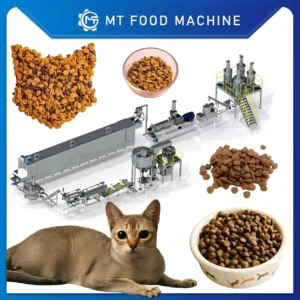
200-250kg/h Capacity PLC Controlled Multi-Species Dog Food Processing Line with MT-70 Extruder
¥35,000.00 Select options This product has multiple variants. The options may be chosen on the product page -
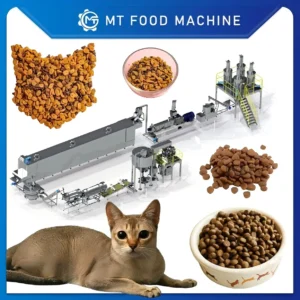
100-200kg/h Capacity PLC Controlled Multi-Species Cat Food Processing Line
¥34,000.00 Select options This product has multiple variants. The options may be chosen on the product page -
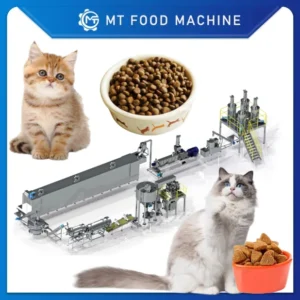
MT135 Brand 2.5-3.0t/h PLC Controlled Multi-Species Cat Food Processing Line
¥55,000.00 Select options This product has multiple variants. The options may be chosen on the product page -
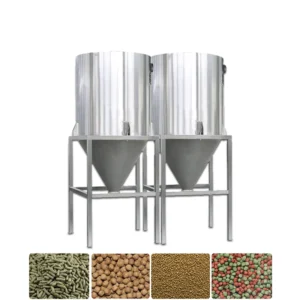
In Stock Pet Feed Production Line / Dog Cat Food Extrusion Machine
¥9,500.00 Select options This product has multiple variants. The options may be chosen on the product page