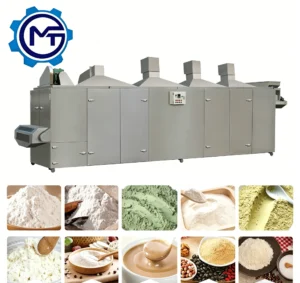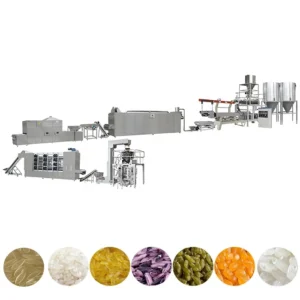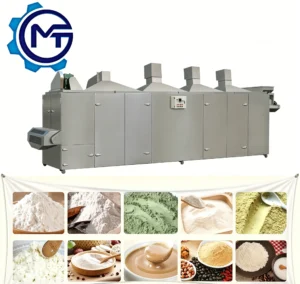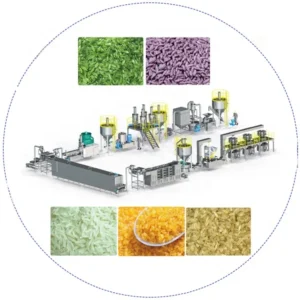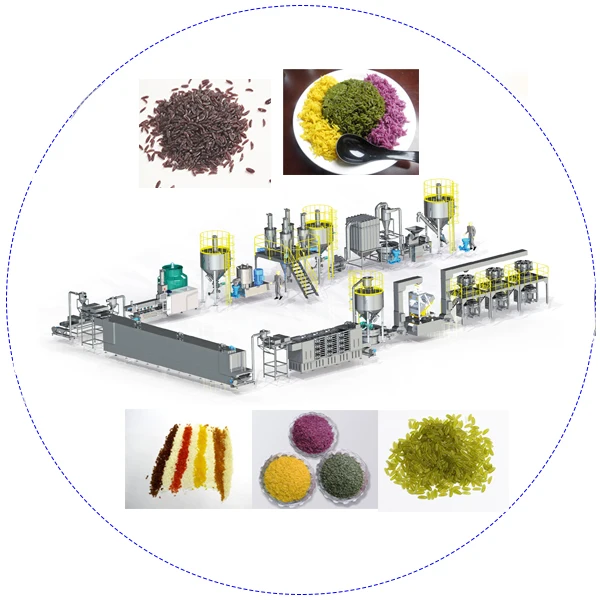
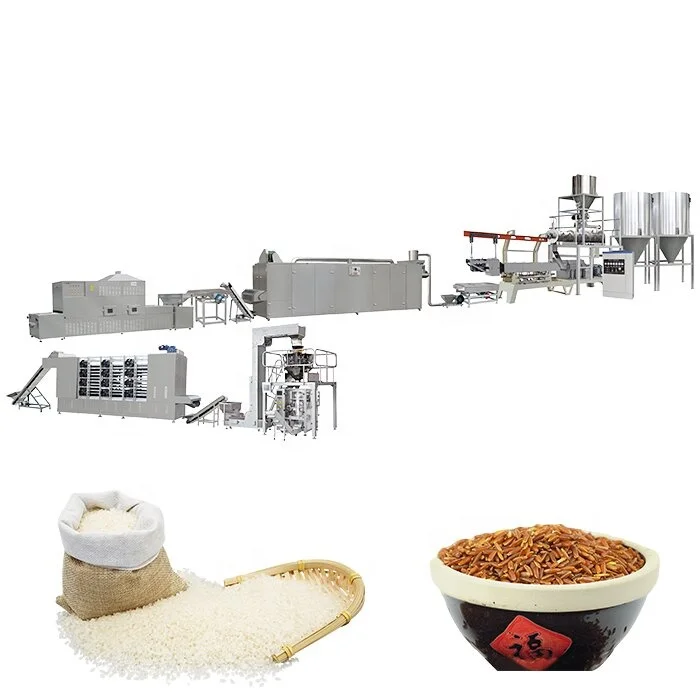
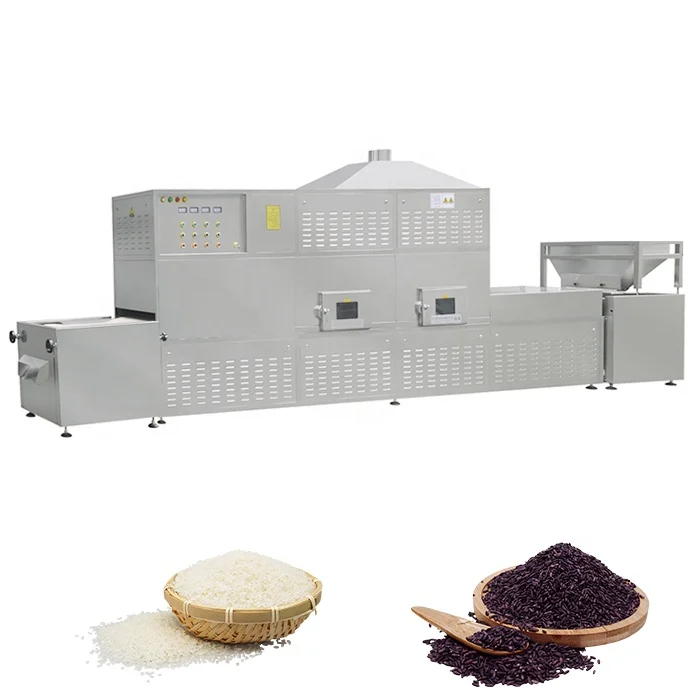
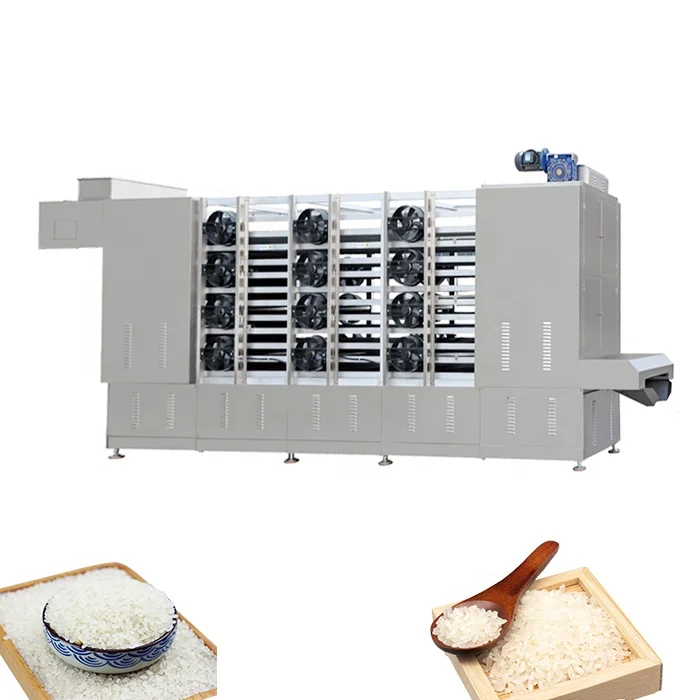
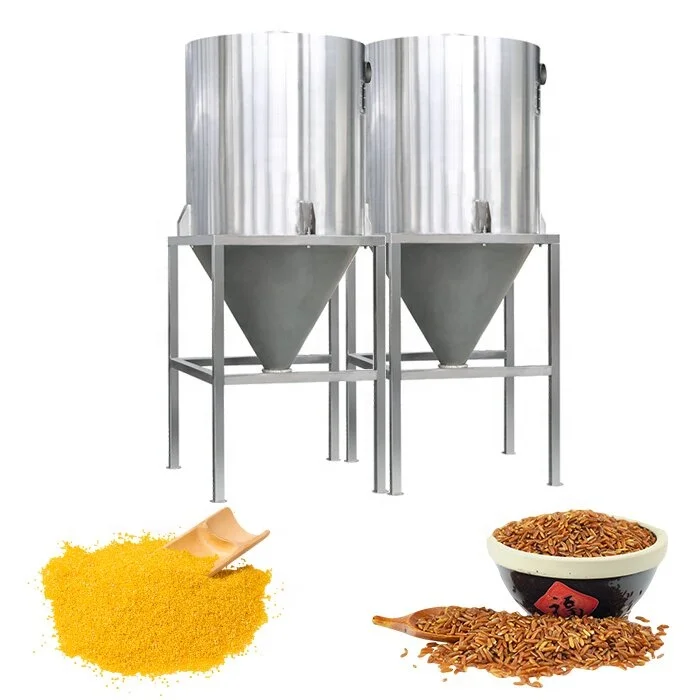
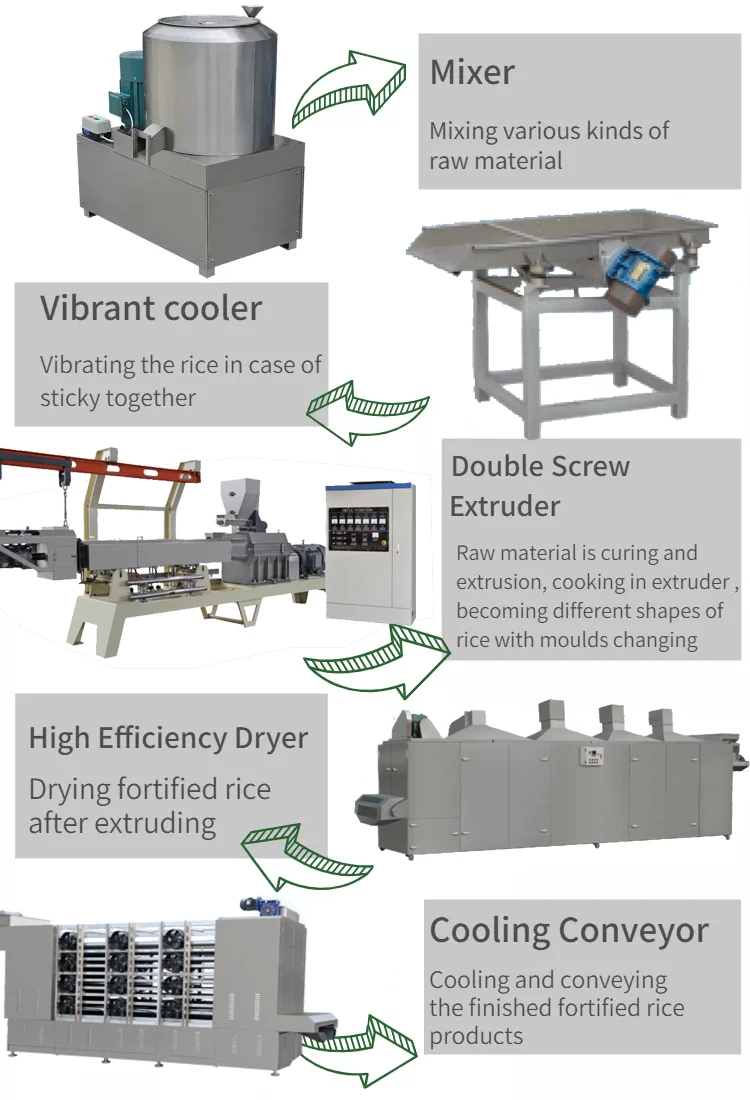
MT65 / MT70 / MT75 / MT85 / MT95 Fortified Rice Kernel Extrusion Line, Twin-screw, CE Certified — complete turnkey layout from batching through extrusion, circulation drying, cooling and packing. Screw configuration and die design are specified to your raw material blend, targeting precise kernel density and starch gelatinisation. Throughput across every station is matched under one engineering team, with pre-shipment trial runs on your formulation to verify real output capacity.
Description
Turnkey Line Integrity — Every station from batching to packing is throughput-matched under one engineering team, so the fortified rice production line turnkey delivers the capacity verified on your raw material, not a catalog estimate.
Technical Specifications
| Parameter | Value |
|---|---|
| Product Type | Fortified Rice Kernel Extrusion Line |
| Model | MT65 / MT70 / MT75 / MT85 / MT95 |
| Screw Type | Twin-screw |
| Installed Power | MT65: 85 kW / MT70: 120 kW / MT75: 180 kW / MT85: 235 kW / MT95: 260 kW |
| Power Consumption | MT65: 60 kW / MT70: 85 kW / MT75: 135 kW / MT85: 165 kW / MT95: 195 kW |
| Output Capacity | MT65: 80–100 kg/h / MT70: 100–120 kg/h / MT75: 300–500 kg/h / MT85: 200–300 kg/h / MT95: 800–1000 kg/h (basis not stated in source — confirm raw material formulation, moisture content and target kernel size) |
| Overall Dimensions (L×W×H) | MT65: 28×1.2×2.2 m / MT70: 30×1.5×2.2 m / MT75: 32×3.5×4.3 m / MT85: 34×3.5×4.3 m / MT95: 36×3.5×4.3 m |
| Control System | Frequency speed control with PLC / MCC (confirm per order) |
| Feeding System | Single or double screw feeding based on material |
| Screw Material | Special alloy, wear-resistant |
| Automatic Lubrication | Yes |
| Cooling System | Integrated cooling for continuous operation |
| Dryer Heating Source | Electric or gas |
| Dryer Feature | Circulation drying with frequency-controlled mesh belt speed |
| Line Stations | Mixing → Extruding → Vibrating → Low-temperature drying → Cooling → High-temperature roasting → Cooling → Packing |
| Assembly State | Complete turnkey line |
| Standards | CE / ISO (verify certificate validity and scope) |
Application Suitability
| Application | Material or Output |
|---|---|
| Fortified rice kernel production for nutrition programmes | Broken rice, corn, millet, wheat, oats, buckwheat, beans, starch blended with vitamins and minerals |
| Artificial rice reconstitution for retail and institutional markets | Rice flour and rice bran processed into shaped kernels that cook back to natural rice texture |
| Quick-cook and instant rice formats | Blended grain and starch formulations shaped through twin-screw extrusion |
What a Nominal Capacity Number Hides About Your Fortified Rice Line
A capacity figure means nothing unless it is tied to your exact raw material blend, moisture content, and kernel size specification.
Buyers evaluating a fortified rice production line turnkey often receive a single output number — then discover after installation that their actual formulation of rice flour, corn grits, and micro-nutrient premix behaves differently under shear and heat than the generic test material the supplier used. The extruder runs, but kernels emerge with inconsistent density, cracking during low-temperature drying, or failing to rehydrate to the expected cook-back texture. I have watched entire nutrition programme shipments get rejected because kernel density drifted outside specification after the first production week [NEED_CITE: WFP fortified rice kernel quality standards]. The throughput gap between a catalog number and a verified output on your formulation is where projects stall and budgets slip.
Matching Throughput Across Every Station on the Extrusion Line
The extruder is only one station. A fortified rice production line turnkey must balance the mixing system batch cycle against the extruder’s continuous feed rate, then ensure the vibrating conveyor transfers kernels to the dryer without clumping or bridging. If the dryer’s belt speed and residence time are not calculated against the extruder’s actual moisture output, kernels arrive at the roasting stage either too wet to hold shape or too dry to roast evenly. Every station on this line — mixing, extruding, vibrating, low-temperature drying, cooling, high-temperature roasting, and packing — is specified together so that throughput at one station does not starve or flood the next.
Screw Configuration and Die Design for Your Specific Kernel
Twin-screw extrusion of rice and grain blends requires the screw elements and die plate to match the starch composition, protein level, and target kernel density of your product. A high-amylose rice flour blend gelatinises differently from a corn-and-millet mix, and the screw configuration that works for one will produce the wrong expansion and texture for the other. On this line, screw configuration and die design are specified after reviewing your raw material data sheet and target kernel dimension, then validated during an in-house trial run before the equipment ships [NEED_CITE: twin-screw extrusion screw element configuration for starch-based materials].
How Installed Power and Line Dimensions Shape Your Floor Plan
The installed power range across this line spans from 85 kW on the MT65 to 260 kW on the MT95, and the overall length stretches from 28 metres to 36 metres depending on the model selected. These are not abstract numbers — they determine whether your facility’s transformer can supply the load, whether the dryer section clears your roof beams, and whether the packing end has enough clearance for pallet movement. On a project in Saudi Arabia, a dryer arrived forty centimetres taller than the workshop ceiling allowed because the room height was never confirmed before shipment. That mistake cost two weeks of cutting into the roof structure. Every line dispatched now goes through a pre-shipment site dimension check covering height at the dryer and roasting sections.
The Cost of Mismatched Dryer Capacity Downstream
When the dryer is undersized relative to the extruder output, kernels queue up on the vibrating conveyor and begin to stick together before they enter the drying chamber. The result is uneven moisture removal: some kernels exit the dryer at acceptable moisture and pass the roasting stage intact, while others retain internal moisture that causes cracking or deformation during high-temperature roasting [NEED_CITE: moisture uniformity requirements for extruded rice kernel shelf stability]. The line still runs, but your reject rate climbs and your pack weight falls short because damaged kernels are screened out. This is the hidden cost of assembling a line from separate vendors who each quote their station in isolation.
Why Sourcing the Entire Line from One Supplier Matters
The engineering team that designs your line layout is the same team that commissions it on your floor — there is no handoff between an extruder vendor and a separate dryer contractor. Throughput is calculated end-to-end so that the mixing batch cycle, extruder feed rate, dryer belt speed, and roasting chamber residence time all target the same output on your formulation. The pre-shipment trial run uses your actual raw material blend to confirm kernel shape, density, and cook-back behaviour before any equipment leaves the workshop. Electrical schematics and voltage specifications are confirmed and signed off before production begins, preventing the kind of commissioning delays that come from mismatched frequency or control language. CE and ISO certifications cover the machinery scope, and spare wear parts including screws, dies, and mesh belts are documented from day one.
Documentation & Verification
- Line layout drawing with throughput calculation for each station matched to your target capacity
- Trial run report on your raw material blend confirming kernel density and cook-back behaviour
- Screw and die configuration record enabling consistent repeat production and spare parts ordering
- Electrical schematic with voltage and frequency confirmed against your facility supply before production
- CE declaration of conformity and ISO certificate covering the extrusion line scope
- Packing photographs and customs documentation support for export shipment
Installation, Commissioning & Support
- Foundation and floor load assessment matched to the MT65 through MT95 frame weight and vibration profile
- Dedicated electrical circuit sized to the selected model’s installed power, up to 260 kW on the MT95
- Dryer and roasting section ceiling clearance verified against your workshop height before shipment
- PLC and MCC control language confirmed during pre-production sign-off to avoid operator confusion at commissioning
- Operator training on screw configuration changes for different grain blends and moisture levels
- Wear parts list with screw elements, die plates, and mesh belt specifications for first-year replacement planning
What We Need from You to Size the Line Correctly
To configure a fortified rice production line turnkey that matches your facility and product target, we need your raw material formulation including the percentage of each grain, starch, and micro-nutrient premix, your target kernel dimensions and density specification, your daily output requirement in tonnes, your workshop length, width and clear ceiling height, and your local voltage and frequency supply. If you have an existing packing system upstream or downstream, let us know its format and speed so the line’s packing station can be matched accordingly.
Frequently Asked Questions
Q: How is line capacity verified against my raw material formulation?
A: Before the equipment ships, your raw material blend is run through the extruder in our testing workshop. We measure kernel shape, density, moisture content after drying, and cook-back behaviour. The trial run report documents actual output on your formulation, so the capacity figure you receive is based on your material, not a generic test grain.
Q: What does the pre-shipment trial run cover?
A: The trial run processes your supplied raw material through the extruder and records screw configuration, die selection, barrel temperature profile, and moisture settings. You receive a written report with output rate, kernel dimensions, density readings, and photographs of the finished product, confirming the line meets your product specification before dispatch.
Q: How are voltage and utility requirements confirmed?
A: Before production begins, we request your facility’s voltage, frequency, and available phases. The electrical schematic is then customised and sent to you for sign-off. Gas or electric heating for the dryer is selected based on your local utility cost and availability, and steam requirements are documented if your site uses a central boiler [NEED_CITE: industrial voltage and frequency standards by region].
Q: What does the installation and commissioning schedule look like?
A: After the line arrives at your facility, the engineering team follows a phased schedule covering mechanical assembly, electrical connection, utility hookup, dry run, and wet run with your raw material. The duration depends on the model size and your site readiness, including foundation, ceiling clearance, and utility connections being prepared before our team arrives.
Q: How do I order spare wear parts after the first year?
A: Every line ships with a wear parts list documenting screw elements, die plates, and mesh belt specifications matched to your configuration. You can reorder directly using these part numbers. We recommend stocking one full set of screw elements and dies from the start so replacements are available when the first wear cycle is due.
Related products
-
Small Scale MT Brand Automatic Baby Food Nutrition Powder Rice Flour Making Machine with 500kg/h Production Capacity PLC Control
¥9,500.00 Add to cart -
500kg/h Automatic PLC Controlled Nutrition Baby Food Extruder Machine for Rice Cereal Processing
¥9,500.00 Add to cart -
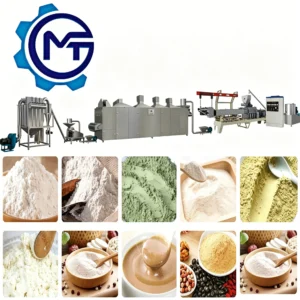
Organic Gluten Free Baby Rice Nutrition Powder Automatic 500kg/h Production Processing Line
¥8,238.27 Add to cart -
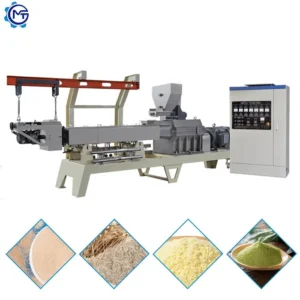
High Productivity New Condition Safe Healthy and Nutritious Baby Food Meal Replacement Powder Production Line
¥30.00 Select options This product has multiple variants. The options may be chosen on the product page