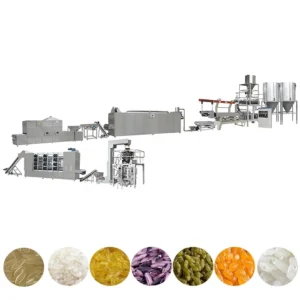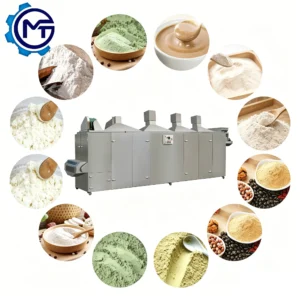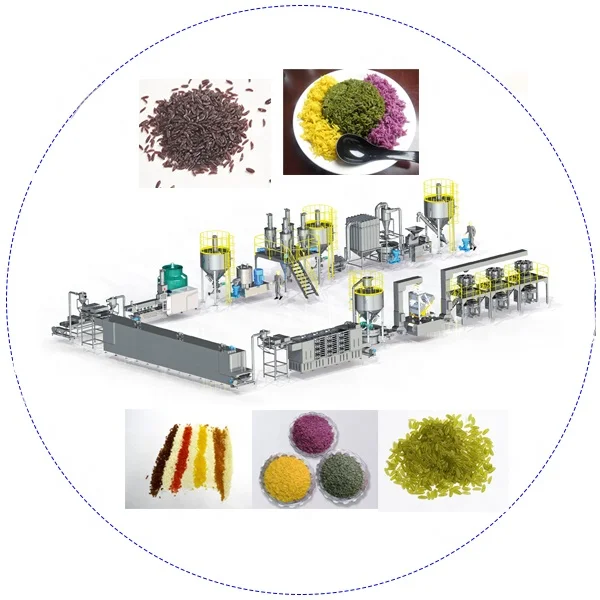
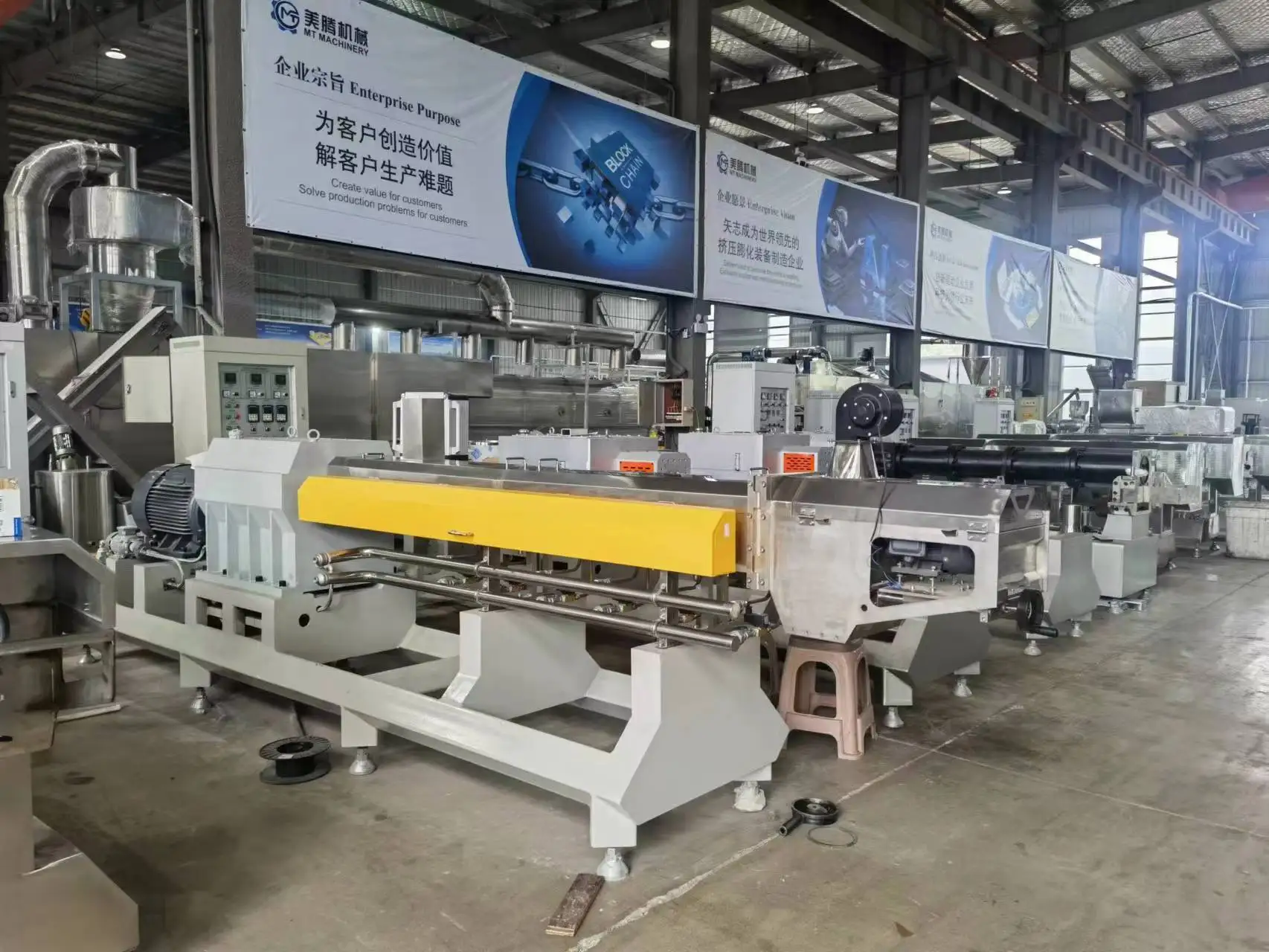
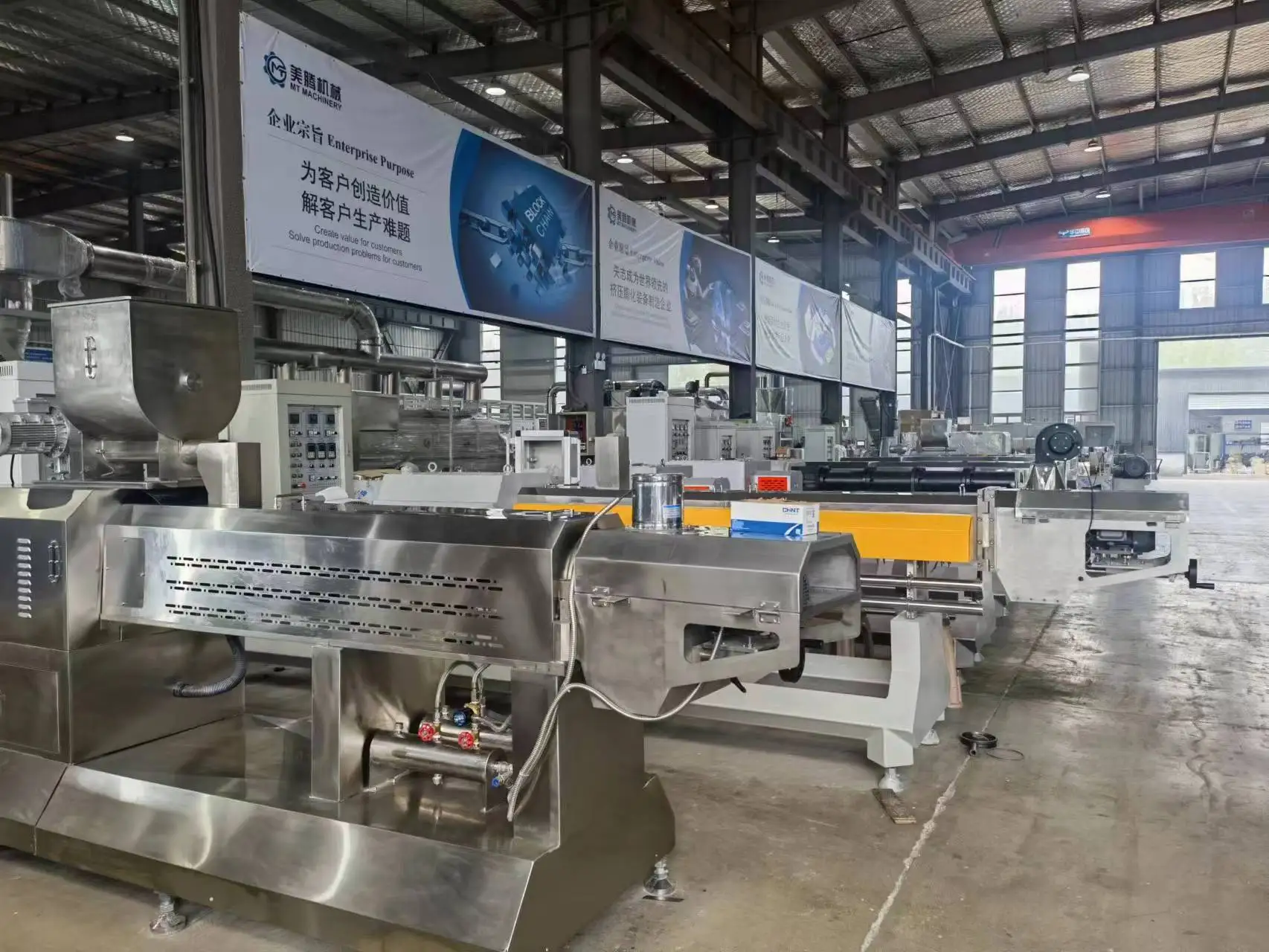
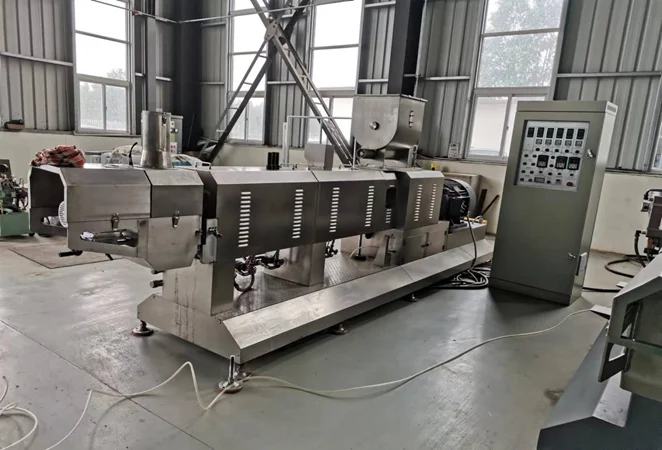
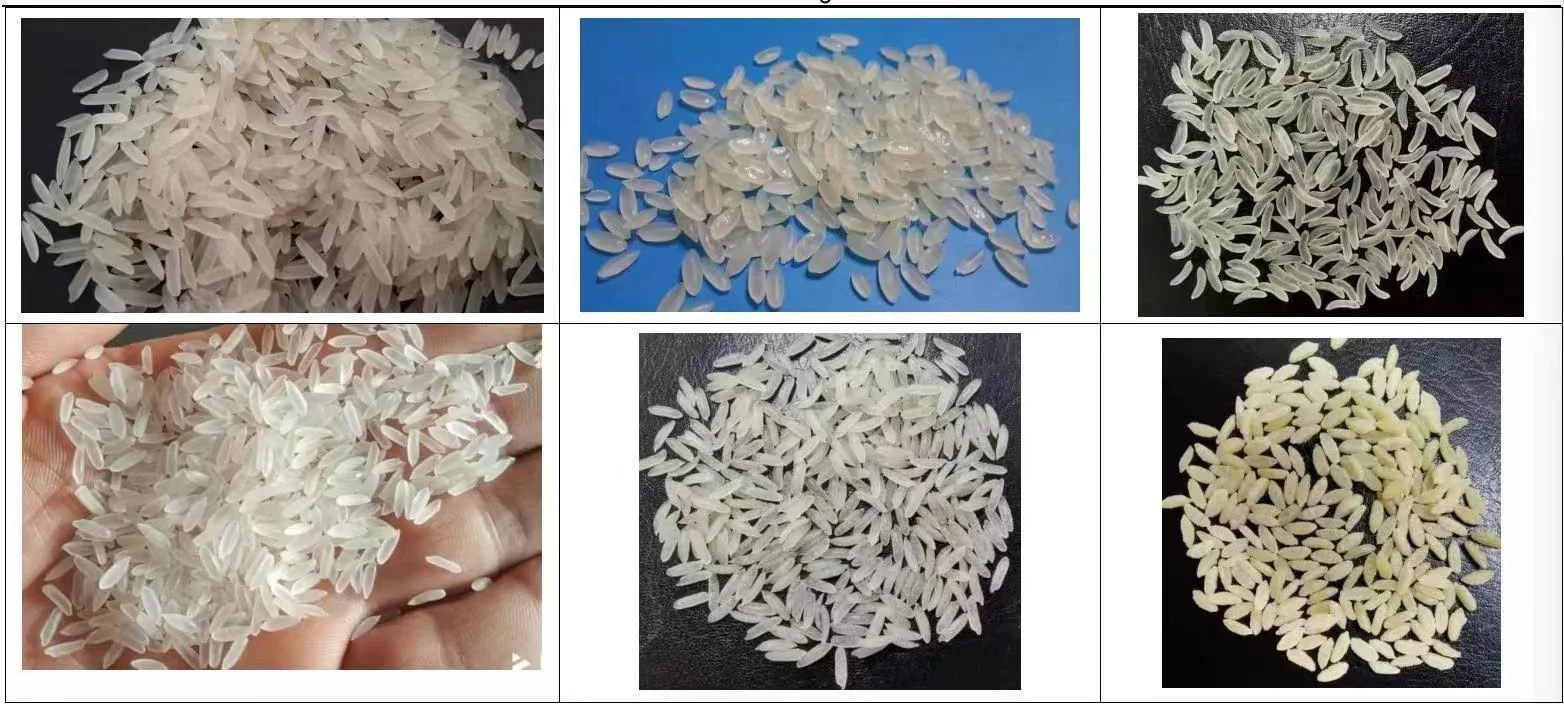
MT65 / MT70 / MT85 / MT75 / MT95 Fortified Rice Production Line, Twin-Screw, CE Certified — engineered as a complete turnkey project from batching to packing.
- Throughput matched across mixing, extrusion, drying, roasting and packing stations to eliminate bottlenecks
- Screw configuration and die design specified to your raw material formulation and target kernel density
- Dryer available with electric or gas heating, adjustable mesh belt speed for consistent moisture control
Delivered with a trial run report on your raw material before shipment, so product density, texture and nutritional retention are verified prior to installation.
Description
Matched Throughput Design — Every station in this Fortified Rice Production Line turnkey system is sized to the same verified output on your raw material, eliminating the bottleneck where one machine waits on another.
Technical Specifications
| Parameter | Value |
|---|---|
| Product Type | Fortified Rice Production Line |
| Available Models | MT65 / MT70 / MT85 / MT75 / MT95 |
| Installed Power | 85 kW (MT65) / 120 kW (MT70) / 235 kW (MT85) / 180 kW (MT75) / 260 kW (MT95) |
| Power Consumption | 60 kW (MT65) / 85 kW (MT70) / 165 kW (MT85) / 135 kW (MT75) / 195 kW (MT95) |
| Output Capacity | 80–100 kg/h (MT65) / 100–120 kg/h (MT70) / 200–300 kg/h (MT85) / 300–500 kg/h (MT75) / 800–1000 kg/h (MT95) (basis not stated in source — confirm raw material formulation and moisture content) |
| Voltage | 220V / 380V (verify against target market frequency and phase) |
| Overall Dimensions (L×W×H) | 28×1.2×2.2 m (MT65) / 30×1.5×2.2 m (MT70) / 34×3.5×4.3 m (MT85) / 32×3.5×4.3 m (MT75) / 36×3.5×4.3 m (MT95) |
| Screw Type | Twin-screw |
| Control System | Frequency speed controlling with high automation |
| Heating Source (Dryer) | Electric or gas |
| Construction Material | Stainless Steel |
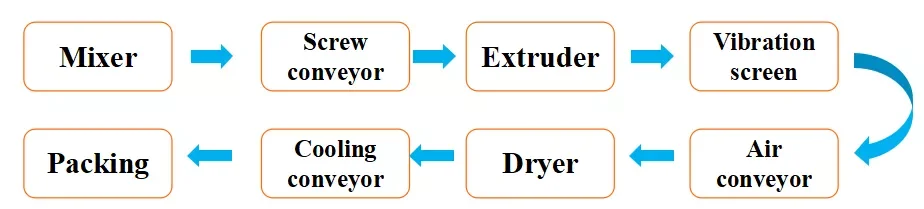
| Line Stations | Mixing → Extruding → Vibrating → Low Temperature Drying → Cooling → High Temperature Roasting → Cooling → Packing |
| Assembly State | Complete production line |
| Warranty | 1 Year |
Application Suitability
| Application | Material or Output |
|---|---|
| Micronutrient-fortified rice kernel production for government nutrition programmes | Broken rice, rice bran, corn, millet with added vitamins and minerals |
| Artificial rice manufacturing from grain by-products | Wheat, oats, buckwheat, bean, starch-based formulations |
| High-nutritional-value rice analogues for food aid and institutional supply | Multi-grain blends with iron, zinc, folic acid and vitamin A premix |
| Rice processor value-addition lines converting broken rice | Fragmented rice kernels reconstituted into uniform, fortified grains |
What "300 kg/h" Really Means When the Dryer Can’t Keep Up
A Fortified Rice Production Line turnkey project fails the moment one station runs slower than the rest. The extruder may push 300 kg/h, but if the dryer belt cannot hold that volume at the required residence time, the entire line stalls at the dryer inlet.
I watched a South Asian contractor lose a government nutrition programme contract because the extruder was specified on nominal capacity while the dryer was one size smaller. Wet, under-dried kernels piled up at the cooling conveyor, and iron content readings swung outside tolerance because the moisture gradient varied kernel by kernel. The project spec called for uniform micronutrient distribution; what they delivered was a batch where some kernels carried triple the target iron and others carried almost none [NEED_CITE: micronutrient uniformity standards in fortified food programmes].
Phased Layout from Batching Through Packing
A Fortified Rice Production Line turnkey installation begins with the mixing station, where the base grain flour and micronutrient premix must reach homogeneity before entering the extruder. The twin-screw configuration provides the shear and residence time needed to gelatinise starch from broken rice or corn while distributing vitamin and mineral particles evenly through the matrix. Each station downstream is selected so its rated throughput matches the extruder output on your specific formulation.
Dryer and Roaster Sizing Against Extruder Output
The low-temperature dryer and high-temperature roaster are where most lines lose their balance. Drying must remove moisture gently enough to prevent kernel cracking, yet fast enough to keep pace with the extruder discharge. The mesh belt speed is adjustable, and the heating source is configurable between electric and gas depending on local utility cost [NEED_CITE: industrial dryer energy source selection for food processing facilities]. When the roaster follows, it sets the final kernel hardness and cooking behaviour — parameters the end market will test before accepting the shipment.
Reading the Spec Sheet Against Your Formulation
The installed power range — from 85 kW on the MT65 to 260 kW on the MT95 — reflects motor sizing matched to barrel length and screw diameter. A higher-formation-fibre blend such as buckwheat and bean demands more torque than a straight broken-rice mix, which shifts the model selection upward even when target output in kg/h appears to fit a smaller frame. Voltage must be confirmed against your facility supply; the 220V/380V range covers common industrial three-phase systems, but frequency and phase must match before the control cabinet is wired. Stainless steel contact surfaces throughout the line prevent iron or zinc contamination from the equipment itself, which matters when the final product is being tested for trace mineral content at parts-per-million levels.
The Cost of an Unmatched Line
When an extruder is paired with a dryer one size smaller, operators compensate by slowing the extruder feed — which drops output below the contracted capacity and pushes delivery dates back. Kernels that sit too long in the dryer at low belt speed develop case-hardened surfaces that resist water absorption during cooking, and buyers reject the batch for failing the 20-minute cooking test. On the electrical side, running a 380V machine on a 415V supply without transformer adjustment burns out frequency inverters within the first month [NEED_CITE: voltage mismatch failures in exported food processing machinery]. These are not warranty claims; they are site conditions that void the warranty.
Why Buyers Source This Line Here
The line is engineered as a single project rather than assembled from separate vendors, so the extruder, dryer, roaster and packing station share one throughput calculation and one accountability chain. Screw configuration and die design are specified to the buyer’s raw material — not copied from a generic starch build — which prevents the density and texture mismatches that cause floating or sinking kernels in the cooking pot. An in-house testing workshop runs trial production on your actual formulation before shipment, generating a report that confirms kernel shape, moisture content and nutritional retention. Electrical schematics and voltage confirmation are locked in before the control cabinet is built, so the PLC language and frequency match your facility on day one. Pre-sales consultation extends through on-site installation, commissioning and operator training, so the first production run is supervised rather than left to a manual.
Documentation & Verification
- Line layout and capacity calculation showing matched throughput at each station for your formulation
- Screw and die configuration record matched to your grain blend and target kernel density
- Trial run report on your raw material confirming moisture, texture and micronutrient distribution
- Electrical schematic and voltage confirmation matched to your facility frequency and phase
- Factory test record documenting full-line run before crating and dispatch
- Operation and maintenance manual with wear parts list for screws, dies and dryer belts
Installation, Commissioning & Support
- Foundation plan accounts for the full line footprint up to 36 m length and 4.3 m height on the MT95 configuration
- Dedicated electrical circuit sized to the model’s installed power, up to 260 kW, with confirmed voltage and phase
- Modular station delivery with reassembly supervised by installation engineers on site
- First-run parameter setting covering screw speed, barrel temperature profile, dryer belt speed and roaster dwell time
- Operator training on formulation changeover, die replacement and daily screw inspection routines
- Wear parts supply covering twin-screw segments, die plates and dryer mesh belts with lead times confirmed at order
What We Need to Start Your Project
To prepare a line layout and capacity proposal, share your primary grain material — whether broken rice, corn, millet or a multi-grain blend — along with the micronutrient premix composition and target kernel specifications. We also need your facility voltage, frequency and phase, available floor space with ceiling height, and whether the line will connect to existing packing equipment or require a standalone packing station. If you can send a sample of your raw material, we will run a trial in the testing workshop before finalising the quotation.
Frequently Asked Questions
Q: How is line capacity verified on my specific fortified rice formulation?
A: We run a trial in the testing workshop using your actual grain blend and micronutrient premix. The trial measures extruder throughput, kernel density, moisture after drying and micronutrient distribution uniformity. Results are documented in a trial run report that becomes the basis for the final line configuration and capacity guarantee.
Q: How do you ensure throughput is matched between extruder, dryer and packing stations?
A: Each station is selected from a capacity calculation that starts with your formulation’s verified extruder output. The dryer belt width and length, roaster chamber volume and packing machine speed are all specified to handle that same output without accumulation or idle time between stations.
Q: What voltage and control language options are confirmed before shipment?
A: Before the control cabinet is built, we confirm your facility voltage, frequency and phase, along with the preferred HMI language for the operator interface. The electrical schematic is submitted for your approval so the line matches local supply standards on arrival.
Q: Is a trial run on my raw material performed before the line ships?
A: Yes. Every line undergoes a production trial in our testing workshop on the buyer’s raw material. The trial verifies kernel shape, cooking behaviour, moisture content and micronutrient retention, and the results are shared in a written report before dispatch approval.
Q: What is the phased installation and commissioning schedule for a complete turnkey line?
A: Installation follows a sequence from the mixing station downstream through extrusion, drying, roasting and packing. Each station is mechanically installed, electrically connected and individually tested before the full line runs together. Commissioning includes parameter setting on your formulation and operator training before handover.
Related products
-
Full Automatic Complete Baby Food Nutrition Powder Porridge Processing Production Line for Infant Nutrition Factory
¥9,500.00 Add to cart -

High Precision Automatic 500kg/h Baby Food Nutrition Powder Rice Extrusion Processing Line
¥8,238.27 Add to cart -
Healthy Baby Food Production Line Nutritional Powder Equipment for Baby Food Supplements for Flour Processing Machinery
¥8,500.00 Select options This product has multiple variants. The options may be chosen on the product page -

Automatic Iron Fortified Baby Rice Cereal Nutrition Powder Making Machine 500kg/h PLC Controlled
¥8,238.27 Add to cart