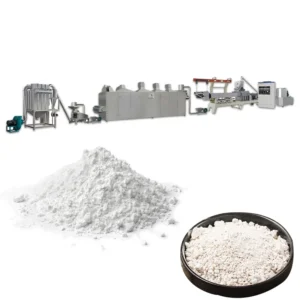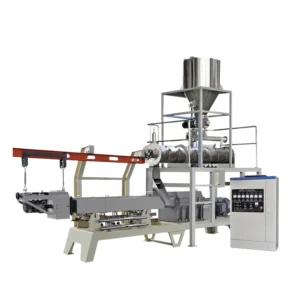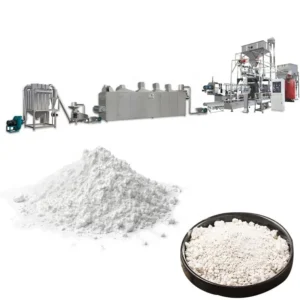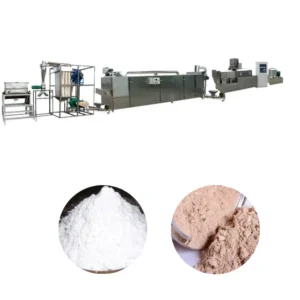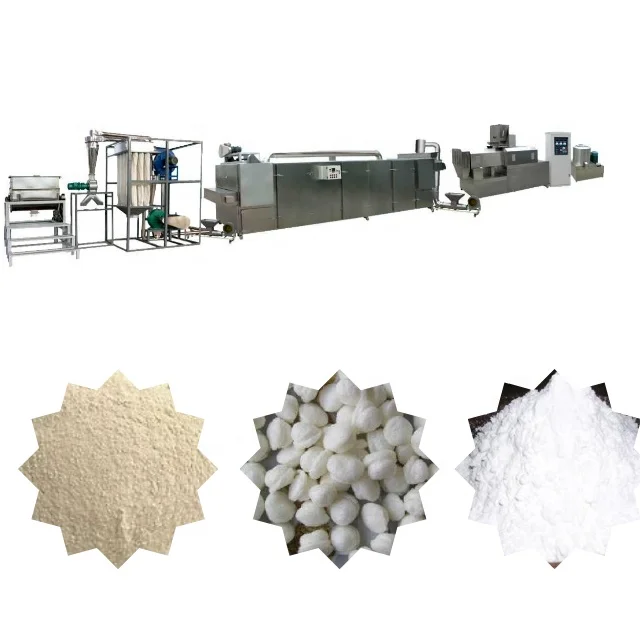


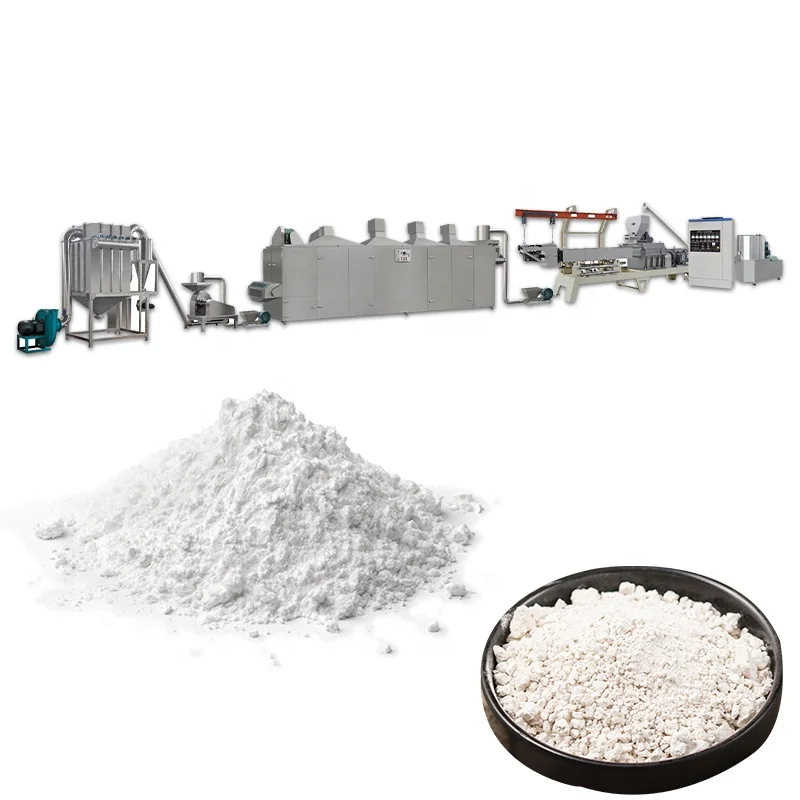

Modified Starch Processing Line, Twin-Screw Extrusion, PLC & MCC Control — configured for continuous production of modified and pregelatinised starch from potato, corn, cassava, and tapioca feedstock.
- Screw configuration and die design specified to your raw material viscosity and target gelatinisation degree
- Line stations — mixing, extrusion, drying, grinding, blending, packing — throughput-matched to eliminate bottlenecks
- Three capacity tiers (MT65, MT70, MT85) covering pilot through full-scale output
Trial runs on your actual starch feedstock are completed in our in-house testing workshop before shipment, so process parameters are verified against your formulation from day one.
Description
Screw and Die Configuration Specified to Starch — Every modified starch processing line we build starts with your raw material sample, not a generic catalog build.
Technical Specifications
| Parameter | Value |
|---|---|
| Product Type | Modified Starch Processing Line |
| Screw Type | Twin-screw |
| Model Options | MT65, MT70, MT85 |
| MT65 Power Consumption | 60 kW |
| MT65 Output Capacity | 100–150 kg/h (basis not stated in source — confirm raw material type, moisture content, and target starch specification) |
| MT65 Overall Dimensions | 24,000 × 1,200 × 2,200 mm |
| MT70 Power Consumption | 80 kW |
| MT70 Output Capacity | 200–250 kg/h (basis not stated in source — confirm raw material type, moisture content, and target starch specification) |
| MT70 Overall Dimensions | 26,000 × 1,500 × 2,200 mm |
| MT85 Power Consumption | 145 kW |
| MT85 Output Capacity | 300–500 kg/h (basis not stated in source — confirm raw material type, moisture content, and target starch specification) |
| MT85 Overall Dimensions | 29,000 × 3,500 × 4,300 mm |
| Mixer Power | 3 kW |
| Mixer Output | 70–100 kg/h (basis not stated in source — confirm raw material type and moisture content) |
| Mixer Dimensions | 900 × 700 × 1,200 mm |
| Extruder Total Power | 22 kW (rated or peak not specified) |
| Extruder Dimensions | 2,800 × 800 × 1,800 mm |
| Control System | Automated PLC and MCC |
| Line Stations | Mixing → Extrusion → Drying → Grinding → Blending → Packing |
| Assembly State | Complete turnkey production line |
| Food-grade Contact Materials | Yes |
| Voltage & Frequency | Configurable per buyer’s market |
| Control Language | Configurable |
| Standards | CE, ISO |
Application Suitability
| Application | Material or Output |
|---|---|
| Food-grade modified starch for sauces, bakery, and confectionery | Corn starch, maize starch, tapioca starch |
| Pregelatinised starch for instant food and nutritional powders | Potato starch, cassava starch |
| Industrial modified starch for textile sizing and paper coating | Corn starch, cassava starch |
| Modified starch for oil drilling fluid additives | Maize starch, tapioca starch |
| Cold-water swelling starch for chemical and building material applications | Potato starch, corn starch |
Why Nominal Capacity Numbers Mislead Starch Buyers
A modified starch processing line turnkey quoted at a clean round number often tells you nothing about what happens when your specific feedstock enters the barrel. Real throughput depends on the starch source, its amylose-to-amylopectin ratio, incoming moisture, and the degree of modification you are targeting.
I once watched a line built around corn starch specifications choke within hours when the buyer switched to a potato starch batch with higher viscosity. The extruder motor amperage climbed, throughput dropped by roughly half, and the downstream dryer could not keep up with the wetter extrudate. It took weeks of screw element swaps and barrel temperature adjustments before the line held a stable run [NEED_CITE: starch gelatinisation behaviour differences across botanical sources]. That is the reason a modified starch processing line turnkey must be validated on your actual raw material before it leaves the factory, not after it arrives on your floor.
Matching Screw Geometry to Starch Rheology
Different starch sources behave differently under shear and heat. Potato starch gelatinises at a lower temperature but generates higher melt viscosity than corn starch, which changes how the screw elements must be arranged. A modified starch processing line turnkey configured with aggressive kneading blocks suited for corn may overwork a potato starch melt, causing excessive dextrinisation and unwanted colour. Our screw configuration is selected after reviewing your target modification — whether esterification, etherification, cross-linking, or simple pregelatinisation — and the specific botanical source you will run most often.
Throughput Balance from Mixer to Packing
A bottleneck at any single station forces the entire line to run at the pace of the slowest link. If the mixer delivers less mass per hour than the extruder can accept, the twin-screw runs partially starved, residence time shortens, and gelatinisation becomes uneven. Conversely, an undersized dryer downstream causes wet extrudate to pile up, forcing operators to reduce extruder feed rate. Each station on this modified starch processing line turnkey is sized against the extruder’s verified output on your material, so the mixer, dryer, grinder, blender, and packing station all carry the same throughput envelope [NEED_CITE: continuous line throughput matching principles].
Reading the Power and Dimension Data
The MT65 draws 60 kW across the full line while occupying roughly 24 metres in length, making it suitable for pilot production or smaller starch processors with limited floor space. The MT85, at 145 kW and nearly 29 metres long, demands a dedicated transformer circuit and significant hall length but handles the volume required for industrial-scale modified starch supply. The 22 kW extruder main drive rating reflects the motor that turns the screws; total line power includes the mixer, dryer heating elements, grinder, and packing motors, which is why the overall consumption figure is several times higher. Food-grade contact materials throughout the product zone mean stainless steel contact surfaces where starch passes, supporting hygiene protocols common in food and pharmaceutical supply chains.
What Happens When Configuration Is Left to Chance
Ordering a line without specifying screw profile and die geometry against your starch type leads to problems that surface only after commissioning. The extruder may run, but product viscosity can drift outside your customer’s specification, forcing you to blend batches or reject output. Downstream equipment that was never matched to actual extruder throughput will either sit idle or overflow. Electrical mismatches — wrong voltage, frequency, or control language — delay first startup while transformers are sourced and panels rewired [NEED_CITE: voltage and frequency standards by export market]. Every one of these issues costs weeks of production time that a proper pre-shipment trial would have prevented.
Why Procurement Through This Channel Works
Screw and die design is matched to your raw material sample and target starch modification, not copied from a generic build. Every station from mixing through packing is supplied by one entity, so throughput calculations span the whole line rather than individual machines. An in-house testing workshop runs your actual starch feedstock before shipment, generating a trial run report you receive with the documentation package. PLC and MCC control is automated across all stations, keeping barrel temperatures, screw speed, and dryer settings consistent from the first shift to the hundredth. Pre-sales engineering consultation through on-site installation, commissioning, and operator training means the same team that configured the line is responsible for making it run.
Documentation & Verification
- Line layout drawing showing station sequence, footprint, and throughput match for your starch capacity target
- Screw and die configuration record listing element types, arrangement, and die bore diameter for your formulation
- Trial run report from our testing workshop on your raw material, noting achievable output and process parameters
- Electrical schematic with voltage, frequency, and control language confirmed for your destination market
- CE declaration of conformity and ISO certificate covering the full line
- Operation and maintenance manual with wear parts list specific to your twin-screw configuration
Installation, Commissioning & Support
- Foundation plan aligned with line dimensions, up to 29,000 mm length, specifying floor load and anchor points
- Power supply spec covering up to 145 kW total consumption with dedicated circuit recommendations
- Assembled line arrives in modular sections with matched utility connection points for rapid hook-up
- First-run commissioning includes barrel temperature profiling and screw speed tuning on your starch material
- Operator training covers PLC interface navigation, daily inspection points, and starch changeover procedures
- Wear parts inventory list identifies screw elements, die plates, and seals with reorder intervals
What We Need Before Quoting Your Line
Share the botanical source of your starch, incoming moisture content, and the modification type or viscosity specification you are targeting. Tell us the daily or hourly output you need to plan for and the voltage and frequency standard at your facility. If you already operate upstream milling or downstream packing equipment, let us know the make and capacity so the new line can integrate cleanly.
Frequently Asked Questions
Q: How is line capacity verified against my specific starch raw material and moisture content?
A: We conduct a trial run in our testing workshop using a sample of your actual starch feedstock. The extruder is fitted with the proposed screw configuration and die, and we record achievable throughput, motor amperage, barrel temperatures, and product quality. You receive the full trial run report before shipment, so the capacity figure is grounded in your material, not a generic benchmark.
Q: How is screw configuration and die design selected for my target modified starch product?
A: We review your starch source, target modification type — esterification, cross-linking, pregelatinisation, or other — and required end-use viscosity. Based on that, we select kneading block angles, screw element sequence, and die bore geometry to control shear, residence time, and expansion. The exact configuration is documented and can be replicated or adjusted for future product changeovers.
Q: What electrical voltage, frequency, and control language do I need to confirm before production starts?
A: We need your facility’s supply voltage, phase count, and frequency, as well as the preferred language for the PLC operator interface. These parameters are confirmed before production begins so that motors, heating elements, and control panels arrive ready for your local grid and your operators’ working language, avoiding on-site rewiring or programming delays.
Q: How are downstream stations matched to extruder throughput to prevent bottlenecks?
A: Each station — mixer, dryer, grinder, blender, and packing — is sized using the extruder’s verified output on your material. We calculate moisture removal rate for the dryer, grinding capacity for the target particle size, and packing speed for your bag format. The line layout document shows the throughput match at every station so no single link limits the whole line.
Q: What is included in on-site installation, commissioning, and operator training?
A: Our engineers supervise mechanical assembly, utility connections, and electrical hook-up at your site. Commissioning covers heating zone calibration, screw speed optimisation, and a sustained production run on your starch. Operator training addresses the PLC interface, daily maintenance checkpoints, and screw or die changeover procedures, with a wear parts list provided for your maintenance planning.
Related products
-
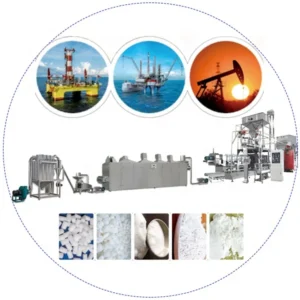
Pre-gelatinized Starch Production Line – Modified Starch Integrated Puffing Equipment
¥65.00 Select options This product has multiple variants. The options may be chosen on the product page -
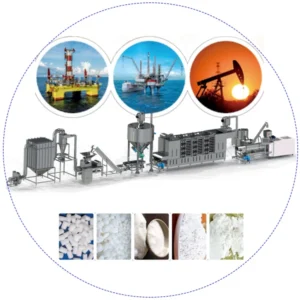
Automatic Pregelatinized Starch Processing Machine – Large-Scale New Condition Modified Starch Production Line
¥65.00 Select options This product has multiple variants. The options may be chosen on the product page -
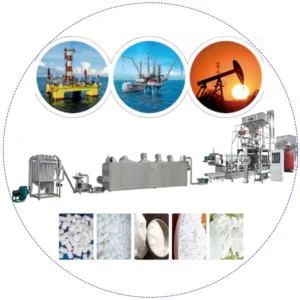
Cassava & Pregelatinized Corn Starch Extrusion Equipment – CE Certified Industrial Twin-Screw Modified Starch Line
¥65.00 Select options This product has multiple variants. The options may be chosen on the product page -
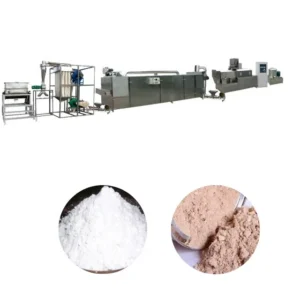
Modified Starch Production Line Industrial Drilling Twin Screw Extruder 304 Stainless Steel High Efficiency Flour Mill CE
¥50.00 Select options This product has multiple variants. The options may be chosen on the product page