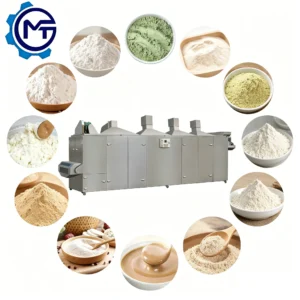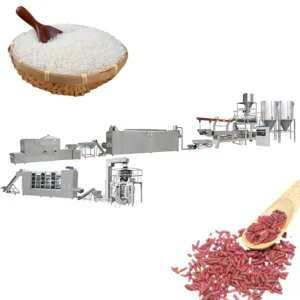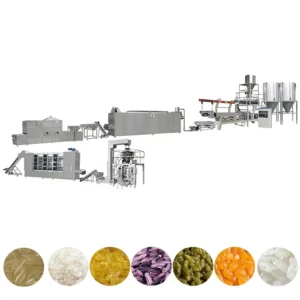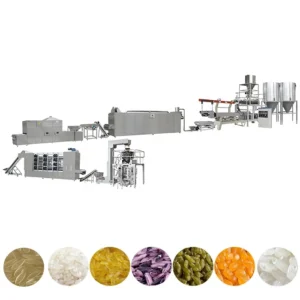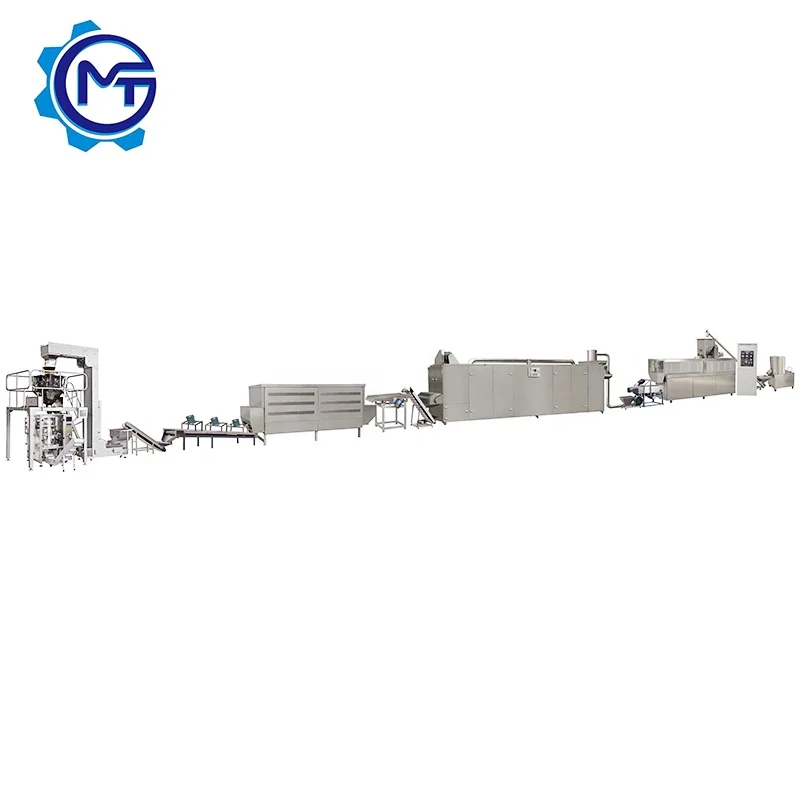


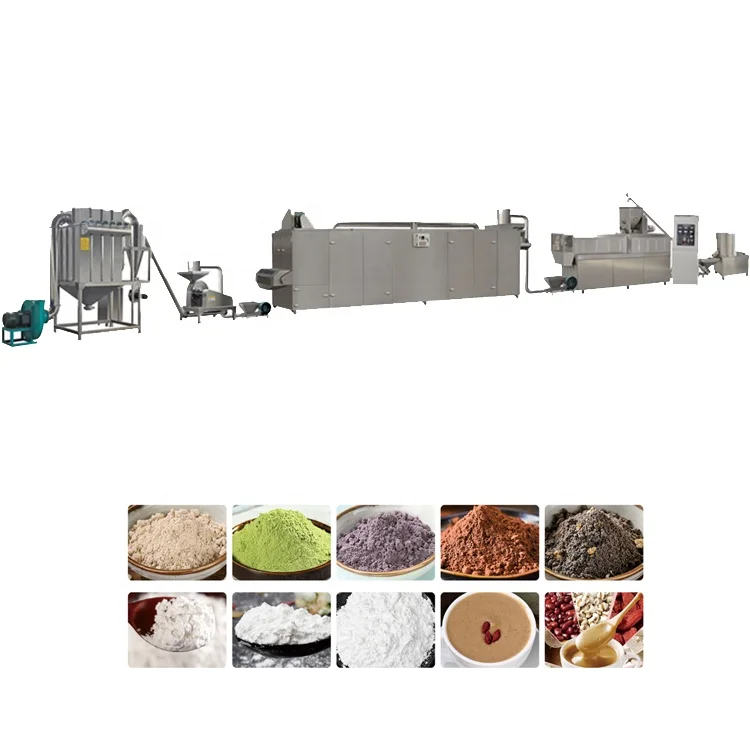


MT65 / MT70 / MT70C Nutritional Powder Processing Line, Twin-Screw Extruder, PLC/MCC Control — complete turnkey layout from batching through extrusion, drying, and flavoring with throughput matched at every station. Screw configuration and die design are specified to your raw material, and trial runs in our testing workshop verify output before shipment. Line capacity calculation, electrical schematics, and voltage confirmation are provided for your target market.
Description
Integrated Turnkey Layout — A nutritional powder line is only as strong as its weakest station, which is why this Nutritional Powder Processing Line turnkey project matches throughput from the batching system through extrusion, drying, and packing under a single supplier, so no upstream or downstream bottleneck limits your actual output.
Technical Specifications
| Parameter | Value |
|---|---|
| Product Type | Nutritional Powder Processing Line |
| Available Models | MT65 / MT70 / MT70C |
| Screw Type | Twin-screw (Double Screw Extruder) |
| Control System | PLC / MCC |
| MT65 Installed Power / Real Power | 70 kW / 40 kW |
| MT65 Output Capacity | 100–150 kg/h (basis not stated in source — confirm raw material / moisture content) |
| MT65 Overall Dimensions (L×W×H) | 22000 × 1200 × 2200 mm |
| MT70 Installed Power / Real Power | 90 kW / 60 kW |
| MT70 Output Capacity | 150–200 kg/h (basis not stated in source — confirm raw material / moisture content) |
| MT70 Overall Dimensions (L×W×H) | 25000 × 1500 × 2200 mm |
| MT70C Installed Power / Real Power | 110 kW / 90 kW |
| MT70C Output Capacity | 200–250 kg/h (basis not stated in source — confirm raw material / moisture content) |
| MT70C Overall Dimensions (L×W×H) | 30000 × 3500 × 4300 mm |
| Line Stations | Mixing system, Twin-screw extruder, Dryer, Flavoring/Coating system |
| Assembly State | Complete processing line |
| Standards | CE, ISO |
Application Suitability
| Application | Material or Output |
|---|---|
| Infant formula and baby cereal production | Rice flour, wheat flour, corn flour blended with milk powder and micronutrients |
| Fortified nutritional powder for feeding programmes | Grain base with added vitamin and mineral premix |
| Instant breakfast and health drink powder | Pre-gelatinised starch and cereal flour blends |
| Modified starch and pregelatinised flour | Native starch sources processed through high-shear extrusion |
Why Nominal Capacity Figures Fail on Real Nutritional Formulations
A rated output is meaningless unless verified on the exact formulation you plan to run.
Buyers sourcing a Nutritional Powder Processing Line turnkey project often receive capacity numbers based on plain corn or rice flour. The problem surfaces weeks after commissioning, when the actual recipe — loaded with whey protein isolates, lipid-rich premixes, or high-fibre additives — changes the melt viscosity inside the barrel. The screws that handled a simple starch profile now struggle to convey a sticky, shear-sensitive mass, and throughput drops noticeably below the quoted figure. This is not a machine defect; it is a specification mismatch. [NEED_CITE: effect of protein and fat content on extruder melt viscosity and throughput]
Starch Gelatinisation Under Controlled Shear and Temperature
The core of any nutritional or infant formula powder line is the degree of starch gelatinisation achieved inside the extruder barrel. Twin-screw extrusion applies high temperature and high pressure within seconds, denaturing the starch granules so they become readily digestible and dispersible in water or milk. The screw configuration must be matched to the specific grain base — rice, wheat, or corn — because each has a different gelatinisation onset temperature and shear sensitivity. Getting this right determines whether the final powder wets out cleanly in a baby bottle or forms lumps that a parent will reject.
Matching Every Station to Prevent Line Imbalances
A Nutritional Powder Processing Line turnkey project is not just an extruder with ancillary equipment bolted on. The mixing system must feed at a rate that keeps the extruder hopper level without flooding it. The dryer must remove moisture at a pace consistent with the extrudate throughput, or partially wet powder will cake in the conveyor. The flavouring and coating drum must have enough residence time to distribute fat or vitamin slurry evenly. When throughput is calculated station by station before the line is built, the result is a continuous process where no single unit forces the others to idle. [NEED_CITE: principles of throughput matching in continuous food processing lines]
Interpreting the Specification Sheet for Production Planning
The three available models span different installed power levels and physical footprints, which directly shape your factory layout and utility planning. Installed power figures of 70 kW, 90 kW, and 110 kW set the upper bound for your electrical infrastructure, but real running power is considerably lower at 40 kW, 60 kW, and 90 kW respectively — a distinction that matters when sizing transformers and cable runs. The twin-screw design across all models means the extruder can handle formulations with higher fat and protein loads than a single-screw equivalent, because the intermeshing screws provide a positive conveying action that does not rely solely on friction. PLC and MCC control options allow integration with your existing plant SCADA or stand-alone operation, depending on the automation level you need. The overall line lengths, ranging up to 30 metres for the largest configuration, dictate clear floor space requirements that must be confirmed before the foundation is poured.
The Hidden Cost of Skipping a Raw-Material Trial
When an extruder ships without a trial run on the buyer’s actual recipe, the first production campaign becomes an expensive experiment. Screw elements may need to be swapped, barrel temperature zones re-profiled, and dryer retention time extended — all while raw material is consumed and delivery deadlines slip. In the worst cases, a nutritional powder processing line configured for generic starch simply cannot achieve the target density or solubility on a high-protein formulation, and the buyer faces a capital equipment decision that should have been resolved in a testing workshop weeks earlier. [NEED_CITE: cost implications of post-installation extruder reconfiguration]
Why This Line Is Built as One Project
Every station is sourced and assembled by a single supplier, so the mixing batch size, extruder screw speed, dryer belt width, and coating drum volume are all calculated against one throughput target rather than pulled from independent catalogues. The screw configuration and die geometry are specified to your raw material and target powder texture, not copied from a generic build. Before dispatch, a trial run on your actual formulation takes place in the in-house testing workshop, and a written report is issued so you know the achievable output before the machines leave the factory floor. Pre-sales engineering covers layout, utility planning, and phased installation scheduling, with on-site commissioning and operator training included once the line is in position. Documentation — from CE declarations to electrical schematics — is matched to your export market’s requirements.
Documentation & Verification
- Line layout drawing showing station-by-station throughput calculation for your target powder
- Screw and die configuration record matched to your raw material formulation
- Trial run report produced on your actual ingredients before shipment
- Electrical schematic confirming voltage, frequency, and control language for your market
- CE declaration of conformity and ISO certificate for regulatory submission
- Operation and maintenance manual with illustrated wear parts catalogue
Installation, Commissioning & Support
- Floor plan review to confirm the 22 to 30 metre line length fits your facility clearance
- Dedicated power circuit sized for up to 110 kW installed load with confirmed local voltage
- Phased assembly sequence so extruder, dryer, and coating stations are aligned before utilities are connected
- First production run supervised on-site with screw speed and barrel temperatures adjusted to your recipe
- Operator training covering PLC interface navigation, daily cleaning, and safety interlock procedures
- Wear parts list including screws, dies, and seals with recommended reorder intervals
What to Share Before Requesting a Quotation
To prepare an accurate layout and capacity calculation for your Nutritional Powder Processing Line turnkey project, provide the full ingredient list with approximate ratios, the target hourly output, and the desired powder characteristics such as bulk density and solubility. Specify your local voltage and frequency, the preferred control language for the PLC interface, and whether an existing packing system will be integrated or a new one is required. If you can supply a sample of your raw material blend, a trial run in the testing workshop will confirm achievable throughput before any commercial commitment.
Frequently Asked Questions
Q: How is line capacity verified against my specific raw material and formulation?
A: Before shipment, your actual ingredient blend is run through the twin-screw extruder in the in-house testing workshop. Screw configuration, barrel temperature profile, and die geometry are adjusted during this trial until the target powder texture and density are achieved. A written trial run report documenting the verified output is issued before the line is packed.
Q: What is the phased installation and commissioning schedule for a complete line?
A: Installation follows a staged sequence: extruder positioning and alignment first, then dryer and conveyor connection, followed by mixing and coating stations. Once all utilities are connected, the commissioning engineer runs your formulation on-site, adjusts process parameters, and trains your operators before handover.
Q: How are upstream batching and downstream packing stations matched to extruder throughput?
A: Each station’s capacity is calculated against the extruder’s verified output on your specific formulation. The mixing batch size, dryer belt speed, and coating drum volume are all set so that no station forces the others to idle or overflow during continuous production.
Q: What utility requirements need to be confirmed before installation?
A: You need to confirm local voltage and frequency, available steam supply for the dryer, compressed air pressure for pneumatic controls, and cooling water flow rate. The electrical schematic is then adapted to match your site conditions before the control cabinets are wired.
Q: Is operator training included, and what does on-site commissioning cover?
A: Yes. The commissioning engineer trains your team on PLC interface operation, screw speed and temperature adjustment, daily cleaning procedures, and wear part replacement. Training continues until your operators can run the nutritional powder line independently and consistently.
Related products
-
Automatic Nutritional Powder Making Machine Safe Rice Cereal for Babies
¥30.00 Select options This product has multiple variants. The options may be chosen on the product page -

Hygienic Stainless Steel Infant Rice Powder Processing Line Automatic 500kg/h Capacity PLC Controlled
¥9,500.00 Add to cart -
Organic Gluten Free Baby Rice Nutrition Powder Automatic 500kg/h Production Processing Line
¥8,238.27 Add to cart -

High Quality Automatic PLC Controlled 500kg/h Twin Screw Extruder Machine for Baby Rice Nutrition Powder
¥8,238.27 Add to cart