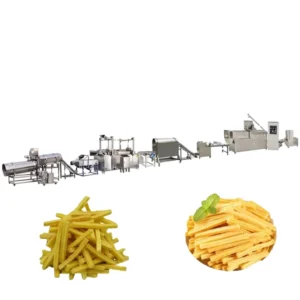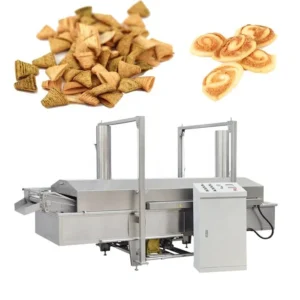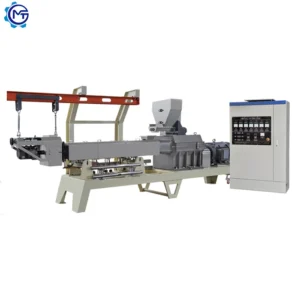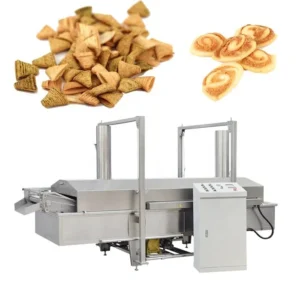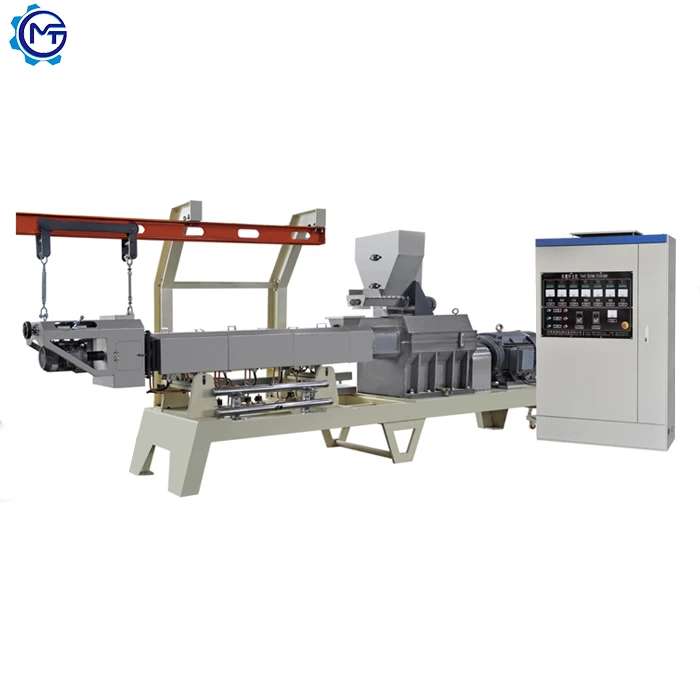
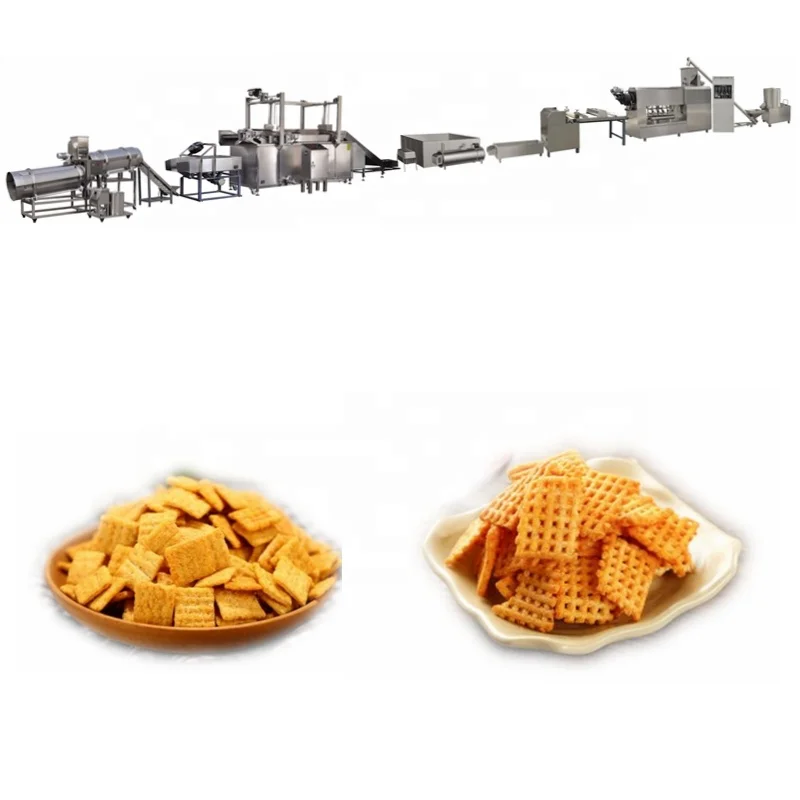
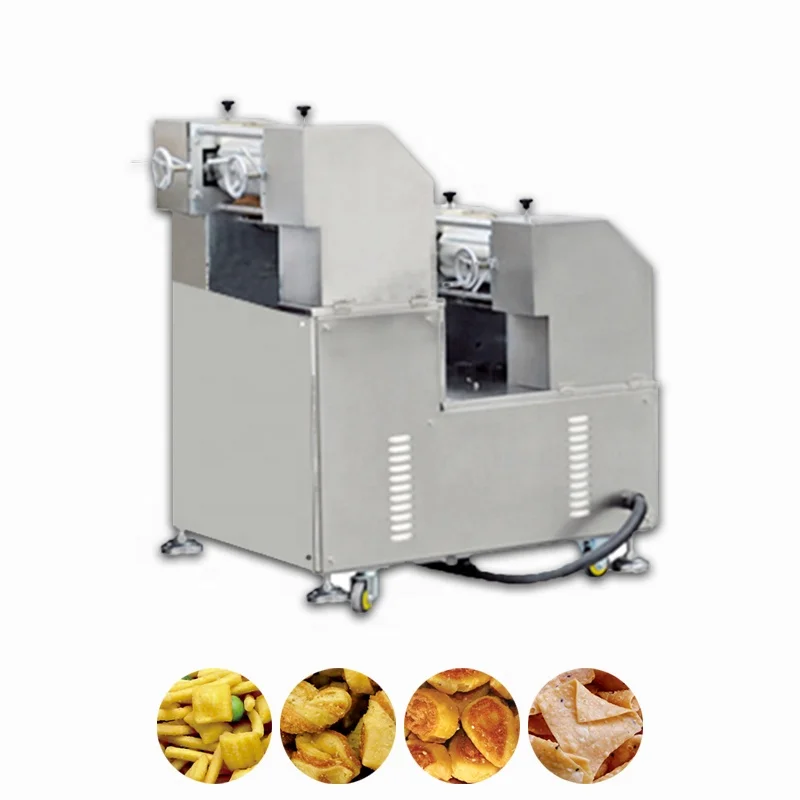
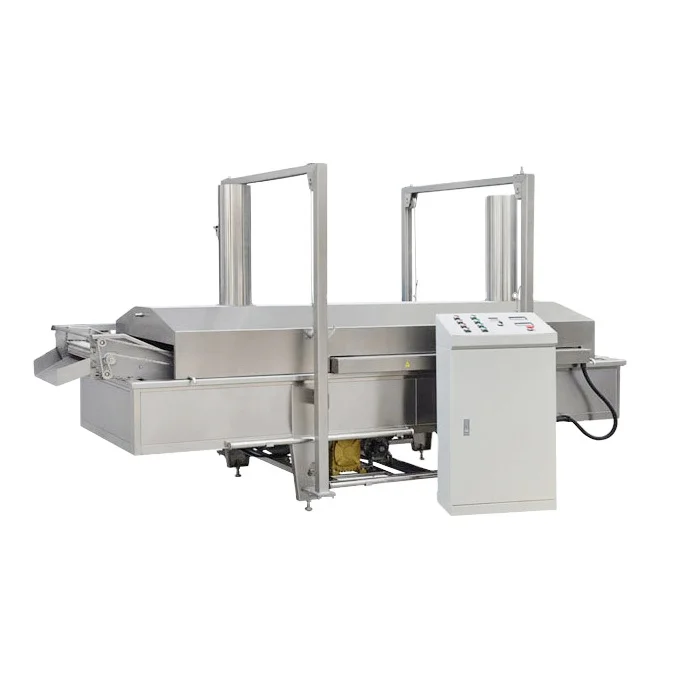


MT100/MT120 Single Screw Puffed Snack Production Line, 120 kg/h, 50-70 kW, Food-Grade SS 304 — engineered for starch-based secondary puffing applications including golgappa, grid crust chips, and vegan salad strips. The single screw configuration with adjustable dies supports multiple product shapes on one extruder platform, while energy options span electricity, gas, diesel, and steam to match your facility’s utility infrastructure. Every station from mixing through frying and flavoring is throughput-matched to eliminate bottlenecks. Trial runs on your raw material are completed in our testing workshop before shipment, verifying texture and density against your specifications.
- CE & ISO 9001 certified
- Three-phase 380V/50Hz, customizable voltage
- Complete turnkey layout with matched station capacity
- Screw and die configuration documented per your target product
Description
Throughput-Matched Engineering — every station from the single-screw extruder through the fryer and flavoring drum is sized to the same output target so半成品 never piles up on the conveyor.
Technical Specifications
| Parameter | Value |
|---|---|
| Model | MT100/MT120 |
| Product Type | Puffed Snack Production Line (Single Screw Extruder) |
| Extruder Type | Single screw extruder with high and low pressure screw configuration |
| Rated Power | 50–70 kW (electric heating); 50–60 kW (gas/diesel heating) |
| Voltage & Frequency | Three-phase 380 V / 50 Hz, single-phase 220 V / 50 Hz (configurable to local grid) |
| Output Capacity | 120 kg/h (basis not stated in source — confirm raw material and moisture content) |
| Overall Dimensions | 12 000–26 000 × 1 200 × 2 200 mm (L × W × H) |
| Construction Material | Food-grade stainless steel 201 / 304 |
| Energy Options | Electricity, gas, diesel, steam |
| Motor & Inverter | Siemens (made in China) or China top-brand motor; Delixi or Delta inverter |
| Raw Materials | Wheat flour, corn starch, potato starch |
| Product Shapes | Screw shell, round tube, square tube, ring, cartoon shapes (adjusted via dies) |
| Process Flow | Mixer → Screw conveyor → Single screw extruder → Pulling and cutting machine → Automatic fryer → Automatic flavoring line → Cooling |
| Assembly State | Complete line from batching to packing |
| Standards | CE, ISO 9001 |
Application Suitability
| Application | Material or Output |
|---|---|
| Golgappa / pani puri shells | Wheat flour and starch blends, thin-wall hollow shapes |
| Grid-pattern rice cakes | Rice and corn starch mixtures, lattice die cutting |
| Vegan salad strips | Potato starch and wheat flour, strip die profiles |
| Crispy grid-crust snacks | Starch-based dough, secondary puffing through frying |
| Assorted shaped puffed snacks | Swapping dies for screw shell, ring, tube and cartoon forms |
Why the Extruder Output Must Match the Fryer Intake on a Puffed Snack Production Line Turnkey
A puffed snack line is only as fast as its slowest station, and the fryer is where most bottlenecks hide.
Early in my career I watched an extrusion line in a Gulf-state snack plant push dough pieces onto a conveyor faster than the fryer basket could cycle. The pieces sat exposed to ambient humidity, absorbed moisture, and lost the surface dryness needed for clean oil expansion. By the time they reached the fryer, texture was inconsistent and oil absorption spiked. The extruder was rated correctly, the dryer was undersized, and nobody had calculated the fryer dwell time against actual dough moisture. That mismatch is exactly what a properly engineered puffed snack production line turnkey is designed to prevent [NEED_CITE: throughput matching across extrusion and frying stations].
When you evaluate a single-screw line for starch-based snacks, ask for a station-by-station capacity sheet that shows residence time at the cutter, dryer belt length, fryer basket volume, and flavoring drum RPM — all referenced to the extruder screw speed and dough density you will actually run.
Screw Configuration and Starch Gelatinisation
The MT100/MT120 uses a high- and low-pressure screw arrangement rather than a uniform-pitch flight. Low-pressure sections allow gradual starch hydration and gelatinisation before the dough reaches the high-pressure compression zone where sudden expansion occurs at the die face. This staged pressure profile means you can run wheat flour, corn starch, or potato starch without swapping the entire screw assembly — you adjust barrel temperature and feed moisture instead. For a snack manufacturer planning to launch multiple SKUs from one puffed snack production line turnkey, that flexibility cuts changeover time and keeps die inventory lean.
Die Swapping and Shape Range
A single extruder platform produces screw shells, round tubes, square tubes, rings, and custom cartoon shapes by changing the die plate and adjusting the cutting speed downstream. The pulling-and-cutting station synchronises blade travel with extrudate velocity so that wall thickness stays within tolerance across shapes. When you move from a thin-wall golgappa shell to a thicker grid-crust chip, the die land length and orifice diameter change, which shifts the back-pressure the screw must overcome. Operators compensate by tuning inverter frequency on the main drive and barrel zone temperatures, a process that takes one shift of trial runs rather than mechanical rebuilds [NEED_CITE: die geometry and extrudate expansion relationship in single-screw snack extrusion].
Reading the Spec Sheet Against Your Raw Material
Rated power spans 50–70 kW depending on whether the heating medium is electric elements or gas/diesel burners; the choice affects both peak current draw and the thermal response time of the barrel zones. A facility running on diesel heat will see slower zone-temperature recovery after a cold start, which matters if you batch-run short production lots. The overall line length of 12 to 26 metres reflects whether the dryer and cooler are inline or stacked, and that decision hinges on ceiling height and conveyor routing in your building. Voltage is listed as three-phase 380 V / 50 Hz but is configurable — confirming your local supply before the control panel is wired avoids costly rewiring on site. The stainless steel contact surfaces (201 or 304 grade) should be specified to match local food-safety audit expectations; some Gulf and EU buyers require 304 on all product-contact zones, while 201 suffices for structural frames [NEED_CITE: food-grade stainless steel selection for snack processing equipment].
What Happens When Stations Are Sized Independently
I have seen lines where the extruder was chosen on brochure capacity, the dryer was quoted as a standard catalogue model, and the fryer was sourced from a separate vendor who only knew the target hourly output in vague terms. The result was a conveyor pile-up between the cutter and the fryer hopper. Dough pieces cooled below the glass-transition temperature of the starch matrix, so when they finally entered the hot oil they puffed unevenly and absorbed excess oil. The flavouring drum then received an inconsistent feed, leaving some pieces under-seasoned and others over-coated. Every one of those defects traces back to a throughput mismatch that a coordinated puffed snack production line turnkey layout would have prevented.
Why Procurement Through One Supplier Changes the Outcome
Line layout and capacity calculation are produced as a single document, so the extruder screw speed, dryer belt speed, fryer cycle time, and flavouring drum RPM all reference the same mass-balance target. Screw and die configuration records are written against your specific flour or starch blend before the machine leaves the factory, not guessed from a generic build. An in-house testing workshop runs your actual raw material through the extruder and fryer, generating a trial-run report that shows product density, oil uptake, and texture before you sign off on shipment. Electrical schematics arrive with voltage, frequency, and control language confirmed to your local grid standard, eliminating the commissioning delays that happen when a panel is built for 50 Hz and the site runs 60 Hz. Spare wear parts — screws, dies, cutting blades — ship with the line in a first-replacement kit, so your maintenance team is not searching for custom tooling in the first month of production [NEED_CITE: importance of pre-shipment trial runs on customer raw material].
Documentation & Verification
- Line layout showing station-by-station throughput match for your target snack shape and raw material
- Trial-run report on your wheat flour or starch blend verifying expansion ratio and fryer oil uptake
- Screw and die configuration record tied to the specific product shapes you will produce
- Electrical schematic with voltage, frequency, and PLC language confirmed to your local standard
- CE declaration of conformity and ISO 9001 certificate for customs and regulatory clearance
- Packing photographs and customs documentation support for container loading inspection
Installation, Commissioning & Support
- Foundation plan aligned to the 12 000–26 000 mm line length, with levelness tolerance for the extruder and fryer
- Dedicated power circuit sized to the 50–70 kW rated load, with breaker rating confirmed to local code
- Modular conveyor sections bolted on site to match your ceiling height and dryer routing constraints
- First-run parameter logging for barrel zone temperatures, screw RPM, and fryer oil temperature against your starch blend
- Operator training covering die changeover, inverter adjustment, and cutting-blade synchronisation
- Wear-parts list with screw flights, die plates, and cutting blades identified by part number for reorder
What to Include in Your Inquiry
Send your target snack shape with a reference photo or sample, the primary flour or starch type you plan to run, and the daily output you need the line to sustain over a standard shift. Include your facility voltage and frequency, available floor length and ceiling height, and whether you already have upstream batching or downstream packing equipment that the new line must integrate with. If you have a specific oil-uptake or product-density requirement from your market, state that up front so the trial-run programme can be built around it.
Frequently Asked Questions
Q: How is line capacity verified against my specific raw material and moisture content?
A: We run your actual flour or starch blend through the single-screw extruder and fryer in our testing workshop, measuring expansion ratio, product density, and oil uptake. The resulting trial-run report becomes the baseline for line tuning and is shared with you before shipment approval.
Q: What voltage, frequency, and control language options are confirmed before shipment?
A: The standard panel is three-phase 380 V / 50 Hz, but we rewire and reconfigure the inverter and heater contactors to your local grid specification. Control-panel labels and HMI language are set to your operator preference and confirmed on the electrical schematic before the line is crated.
Q: How do you match dryer, fryer, and flavoring station capacity to the extruder output?
A: We calculate mass flow at the extruder die, then size the dryer belt length, fryer basket volume, and flavoring drum RPM so each station handles the same hourly throughput. The station-by-station capacity sheet is included in the line-layout document you review before production begins.
Q: Which spare wear parts are included, and how are replacements sourced?
A: A first-replacement kit of screw flights, die plates, and cutting blades ships with the line, each item listed by part number. Replacement orders reference the same configuration record, so we manufacture or dispatch identical components without requiring a new trial run.
Related products
-
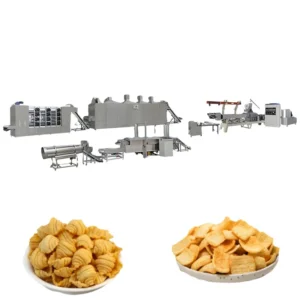
Automatic Fried Crispy Bugles Snacks Food Making Machines Wheat Flour Sala Food Extruder
¥100.00 Select options This product has multiple variants. The options may be chosen on the product page -
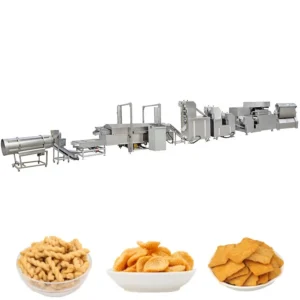
Frying Crispy 3D Corn Bugles Pellets Fried Chips Snacks Food Machine Production Line Bugles Making Extruder
¥100.00 Select options This product has multiple variants. The options may be chosen on the product page -
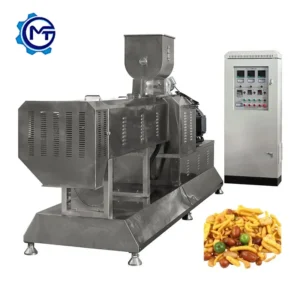
New 100-200kgh Automatic Fried Nimko Extruder Machine Food Grade Stainless Steel for High Productivity Fried Snacks Processing
¥8,575.00 Select options This product has multiple variants. The options may be chosen on the product page -
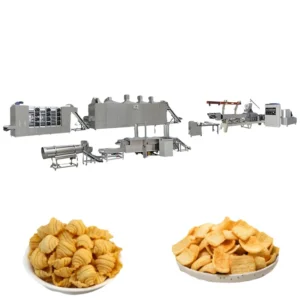
New Doritos Chips Frying Equipment Machine Automatic Tortilla Corn Chips Making Line Portable High Productivity
¥100.00 Select options This product has multiple variants. The options may be chosen on the product page