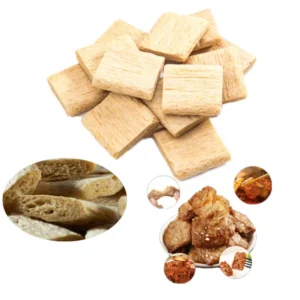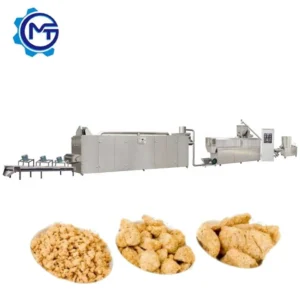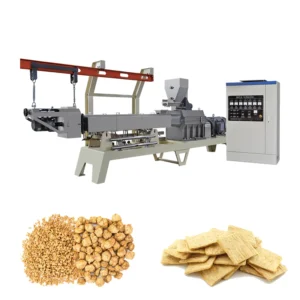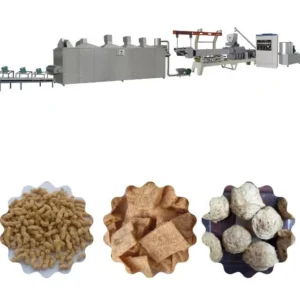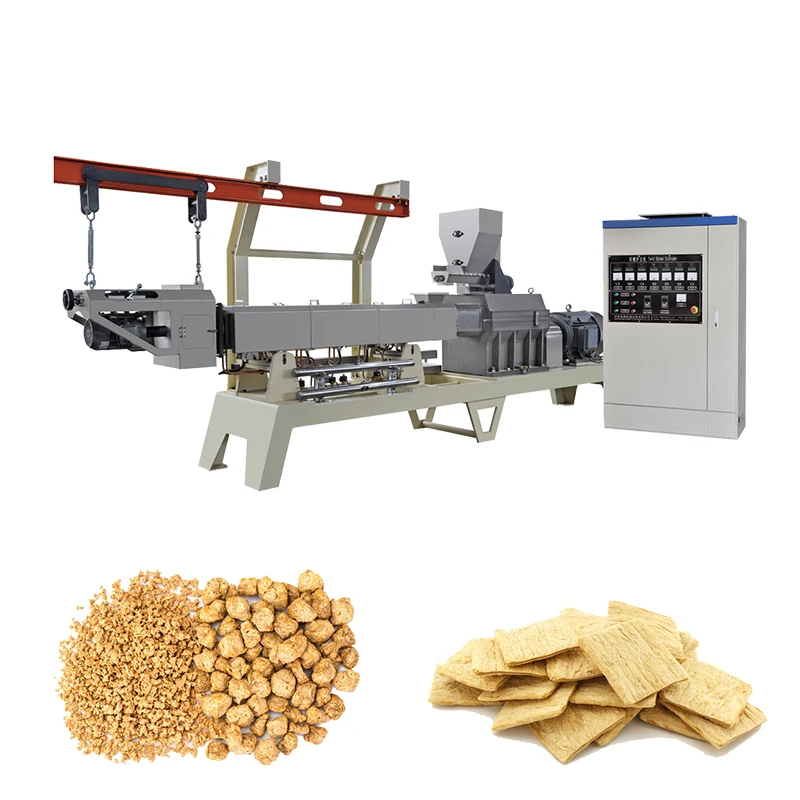


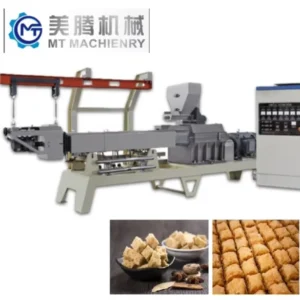
MT65 / MT70 / MT85 Textured Vegetable Protein Production Line, Twin-Screw Extruder, PLC & MCC Control — engineered for soy chunks and plant-based meat from low-temperature soybean meal and peanut meal. Screw configuration and die design are matched to your raw material blend and target fiber structure, with every station throughput-balanced from mixing through drying, cooling and packing. Backed by in-house trial runs on your actual raw material before shipment, full line layout documentation, and on-site installation with commissioning support.
Description
Turnkey Line Accountability — a single supplier covers every station from raw material batching through extrusion, drying, cooling and packing, so throughput is balanced across the entire textured vegetable protein production line turnkey rather than assembled from mismatched vendors.
Technical Specifications
| Parameter | Value |
|---|---|
| Product Type | Textured Vegetable Protein (TVP) Production Line |
| Model Options | MT65 / MT70 / MT85 |
| Screw Type | Twin-screw (Double Screw Extruder) |
| Installed Power | MT65 — 85 kW; MT70 — 120 kW; MT85 — 195 kW |
| Real Power Consumption | MT65 — 65 kW; MT70 — 90 kW; MT85 — 165 kW |
| Output Capacity | MT65 — 150–200 kg/h; MT70 — 200–300 kg/h; MT85 — 600–800 kg/h (basis to be confirmed by raw material, moisture and product format) |
| Overall Dimensions (L×W×H) | MT65 — 18000×1300×2300 mm; MT70 — 20000×1500×2400 mm; MT85 — 24000×3500×4300 mm |
| Line Stations | Raw material preparation → Mixing → Conveying → Extrusion → Conveying → Drying → Cooling → Packing |
| Mixer Tank Volume | 150 kg |
| Mixer Rotary Speed | 385 rpm |
| Mixer Power | 4 kW |
| Mixer Dimension | 1000×630×1100 mm |
| Dryer Effective Belt Length | 3.5 m |
| Dryer Far Infrared Heater Power | 3.9 kW × 24 |
| Dryer Belt Motor Power | 0.55 kW |
| Dryer Dimension | 4500×1500×1600 mm |
| Cooling Machine Temperature Range | 0–260°C (verify against manufacturer catalog) |
| Control System | PLC and MCC control |
| Contact Material | Stainless steel (food-grade) |
| Assembly State | Complete turnkey line |
| Warranty | 1 year complete guarantee with lifetime maintenance service |
| Standards | CE (certified since 2014), ISO |
Application Suitability
| Application | Material or Output |
|---|---|
| Soy chunk production for retail and food-service markets | Low-temperature soybean meal, water, minor additives |
| Textured protein ingredient supply to meat processors | Soybean meal or peanut meal blends for ham, sausage and canned food use |
| Plant-based meat alternative manufacturing | Defatted soy flour and protein concentrates for patty, nugget and strip formats |
| Quick-frozen food ingredient processing | TVP granules and chunks for frozen meal assembly lines |
| High-volume food ingredient production | Peanut meal and soy blends at MT85 capacity range |
What "Rated Output" Means When the Raw Material Changes
A capacity figure is only meaningful when tied to the specific raw material, moisture level and fiber structure you are actually producing.
I spent four days on-site in the Middle East last year re-tuning a soy protein line because the client’s soybean meal carried a noticeably higher fat content than the standard test material we used during factory trials. The fiber structure collapsed at the die exit, and the extruded chunks lacked the layered, meat-like texture the market expected. The extruder was rated for a certain throughput on paper, but that number assumed a specific protein-to-fat ratio and moisture profile. When the real material behaved differently, the entire line — including the downstream dryer — had to be re-balanced around revised parameters [NEED_CITE: impact of raw material fat content on extrusion fiber formation]. A textured vegetable protein production line turnkey should never be quoted on nominal capacity alone without confirming the buyer’s actual formulation.
Screw Configuration Dictates Fiber Structure, Not Just Throughput
The twin-screw extruder at the heart of this textured vegetable protein production line turnkey uses a screw configuration and die design matched to the buyer’s specific soybean meal or peanut meal blend. The shear profile, residence time and compression ratio inside the barrel determine whether the extrudate develops the fibrous, layered structure that meat processors and food-service buyers expect. A generic screw build copied from a different application will push material through, but the resulting chunks will lack the chew and tear characteristics that define market-grade TVP.
Throughput Matching Prevents the Dryer Bottleneck
Every station in the line — mixer, extruder, dryer and cooling conveyor — is sized to hold the rated output without creating a choke point. The dryer’s effective belt length of 3.5 m and far infrared heater array are calculated against the moisture load exiting the extruder. When an extruder is supplied without matching dryer capacity, the line backs up and operators are forced to slow the screw speed, dropping actual output well below the quoted figure. Our configurations specify each station’s capacity relative to the others so the rated throughput is achievable on the buyer’s actual raw material [NEED_CITE: throughput balancing methodology for extrusion-based food processing lines].
Power, Dimensions and Control Logic Across the MT Range
The MT65 draws 65 kW in real operation across an 18-meter line footprint, suited to smaller ingredient processors or pilot-scale plant-based meat producers. The MT70 steps up to 90 kW real consumption over a 20-meter layout, while the MT85 pulls 165 kW across a 24-meter line with a 3.5-meter width that accommodates higher-volume drying and cooling stations. All three models run under PLC and MCC automated control, which locks in barrel temperature profiles, screw speed and moisture dosing across shifts — critical for batch-to-batch consistency when supplying food manufacturers who audit incoming ingredient specifications. Food-grade stainless steel contact surfaces throughout the line meet hygiene requirements for direct food ingredient production.
The Hidden Cost of Skipping a Trial Run
When a textured vegetable protein production line turnkey ships without a factory trial on the buyer’s actual material, all process development happens on-site during commissioning. That means the installation crew is troubleshooting fiber structure, moisture balance and dryer settings while the buyer’s production schedule is already delayed. Screw configurations and die selections that looked reasonable on paper may need physical replacement once real material runs through the barrel. The cost is not just the engineering days — it is the lost production window and the raw material consumed during repeated test runs [NEED_CITE: typical commissioning delays when extrusion lines skip pre-shipment trials].
Why Source the Complete Line From One Supplier
The entire line from batching to packing sits under a single supplier’s accountability, so throughput calculations are coordinated across every station rather than left to the buyer to reconcile between separate equipment vendors. Screw and die configurations are specified against the buyer’s raw material sample, not pulled from a generic catalog build. An in-house testing workshop runs trial extrusions on the customer’s actual soybean meal or peanut meal before shipment, producing a trial run report that confirms fiber structure and output. Electrical schematics with confirmed voltage, frequency and control language are locked in before production begins, preventing commissioning delays at the destination. Pre-sales line layout through on-site installation, operator training and ongoing wear parts supply keeps one engineering team responsible from first inquiry through steady-state production [NEED_CITE: CE machinery directive requirements for food processing equipment exports].
Documentation & Verification
- Line layout drawing with throughput calculations for every station matched to your target output
- Screw and die configuration record specifying the build matched to your soybean meal or peanut meal blend
- Trial run report on your actual raw material conducted in our testing workshop before shipment
- Electrical schematic with voltage, frequency and PLC language confirmed before production begins
- CE declaration of conformity and ISO certificate for customs clearance and local regulatory compliance
- Wear parts list identifying screw segments, dies and seals with replacement intervals
Installation, Commissioning & Support
- Foundation and utility planning based on the MT model’s overall dimensions and total connected power load
- Dedicated electrical circuit sized to the line’s real power consumption with voltage and frequency confirmed pre-build
- Modular station delivery with assembly sequencing to match your facility’s access and overhead clearance
- On-site commissioning with barrel temperature profile, screw speed and dryer settings tuned to your raw material
- Operator training covering PLC interface navigation, screw configuration changes and daily cleaning procedures
- Wear parts kit including spare screw segments and die plates supplied with first delivery for planned maintenance cycles
What We Need To Configure Your Line
Share your raw material specification — protein content, fat percentage and particle size of your soybean meal or peanut meal — along with the target chunk or granule format and your daily production volume. Include your facility’s available floor space, ceiling height and local voltage and frequency so we can confirm the electrical configuration and line layout before quoting. If you have existing upstream batching or downstream packing equipment, let us know so the interface points can be matched.
Frequently Asked Questions
Q: How is the line output capacity verified before shipment?
A: We run trial extrusions on your actual raw material in our in-house testing workshop, measuring throughput, moisture content at the extruder exit and fiber structure quality. The trial run report documents these results under the specific material and moisture conditions tested, so the capacity figure you receive is tied to your real formulation rather than a generic benchmark.
Q: How do you match screw and die configuration to our raw material?
A: Your soybean meal or peanut meal sample is analyzed for protein content, fat level and particle size. The screw profile — including compression ratio, shear intensity and residence time — is then configured to develop the fiber structure your market requires. Die geometry is selected to produce the chunk or granule dimensions specified in your product sheet.
Q: What does the pre-shipment trial run report include?
A: The report covers the screw configuration used, barrel temperature profile, moisture dosing rate, throughput measured at steady state, product density and fiber structure assessment. It also records dryer inlet and outlet moisture levels. This document travels with the line and serves as the baseline for on-site commissioning.
Q: What electrical and control details are confirmed before production?
A: We confirm your local voltage, frequency and phase requirement, then lock in the electrical schematic and PLC programming language before the control cabinets are wired. This prevents the commissioning delays that occur when voltage mismatches or untranslated HMI screens are discovered after the line arrives at your facility.
Q: How are dryer and cooler capacities matched to extruder output?
A: The dryer belt length, heater array and airflow are calculated against the moisture load exiting the extruder at rated throughput. The cooling station is sized to bring the dried product to packing temperature within the available conveyor travel. This prevents the bottleneck that occurs when downstream stations cannot keep pace with the extruder.
Related products
-
High Productivity Single Screw Extruder Machine New Condition Textured Soya Meat & Soy Protein Like Meat Making Machine
Price range: ¥20.00 through ¥30.00 Select options This product has multiple variants. The options may be chosen on the product page -
Meat Taste Textured Soybean Protein Processing Machine Vegetable Protein Soy Meat Making Machine
¥8,650.00 Select options This product has multiple variants. The options may be chosen on the product page -
High Productivity New Soy Protein Automated Production Line Meat Substitute Processing Line
¥30.00 Select options This product has multiple variants. The options may be chosen on the product page -
Vegetarian Beef Substitute Making Machine with Twin Screw Extruder
¥9,500.00 Select options This product has multiple variants. The options may be chosen on the product page