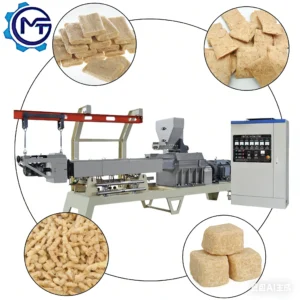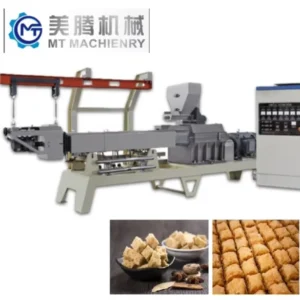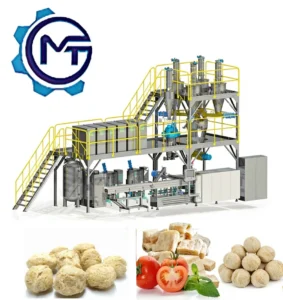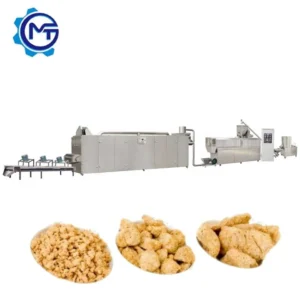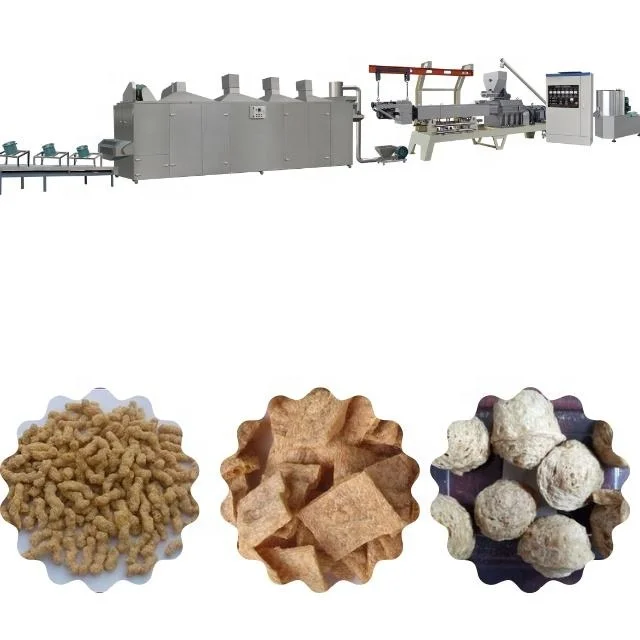


MT65, MT70, MT85 Texturized Vegetable Protein Extrusion Line, Twin-Screw — designed for soybean and peanut meal processing into high-fiber plant-based meat structures. Screw configuration and die design are matched to your raw material and target fiber density, with throughput balanced across mixing, extrusion, drying, cooling, and packing stations. Trial runs on your actual formulation are completed in-house before shipment, supported by full layout documentation and on-site commissioning.1
Description
Throughput-Matched Turnkey Design — Every station from powder mixing to cooling is sized to the extruder’s real output on your soybean or peanut meal formulation, not rated on paper capacity.
Technical Specifications
| Parameter | Value |
|---|---|
| Product Type | Texturized Vegetable Protein (TVP) Extrusion Line |
| Models Available | MT65, MT70, MT85 |
| Extruder Type | Twin-screw |
| MT65 Installed Power | 85 kW |
| MT65 Real Power Consumption | 65 kW |
| MT65 Output | 150–200 kg/h (basis not stated in source — confirm raw material formulation / moisture content) |
| MT65 Overall Dimensions | 18000 × 1300 × 2300 mm |
| MT70 Installed Power | 120 kW |
| MT70 Real Power Consumption | 90 kW |
| MT70 Output | 200–300 kg/h (basis not stated in source — confirm raw material formulation / moisture content) |
| MT70 Overall Dimensions | 20000 × 1500 × 2400 mm |
| MT85 Installed Power | 195 kW |
| MT85 Real Power Consumption | 165 kW |
| MT85 Output | 600–800 kg/h (basis not stated in source — confirm raw material formulation / moisture content) |
| MT85 Overall Dimensions | 24000 × 3500 × 4300 mm |
| Double Screw Extruder Main Motor Power | 30 kW |
| Powder Mixer Tank Volume | 150 kg per batch |
| Powder Mixer Rotary Speed | 385 rpm |
| Powder Mixer Mixing Time | 10 min per batch |
| High-temperature Roaster Effective Belt Length | 3.5 m |
| Roaster Far Infrared Heater Power | 3.9 kW × 24 elements |
| Construction Material | Stainless steel throughout |
| Warranty | 1 year complete, lifetime maintenance service |
| Certification | CE, ISO (company-level) |
Application Suitability
| Application | Material or Output |
|---|---|
| Plant-based meat alternatives | Texturized soy protein for vegetarian patties, nuggets, and strips |
| Ham and sausage production | TVP blended as partial or full meat substitute in emulsified products |
| Canned and retort food | Soy tissue protein maintaining fiber structure after sterilization |
| Quick-frozen food ingredients | TVP chunks and shreds for frozen meal kits and ready-to-eat formats |
| Fast-food supply chain | High-protein textured pieces for quick-service menu items |
Why "Rated Output" Fails on Actual Raw Material
Many buyers discover after installation that a line quoted at nominal capacity cannot sustain that throughput when the actual soybean meal or peanut meal formulation enters the extruder barrel. A turnkey texturized vegetable protein production line must be validated on the buyer’s own raw material before the machine leaves the factory.
In my years running trial runs across Southeast Asian workshops, I have watched lines that performed flawlessly on standard soy isolate collapse the moment a buyer substituted a lower-cost protein powder. The barrel temperature curve shifted, moisture absorption dropped, and the fibrous structure vanished entirely. The whole batch was scrapped. That is why a texturized vegetable protein production line turnkey project demands an in-house testing phase — the only way to confirm whether the screw configuration, die geometry, and thermal profile actually match your formulation [NEED_CITE: importance of raw material validation in extrusion processing].
Screw Configuration Dictates Fiber Formation
The fibrous, meat-like structure that defines TVP comes from the shear, temperature, and pressure profile inside the twin-screw barrel. Screw element arrangement — mixing blocks, kneading paddles, and reverse-flight sections — determines how long the protein mass stays under shear and at what temperature. On a texturized vegetable protein production line turnkey setup, the screw configuration must be matched to the protein content and particle size of your soybean or peanut meal, not copied from a generic template.
Die Geometry and Post-Extrusion Control
The die plate shapes the extrudate into chunks, shreds, or granules, and the die aperture interacts directly with barrel pressure to control expansion ratio. After extrusion, the roaster and cooling station must handle the exact moisture load leaving the die. If the roaster belt speed or infrared heating zones are undersized, the TVP exits the line with residual moisture that compromises shelf life. Throughput matching between the extruder, the 3.5-meter roaster belt, and the cooling machine is what separates a functional line from one that bottlenecks at every station transition [NEED_CITE: thermal management in protein extrusion lines].
Reading the Power and Dimension Specs
The MT65, MT70, and MT85 designations correspond to installed power figures of 85 kW, 120 kW, and 195 kW respectively, with real power consumption noticeably lower at 65 kW, 90 kW, and 165 kW. The gap between installed and real power reflects motor headroom for start-up surges and formulation variability. The overall line dimensions scale accordingly — the MT65 fits within an 18-meter footprint while the MT85 requires a 24-meter run with a wider and taller profile to accommodate the larger extruder, high-capacity roaster, and expanded cooling section. The powder mixer handles 150 kg per batch at 385 rpm with a 10-minute cycle, meaning mixing capacity must be calculated against the extruder’s real hourly output to avoid idle time between stations. The 24 far-infrared heating elements in the roaster deliver concentrated thermal energy across the 3.5-meter belt, and the stainless steel construction throughout every contact surface ensures food-grade compliance and simplifies washdown procedures.
The Cost of Undersized Downstream Stations
A common failure mode on plant-based protein lines is the extruder producing at full capacity while the dryer or cooler cannot keep pace. Wet TVP accumulates on the roaster belt, moisture removal becomes uneven, and the final product enters packing with inconsistent water activity. In humid Southeast Asian environments, this moisture variance accelerates mold growth inside sealed packaging, generating customer complaints weeks after shipment. I have seen producers forced to throttle extruder output down to match the dryer, leaving paid-for capacity sitting unused [NEED_CITE: moisture control challenges in tropical food processing].
Why Sourcing the Full Line from One Supplier Matters
When the texturized vegetable protein production line turnkey project comes from a single source, the mixing cycle time, extruder throughput, roaster belt speed, and cooling capacity are calculated together rather than assembled from independent vendor quotes. The screw and die configuration is specified against your raw material sample before production begins. An in-house testing workshop runs your actual soybean or peanut meal through the extruder to verify fiber structure and output stability. The electrical schematic confirms voltage and frequency match your facility before the control cabinet is wired. And installation support covers the entire line — not just the extruder — so commissioning addresses every station transition from day one.
Documentation & Verification
- Line layout and capacity calculation matching mixing, extrusion, roasting, and cooling throughput
- Trial run report on your soybean or peanut meal formulation before dispatch
- Screw and die configuration record matched to your target fiber structure
- Electrical schematic with voltage and frequency confirmation for your facility
- Operation and maintenance manual covering every station in the line
- Wear parts list with replacement intervals for screws, dies, and roaster belts
Installation, Commissioning & Support
- Floor plan review confirming the 18–24 meter line footprint and utility connection points
- Power supply verification against the 85–195 kW installed load and local voltage standard
- Full-line assembly and alignment from mixer discharge through cooling conveyor
- First-run parameter tuning on your raw material across barrel zones and roaster temperatures
- Operator training covering screw configuration changes and daily washdown procedures
- Spare screw elements and die plates supplied with initial shipment for first replacement cycle
Preparing Your Inquiry
To size the right line and configure the correct screw and die set, share your raw material type and protein content, target hourly or daily output, available floor space and ceiling height, and your facility’s voltage and frequency standard. If you can send a raw material sample, we will run it through the testing workshop and provide a trial report with the proposal.
Frequently Asked Questions
Q: How is line throughput verified on my specific soybean or peanut meal formulation before shipment?
A: Your raw material sample is run through the extruder in the testing workshop with the screw and die configuration specified for your formulation. The trial run report documents barrel temperature profiles, moisture levels, fiber structure, and sustained output rate so you can review performance before the line ships.
Q: How do I choose between MT65, MT70, and MT85 based on my production target and factory space?
A: The three models cover different output ranges and physical footprints. The MT65 suits smaller operations with limited floor space, while the MT85 supports industrial-scale volume across a 24-meter line. Your raw material formulation and target daily tonnage determine which model maintains stable output without throttling.
Q: What voltage, frequency, and control language options are confirmed before commissioning?
A: The electrical schematic and control cabinet wiring are confirmed against your facility’s power supply before production. Voltage, frequency, and HMI language are locked in during the specification stage so the line powers up correctly on arrival without rewiring delays.
Q: How are screw configuration and die design specified to achieve the correct fiber texture and density?
A: The screw element sequence — mixing blocks, kneading paddles, and conveying flights — is arranged based on your protein source and target fiber structure. Die aperture and plate thickness are selected to control expansion ratio. Both are validated during the in-house trial run before final configuration is recorded.
Q: What does on-site installation, commissioning, and operator training include?
A: Engineers install and align every station from mixer to cooler, tune barrel temperature zones and roaster settings on your raw material, and train operators on screw changes, die replacement, and daily maintenance. Wear parts guidance and support continue after commissioning is complete.
Related products
-
Vegetable Meat Making Machine Textured Soybean Protein Maker
¥30.00 Select options This product has multiple variants. The options may be chosen on the product page -
Small Multifunctional Textured Soy Protein Machine – Soy Protein Production Line – Vegetarian Meat Processing Equipment
¥65.00 Select options This product has multiple variants. The options may be chosen on the product page -
High-yield Soybean Protein Automated Production Line Single Screw Extruder for TVP
Price range: ¥20.00 through ¥30.00 Select options This product has multiple variants. The options may be chosen on the product page -

Vegetarian Meat Floss Production Line with Twin Screw
¥9,500.00 Select options This product has multiple variants. The options may be chosen on the product page