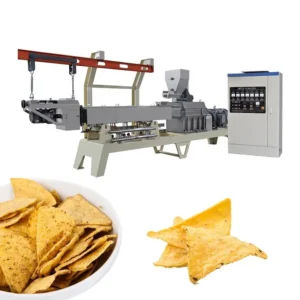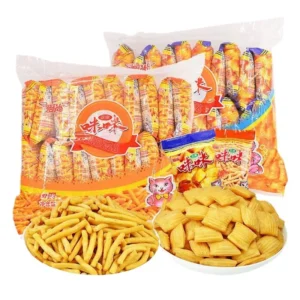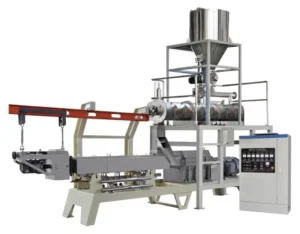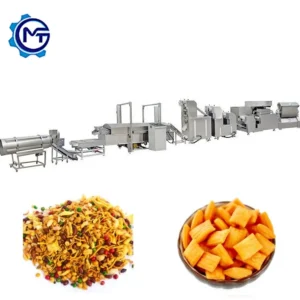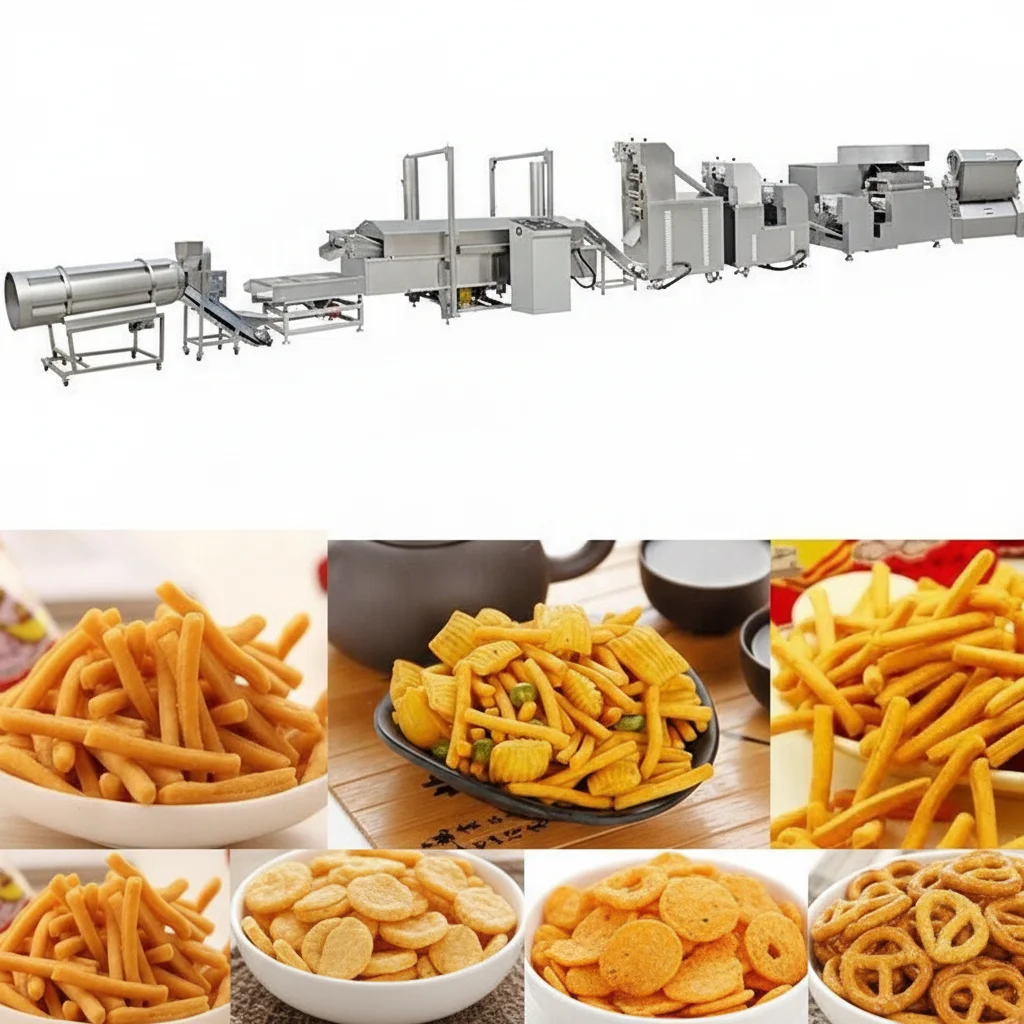

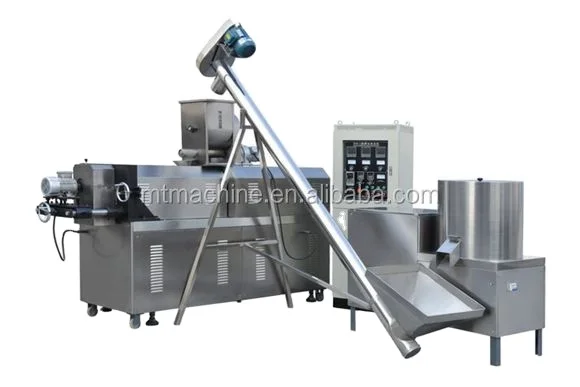


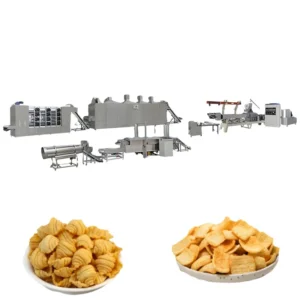
MT100/MT120 Twin-Screw Puffing & Deep Frying Production Line, PLC Control, Food-Grade SS 201/304 — engineered for secondary puffing snacks like bugles, rice crust and pani puri from wheat flour, corn starch or potato starch.
- Energy options include electricity, gas, diesel and steam for flexible plant setup
- Screw and die sets switchable across shell, tube, ring and custom shapes
Throughput-matched stations from extrusion to frying and flavoring eliminate bottlenecks, backed by an in-house trial run on your raw material before shipment.
Description
Integrated Line Engineering — throughput calculations across extrusion, frying and flavoring stations prevent bottlenecks before the line ships, verified in a dedicated testing workshop.
Technical Specifications
| Parameter | Value |
|---|---|
| Product Type | Twin-Screw Puffing & Deep Frying Production Line |
| Model | MT100/MT120 |
| Extruder Configuration | Single screw extruder |
| Rated Capacity | 120 kg/h (basis not stated in source — confirm raw material / moisture / product format) |
| Installed Power | 50–70 kW (electricity); 50–60 kW (gas or diesel) |
| Voltage & Frequency | Three phases 380V/50Hz, Single phase 220V/50Hz (customizable to local voltage) |
| Overall Dimensions (L×W×H) | 12000–26000 × 1200 × 2200 mm |
| Contact Material | Food-grade stainless steel 201/304 |
| Control System | PLC controlled |
| Line Sequence | Mixer → Screw conveyor → Single screw extruder → Pulling and cutting machine → Automatic fryer → Automatic flavoring line → Cooling |
| Energy Options | Electricity / Gas / Diesel / Steam |
| Electrical Components | Siemens (China) or China top-brand motors; Delixi or Delta inverters |
| Certification | CE / ISO 9001 |
Application Suitability
| Application | Material or Output |
|---|---|
| Bugles and corn chip production | Wheat flour and corn starch blends |
| Rice crust and golgappa snack runs | Rice flour and potato starch formulations |
| Pani puri and hollow shell snacks | Starch-based dough with controlled moisture |
| Screw shell and tube shapes | Wheat flour with die changes |
| Ring and cartoon-shape extruded snacks | Multi-grain flour and starch mixtures |
Why "120 kg/h" Means Nothing Without the Full Line Context
A rated extruder output is irrelevant if the fryer and flavoring drum cannot absorb it.
When the extruder pushes product faster than the fryer can handle, semi-finished pieces pile up on the conveyor, cool down unevenly and absorb oil inconsistently. The reverse — an oversized fryer waiting for feed — burns fuel for no reason and shortens oil life. I have walked into workshops where operators were literally hand-shoveling backlog off the belt because the two stations were quoted by different vendors who never spoke to each other [NEED_CITE: line integration and station throughput matching]. A properly specified turnkey puffing and frying snack production line eliminates this mismatch at the layout stage, not after installation.
Throughput Matching Across Every Station
The sequence from mixer through screw conveyor, single screw extruder, pulling and cutting machine, automatic fryer, flavoring drum and cooling conveyor operates as one continuous chain. Each station is sized so that its processing window aligns with the upstream output rate. The turnkey puffing and frying snack production line avoids the common failure mode where one oversized or undersized machine forces every other station to run below its design point.
PLC Control as the Central Nervous System
PLC control ties every motor, heater and conveyor into a single interface rather than leaving each station on its own isolated panel. Operators adjust extruder screw speed, fryer temperature and flavoring drum rotation from one screen, which keeps the entire turnkey puffing and frying snack production line synchronized when product changeovers happen. Delixi or Delta inverters regulate motor speed smoothly, reducing mechanical shock on start-up [NEED_CITE: PLC and inverter integration in food processing lines].
Reading the Spec Sheet Beyond the Headline Numbers
The installed power range of 50–70 kW for electric heating or 50–60 kW for gas and diesel tells you the thermal load the fryer and extruder barrel together demand. A workshop must confirm that its transformer and dedicated circuit can carry this continuous draw without voltage sag, because voltage drop directly affects heater performance and extruder torque stability. The food-grade stainless steel 201/304 contact surfaces meet hygiene standards expected by food safety auditors, and the CE marking supports machinery directive compliance in regulated markets. Electrical components from Siemens China or equivalent domestic brands keep spare part sourcing practical without inflating the bill of materials.
The Hidden Cost of Mismatched Energy Sources
Choosing the wrong energy option for the fryer creates problems that surface months after commissioning. A workshop running on expensive commercial electricity may find that electric fryer heating costs far more per shift than a gas-fired alternative, yet switching later requires replacing the entire heating assembly. Conversely, a facility without reliable gas supply forced onto a gas fryer faces unplanned downtime every time the pressure drops. These are not theoretical concerns — they show up as line stoppages and margin erosion that buyers blame on the machine rather than on the initial specification gap [NEED_CITE: energy source selection for industrial frying equipment].
What This Supplier Actually Delivers
The complete line from batching to packing stays under one supplier, so throughput calculations are coordinated across every station rather than assembled from separate vendors who never validated compatibility. Screw configuration and die design are specified against the buyer’s actual raw material formulation and target product shape, not copied from a generic template. The in-house testing workshop runs trial batches on customer-supplied flour and starch blends before the line ships, producing a test report that confirms expansion, texture and fryer absorption under real conditions. Pre-sales engineering consultation carries through to on-site installation, commissioning and ongoing maintenance support, so the same team that designed the layout is accountable when the line runs in production.
Documentation & Verification
- Line layout drawing with throughput calculations for each station matched to your product format
- Screw and die configuration record specific to your raw material blend and target snack shape
- Electrical schematic with voltage, frequency and control language confirmed for your facility
- Trial run report produced in the testing workshop on your flour or starch formulation before dispatch
- CE declaration of conformity and ISO 9001 certificate for machinery directive compliance
Installation, Commissioning & Support
- Foundation leveling within the 12000–26000 mm footprint confirmed against the supplied layout drawing before equipment arrival
- Dedicated circuit sized for the 50–70 kW electric or 50–60 kW gas/diesel thermal load with voltage verified at the panel
- Modular station delivery allowing staged assembly of extruder, fryer and flavoring sections within your workshop clearance
- PLC parameter upload and first-run calibration on your raw material during on-site commissioning
- Operator training covering die changeover, fryer temperature management and emergency stop procedures
- Wear parts list covering screws, dies and fryer mesh belts with recommended stock quantities for the first year
What to Include in Your Inquiry
Share the specific flour and starch formulations you plan to run, along with the target snack shapes and expected daily output. Provide your workshop floor dimensions, ceiling height and local voltage with frequency so the layout and electrical package match your site. If you already operate upstream mixers or downstream packing machines, list those models so the new turnkey puffing and frying snack production line integrates without duplication or gaps.
Frequently Asked Questions
Q: How is the 120 kg/h capacity figure validated for my specific product?
A: The stated capacity depends on raw material composition, moisture content and the target shape produced by the die. Before confirming a final number, we run trial batches in the testing workshop using your actual flour and starch formulation, then document the output rate, expansion ratio and fryer absorption in a test report shared with you before the line ships.
Q: The product title mentions twin-screw but the spec lists a single screw extruder — which is correct?
A: The line as configured ships with a single screw extruder matched to secondary puffing applications like bugles, rice crust and pani puri. If your formulation or product shape requires twin-screw shear characteristics, the extruder station can be re-specified during the line layout phase before production begins.
Q: Can the voltage, frequency and control language be adapted to my country?
A: The standard configuration covers three-phase 380V/50Hz and single-phase 220V/50Hz, with customization available for other voltage and frequency combinations. The PLC interface language is set to match your operators before shipment, and the electrical schematic is delivered in the confirmed language.
Q: How do you ensure the fryer and flavoring drum keep pace with the extruder?
A: Every station is sized during the layout stage using throughput calculations based on your target product weight and frying time. The pulling and cutting machine speed, fryer belt travel rate and flavoring drum rotation are all coordinated through the PLC so no station becomes a bottleneck.
Q: Is a trial run possible before the equipment leaves the factory?
A: Yes. The in-house testing workshop conducts trial runs on customer-supplied raw material, producing samples of the final fried and flavored snack. A full trial report covering output rate, product density, oil absorption and flavoring coverage is provided before the line is packed for shipment.
Related products
-
New Automatic Portable High Productivity Frying Salad Sticks Chips Snacks Food Production Line
¥100.00 Select options This product has multiple variants. The options may be chosen on the product page -
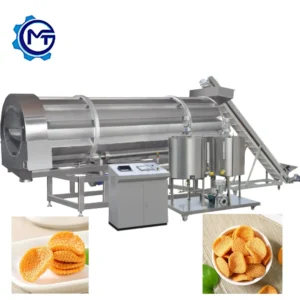
Automatic Rice Crust Chips Making Machine Bugles Pizza Rolls Fried Snack Food Processing Line Machine
¥8,570.00 Select options This product has multiple variants. The options may be chosen on the product page -
Automatic Fried Crispy Bugles Snacks Food Making Machines Wheat Flour Sala Food Extruder
¥100.00 Select options This product has multiple variants. The options may be chosen on the product page -

Electric Heating Fried Puffed Food Production Line – Salad Sticks Making Equipment
¥65.00 Select options This product has multiple variants. The options may be chosen on the product page