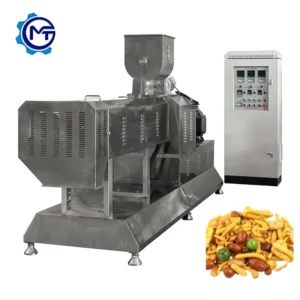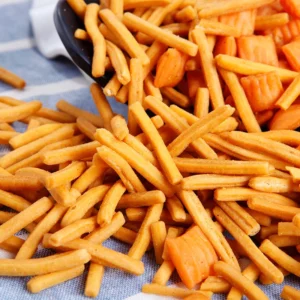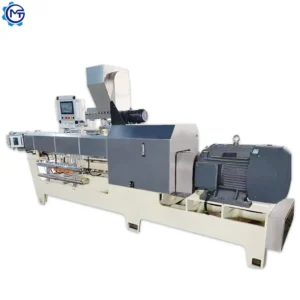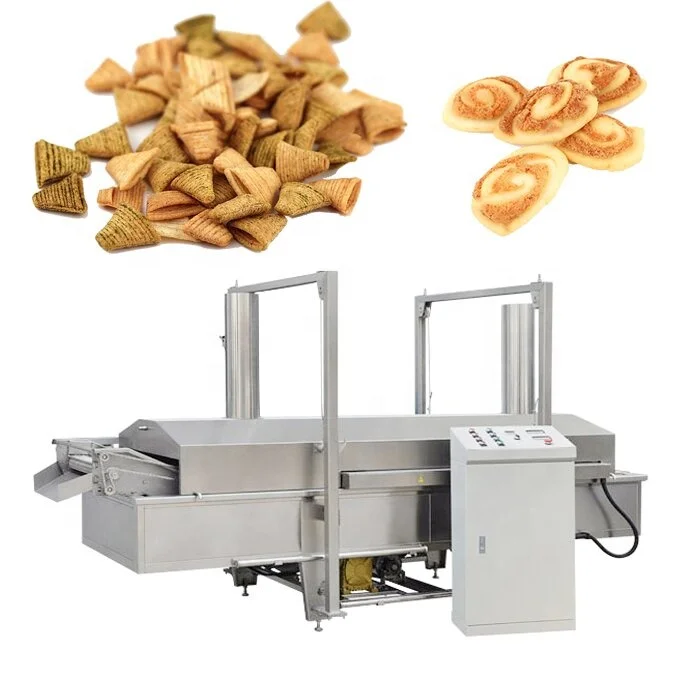
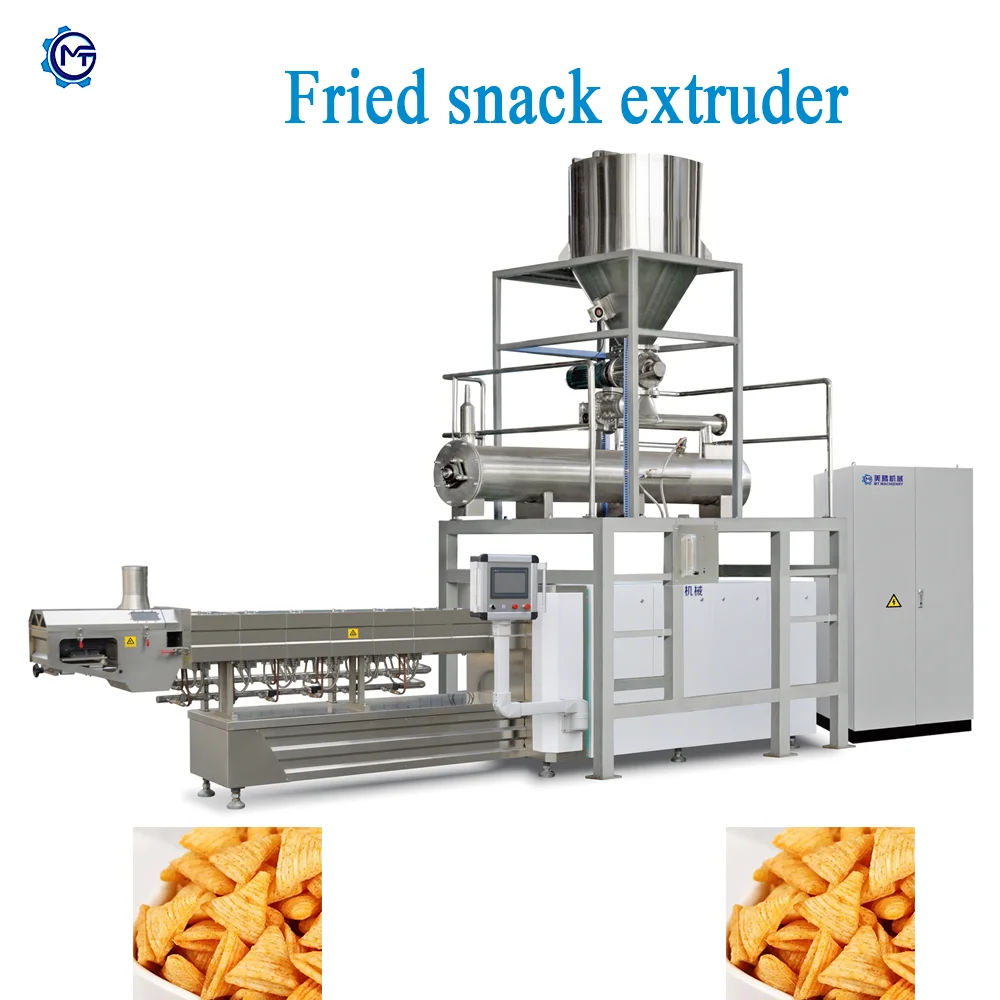
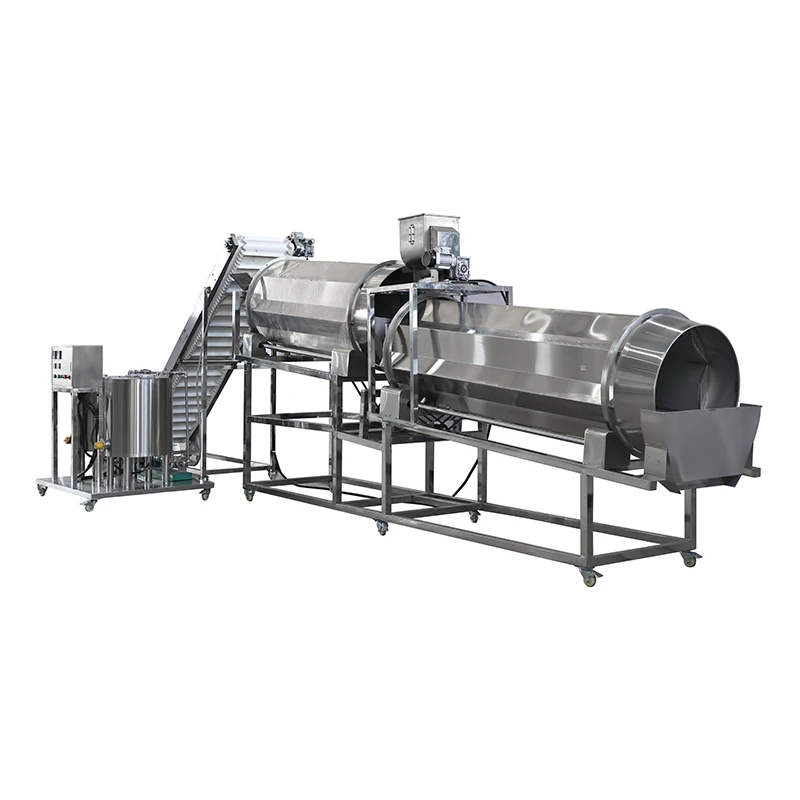
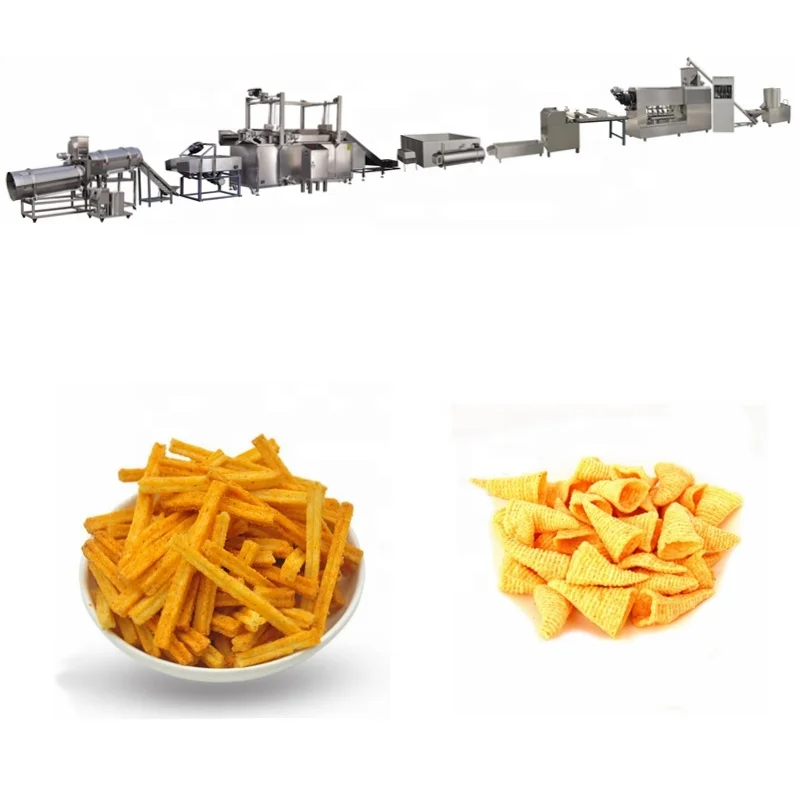
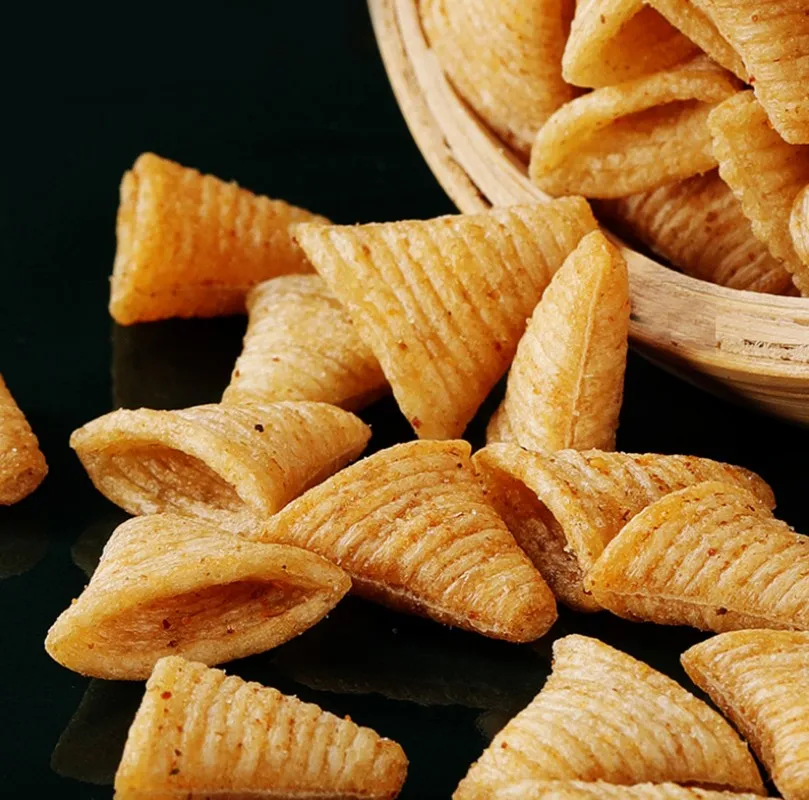
MT65 / MT70 / MT70c / MT75 Twin Screw Extruder, Nacho & Tortilla Chips Line, 22–55 kW — engineered for corn flour puffed snack production with matched frying and double-drum flavoring stations.
- Screw configuration and die design specified to your corn blend and target chip density, controlling expansion and texture through precise barrel temperature and moisture profiles
- Twin screw self-cleaning design in 38CrMoAl nitrided alloy minimizes changeover time between Nacho, Tortilla and Doritos formats
Trial runs on your actual raw material are completed in our testing workshop before shipment, with full configuration documentation provided.
Description
Single-vendor throughput matching — Every station from the twin-screw extruder through the fryer and double-drum flavoring line is capacity-balanced on one layout, eliminating the bottleneck that forms when equipment is assembled from separate suppliers.
Technical Specifications
| Parameter | Value |
|---|---|
| Model | MT65 / MT70 / MT70c / MT75 |
| Product Type | Twin Screw Extruder for Puffed Snack and Nacho Chips Production Line |
| Screw Type | Twin screw |
| Screw Material | 38CrMoAl alloy, nitriding process |
| Main Power (MT65) | 22 kW |
| Main Power (MT70) | 30 kW |
| Main Power (MT70c) | 45 kW (basis to be confirmed) |
| Main Power (MT75) | 55 kW |
| Output Capacity (MT65) | 100–150 kg/h (basis not stated in source) |
| Output Capacity (MT70) | 150–200 kg/h (basis not stated in source) |
| Output Capacity (MT70c) | 200–250 kg/h (basis not stated in source) |
| Output Capacity (MT75) | 200–300 kg/h (basis not stated in source) |
| Main Motor Brand | Siemens |
| Gearbox | Automatic lubrication function |
| Feeding System | Food-grade stainless steel twin screw feeder |
| Cutting System | Rotary cutting knife fixed on die head seat, V-belt drive |
| Control System | Speed-adjusted converter on feeding, extrusion, and cutting systems |
| Cooling | Increased radiator on driving part for forced cooling |
| Line Stations | Extruder → shaper → hot-air expansion → fryer (electric/diesel/gas) → double-drum flavoring system |
| Fryer Energy Options | Electric, diesel, or gas |
| Standards | CE certified (since 2014); ISO certified |
| Warranty | 1 year from equipment arrival at customer site |
Application Suitability
| Application | Material or Output |
|---|---|
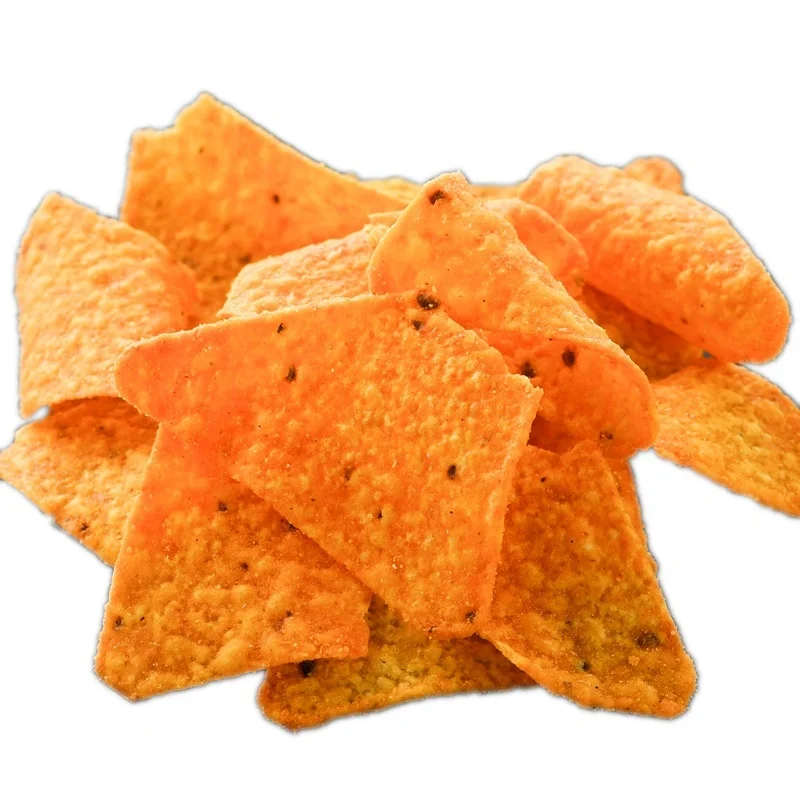
| Nacho chips | Corn flour blend, post-extrusion fried and seasoned |
| Tortilla chips | Corn masa or wheat-corn blend, fried to target crispness |
| Doritos-style triangular snacks | Corn-based dough, shaped, expanded, fried, and coated |
| Corn flour puffed snacks | Refined corn grits or flour, direct extrusion with seasoning |
What "Rated Capacity" Actually Means for Your Corn Blend
A line quoted at nominal output that cannot hold that number on your specific corn flour particle size and moisture level is not a production line — it is a cost overrun waiting to happen.
I worked on a project for a Middle Eastern client producing Doritos-format chips. The line was configured based on a standard corn flour specification, but the buyer’s local supplier delivered a grind with noticeably coarser particles. The extruder ran, but expansion dropped and the nacho chips shattered at the cutter. We had to rework the screw combination and die geometry after the fact. A trial run on the buyer’s actual raw material before shipment would have caught that mismatch in the testing workshop instead of on the factory floor [NEED_CITE: raw material variability impact on extrusion output consistency].
This is why the twin screw extruder snack production line turnkey approach starts with your material, not with a catalog number.
Screw Configuration Matched to Chip Format
Nacho, Tortilla, and Doritos-style chips each demand a different balance of shear, residence time, and die pressure. The twin screw design allows the screw elements to be rearranged — adjusting the ratio of conveying, kneading, and reverse elements — so the barrel profile fits the starch gelatinisation behavior of your specific corn flour. A generic screw build copied from a different product will produce the wrong expansion or density, and no amount of downstream adjustment fixes that.
Die Design and Expansion Control
The die plate determines chip thickness, shape, and the initial moisture gradient that drives expansion in the hot-air stage. For a triangular Doritos-style snack, the die orifice geometry must produce a uniform sheet that the rotary cutter can handle without edge cracking. The 38CrMoAl nitrided screw and die set resists abrasion from corn grits over extended runs, maintaining dimensional accuracy across production cycles. When the twin screw extruder snack production line turnkey configuration is specified, the die is selected alongside the screw profile — not as an afterthought [NEED_CITE: die geometry influence on snack expansion and texture].
Reading the Power and Capacity Data
The MT65 at 22 kW sits at the entry level for small-batch or pilot snack runs, while the MT75 at 55 kW anchors higher-volume operations. The critical relationship is between main motor power and the torque demand of your specific corn formulation — higher fat or fiber content increases barrel resistance and requires more drive headroom. Variable-frequency drives on the feeding, extrusion, and cutting systems allow operators to fine-tune throughput across the rated range rather than running at a single fixed speed. The Siemens main motor provides consistent torque delivery under the cyclic loads that corn dough extrusion produces, and the automatic-lubrication gearbox reduces maintenance intervention during continuous shifts.
The Hidden Cost of a Mismatched Fryer
An extruder running at its rated output means nothing if the fryer downstream cannot keep up. Oil temperature drops when product volume exceeds the fryer’s thermal recovery rate, producing chips that are oily rather than crisp. The double-drum flavoring system must also match the line speed — undersized seasoning drums leave uneven coating, and product backs up on the conveyor between stations. This cascade of small bottlenecks is what causes a line to deliver noticeably less than its nameplate capacity in actual production [NEED_CITE: throughput balancing across extrusion frying and coating stations].
Why Source the Full Line from One Supplier
Throughput matching across every station is calculated during the layout phase, not discovered during commissioning. The screw and die configuration is documented against your raw material specification before production begins. An in-house testing workshop allows trial runs on your actual corn flour blend, generating a report that confirms expansion, density, and chip integrity before the equipment ships. Electrical schematics with voltage, frequency, and HMI language are confirmed during the specification stage, preventing delays when the line arrives on site. CE and ISO certification provides a baseline for import compliance in most export markets.
Documentation & Verification
- Line layout showing throughput calculation across extruder, fryer, and flavoring stations
- Screw and die configuration record tied to your corn flour specification
- Trial run report on your raw material from the in-house testing workshop
- Electrical schematic with confirmed voltage, frequency, and control language
- Factory test record and CE declaration of conformity before dispatch
Installation, Commissioning & Support
- Foundation plan matched to the full line footprint and extruder vibration load
- Dedicated power circuit sized for the main motor rating up to 55 kW on the MT75
- Fryer utility connection configured for your selected electric, diesel, or gas energy source
- Variable-frequency drive calibration across feeding, extrusion, and cutting during startup
- Operator training covering screw changeover and die replacement procedures
- Wear parts list including 38CrMoAl screw elements and die plates for first reorder
What to Include in Your Inquiry
To configure a twin screw extruder snack production line turnkey project that actually holds its output, the starting information should cover your corn flour specification — including particle size distribution and typical moisture content — along with the target chip format and your daily production target. Confirm the local voltage and frequency standard, the preferred HMI language, and whether you have existing upstream mixing or downstream packing equipment that the line needs to integrate with. If a trial run on your raw material is needed before commitment, state that early so the testing workshop schedule can be planned accordingly.
Frequently Asked Questions
Q: How is output capacity verified against my specific corn flour blend and moisture level?
A: Before the line ships, your actual corn flour is run through the extruder in the in-house testing workshop. The trial run measures expansion ratio, chip density, and cutting integrity at the target throughput. A written report documents the results and the screw configuration used, so you know the line will perform on your material — not just on a generic test flour.
Q: What screw and die configuration is selected for Nacho vs Tortilla vs Doritos chip formats?
A: Each format requires a different screw element arrangement to control shear and residence time, plus a die plate matched to chip thickness and shape. Nacho chips need higher expansion and a thicker cross-section, while Tortilla chips require a thinner sheet with controlled surface texture. The configuration is specified during the layout phase based on your target product samples.
Q: How is fryer and flavoring capacity matched to extruder output to avoid line bottlenecks?
A: The line layout document calculates thermal recovery rate for the fryer and drum volume for the double-drum flavoring system against the extruder’s confirmed output. Each station is sized so product flow remains continuous without accumulation or starvation between stages, which is the most common cause of lines failing to reach rated capacity.
Q: Is a trial run on my raw material performed before shipment, and what does the report cover?
A: Yes. The testing workshop runs your corn flour through the configured extruder and records expansion, density, chip integrity at the cutter, and the specific screw and die setup used. The report is shared before dispatch so any adjustments can be made in the factory rather than after installation on your floor.
Related products
-
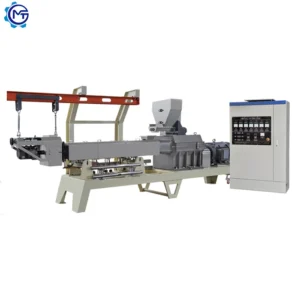
Industrial Wheat Flour Snacks Processing Equipment – Stainless Steel Fried Food Production Line
¥65.00 Select options This product has multiple variants. The options may be chosen on the product page -
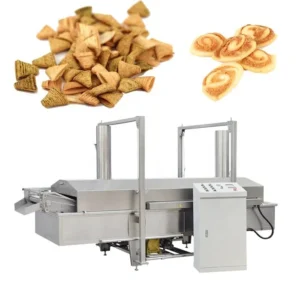
Double Screw Extruder Corn Flour Puffs Snack Nacho Chips Tortilla Doritos Making Machine Savory Snack Production Line
¥50.00 Select options This product has multiple variants. The options may be chosen on the product page -
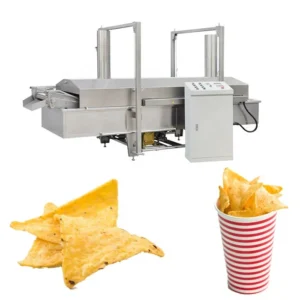
New Fully Automatic Large Capacity 304 Stainless Steel Savory Frying Snack Production Line Crisp Bugles Chips Processing Machine
¥30.00 Select options This product has multiple variants. The options may be chosen on the product page -

Electric Heating Fried Puffed Food Production Line – Salad Sticks Making Equipment
¥65.00 Select options This product has multiple variants. The options may be chosen on the product page