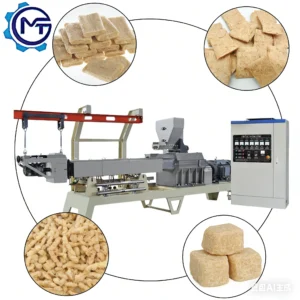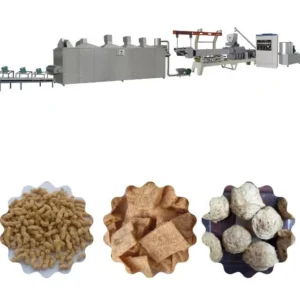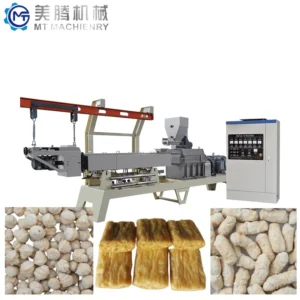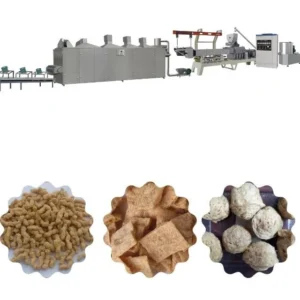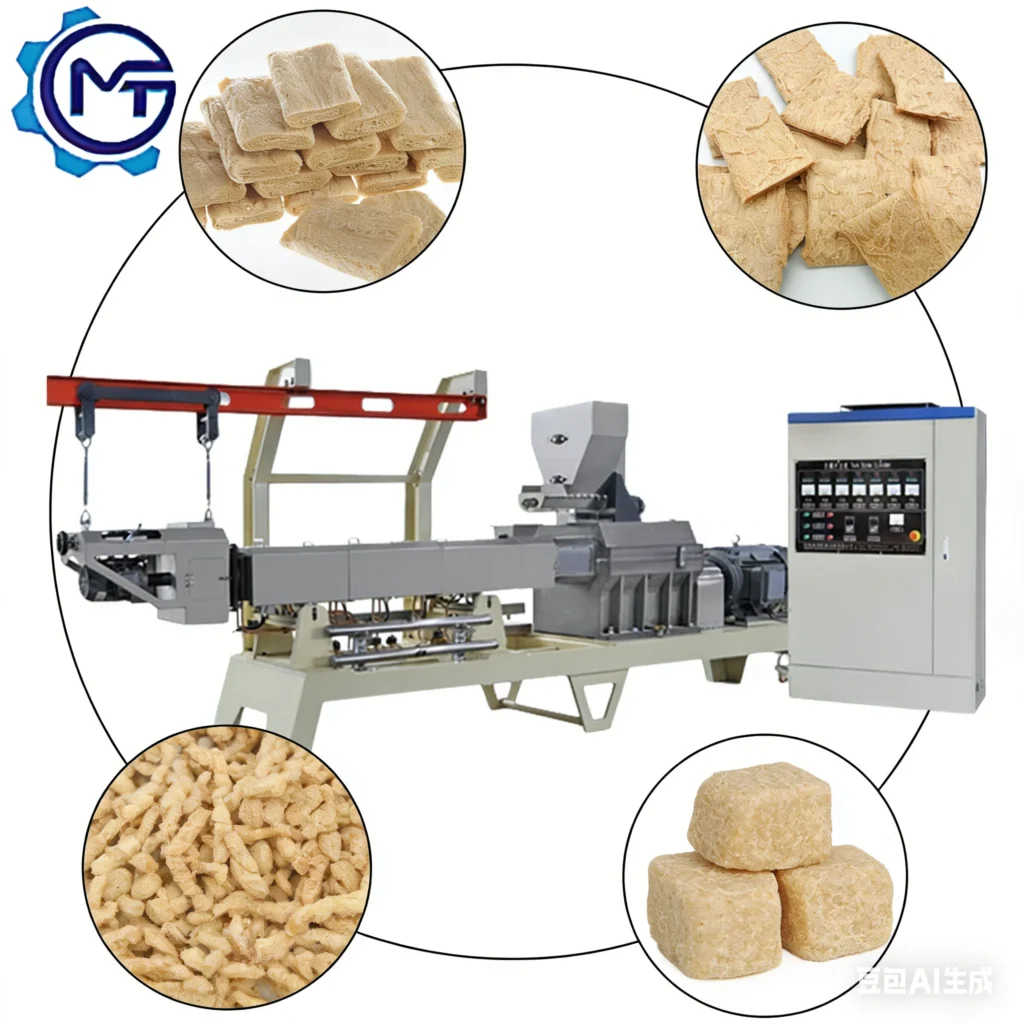


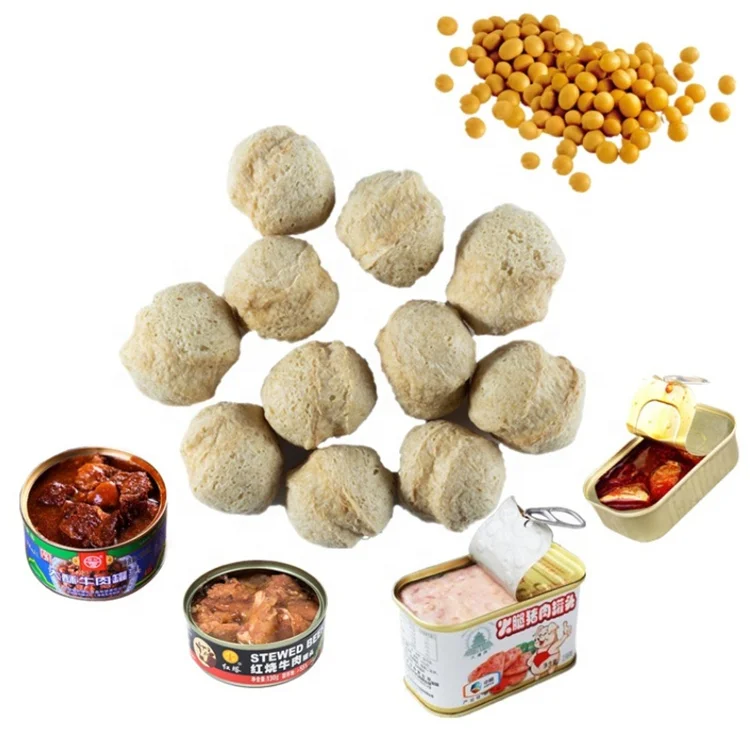
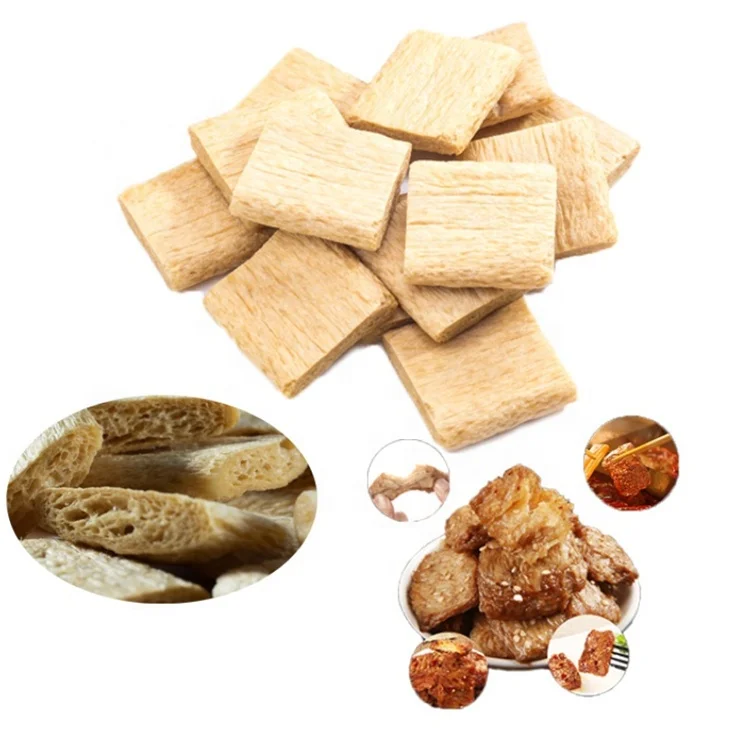
MT65 / MT70 / MT75 / MT85 Twin Screw Extruder for TVP Production Line, 22–45 kW Main Motor, Adjustable Die Moulds — configured for defatted soya flour and low-temperature soya flakes to produce soya nuggets, TSP, and plant-based meat analogues. Screw elements and die design are matched to your raw material behaviour and target fibre structure, with throughput balanced across mixer, extruder, multi-layer dryer, and cooling stations. Trial runs on your actual raw material are completed in our testing workshop before shipment, with full line layout and capacity documentation provided.
Description
Turnkey Line Projects — Layout, throughput matching between stations, utility planning, phased installation, commissioning schedule, operator training.
Matched Throughput Across Every Station — A TVP production line engineered so the extruder output, dryer capacity, and cooling belt speed are calculated together, preventing the bottleneck that occurs when each machine is sourced separately.
Technical Specifications
| Parameter | Value |
|---|---|
| Product Type | Twin Screw Extruder for Textured Vegetable Protein (TVP) Production Line |
| Model Options | MT65 / MT70 / MT75 / MT85 |
| Screw Configuration | Twin Screw |
| Installed Power | MT65: 84 kW / MT70: 160 kW / MT75: 190 kW / MT85: 210 kW |
| Power Consumption | MT65: 59 kW / MT70: 120 kW / MT75: 140 kW / MT85: 140 kW |
| Output Capacity | MT65: 100-150 kg/h (basis to be confirmed) / MT70: 150-200 kg/h (basis to be confirmed) / MT75: 150-200 kg/h (basis to be confirmed) / MT85: 250-300 kg/h (basis to be confirmed) |
| Overall Dimensions (L×W×H) | MT65: 40000×1200×2200 mm / MT70: 41000×1500×2200 mm / MT75: 43000×1500×3200 mm / MT85: 45000×1500×3500 mm |
| Main Motor Power | 22 kW / 30 kW / 45 kW |
| Screw Length Options | 1050 mm / 1520 mm |
| Die Configuration | Adjustable moulds for soya nuggets, TVP, TSP, soya chunks |
| Mixer Capacity Options | 20-30 kg / 70-80 kg / 170-180 kg |
| Mixer Power Options | 4 kW / 7.5 kW / 15 kW |
| Dryer Fuel Options | Fuel / Gas / Electricity (selectable) |
| Dryer Drive System | Double pitch roller chain drive, round-trip drying |
| Line Stations | Mixer → Screw Conveyor → Twin Screw Extruder → Air Conveyor → Multi-layer Dryer → Cooling Machine |
| Standards | CE / ISO |
Application Suitability
| Application | Material or Output |
|---|---|
| Textured Vegetable Protein Production | Defatted soya flour, low-temperature soya flakes |
| Soya Nuggets and Chunks | Soya protein concentrate, soybean dregs |
| Plant-Based Meat Analogues | High-protein vegetarian food bases, peanut dregs |
| Institutional Nutrition Products | Fortified meat substitutes for food programmes |
| Food-Service Ingredients | Fast food and deep-frozen food component production |
Why "Nominal Capacity" Often Fails on Plant-Based Proteins
Capacity is not a fixed number; it is a relationship between your specific raw material and the screw geometry inside the barrel.
When a plant-based meat processing line is quoted based on a generic capacity figure, that number usually assumes a standard defatted soya flour at a specific moisture content. If your facility uses pea protein, wheat gluten blends, or soya flakes with different protein dispersibility indices, the actual throughput can drop significantly while the fibre structure fails to develop correctly. I spent two weeks in a workshop adjusting screw elements and die temperatures for a client whose actual raw material behaved completely differently from the specification sheet they initially provided [NEED_CITE: raw material variability in protein extrusion processes]. The extruder motor was running at full load, but the output was half of what the nameplate suggested.
Line Integration Eliminates the Bottleneck Risk
A textured vegetable protein extrusion line only performs as well as its weakest station. If the extruder produces 200 kg/h but the dryer can only handle 150 kg/h at the required moisture reduction level, your actual capacity is 150 kg/h. When machines come from different vendors, nobody takes responsibility for this mismatch.
Our TVP production line turnkey approach means the vertical mixer capacity, screw conveyor throughput, extruder output, air conveying rate, multi-layer dryer residence time, and cooling machine belt speed are all calculated against the same production target. The mixer options range from 20-30 kg to 170-180 kg batch sizes, matched to the extruder model selected. The dryer uses a double pitch roller chain drive with round-trip drying to ensure even moisture removal without case-hardening the protein structure.
Screw Configuration Determines Fibre Structure
The twin-screw extrusion process for TVP relies on precise mechanical and thermal energy input to align protein molecules into fibrous structures that mimic meat texture. Screw length options of 1050 mm or 1520 mm determine residence time inside the barrel, which directly affects protein denaturation and realignment. Shorter screws work for simpler nugget formats, while longer screws provide the extended shear history needed for complex chunk structures [NEED_CITE: twin screw extrusion parameters for protein texturization].
The die configuration uses adjustable moulds that can produce soya nuggets, TVP granules, TSP, and soya chunks from the same extruder platform. Changing the die plate and cutting mechanism allows one TVP production line turnkey installation to serve multiple product formats without major equipment changes.
Reading the Specifications That Actually Matter
Main motor power options of 22 kW, 30 kW, and 45 kW determine the torque available for high-protein materials that create significant barrel resistance. Higher protein content requires more mechanical energy to achieve proper texturization. Installed power figures include heating zones, feeder motors, and cutting systems — the MT85 at 210 kW total installed power with 140 kW actual consumption reflects the thermal energy needed to maintain barrel temperature profiles across multiple zones.
Overall dimensions suggest the full line footprint rather than just the extruder. The MT85 line stretches 45000×1500×3500 mm, which affects factory layout planning, utility routing, and maintenance access. Dryer fuel options of electricity, gas, or fuel allow the TVP production line turnkey installation to match local energy costs and availability [NEED_CITE: industrial dryer energy source selection criteria].
The Hidden Cost of Voltage Mismatches
Voltage, frequency, and control language often remain unconfirmed until the machine arrives at the facility. A 380V/50Hz extruder shipped to a 440V/60Hz market will run at incorrect screw speeds, destroying the shear profile needed for protein texturization. Motor burnout within the first week is common when frequency converters are added as an afterthought rather than specified during the order [NEED_CITE: electrical compatibility requirements for exported machinery].
Control systems with English-only interfaces create operator errors in non-English-speaking facilities. The result is incorrect temperature settings, wrong feeder speeds, and inconsistent product quality that gets blamed on the machine rather than the interface.
Why This Supplier Approach Works
Single-supplier responsibility means one entity calculates throughput across every station. The mixer, extruder, dryer, and cooler are specified together, so no station bottlenecks another. Screw configuration and die design are matched to your actual defatted soya flour or soya flakes, not copied from a generic build. An in-house testing workshop runs trial production on your raw material before shipment, validating fibre structure and capacity. Pre-sales consultation through installation, commissioning, and operator training keeps the same technical team involved across the entire TVP production line turnkey project.
Documentation & Verification
- Line layout and capacity calculation showing throughput matching across all stations
- Screw and die configuration record specific to your protein source and target format
- Trial run report on your actual raw material from the testing workshop
- Electrical schematic with voltage and frequency confirmation for your facility
- CE declaration of conformity and ISO certificate documentation
- Operation and maintenance manual with wear parts specifications
Installation, Commissioning & Support
- Factory floor space planning based on 40000-45000 mm line length depending on model selected
- Dedicated electrical circuit sized for 84-210 kW installed power with proper grounding
- Phased assembly sequence from mixer through cooling station with utility connections
- First-run parameter setting including barrel temperatures, screw speed, and feeder rate
- Operator training on die changes, screw cleaning, and production troubleshooting
- Wear parts inventory including replacement screws, dies, and cutter blades
- Maintenance schedule covering gearbox oil, bearing lubrication, and heating element checks
Request a Line Configuration
Provide your actual raw material specification including protein content and moisture level. Share your target daily output and the specific TVP formats you need to produce — nuggets, chunks, or granules. Confirm your facility voltage, frequency, and preferred control language. Indicate available floor space and ceiling height for the 2200-3500 mm line height range.
Frequently Asked Questions
Q: How is line capacity verified against my specific raw material before shipment?
A: We run trial production in our testing workshop using your actual defatted soya flour or soya flakes. The trial validates fibre structure development, measures real throughput at your target moisture content, and confirms die configuration produces the correct format. You receive a trial run report documenting all parameters before the TVP production line turnkey ships.
Q: What screw configuration works best for my target TVP format?
A: Screw element arrangement and die design depend on your protein source and desired texture. Soya chunks requiring strong fibre alignment need different screw geometry than small TVP granules. We specify screw length (1050 mm or 1520 mm) and element combination based on your raw material behaviour and target product specification.
Q: How do you prevent throughput mismatches between stations?
A: Every station — mixer, extruder, dryer, cooler — is calculated against the same production target. If the extruder produces at a certain rate, the dryer residence time and cooling belt speed are sized accordingly. This eliminates the bottleneck that occurs when machines are sourced from separate vendors without integrated capacity planning.
Q: What electrical specifications must I confirm before production begins?
A: We need your facility voltage, frequency (50Hz or 60Hz), and phase configuration. Control system language preferences should be confirmed at order stage. This ensures motor speeds, heating elements, and PLC interfaces match your local electrical standards and operator requirements from day one.
Q: What does installation support include?
A: Our team handles on-site assembly following the phased installation schedule, connects utilities to each station, runs commissioning tests with your raw material, and trains operators on production parameters, die changes, and maintenance procedures. We provide a wear parts list and ongoing support for screw and die replacement.
Related products
-
Meat Taste Textured Soybean Protein Processing Machine Vegetable Protein Soy Meat Making Machine
¥8,650.00 Select options This product has multiple variants. The options may be chosen on the product page -
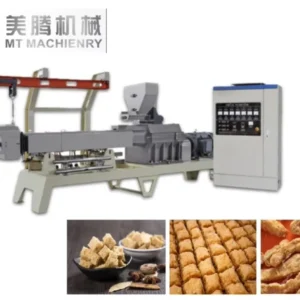
Twin Screw Extruder for High Moisture Vegetarian Meat
¥9,500.00 Select options This product has multiple variants. The options may be chosen on the product page -
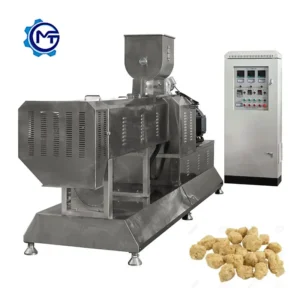
Soy Bean Meat Protein Production Line Machine Multi-functional Extruder for Soy Protein Food
¥8,650.00 Select options This product has multiple variants. The options may be chosen on the product page -
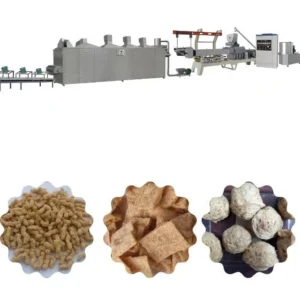
Vegetable Meat Making Machine Textured Soybean Protein Maker
¥30.00 Select options This product has multiple variants. The options may be chosen on the product page