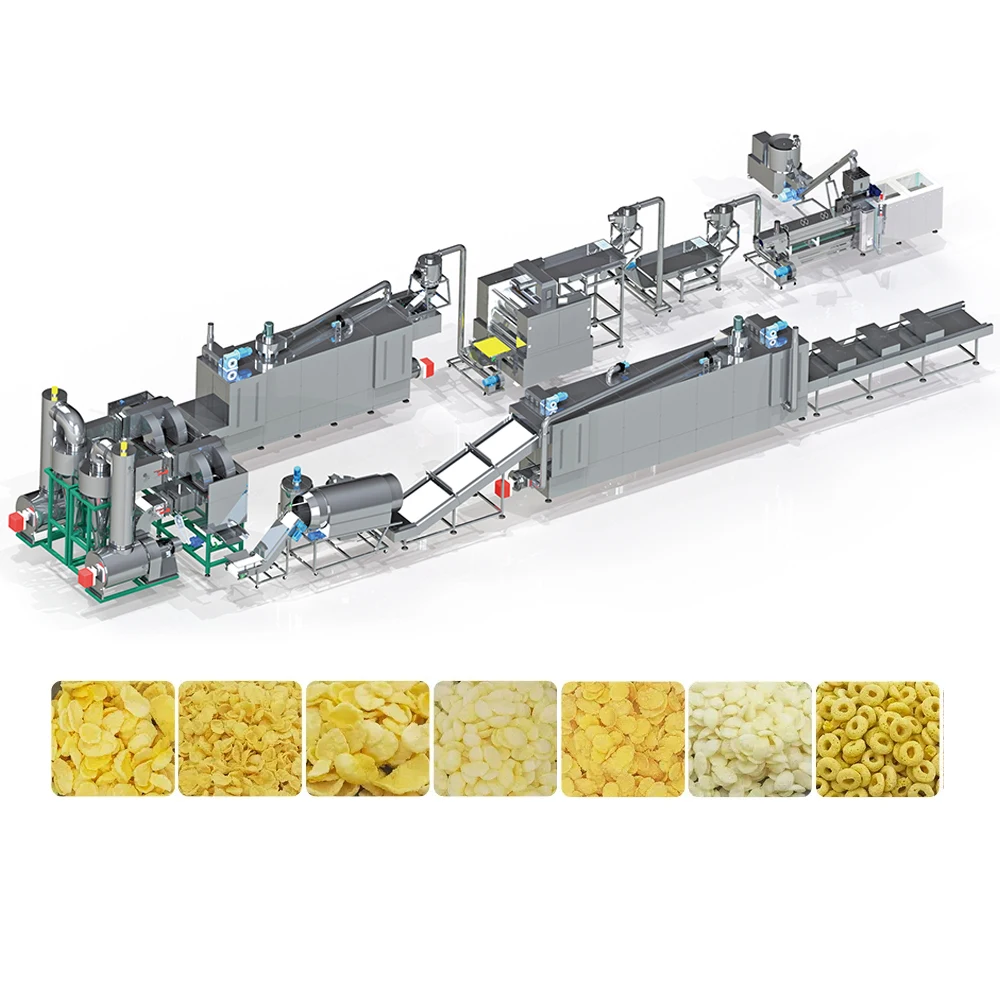
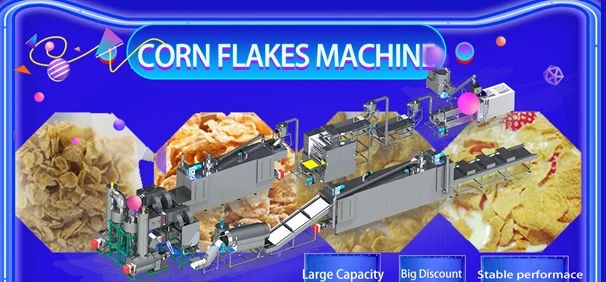
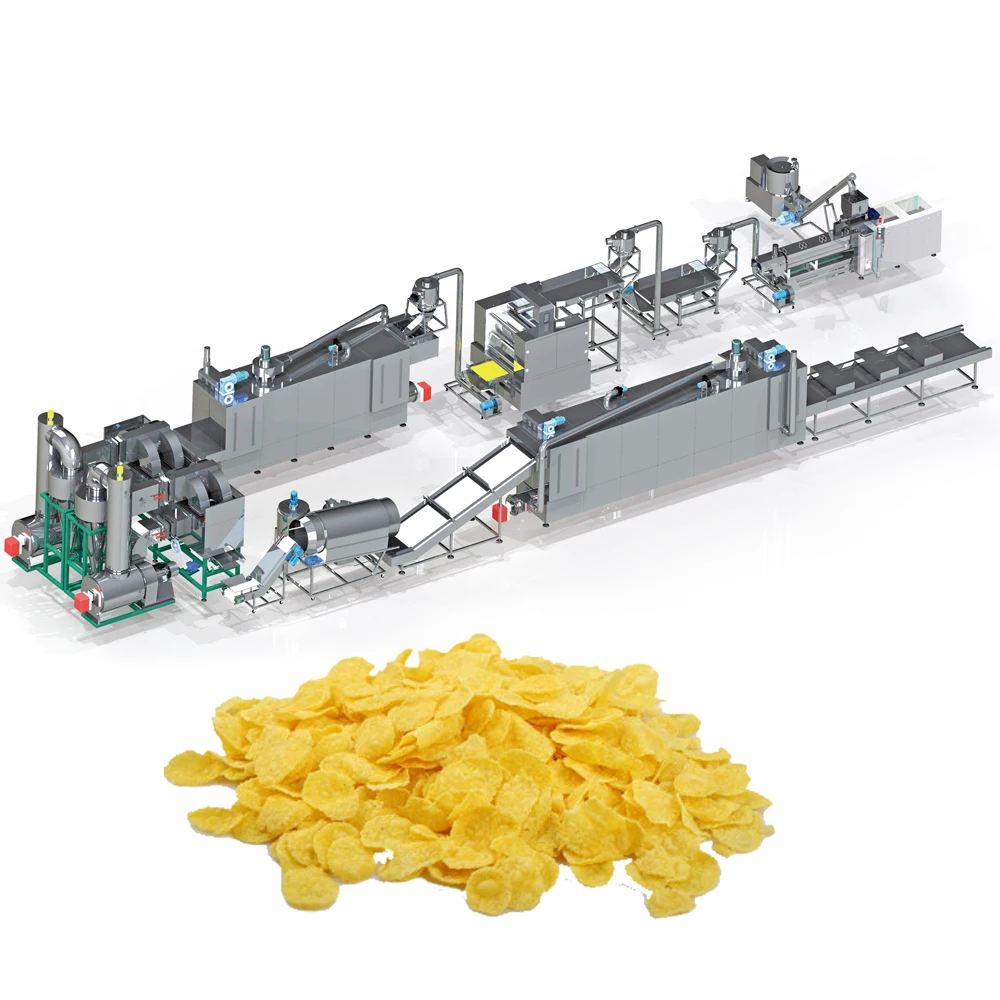
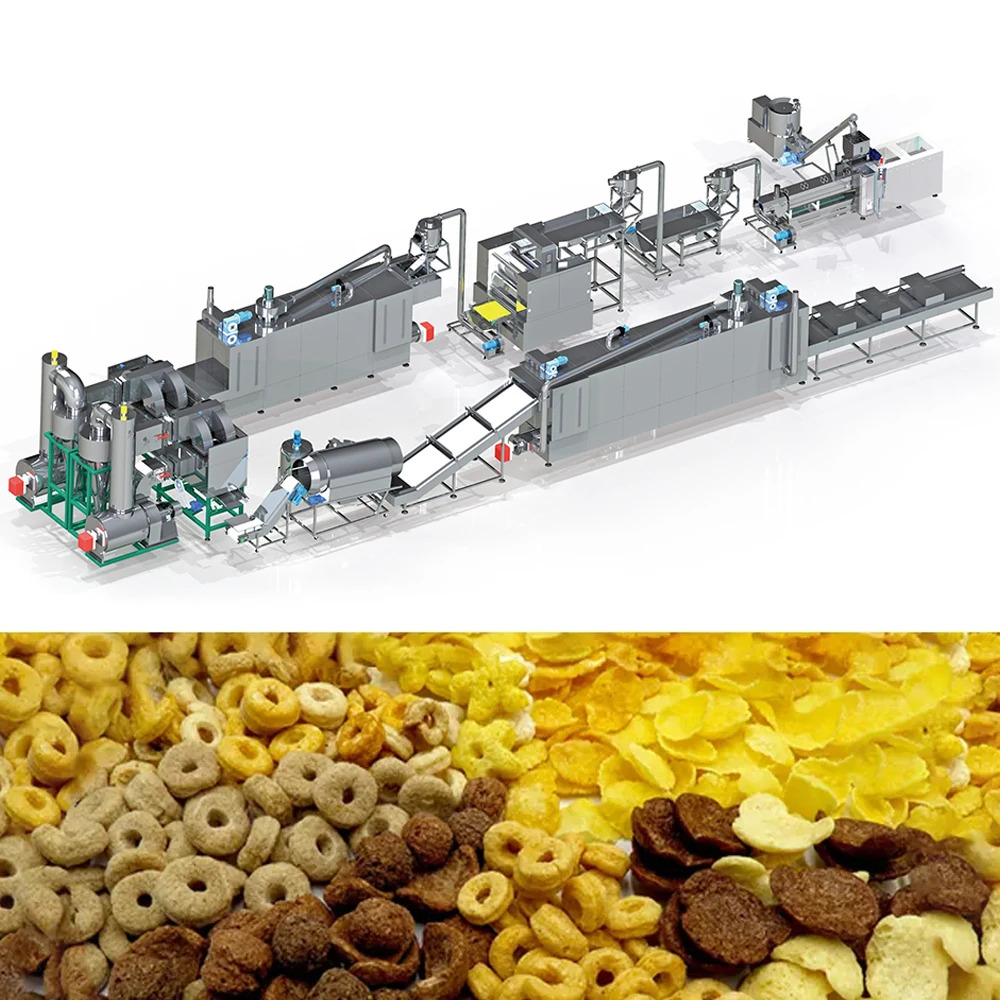
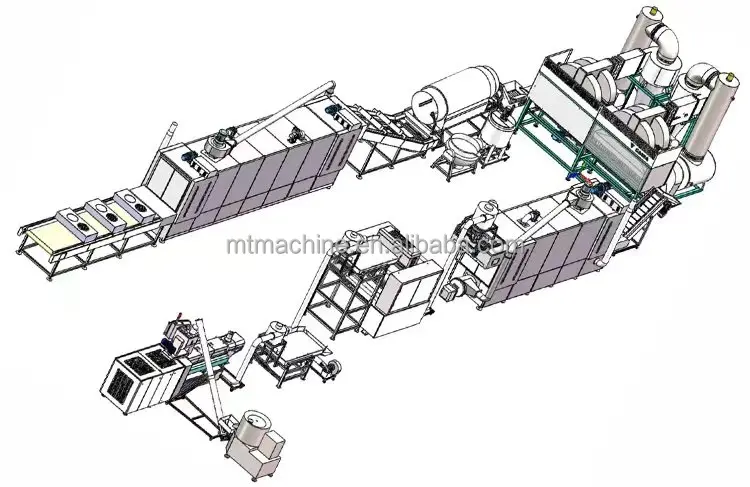
Corn Flakes Breakfast Cereal Production Line, Twin-Screw Extrusion, Gas-Fired Oven, PLC Control — engineered as a complete turnkey project from batching through coating and packing.
- Twin-screw extruder MT-65 with co-rotating sectional modules ensures continuous gelatinisation and uniform expansion; matched dryer and sugar spraying stations eliminate throughput bottlenecks across the line
- Dual-side baking oven and adjustable press roller deliver consistent flake crispness and precise thickness control
Layout, capacity calculation, and on-site commissioning handled by one supplier — so every station performs to spec from day one.
Description
Integrated line throughput verification — every station from the flour mixer through the sugar spraying system and final dryer is calculated against the same raw material formulation to prevent the bottleneck effect that occurs when extruders, dryers, and coating drums are sourced from separate vendors.
Technical Specifications
| Parameter | Value |
|---|---|
| Product Type | Corn Flakes Breakfast Cereal Production Line |
| Extruder Model | MT-65 |
| Extruder Configuration | Twin-screw, co-rotating, sectional screw modules |
| Line Sequence | Flour Mixer → Screw Elevator → Twin-screw Extruder → Elevator → Dryer → Elevator → Coating Line → Vibrating Spreader → Elevator → Dryer → Cooling Conveyor |
| Mixer Output | 10–30 kg per load |
| Mixer Power | 4 kW |
| Mixer Tank Size | φ600 × 500 mm |
| Mixer Dimensions | 1000 × 800 × 1200 mm |
| Screw Conveyor Power | 0.75 kW |
| Screw Conveyor Dimensions | 2700 × 500 × 2400 mm |
| Corn Flakes Press Power | 16.12 kW |
| Corn Flakes Press Roller Size | 510 × 310 × 1050 mm |
| Corn Flakes Press Dimensions | 1550 × 1300 × 2000 mm |
| High-temperature Oven Dimensions | 4.5 × 1.4 × 1.8 m |
| High-temperature Oven Power | 3.75 kW |
| High-temperature Oven Heating | Gas-fired, dual-side baking |
| Sugar Spraying System Power | 28.75 kW |
| Sugar Spraying System Dimensions | 4000 × 1900 × 1880 mm |
| Voltage Options | 3ph 380V 50Hz / 3ph 380V 60Hz / 3ph 415V 60Hz / 3ph 220V 60Hz |
| Certification | CE |
Application Suitability
| Application | Material or Output |
|---|---|
| Corn flakes production | Maize and corn flour formulations |
| Multi-grain breakfast cereals | Blends of corn, rice, and oat powders |
| Fortified cereal manufacturing | Grain bases with added vitamin premixes |
| Coated cereal snacks | Sugar or honey syrup on extruded pellets |
| Shaped cereal variants | Ring, ball, star, and stick forms via die change |
When a Corn Flakes Production Line Turnkey Fails at the Dryer
The extruder is rarely the problem — the mismatch between extrusion throughput and downstream drying capacity is where most breakfast cereal lines break down.
Running a twin-screw extruder at full output into an undersized oven means corn flakes exit the drying stage with residual moisture above the target specification. The flakes lose crispness within hours of packaging, and entire batches are rejected at quality inspection. I have visited factories in Southeast Asia where the extruder was new but the dryer was carried over from an older line, and the moisture readings never came down to acceptable levels regardless of how the oven temperature was adjusted. [NEED_CITE: moisture content standards for shelf-stable breakfast cereals] A corn flakes production line turnkey project only works when every station is sized to the same throughput target from the first layout drawing.
How Twin-Screw Extrusion Shapes the Corn Flake Base
The MT-65 twin-screw extruder uses co-rotating sectional screw modules to perform mixing, gelatinisation, cooking, and forming in a single continuous pass. Each screw section can be reconfigured to adjust shear intensity and residence time based on the grain formulation being processed. This flexibility matters when a buyer switches between a pure corn flour recipe and a multi-grain blend containing rice or oat fractions, because each raw material demands a different gelatinisation temperature profile.
Why Dryer and Coating Station Matching Matters
A gas-fired high-temperature oven with dual-side baking delivers uniform heat distribution across the full width of the corn flake bed. When the oven is correctly matched to extruder output, flakes reach the target moisture level without over-browning on the surface. Downstream, the sugar spraying system integrates a melting tank and a temperature-keeping roller so that syrup viscosity remains stable throughout the coating cycle. [NEED_CITE: syrup coating consistency requirements in breakfast cereal production] If either the oven or the coating drum is undersized relative to the extruder, the corn flakes production line turnkey configuration will accumulate work-in-progress inventory between stations and disrupt shift scheduling.
Reading the Press and Oven Specifications
The corn flakes press features an adjustable roller gap with a built-in cooling system, allowing operators to set flake thickness precisely before the product enters the high-temperature oven. The roller dimensions of 510 × 310 × 1050 mm define the effective pressing width and determine how much material can pass through per minute. The gas-fired oven at 4.5 metres in length provides the residence time needed for moisture reduction, but only when the conveyor speed is calibrated to the extruder’s actual output. Voltage configuration — whether 380V 50Hz or 415V 60Hz — must be confirmed against the buyer’s facility before production begins, because motor speeds on the press and conveyor are frequency-dependent. The flour mixer delivers 10–30 kg per load, and the batch cycle time sets the upstream rhythm that every subsequent station must absorb without accumulation or starvation.
The Cost of Assembling a Line from Separate Vendors
When the extruder, dryer, and coating system arrive from different suppliers, no single party takes responsibility for the throughput balance between stations. The extruder vendor quotes based on nominal capacity without verifying whether the downstream oven can handle that output on the buyer’s specific corn flour formulation. [NEED_CITE: throughput mismatch consequences in multi-vendor food processing lines] I have seen installations where the coating drum could only process a fraction of what the extruder produced, forcing the factory to run the extruder at reduced speed and leave capacity on the table every shift. The corn flakes press then receives an inconsistent feed rate, producing flakes of uneven thickness that bake unevenly in the oven.
Why Buyers Source This Line Here
Throughput matching across every station is documented in the line layout and capacity calculation before the quotation stage, so the mixer cycle time, extruder output, oven residence time, and coating drum speed are all verified against the same target. The screw configuration and die design are specified to the buyer’s actual corn flour or multi-grain formulation rather than copied from a generic build. An in-house testing workshop runs the buyer’s raw material on the line before shipment, generating a trial run report that confirms flake density, texture, and moisture content. The voltage, frequency, and control language are confirmed during the specification review so that electrical schematics match the destination facility from the start. Twin-screw extrusion expertise across breakfast cereal, snack, and fortified food applications means the process parameters are set based on production experience rather than catalog defaults.
Documentation & Verification
- Line layout drawing showing throughput calculation for each station from mixer to cooling conveyor
- Trial run report on your corn flour formulation confirming flake density and moisture at each stage
- Screw and die configuration record matched to your target corn flake thickness and shape
- Electrical schematic with confirmed voltage and frequency for your facility
- Factory test record documenting oven temperature profile and press roller gap settings
- Operation manual covering press roller adjustment and sugar spraying system temperature control
Installation, Commissioning & Support
- Foundation requirements calculated for the 4.5-metre oven and full line footprint with utility connection points
- Dedicated electrical circuits specified for the 28.75 kW sugar spraying system and 16.12 kW press
- Multi-station assembly sequence with mechanical and electrical commissioning staged across the line
- First-run parameter setting for extruder screw speed, oven temperature zones, and press roller gap
- Operator training on die changes for ring, ball, star, and stick cereal shapes
- Wear parts inventory plan covering screw modules, die plates, and press roller surfaces
Starting Your Line Configuration
To build a layout proposal that reflects your actual production environment, share your target corn flour or multi-grain formulation, the daily output you need to meet, and the available floor space with ceiling height in your facility. Confirm your local voltage standard and frequency so that every motor and heating element is specified correctly before manufacturing starts.
Frequently Asked Questions
Q: How is throughput matched across the mixer, extruder, dryer, and coating stations?
A: Each station’s capacity is calculated against the same raw material formulation and target output during the layout phase. The mixer batch cycle, extruder screw speed, oven conveyor speed, and sugar spraying drum rotation are all balanced so that no station accumulates excess material or starves the next station downstream.
Q: Can the line process my specific grain formulation and what trials are done before shipment?
A: The twin-screw extruder accepts corn, rice, oat, and blended grain powders with adjustable screw modules for each formulation. Before shipment, your raw material is run through the line in the testing workshop, and a trial report documents flake density, texture, and moisture readings at each station.
Q: How are voltage and frequency confirmed for my facility?
A: Voltage options include 380V 50Hz, 380V 60Hz, 415V 60Hz, and 220V 60Hz. During the specification review, your facility’s electrical standard is confirmed, and the motor ratings, heating elements, and control panel are built to match before the corn flakes production line turnkey project ships.
Q: What does the installation and commissioning schedule look like?
A: The line arrives as individual stations that are positioned according to the approved layout drawing. Mechanical assembly, electrical connection, and parameter tuning are carried out in sequence, starting with the mixer and extruder before moving to the oven, press, and coating system for integrated line testing.
Q: How are spare wear parts supplied and when is the first replacement needed?
A: A wear parts list covering screw modules, die plates, and press roller surfaces is included with the shipment. The replacement timeline depends on your raw material abrasiveness and daily operating hours, and the initial spare inventory is sized to cover the first maintenance cycle.
Related products
-
Corn Flake Making Machine Corn Puffs Making Machine Snack Food Production Line
Price range: ¥500.00 through ¥1,200.00 Select options This product has multiple variants. The options may be chosen on the product page -
Sweet Corn Flakes Maize Breakfast Cereal Full-automatic Food Grade Stainless Steel Heat Exchanger Mixer Fryer Processing Line
¥8,000.00 Add to cart -
Automatic Commercial Breakfast Wheat Circle Corn Flake Production Line
¥65,000.00 Add to cart -

200kg/h Breakfast Cereal Extruder Making Machine Hot Sale Corn Flake Production Line
¥30,000.00 Select options This product has multiple variants. The options may be chosen on the product page