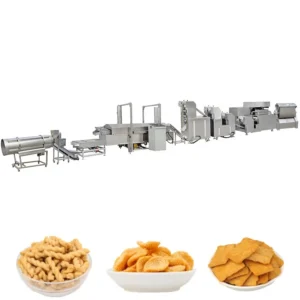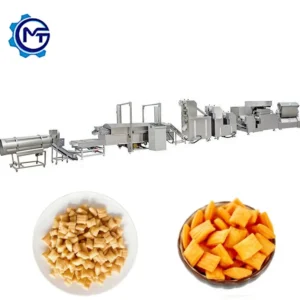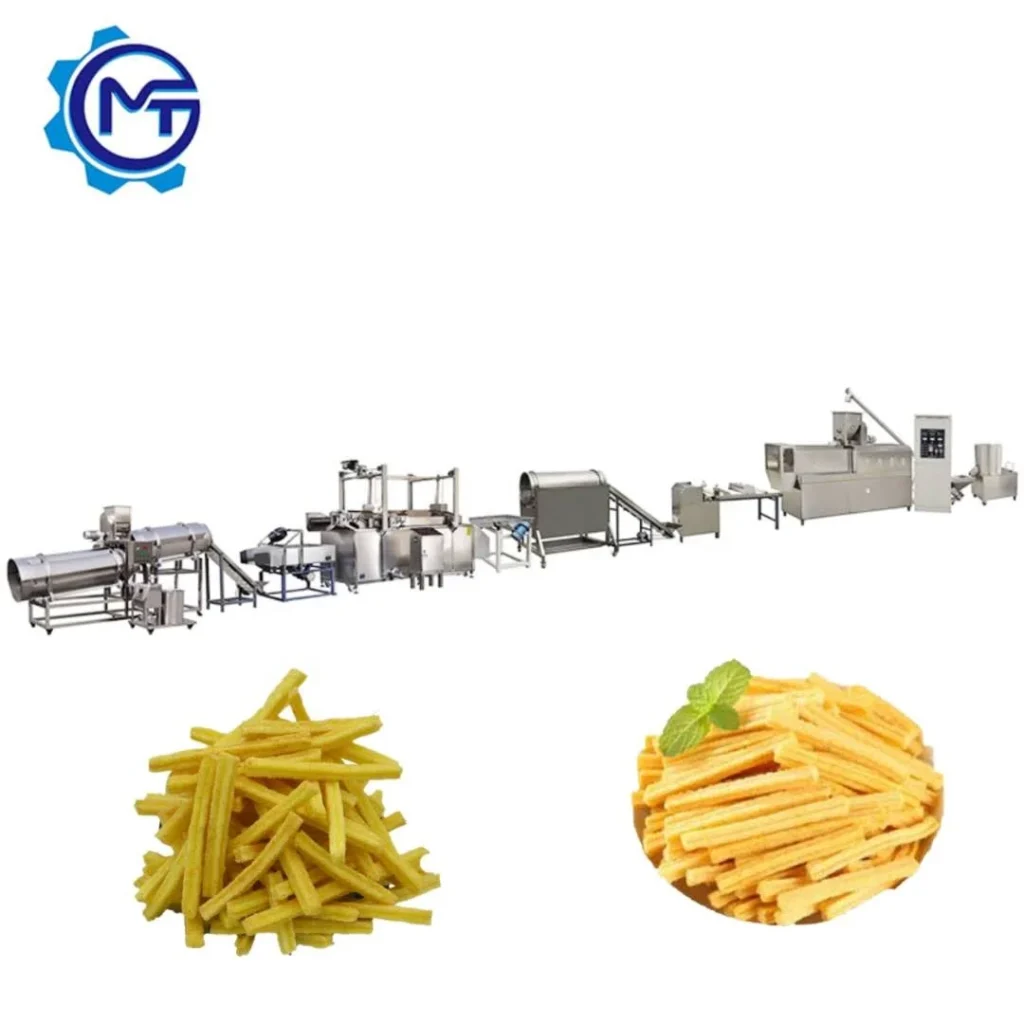
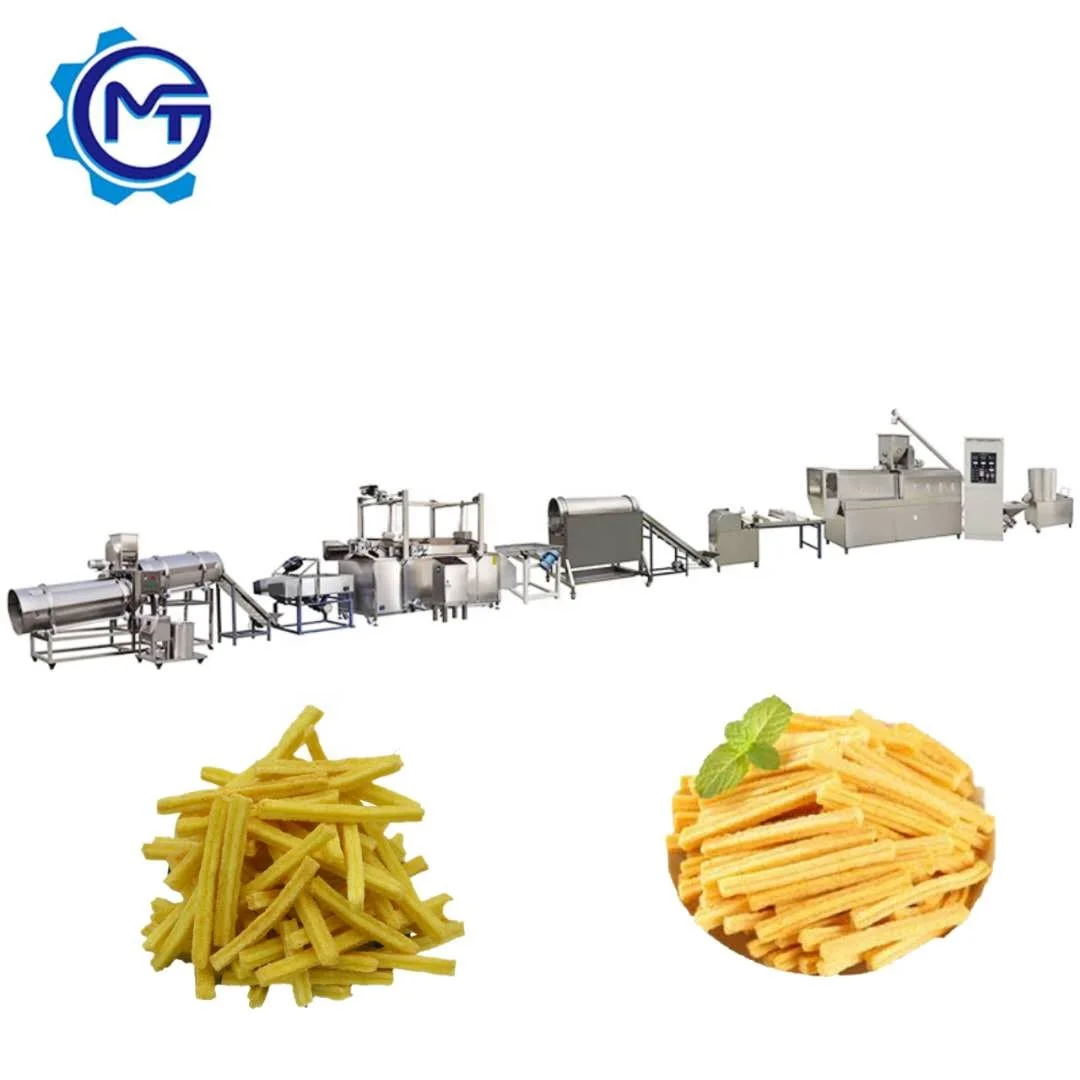



Fried Snack Food Processing Line, Twin-Screw Extruder, PLC Control, 380V/50Hz — engineered as one turnkey project from mixing through frying and flavoring, with every station’s throughput matched to eliminate bottlenecks.
- Line stations: Mixer → Extruder → Cutting Machine → Fryer → Flavoring Drum
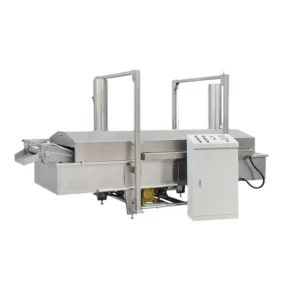
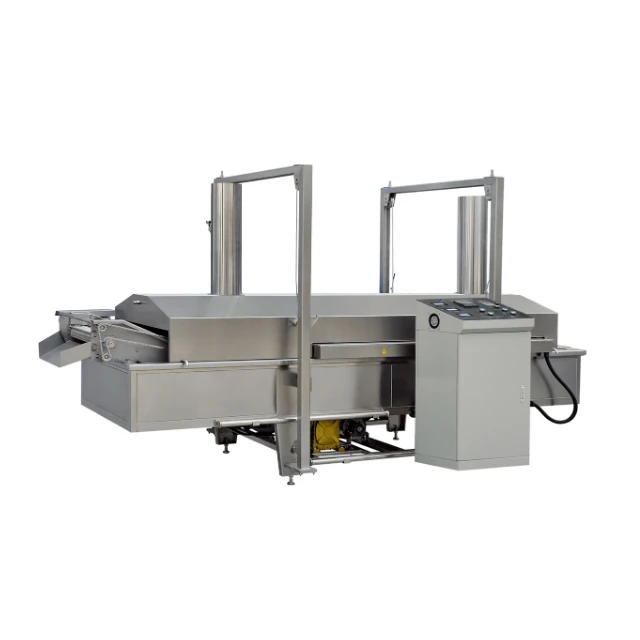
- Fryer configurable in length and layer to match snack format and frying profile
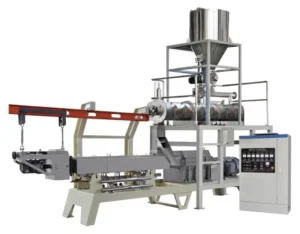
- Screw configuration and die design specified to buyer’s raw material and target texture
- Voltage, frequency, and control language confirmed to local grid before production
Trial runs on customer raw material conducted in-house before shipment ensure product development starts well before installation.
Description
Throughput-Matched Stations — Every station in this fried snack food processing line turnkey project, from the mixer through the extruder, fryer, and flavoring drum, is configured so that none of them becomes a bottleneck when running the buyer’s actual raw material.
Technical Specifications
| Parameter | Value |
|---|---|
| Product Type | Fried Snack Food Extrusion and Frying Production Line |
| Line Configuration | Mixer → Extruder → Cutting Machine → Fryer → Flavoring Drum |
| Extruder Type | Twin-screw |
| Control System | PLC and MCC control |
| Fryer Power | 60 kW |
| Flavoring Drum Power | 0.37 kW |
| Voltage Options | Three phases: 380V/50Hz, Single phase: 220V/50Hz (customizable to local voltage) |
| Output Capacity | Basis to be confirmed — dependent on raw material, product format, and line speed |
| Fryer Design | Configurable length and layer depending on product type |
| Certification | CE |
Application Suitability
| Application | Material or Output |
|---|---|
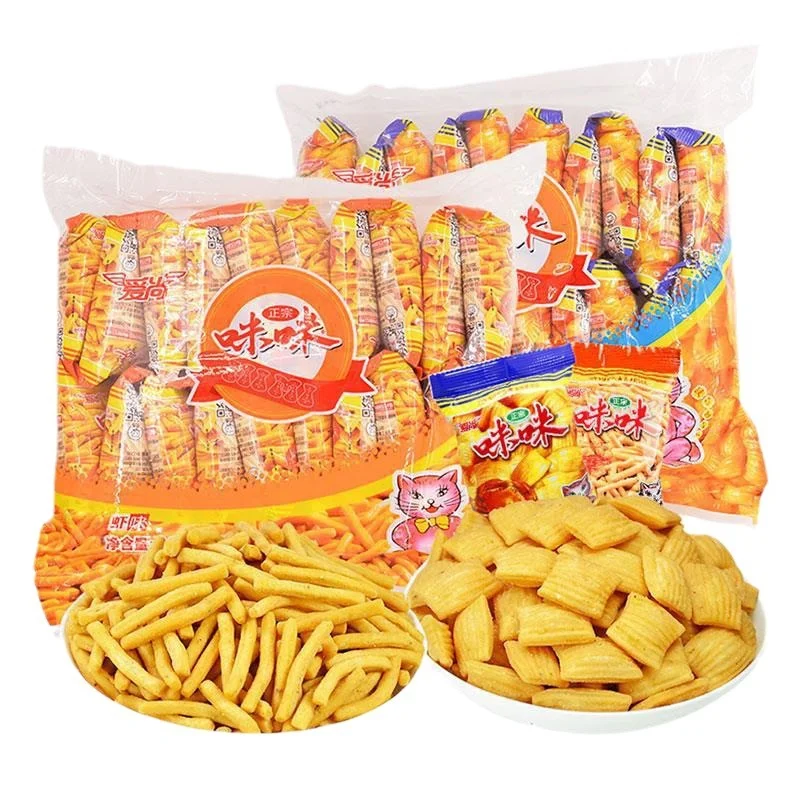
| Rice crust chips and锅巴 production | Wheat flour, rice flour, and grain blends |
| Bugles and horn-shaped fried snacks | Corn meal and wheat flour formulations |
| Mini pillow and core-filled fried snacks | Wheat flour with various starch additions |
| Wheat flour-based fried chips | Refined and whole wheat flour blends |
| Expansion into fried extruded formats | Corn, rice, and multi-grain snack bases |
Why the Fryer Length Matters More Than the Extruder Motor Size
A fryer that is too short for the pellet density will produce snacks that are undercooked in the center and over-browned on the surface.
When snack food manufacturers source a fried snack food processing line turnkey, they often focus heavily on the extruder’s motor power or screw diameter. The reality is that the fryer is where the product’s final texture, oil absorption, and color are decided. A fryer that cannot hold the product for the correct residence time will force the operator to either lower the line speed — creating a bottleneck that negates the extruder’s capacity — or push the product through too fast, resulting in a pale, soggy chip that stales within days [NEED_CITE: typical residence time requirements for extruded snack frying]. I have seen lines where the extruder was perfectly sized, but the fryer was a generic catalog model that was two meters too short for the specific wheat flour formulation the buyer was running. The expansion rate collapsed because the surface set before the internal moisture had fully flashed off.
Integrated Line Sequencing Rather Than Standalone Assembly
The sequence from mixer through extruder, cutting machine, fryer, and flavoring drum operates as a single continuous system. Each station’s belt speed, transfer height, and holding capacity are calculated against the others, so product flows without manual intervention or buffer pile-ups. This matters especially between the cutting station and the fryer inlay, where wet cut pieces must enter the oil at a consistent rate to maintain stable oil temperature and avoid localized cooling spots that cause uneven cooking.
Fryer Configuration for Snack Format and Oil Profile
The fryer on this line is configurable in both length and layer count, which directly affects how the product moves through the oil bath. A single-layer fryer suits flat, quick-frying formats like thin wheat chips, while a multi-layer design gives longer residence time for denser items like rice crust pieces or thick-cut bugles that need more time for internal moisture to migrate outward before the surface reaches the target color. This configurability is what allows a fried snack food processing line turnkey to handle multiple product formats without requiring a second dedicated fryer.
Reading the Specifications That Actually Define Output
The twin-screw extruder is the heart of the forming stage, and its screw configuration and die design must be specified to the buyer’s raw material — a wheat flour blend with high gluten content behaves very differently under shear and heat than a corn meal base. The L/D ratio of the screw barrel determines residence time inside the extruder, which controls the degree of starch gelatinisation before the product reaches the die. The 60 kW fryer power rating indicates the thermal capacity available to recover oil temperature as cold product enters; if the product load exceeds what 60 kW can recover, the oil temperature drops and absorption spikes. The PLC and MCC control system ties the extruder screw speed, cutter frequency, and fryer belt speed together, so that a change at one station propagates correctly to the next — this is what maintains batch consistency when an operator adjusts line speed [NEED_CITE: PLC integration benefits in food extrusion lines]. Voltage and frequency are confirmed to the buyer’s local grid before production, which prevents the situation where a 380V/50Hz motor arrives at a 440V/60Hz facility and cannot run without a transformer.
The Cost of Undersized Downstream Stations
When a line is assembled from separate vendors, the extruder supplier quotes a nominal output, the fryer supplier quotes a separate nominal output, and neither takes responsibility for what happens when the two are connected. The result is a line that cannot hold its rated output because one station is always waiting on another. With fried extruded snacks, this mismatch shows up most painfully at the fryer: product backs up on the conveyor, cools down, loses surface moisture, and then enters the oil in an inconsistent state that produces variable color and texture within the same batch [NEED_CITE: snack food line throughput matching principles]. The flavoring drum then receives an uneven product stream, causing some pieces to be over-seasoned and others barely coated.
Why Engineering the Whole Line Matters
The line layout and capacity calculation document shows matched throughput across every station from mixer to packing, so the buyer can verify before production that no single machine will bottleneck the others. The screw and die configuration record is written against the buyer’s specific raw material, not copied from a generic build. A trial run on the customer’s actual raw material is conducted in the in-house testing workshop before shipment, which catches formulation mismatches — like a wheat flour blend that requires a different screw pitch than originally assumed — while there is still time to change the configuration. Voltage, frequency, and control panel language are confirmed to the installation site’s requirements before the electrical cabinets are wired. The complete line is built, tested, and shipped under one supplier’s responsibility, so commissioning is a single coordinated event rather than a sequence of vendor visits.
Documentation & Verification
- Line layout drawing with station-by-station throughput calculation for the fried snack format
- Screw and die configuration record matched to buyer’s wheat flour or corn meal blend
- Trial run report on customer raw material from the in-house testing workshop
- Electrical schematic with confirmed voltage, frequency, and control language
- CE declaration of conformity for the complete line assembly
- Wear parts list covering screws, dies, fryer belts, and flavoring drum liners
Installation, Commissioning & Support
- Foundation and floor load plan reflecting the fryer’s oil-filled weight and the extruder’s dynamic load
- Dedicated power circuit sizing for the 60 kW fryer and the extruder main drive
- Pre-assembled station modules that require field connection rather than full on-site build
- First-run parameter setting covering extruder barrel zones, cutter timing, and fryer temperature profile
- Operator training on PLC interface for line speed synchronization and fault recovery
- Wear parts inventory covering initial screw sections, die plates, and fryer belt segments
What We Need to Configure Your Line
To prepare a line layout and capacity proposal, we need to know the specific snack format you plan to produce — whether that is rice crust chips, bugles, pillow snacks, or another fried extruded shape — along with the raw material formulation and the target product weight per piece. Your local voltage and frequency standard, as well as the preferred control panel language, should be confirmed at the inquiry stage so that electrical design begins correctly. If you have an existing mixer, dryer, or packing system that the new line must connect to, please share the interface dimensions and throughput data for those stations.
Frequently Asked Questions
Q: How is line capacity verified, and what assumptions underpin the quoted output?
A: Output capacity depends on the raw material formulation, the target snack format, and the line speed that maintains product quality through the fryer. We calculate throughput station by station and document it in the line layout. Before shipment, a trial run on the buyer’s actual raw material in the testing workshop confirms whether the quoted output holds under real conditions.
Q: How do you match throughput between the extruder, fryer, and flavoring stations?
A: Each station’s belt speed, holding capacity, and transfer rate are calculated against the others during the layout phase. The fryer length and layer count are selected so that the product residence time in oil is sufficient without forcing the extruder to idle. The PLC control system synchronizes speeds across all stations.
Q: Can voltage, frequency, and control panel language be confirmed before production?
A: Yes. Voltage and frequency are confirmed to the buyer’s local grid standard, and the control panel language is set to the operator’s preference before the electrical cabinets are wired. This is documented in the electrical schematic and confirmed again at factory test.
Q: Is a trial run on our actual raw material conducted before shipment?
A: A trial run using the buyer’s raw material is conducted in the in-house testing workshop. The trial report covers product expansion, density, color after frying, and oil absorption, and any necessary screw or die adjustments are made before the line is packed for shipment.
Q: What does the installation and commissioning schedule look like?
A: The line arrives as pre-assembled station modules. Installation covers positioning, mechanical connection, electrical hookup, and utility connection. Commissioning includes first-run parameter setting, line speed synchronization via the PLC, and operator training. The schedule is phased to match the buyer’s site readiness.
Related products
-
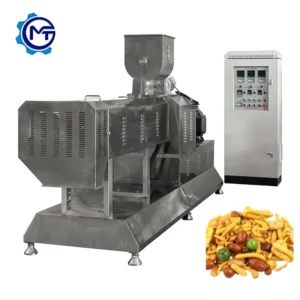
New Automatic Traditional Fried Nimko Making Machine High Productivity Large Capacity Stainless Steel Production Line
¥8,575.00 Select options This product has multiple variants. The options may be chosen on the product page -
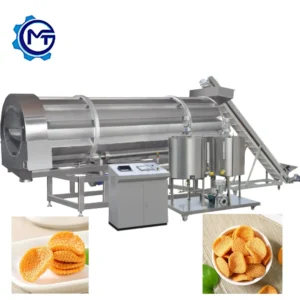
Automatic Rice Crust Chips Making Machine Bugles Pizza Rolls Fried Snack Food Processing Line Machine
¥8,570.00 Select options This product has multiple variants. The options may be chosen on the product page -
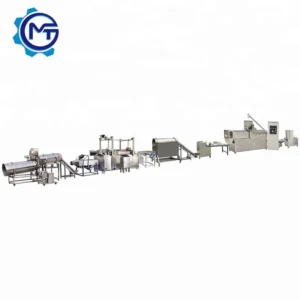
Fried Puffs Snack Food Making Machine Whole Line Solution Design by Factory Price Crispy Snack Machine
¥20.00 Select options This product has multiple variants. The options may be chosen on the product page -
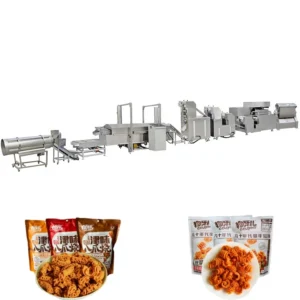
Puffed Octopus Snack Processing Line – Full-Automatic Fried Octopus Production Machinery
¥65.00 Select options This product has multiple variants. The options may be chosen on the product page