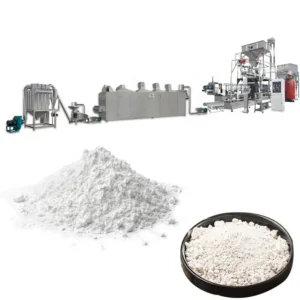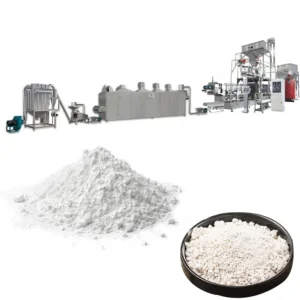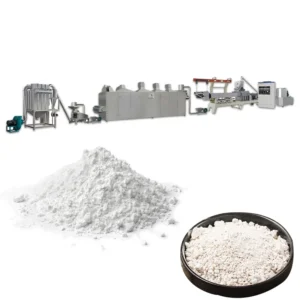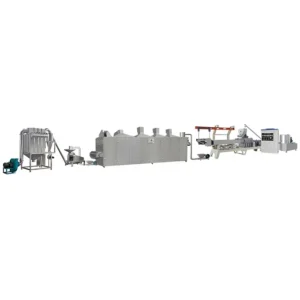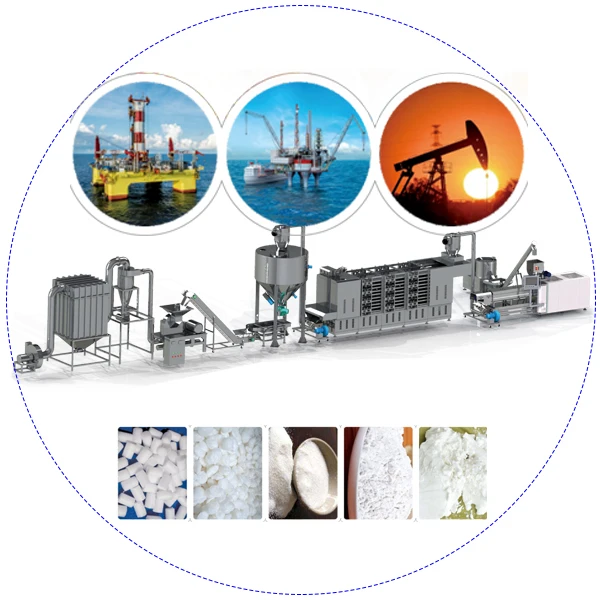


Automatic Modified Starch Processing Line, Twin Screw Extruder, 80–500 kg/h — engineered for pregelatinized and modified starch production from corn, potato, or wheat starch feedstock.
- Complete turnkey line: mixer, twin-screw extruder, dryer, conditioner, and grinder with throughput matched at every station
- Screw configuration and die design specified to your raw material and target modification degree
- Energy options include electricity, gas, diesel, or steam; PLC/MCC control with voltage customized to your facility
In-house testing workshop runs your exact raw material before shipment, so product specs are confirmed before the line leaves our factory.
Description
Complete Line Throughput Coordination — Every station from the mixer through the twin-screw extruder, dryer, and grinder is sized to hold the same hourly throughput, preventing the bottleneck that forms when extruder output exceeds dryer capacity on a pregelatinized starch line.
Technical Specifications
| Parameter | Value |
|---|---|
| Product Type | Modified Starch Processing Line |
| Extruder Type | Twin screw extruder machine |
| Raw Materials | Wheat flour, corn starch, potato starch |
| Capacity | 80–500 kg/h (basis not stated in source — confirm raw material type, moisture content, and target modification degree) |
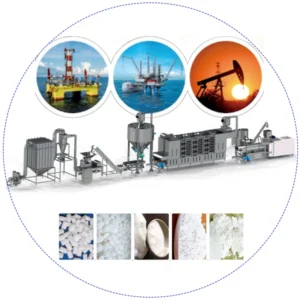
| Process Flow | Mixer → Screw conveyor → Twin screw extruder → Air conveyor → Dryer → Air conveyor → Conditioner → Conveyor → Grinder |
| Main Mixer Motor | 4.0 kW |
| Mixer Dimensions | 1.2 × 0.9 × 1.4 m |
| Mixer Batch Output | 3.0–4.0 kg per batch |
| Screw Conveyor Output | 0–150 kg/h |
| Screw Conveyor Motor | 1.1 kW |
| Screw Conveyor Dimensions | 2.5 × 0.6 × 2.3 m |
| Voltage & Frequency | Three phase 380 V / 50 Hz; Single phase 220 V / 50 Hz (customizable to local voltage) |
| Total Power (electric heating) | Approximately 100 kW |
| Total Power (gas or diesel heating) | Approximately 50–60 kW |
| Energy Options | Electricity, gas, diesel, or steam |
| Frame Material | Stainless steel 201 |
| Contact Parts Material | Food grade stainless steel 304 |
| Control Components | Siemens (China) or Chinese top-brand motors; Delixi or Delta inverters |
| Assembly State | Complete line with supporting equipment |
| Standards | CE; ISO |
Application Suitability
| Application | Material or Output |
|---|---|
| Food-grade pregelatinized starch production | Corn starch, potato starch processed into instant-thickening starch for soups, sauces, and bakery fillings |
| Industrial modified starch for paper making | Wheat flour or corn starch modified for paper surface sizing and coating applications |
| Textile and adhesive starch processing | Potato or corn starch thermally modified for warp sizing and corrugated board adhesives |
| Nutritional and infant formula starch base | Corn or potato starch pregelatinized for easy-digestion nutritional powder blending |
Why the Raw Material Must Arrive Before the Extruder Does
A modified starch processing line turnkey project either succeeds or fails before the first bolt is tightened — the deciding factor is whether the screw configuration matches the buyer’s actual feedstock.
I planned a pregelatinized starch line for a Southeast Asian client two years ago. The screw profile and die were configured for corn starch based on the initial spec sheet. When the line arrived on site, the client’s real raw material turned out to be tapioca starch with a gelatinization temperature roughly fifteen degrees lower. The expansion ratio dropped by nearly a third, and we spent five days rearranging screw elements in a hot, humid workshop to recover the target viscosity. [NEED_CITE: gelatinization temperature differences between corn, potato, and tapioca starch] That is the kind of avoidable delay that a proper factory trial run eliminates before shipment.
Matching Screw Geometry to Starch Gelatinization Behavior
The gelatinization window of corn starch sits around 62–74 °C, while potato starch opens earlier at 58–68 °C, and wheat flour falls somewhere between. A modified starch processing line turnkey installation has to hold the material inside the barrel long enough for complete gelatinization without over-shearing the granule. The twin-screw extruder in this line uses modular screw elements — conveying, kneading, and reverse sections — arranged to match the specific thermal and rheological profile of the buyer’s starch source. When the element sequence is right, the starch exits the die fully pregelatinized and ready for drying.
Throughput Matching Across Every Station
A line is only as fast as its slowest station. If the twin-screw extruder pushes 300 kg/h of wet pregelatinized starch into a dryer rated for 200 kg/h, the excess material piles up on the air conveyor and moisture content drifts out of spec. On this modified starch processing line turnkey configuration, every station — from the 3.0–4.0 kg batch mixer through the screw conveyor, extruder, dryer, conditioner, and grinder — is specified against the same throughput target. The dryer length and airflow, the conditioner residence time, and the grinder screen size are all calculated together rather than sourced from separate vendors who optimize only their own machine. [NEED_CITE: throughput balancing principles in continuous food processing lines]
Reading the Specs That Actually Matter
The total installed power ranges from approximately 50–60 kW with gas or diesel heating to around 100 kW with electric heating — a difference that directly determines the transformer capacity and cable sizing at the buyer’s facility. The 4.0 kW mixer motor drives a 3.0–4.0 kg batch cycle, meaning the mixer is the pacing station for upstream batching: if the extruder consumes 250 kg/h, the mixer must complete a batch roughly every minute to keep the screw conveyor fed. The food-grade stainless steel 304 contact parts are specified for the wet, slightly acidic environment that heated starch creates inside the barrel and die plate; using lower-grade steel in this section would introduce corrosion pitting that contaminates the product and shortens screw life. The Delixi or Delta inverters control motor speed across the line, giving operators the ability to fine-tune feed rate and screw RPM independently — a feature that becomes essential when switching between corn starch and wheat flour on the same line.
The Hidden Cost of Skipping the Trial Run
When a line ships without a factory trial on the buyer’s actual raw material, the first production run becomes the experiment. Operators discover that the die holes are too small for the viscosity of their starch, the dryer belt speed does not match the moisture curve, or the grinder screen lets through oversized particles that fail the mesh-size test. Each of these issues means downtime, wasted raw material, and shipping replacement parts internationally. [NEED_CITE: typical commissioning delays caused by untested raw material in extrusion projects] A factory trial run compresses all of that learning into a controlled environment where screw elements, die plates, and dryer settings are locked down before the crate is sealed.
What Single-Source Delivery Actually Changes
Sourcing the mixer, extruder, dryer, and grinder from separate vendors means each supplier guarantees only their own machine’s output — nobody owns the gap between stations. With this modified starch processing line turnkey approach, one supplier is responsible for the throughput from the first batch of starch entering the mixer to the final powder leaving the grinder. The screw configuration record documents the exact element arrangement for the buyer’s raw material, so reorder is straightforward when wear parts are due. The electrical schematic confirms voltage and frequency before production begins, eliminating the delay of rewiring control panels on site. [NEED_CITE: single-supplier accountability in turnkey processing line contracts] The in-house machine testing workshop runs the buyer’s starch through the complete extruder-and-dryer sequence, generating a trial run report that travels with the shipment. Factory test records, line layout drawings, and capacity calculations are issued as a single documentation package rather than assembled from four different vendors’ paperwork.
Documentation & Verification
- Factory trial run report on your specific starch type confirming gelatinization degree before dispatch
- Line layout drawing with station-by-station throughput calculation matched to your target capacity
- Screw element arrangement and die plate configuration record for your raw material profile
- Electrical schematic with confirmed voltage, frequency, and control language for your facility
- CE declaration of conformity and ISO certificate covering the complete processing line
- Wear parts list identifying screw elements, die plates, and seals with recommended replacement intervals
Installation, Commissioning & Support
- Foundation plan based on the dryer and extruder footprint, including floor load and drainage for the 380 V power supply
- Dedicated circuit sizing for the approximately 100 kW electric heating configuration or gas line routing for the 50–60 kW alternative
- On-site assembly of the air conveyor and dryer sections with alignment verification against the extruder die outlet
- First-run parameter setting including screw RPM, barrel zone temperatures, and dryer belt speed on your raw material
- Operator training covering batch mixer loading sequence, inverter adjustment, and die plate changeover procedure
- Initial spare parts kit including spare screw elements, die plates, and food-grade seals for the twin-screw extruder
What We Need to Size Your Line
To prepare an accurate layout and capacity calculation, share your starch type — corn, potato, wheat, or tapioca — along with the target modification degree and required mesh size of the finished powder. Confirm your facility’s available voltage and frequency, the energy source you prefer for the dryer, and the floor space allocated for the line. If you can send a sample of your raw material, we will run a trial in the testing workshop and include the results with the proposal.
Frequently Asked Questions
Q: How is the actual line capacity verified against the quoted figure?
A: Capacity depends on the raw material type, its moisture content, and the target modification degree. We run your starch sample through the twin-screw extruder in our testing workshop and issue a trial run report showing the measured output, gelatinization level, and product moisture before the line ships. This removes the gap between nominal rating and real-world throughput.
Q: How do you prevent bottlenecks between the extruder and the dryer?
A: Every station is specified against the same throughput target. The dryer length, airflow volume, and belt speed are calculated to handle the moisture load that the extruder delivers at the agreed capacity. The screw conveyor and air conveyor are sized to transfer material between stations without accumulation or starvation, keeping the line balanced end to end.
Q: What factory conditions need to be confirmed before installation?
A: We need the available voltage and frequency, the preferred energy source for heating — electricity, gas, diesel, or steam — and the floor area and ceiling height for the line layout. Utility connection points for water, drainage, and compressed air must be identified. The electrical schematic we provide confirms all requirements before the equipment leaves the factory.
Q: How is the commissioning period structured?
A: Our engineer arrives on site to assemble the air conveyor and dryer, connect utilities, and run the first production batches using your raw material. Parameters for screw speed, barrel temperature, and dryer settings are fine-tuned during this period. Operator training covers daily startup, shutdown, cleaning, and basic troubleshooting before the engineer departs.
Q: What is the supply situation for wear parts like screw elements and dies?
A: The wear parts list included with your documentation identifies every consumable component with part numbers and recommended replacement intervals. Screw elements and die plates are manufactured in our own workshop, so replacement orders do not depend on third-party lead times. We recommend stocking a first set of spares from the initial order to cover the early production period.
Related products
-
Automatic Modified Corn Starch Making Machine 304 Stainless Steel Gearbox High Efficiency Starch Processing Production Line
¥30.00 Select options This product has multiple variants. The options may be chosen on the product page -
Automatic Pregelatinized Starch Processing Machine – Large-Scale New Condition Modified Starch Production Line
¥65.00 Select options This product has multiple variants. The options may be chosen on the product page -
Cassava Corn Potato Flour Starch Production Line – Industrial Pregelatinized & Modified Extrusion Machinery
¥65.00 Select options This product has multiple variants. The options may be chosen on the product page -
Big Capacity Modified Starch Production Line Making Machine
¥30.00 Select options This product has multiple variants. The options may be chosen on the product page