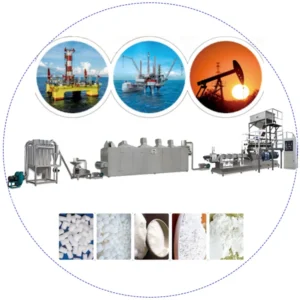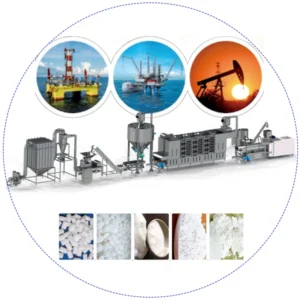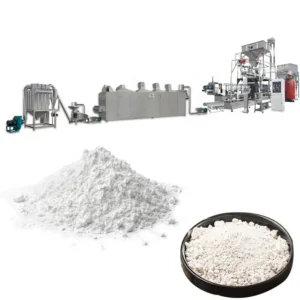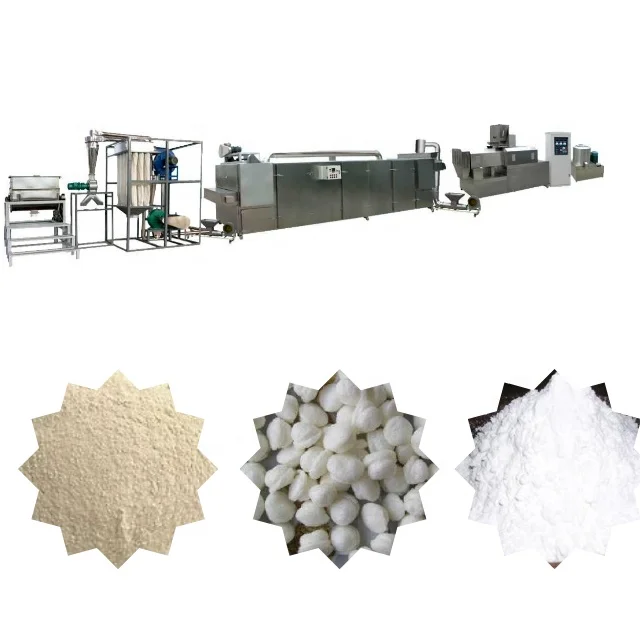


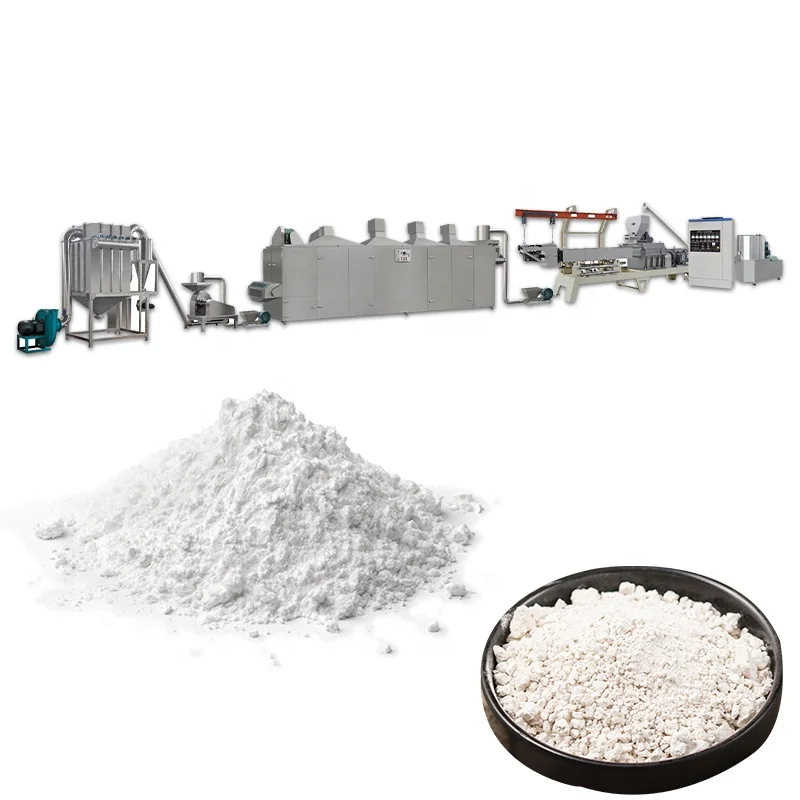

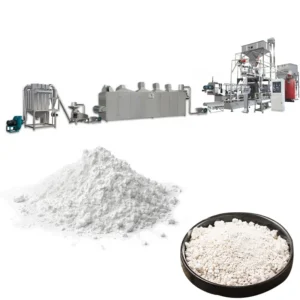
MT65 / MT70 / MT85 Twin Screw Extruder Modified Starch Processing Line — turnkey solution covering mixing, extrusion, drying, grinding, blending and packing with matched throughput at every station.
- Screw configuration and barrel temperature profile specified to your starch type — corn, cassava, potato or tapioca — and target degree of gelatinisation or modification
- Three capacity tiers scale from pilot to full production without redesigning the line layout
- Automated PLC control with voltage and frequency confirmed to your plant supply before build
Trial runs on your actual starch raw material are completed in our testing workshop before shipment, with a full report confirming real output and product specification.
Description
Throughput-matched station design — every mixer, dryer and grinder is sized to the extruder’s real output on your starch formulation, not to a nameplate figure that falls apart on the factory floor.
Technical Specifications
| Parameter | Value |
|---|---|
| Model | MT65 / MT70 / MT85 |
| Product Type | Twin Screw Extruder Modified Starch Processing Line |
| Screw Type | Twin-screw |
| MT65 Power Consumption | 60 kW |
| MT65 Output | 100–150 kg/h (basis not stated in source — confirm raw material / moisture content) |
| MT65 Overall Dimensions | 24000 × 1200 × 2200 mm |
| MT70 Power Consumption | 80 kW |
| MT70 Output | 200–250 kg/h (basis not stated in source — confirm raw material / moisture content) |
| MT70 Overall Dimensions | 26000 × 1500 × 2200 mm |
| MT85 Power Consumption | 145 kW |
| MT85 Output | 300–500 kg/h (basis not stated in source — confirm raw material / moisture content) |
| MT85 Overall Dimensions | 29000 × 3500 × 4300 mm |
| Extruder Main Motor Power | 22 kW (rated or peak not specified) |
| Extruder Dimensions | 2800 × 800 × 1800 mm |
| Mixer Power | 3 kW |
| Mixer Output | 70–100 kg/h (basis not stated in source — confirm raw material / moisture content) |
| Mixer Dimensions | 900 × 700 × 1200 mm |
| Oven Power | 1.1 kW |
| Line Stations | Mixing → Extrusion → Drying → Grinding → Blending → Packing |
| Control System | Automated (PLC / MCC specifics to be confirmed) |
| Certification | CE |
Application Suitability
| Application | Material or Output |
|---|---|
| Pre-gelatinized starch for food processing | Corn starch, potato starch with controlled rehydration viscosity |
| Oil drilling starch | Modified cassava and maize starch for fluid-loss control |
| Textile-grade modified starch | Tapioca and corn starch for warp sizing applications |
| Paper-making starch | Cassava and potato starch for surface sizing and coating |
| Chemical-industry starch derivatives | Cross-linked or oxidized starch from varied botanical sources |
Why the Raw Material Question Must Come Before the Layout
A modified starch processing line turnkey configuration only holds its rated throughput when every station is matched to the buyer’s actual formulation, not a generic test batch.
Sitting on the buyer’s side years ago, I watched a starch line arrive with a quoted capacity that evaporated the moment we ran local cassava instead of the corn starch used at the factory acceptance test. The dryer could not keep up, the grinder choked on the higher-viscosity material, and we spent weeks re-balancing utilities. On a Middle East commissioning job the client quietly swapped the corn-to-cassava ratio after shipment; gelatinisation dropped, the twin-screw extruder had to be reconfigured on site, and the whole line sat idle for days while we sourced new screw elements [NEED_CITE: gelatinisation temperature variance between botanical starch sources]. Locking the raw material specification before steel is cut prevents that cascade.
Phased Installation Across a Full Starch Line
A turnkey starch project spans mixing, extrusion, drying, grinding, blending and packing, and each phase depends on the one before it being commissioned correctly. The modified starch processing line turnkey scope covers utility planning, mechanical erection, electrical termination and sequential start-up so that the drying section is never waiting on an extruder that has not yet reached thermal equilibrium.
Throughput Balancing Between Extruder and Downstream Stations
The extruder sets the pace, but the dryer and grinder determine whether that pace is sustainable over a full shift. On the MT85 configuration, the line stretches to 29 metres in length with a 3500 mm width, giving the drying oven enough residence time for high-moisture pre-gelatinized starch. Every conveyor and flavouring drum is sized so material never piles up at a transfer point, which is where most unplanned stops originate [NEED_CITE: bottleneck analysis in continuous extrusion plants].
What Screw Geometry and Barrel Profile Mean for Starch
Twin-screw extrusion relies on the interplay of shear, heat and moisture to break down native starch granules and achieve the target degree of modification. A longer barrel with multiple heating zones allows the operator to stage gelatinisation gradually, which matters when switching between corn starch and cassava starch because their gelatinisation onset temperatures differ. The screw configuration determines residence time and shear intensity; a high-shear element section will drive more dextrinisation, while a gentler conveying section preserves the granular structure needed for pre-gelatinized starch used in food applications. Die design then controls the pressure drop at exit, influencing the expansion and density of the extrudate before it enters the dryer. Matching all three variables — screw, barrel profile and die — to the buyer’s exact starch type is what separates a line that runs within specification from one that drifts out of it by mid-shift.
The Hidden Cost of Undersized Downstream Equipment
When the dryer or grinder is selected from a catalogue rather than matched to the extruder’s actual output on your starch, the consequences surface during continuous production. The extruder reaches its target rate, but wet extrudate queues ahead of a dryer that cannot remove moisture fast enough. The grinder then receives material that is still tacky, leading to screen blinding and unplanned stops [NEED_CITE: moisture content tolerance in starch grinding operations]. Operators respond by slowing the extruder, and the line’s effective output settles well below what was quoted.
Why Sourcing the Full Line From One Supplier Matters
Throughput calculations for every station — mixing through packing — are produced under one engineering roof, so the modified starch processing line turnkey layout eliminates the finger-pointing that happens when separate vendors each size their own equipment. The screw configuration and die design are specified against the buyer’s actual starch sample, not a generic formulation. An in-house testing workshop runs the buyer’s raw material before shipment, producing a trial run report that documents real output and product characteristics. Pre-sales consultation covers utility planning and phased installation, and the same team handles on-site commissioning and operator training, keeping institutional knowledge intact from design through steady-state production.
Documentation & Verification
- Line layout and capacity calculation matched to your starch type and target modification degree
- Screw and die configuration record tied to the exact raw material batch used during trial
- Factory test record on your starch formulation confirming real output before dispatch
- Electrical schematic with voltage and frequency locked to your plant supply
- Operation and maintenance manual with wear parts list and replacement intervals
Installation, Commissioning & Support
- Foundation and utility plan aligned to the MT85 footprint of 29000 × 3500 × 4300 mm
- Dedicated circuit planning for 145 kW total line power with extruder main motor at 22 kW
- Mechanical assembly and electrical termination supervised on site from mixer through packer
- Screw configuration fine-tuned during commissioning against your local starch supply
- Operator training covering barrel temperature profiling and die change procedures
- Wear parts inventory — screws, dies, mixer blades — shipped with the line for first replacement cycle
What We Need to Size Your Line Correctly
Share the botanical source of your starch, the target modification type, and your daily output requirement so we can select the right model tier and match every downstream station. Include your plant voltage and frequency, available floor area with ceiling height, and whether existing upstream or downstream equipment must be integrated. If your formulation is still being developed, send a sample batch and we will run it in the testing workshop before finalising the modified starch processing line turnkey configuration.
Frequently Asked Questions
Q: How is output capacity verified on my specific starch raw material?
A: Before shipment, your starch sample is run through the extruder in our testing workshop at the moisture content and feed rate planned for production. The trial run report records actual throughput, product viscosity and degree of gelatinisation, giving you a verified baseline rather than a nameplate figure.
Q: How do you prevent the dryer and grinder from becoming bottlenecks?
A: Each station is sized using the extruder’s verified output on your starch, not a generic capacity table. The dryer’s residence time and the grinder’s screen area are calculated so that material flows continuously without queuing at transfer points during full-shift operation.
Q: What screw and barrel configuration is recommended for cassava versus potato starch?
A: Cassava starch gelatinises at a lower onset temperature than potato starch, so the barrel heating profile is staged differently and the screw elements are selected to apply the appropriate shear intensity. The configuration record is tied to your specific raw material and target modification.
Q: What electrical details are confirmed before production begins?
A: Voltage, frequency, plug type and control panel language are locked in during the specification phase. An electrical schematic reflecting your plant’s supply is issued for approval before steel is cut, preventing commissioning delays caused by mismatched power standards [NEED_CITE: industrial voltage and frequency standards by region].
Q: What does on-site commissioning include for a turnkey starch line?
A: Our engineers supervise mechanical assembly, electrical termination, sequential start-up of each station, screw configuration adjustment on your local starch, and operator training covering temperature profiling, die changes and daily maintenance routines.
Related products
-
New Automatic Modified Starch Puffing Production Line – Long Service Life Pregelatinized Starch Equipment
¥65.00 Select options This product has multiple variants. The options may be chosen on the product page -
Automatic Modified Tapioca Starch Production Line 304 Stainless Steel Flour Mill and Bakery Machine
¥30.00 Select options This product has multiple variants. The options may be chosen on the product page -
Cassava Corn Potato Flour Starch Production Line – Industrial Pregelatinized & Modified Extrusion Machinery
¥65.00 Select options This product has multiple variants. The options may be chosen on the product page -
High-Efficiency Customizable Modified Starch Production Line – Automatic Corn Pellet Adhesive Making Equipment
¥65.00 Select options This product has multiple variants. The options may be chosen on the product page