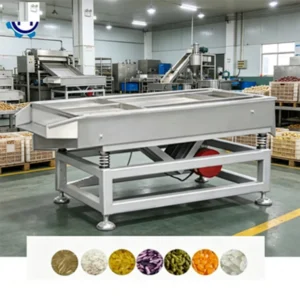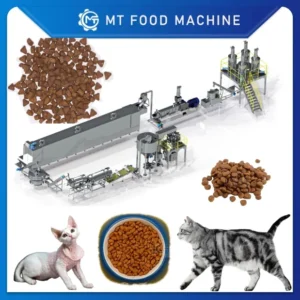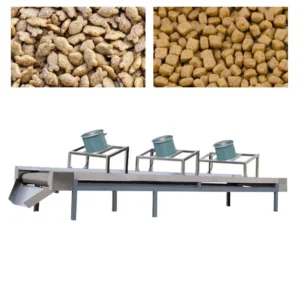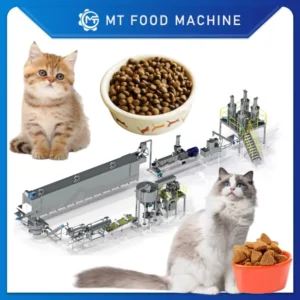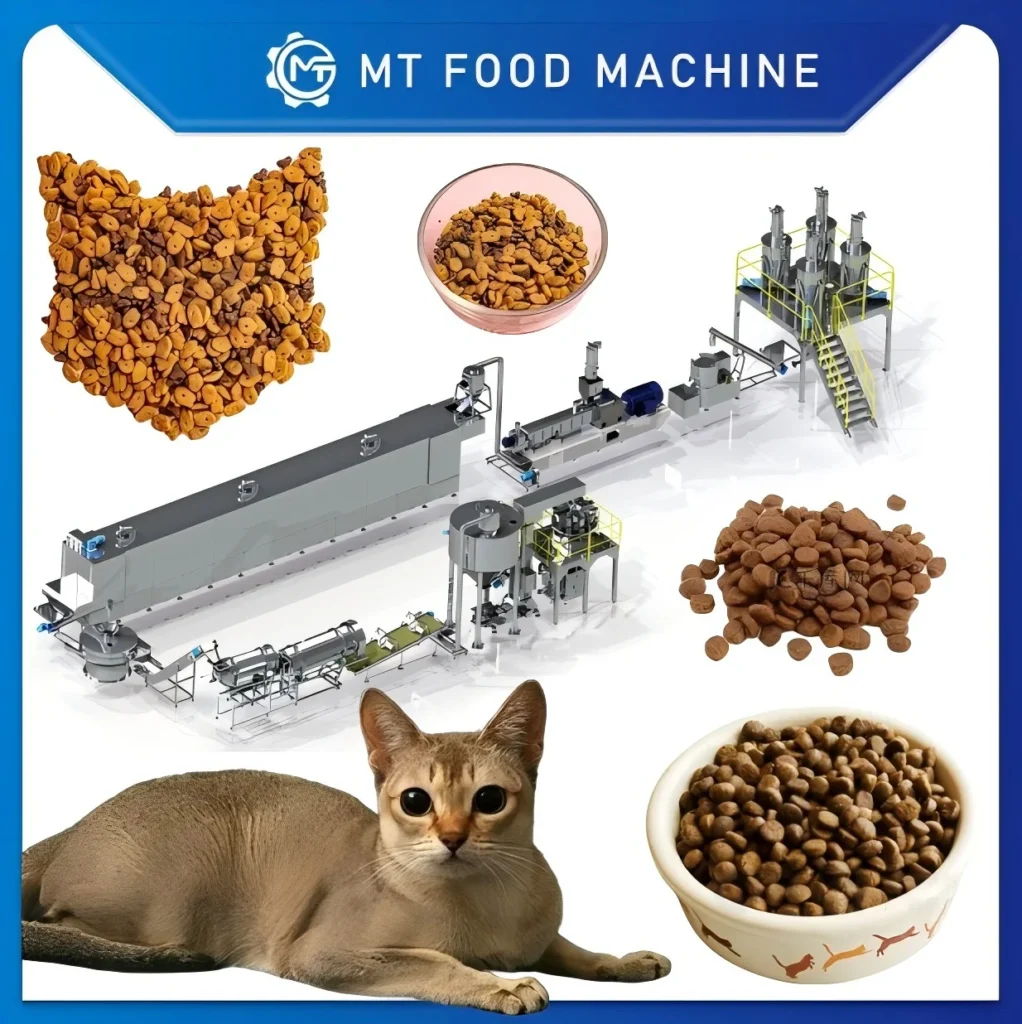
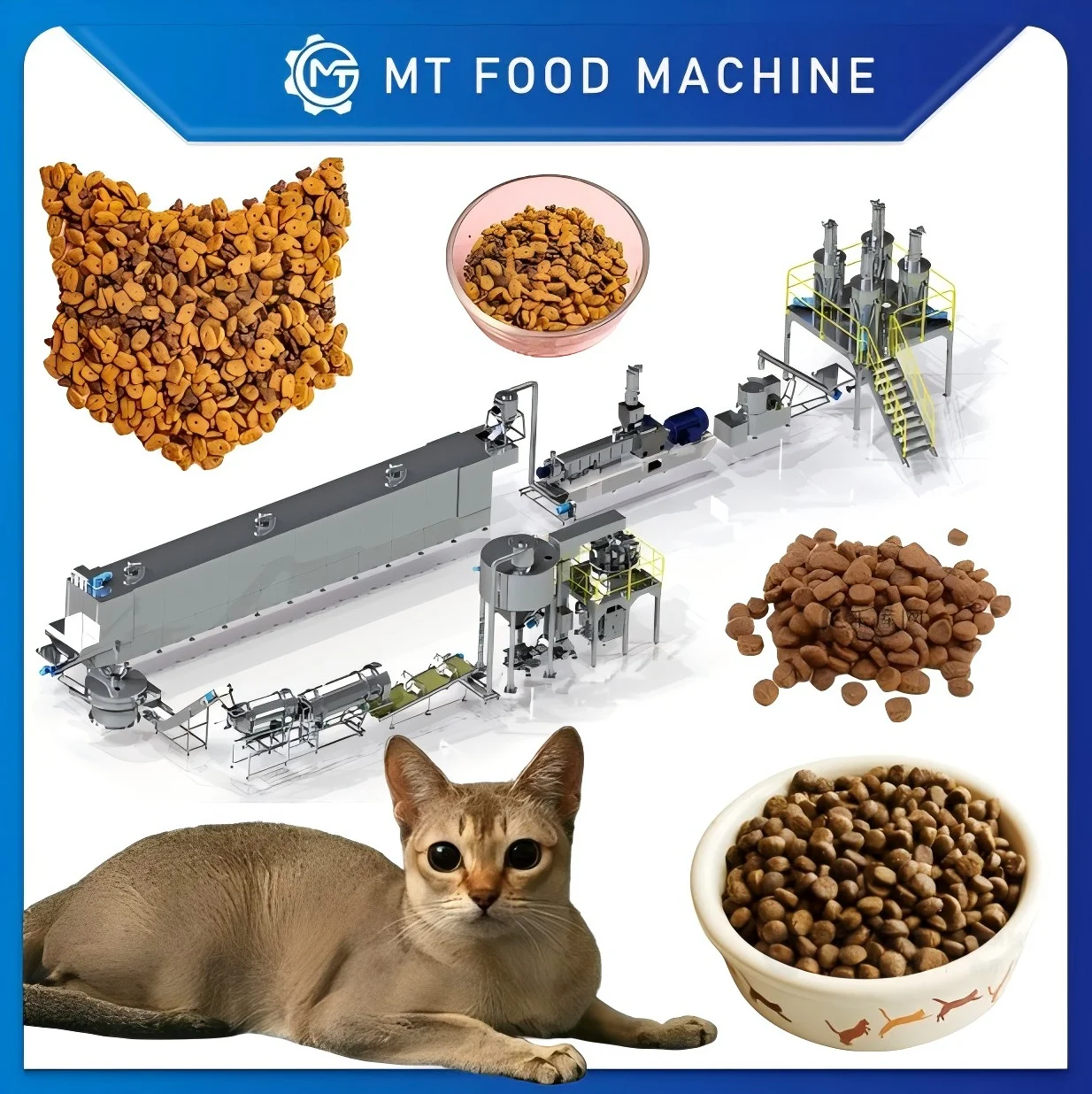
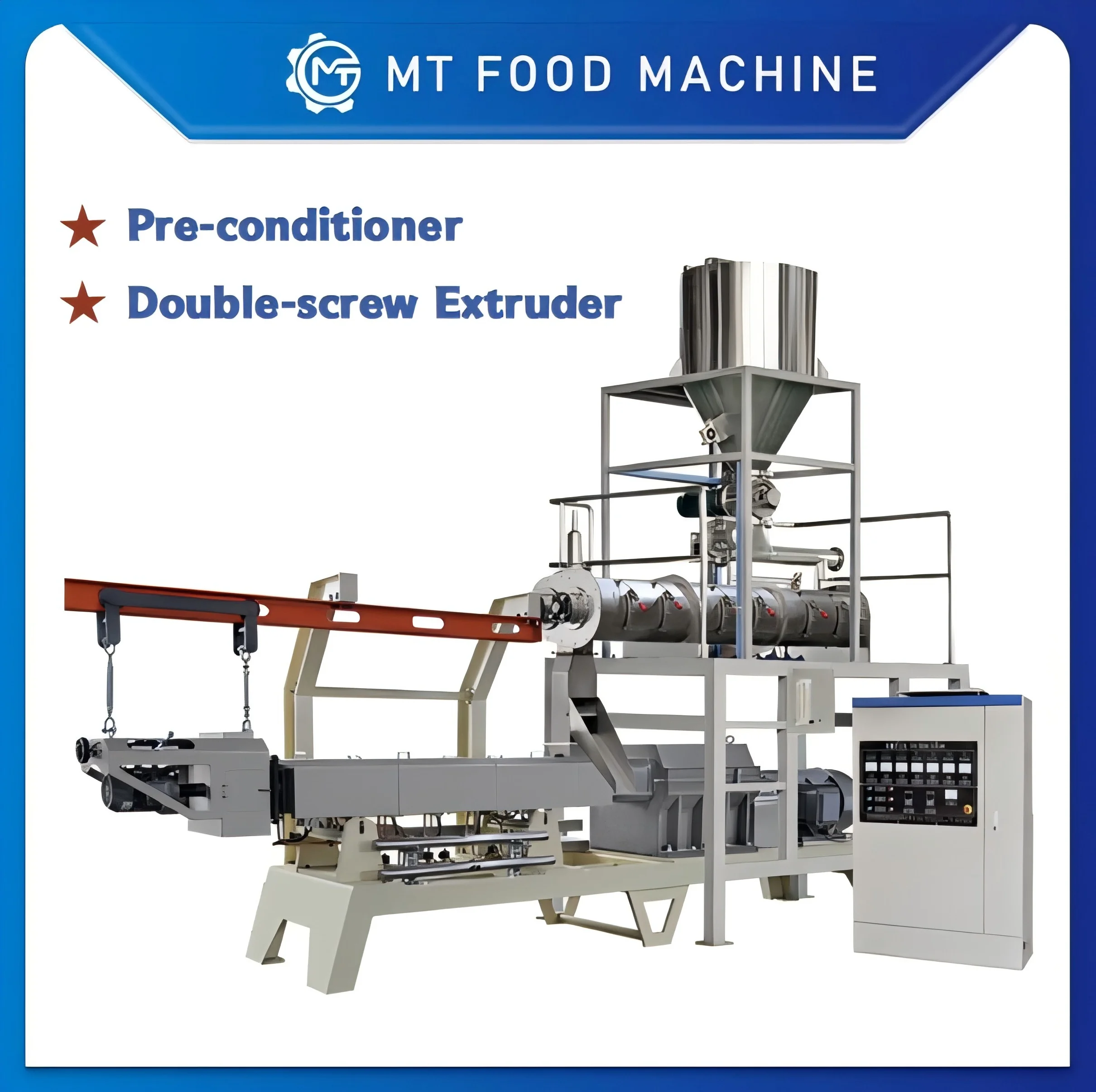
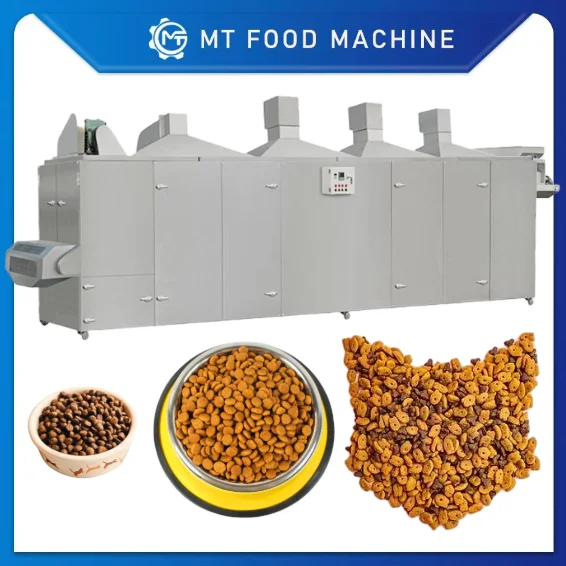
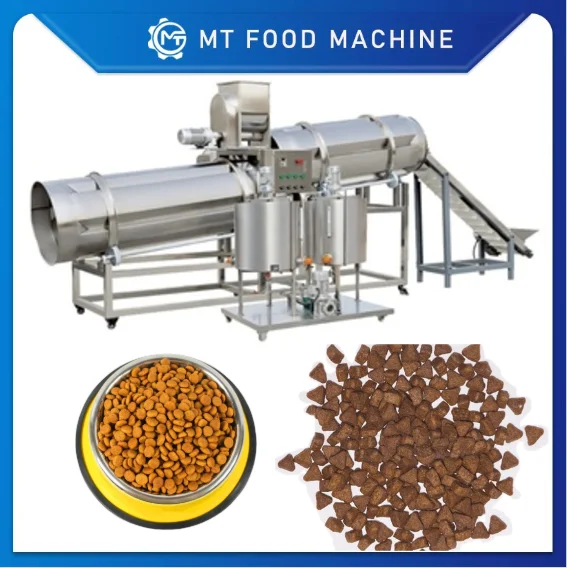
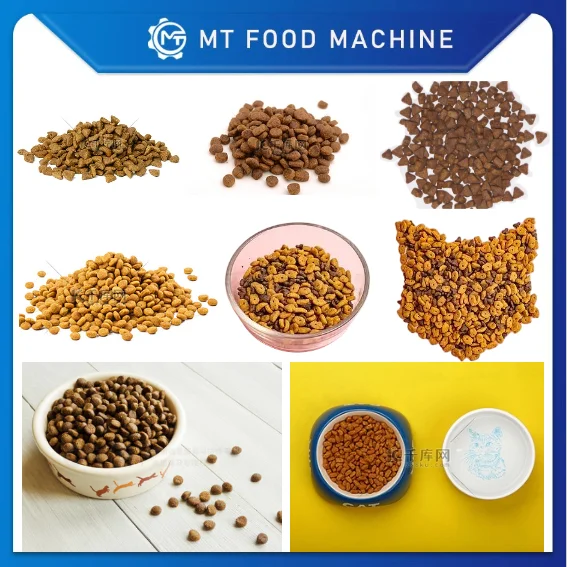
Cat Food Processing Line, 100-200 kg/h, PLC Controlled, Twin-Screw Extrusion — integrated from batching through extrusion, drying, coating to packing with matched throughput at every station. Screw configuration and die design are specified to your raw material formulation and target kibble density, supporting dry kibble, semi-moist, and treat formats on a single line. Full automation with intuitive PLC interface ensures synchronized operation across all stations.
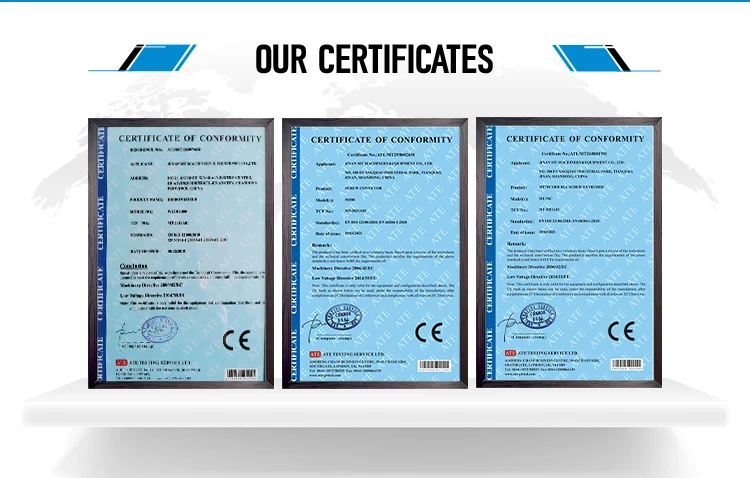
- CE and ISO certified with complete documentation including electrical schematics, wear parts list, and trial run reports on your recipe before shipment
- On-site installation, commissioning, and operator training provided by experienced engineers for turnkey project delivery
- Single supplier responsibility eliminates integration risks and bottlenecks from separately sourced equipment
Description
Turnkey throughput matching — Every station from batching through extrusion to packing is calibrated against your actual recipe to prevent the line from choking at its weakest link.
Technical Specifications
| Parameter | Value |
|---|---|
| Product Type | Multi-Species Cat Food Processing Line |
| Output Capacity | 100-200 kg/h (basis to be confirmed with buyer’s specific raw material formulation, moisture content, and target kibble size) |
| Extruder Configuration | Twin-screw |
| Control System | PLC Controlled with full line synchronization |
| Automation Level | Full automation from batching to packing |
| Supported Formats | Dry kibble, semi-moist pet food, treats |
| Line Integration | Complete stations: batching, extrusion, drying, coating, cooling, packing |
| Energy Design | Energy saving and eco-friendly configuration |
| Interface | User-friendly HMI with intuitive controls |
| Certification | CE, ISO |
Application Suitability
| Application | Material or Output |
|---|---|
| Multi-species dry cat kibble | Poultry meal, fish meal, corn, rice, vitamin premix blends |
| Semi-moist cat food production | High-fresh-meat recipes with elevated moisture retention |
| Functional cat treats | Dental care formulations, hairball control recipes |
| Kitten and senior nutrition lines | Fine-grind protein bases with adjusted expansion targets |
| Mixed-species pet food facilities | Rapid recipe changeover between cat and dog formulations |
Why "200 kg/h on Paper" Becomes 140 kg/h at Your Plant
Quoted capacity assumes a reference recipe that rarely matches what you actually produce.
A cat food processing line turnkey project lives or dies by throughput matching. When an extruder is rated at 200 kg/h on a standard corn-and-poultry-meal blend, but your commercial recipe uses high levels of fresh meat or alternative starches, the actual output can drop significantly. The dryer may be sized for the paper capacity, leaving product too wet at reduced throughput, or the coating drum may not handle the fat application rate your recipe demands. This mismatch surfaces only after installation, when rework becomes expensive and commissioning schedules slip. [NEED_CITE: impact of raw material formulation on twin-screw extruder throughput]
Matching Every Station to the Weakest Link
A cat food extrusion production line project fails when one station dictates the pace for the entire facility. The extruder may run at its rated output, but if the dryer cannot remove enough moisture in the available residence time, the line must slow down. We calculate throughput at each station — mixing, extrusion, drying, coating, cooling, and packing — against your specific recipe parameters, then size every piece of equipment so no single unit becomes the bottleneck.
Phased Installation and Utility Planning
Deploying a complete pet food line involves coordinating steam supply, electrical load distribution, water connections, and dust extraction across multiple stations. Our project sequencing staggers equipment arrival so that foundation work, utility hookups, and mechanical installation proceed without crews blocking each other on the factory floor. Each phase has defined acceptance checkpoints before the next stage begins. [NEED_CITE: industrial food line phased installation protocols]
Reading the Specification Sheet Beyond Marketing Claims
The twin-screw configuration handles high-protein and high-fat formulations that single-screw designs struggle with, because the intermeshing screws provide positive conveyance and self-cleaning action. The PLC control system stores recipe parameters — barrel temperature zones, screw speed, feeder rates, and moisture injection — so that batch-to-batch consistency depends on saved profiles rather than operator memory. The full automation level means that from batching through packing, material flow is coordinated by the central controller, reducing the manual interventions that introduce variability. Energy saving design across motors and heating elements lowers the utility cost per kilogram of finished kibble over extended production runs.
What Happens When Stations Are Sourced Separately
When the extruder comes from one vendor and the dryer from another, nobody takes responsibility for the throughput gap between them. The coating drum may arrive with a different control protocol that refuses to handshake with your PLC. Electrical schematics from separate suppliers use incompatible numbering, making fault tracing slow. Spare parts ordering becomes a multi-vendor exercise, and warranty disputes arise whenever a failure sits at the interface between two machines. [NEED_CITE: risks of multi-vendor food processing line integration]
Why Source This Line as a Single Project
Every station is engineered against the same capacity calculation, so the extruder output, dryer residence time, and coating drum volume are mathematically aligned to your recipe. Screw configuration and die design are specified to your raw material before production begins, not copied from a generic build. Our in-house testing workshop runs your actual formulation before shipment, generating a trial run report that confirms product density, expansion ratio, and texture. Pre-sales engineering covers line layout, utility planning, and phased installation scheduling. On-site commissioning includes operator training on the PLC interface and ongoing maintenance support with documented wear parts lists.
Documentation & Verification
- Line layout drawing showing station placement, material flow, and utility connection points for your facility footprint
- Capacity calculation sheet matching each station to your confirmed recipe and target kibble specification
- Trial run report documenting extrusion parameters, product density, and expansion results on your raw material
- Electrical schematic with PLC I/O mapping and voltage confirmation for your local power supply
- Screw and die configuration record tied to your specific formulation and product geometry
- Operation and maintenance manual covering daily checks, lubrication schedules, and wear part replacement procedures
Installation, Commissioning & Support
- Foundation plan detailing load points and leveling requirements for the twin-screw extruder and dryer assembly
- Dedicated electrical circuit specification matching the PLC control panel voltage and total connected load
- Equipment arrives in staged modules with labeled connection points for sequential assembly
- First-run commissioning includes barrel temperature profiling and screw speed calibration on your recipe
- Operator training covers PLC recipe management, alarm response, and daily sanitation procedures
- Wear parts kit with initial screw elements and die plates, plus documented reorder lead times
What We Need to Size Your Line
To build an accurate layout and capacity calculation for your cat food processing line turnkey project, share your target recipe with ingredient percentages and moisture content, the kibble shapes and sizes you plan to produce, and your daily production target in finished kilograms. We also need your facility dimensions, available ceiling height, and local voltage and frequency so that electrical panels and motor ratings are correct before fabrication begins.
Frequently Asked Questions
Q: How do you confirm the 100-200 kg/h capacity applies to our specific cat food recipe?
A: We run your actual raw material formulation in our in-house testing workshop before finalizing the line design. The trial generates a documented report covering extrusion temperature, screw speed, product expansion, and kibble density. The capacity figure in your quotation reflects these tested results, not a generic benchmark from a standard corn-based reference recipe.
Q: How do you ensure the dryer and coating drum keep pace with the extruder?
A: Each station is sized using the same capacity calculation tied to your recipe’s moisture content and fat application rate. The dryer length and airflow are specified so that product exits at the target moisture level at full extruder output. The coating drum volume and spray system are matched to your fat or palatant dosage requirement.
Q: What does phased installation look like for a complete pet food line?
A: Equipment ships in planned stages aligned with your facility readiness. Foundation and utility work proceed first, followed by main extruder and dryer installation, then auxiliary stations like coating and packing. Each phase has acceptance criteria before the next begins, and commissioning follows a defined sequence from individual station testing to full-line synchronized runs.
Q: Can the line layout adapt to an existing building with fixed utility points?
A: Yes. We work from your facility drawing showing column positions, door locations, and existing utility connections. The line layout positions each station to minimize duct runs and cable lengths while maintaining the material flow sequence. Conveyor lengths and dryer orientation adjust to fit the available footprint without sacrificing throughput.
Q: What spare wear parts should we stock from day one?
A: We provide a wear parts list specific to your screw and die configuration, identifying the elements most subject to abrasion from your recipe’s mineral and fiber content. The initial shipment can include a recommended first-year kit of screw elements, die plates, and cutter blades, with documented lead times for subsequent reorders.
Related products
-
Premium Pet Food Processing Equipment Dog Cat Feed Making Machine
¥9,500.00 Select options This product has multiple variants. The options may be chosen on the product page -
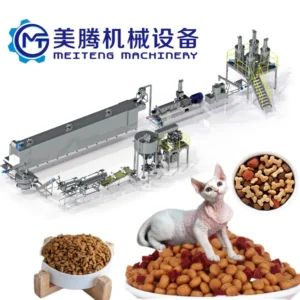
MT70 100-200kg/h Dog & Cat Pet Food Processing Line with 380V 50Hz Three Phase Power
¥35,000.00 Select options This product has multiple variants. The options may be chosen on the product page -
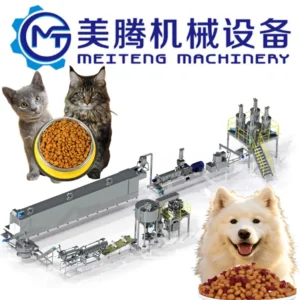
MT High Capacity Pet Food Extrusion Production Line for Dogs Cats Birds Fish Cattle and More (150kg/h-3T/h)
¥35,000.00 Select options This product has multiple variants. The options may be chosen on the product page -
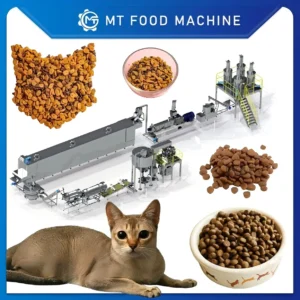
100-200kg/h Capacity PLC Controlled Multi-Species Cat Food Processing Line
¥34,000.00 Select options This product has multiple variants. The options may be chosen on the product page