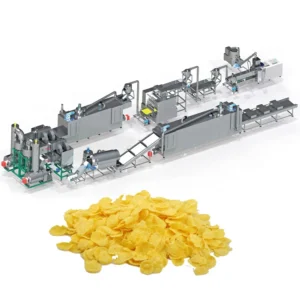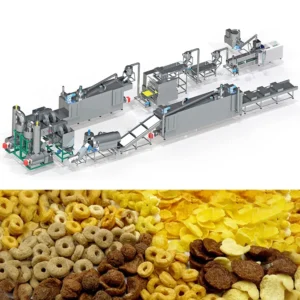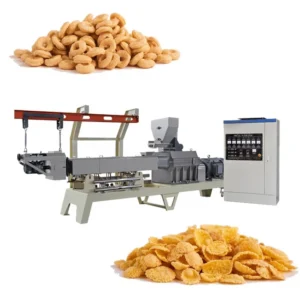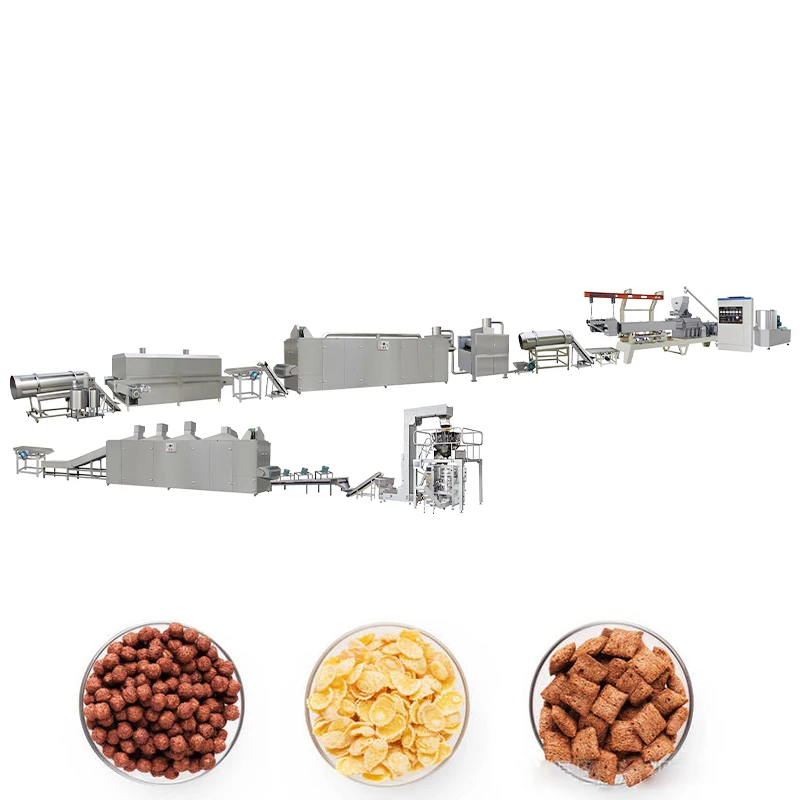
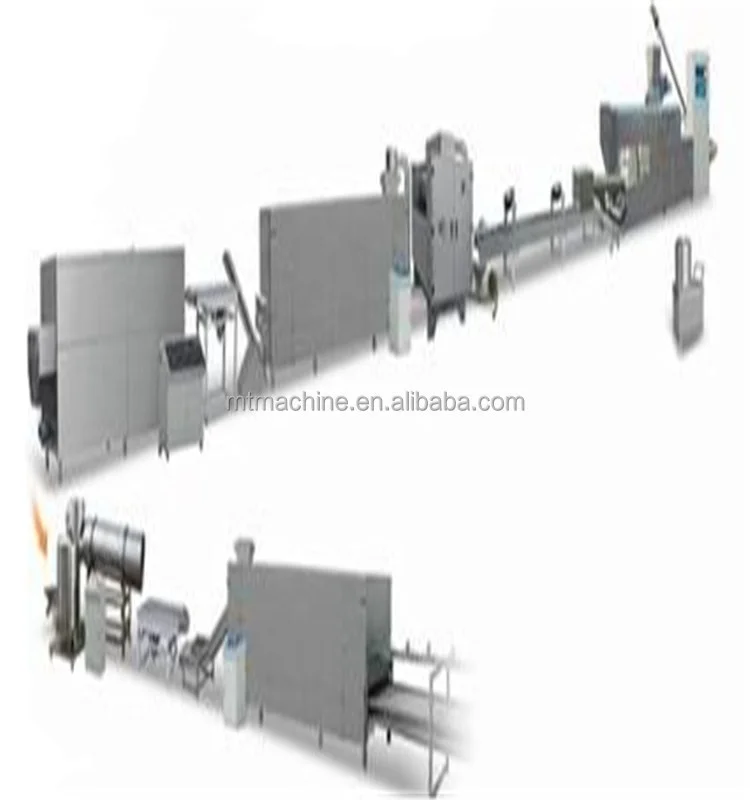


MT70 / MT85 / MT75 Twin Screw Corn Flakes Production Line, PLC Control, Hydraulic Flaking — engineered as a complete turnkey system from mixing through extrusion, flaking, drying, roasting and packing, with throughput matched across every station to eliminate bottlenecks.
- Screw and die configuration specified to your grain blend and target flake density
- Hot-air roasting with circulating fan and cyclone dust removal for consistent crispness
- Trial runs on your raw material in our testing workshop before shipment
- Custom layout designed to your factory footprint with voltage and control language confirmed pre-production
Description
Throughput-Matched Line Design — Every station from batching to packing is sized against the same output target, so no single unit throttles your rated throughput on the actual grain blend you intend to run.
Technical Specifications
| Parameter | Value |
|---|---|
| Product Type | Corn Flakes Production Line / Breakfast Cereal Extrusion Line |
| Extruder Model Options | MT70 / MT85 / MT75 (Twin Screw) |
| Installed Power | MT70 — 160 kW; MT85 — 190 kW; MT75 — 210 kW |
| Power Consumption | MT70 — 120 kW; MT85 — 140 kW; MT75 — 150 kW |
| Output Capacity | MT70 — 150–200 kg/h (basis not stated in source — confirm raw material / moisture / product format); MT85 — 300–400 kg/h (basis not stated in source); MT75 — 300–500 kg/h (basis not stated in source) |
| Overall Dimensions (L×W×H) | MT70 — 41 × 1.5 × 2.2 m; MT85 — 43 × 1.5 × 3.2 m; MT75 — 45 × 1.5 × 3.5 m |
| Screw Type | Twin Screw with automatic lubricating and cooling |
| Control System | PLC and MCC integrated line-wide control |
| Flaking Station | Hydraulic double-roller system, dual independent motors, infrared-sensor temperature control |
| Dryer Heating Source | Gas or Electric (configurable) |
| Roasting Oven | Hot-air roasting with vibrating pan, two circulating fans, cyclone dust removal |
| Coating System | Double tumble sugar melting, elevator, coating drum, spraying nozzle |
| Basic Raw Materials | Corn, rice, wheat, oat, barley powder |
| Final Products | Natural corn flakes, sugar-coated corn flakes, shaped cereals (ball, tube, ring, star, wheel, flower, heart) |
| Assembly State | Complete production line |
| Standards | CE, ISO |
Application Suitability
| Application | Material or Output |
|---|---|
| Natural corn flakes for breakfast cereal packaging | Corn grits or corn flour, flaked and roasted without sugar coating |
| Sugar-coated corn flakes | Corn-based flakes with sugar spraying and tumble coating stage |
| Multi-grain breakfast cereals | Blends of rice, wheat, oat, or barley powder processed through twin-screw extrusion |
| Shaped cereal formats | Rings, balls, stars, wheels, fruit loops by exchanging extruder die inserts |
| Snack food diversification | Puffed snack shapes produced on the same extrusion platform with adjusted screw configuration |
What Your Raw Material Actually Does to the Line’s Rated Output
A capacity figure quoted on one grain blend tells you nothing about what happens when you switch to a different particle size or moisture level.
I once watched a corn flakes line stall for an entire week after installation because the buyer’s local corn flour had a coarser grind and lower moisture than the standard test material. The flakes came off the rollers with cracked edges, and the roasting oven produced uneven color because the density was wrong from the start. The screw profile and die clearance had to be completely reworked on-site [NEED_CITE: raw material variability and extrusion performance]. When buyers evaluate a corn flakes production line turnkey supplier, the question is not what the line runs at peak — it is what it sustains on your specific grain supply, day after day.
Extrusion Configuration for Flaked Cereal Texture
The twin-screw design gives operators a wider processing window for corn, wheat, and oat blends compared to single-screw extruders, because material residence time and shear intensity can be adjusted independently through screw element arrangement. For corn flakes specifically, the degree of starch gelatinization achieved inside the barrel determines whether the pellet will flatten cleanly under the flaking rollers or fracture at the edges. Die design controls pellet size and moisture distribution, both of which carry forward into the flaking and roasting stages.
Matching Downstream Stations to Extruder Output
A corn flakes production line turnkey project fails when the dryer or roasting oven cannot handle the volume the extruder pushes through. The hot-air roasting oven on this line uses a vibrating pan with two separate circulating fans and a cyclone dust removal system, so residence time and heat distribution can be tuned to the flake thickness coming off the rollers. The hydraulic flaking station features independent dual-motor drive and infrared-sensor temperature control on the rollers, which keeps flake thickness uniform across the full width [NEED_CITE: flaking roller temperature uniformity and cereal crispness]. If your coating stage is required, the double tumble drum and spraying nozzle system handles sugar application without creating a bottleneck downstream.
Reading the Specs That Matter for Daily Production
The installed power range across the MT70, MT85, and MT75 models — from 160 kW to 210 kW — reflects the motor capacity needed to push denser multi-grain blends through the twin-screw barrel at sustained output. Power consumption figures run lower than installed power because the extruder does not operate at full draw continuously; actual consumption depends on raw material viscosity and target pellet density. The overall line length stretches from 41 meters for the MT70 configuration to 45 meters for the MT75, which includes mixing, extruding, flaking, drying, roasting, cooling, and packing stations laid out in sequence. PLC and MCC integration means the entire line can be started, stopped, and monitored from a single control panel, and alarm conditions at one station can automatically pause upstream equipment to prevent material buildup. Voltage and frequency are confirmed to your local electrical standard before the control cabinets are wired.
The Cost of Skipping the Trial Run
When a line ships without a trial run on the buyer’s actual raw material, the first production test happens inside your factory, on your schedule, with your customers waiting. Screw configuration adjustments that could have been resolved in the manufacturer’s testing workshop now require a technician to fly on-site, and replacement die inserts may need to be shipped internationally [NEED_CITE: on-site commissioning delays from untested material profiles]. Flaking rollers set for one grain density may produce inconsistent thickness on another, and the roasting oven temperature profile may not match the new pellet moisture content, resulting in product that does not meet market specifications for color and crispness.
Why Buyers Source the Full Line from One Supplier
Every station in this corn flakes production line is specified by the same engineering team, so throughput calculations across the extruder, dryer, roaster, and packing station are based on the same target output and raw material profile. The screw configuration and die design are documented against your grain blend before production begins, not copied from a generic build. An in-house testing workshop allows trial runs on customer-supplied raw material before the line ships, which means product development work happens early rather than during commissioning. Pre-sales engineering covers the full line layout, and on-site installation includes operator training on the PLC interface and daily maintenance routines. CE and ISO documentation accompanies the shipment.
Documentation & Verification
- Line layout drawing scaled to your factory footprint with station-by-station throughput calculations
- Screw and die configuration record matched to your grain blend and target flake density
- Trial run report on customer-supplied raw material from the in-house testing workshop before dispatch
- Electrical schematic with confirmed voltage and frequency for your local power grid
- CE declaration of conformity and ISO certificate included in the shipment documentation package
- Operation and maintenance manual with wear parts list and replacement intervals
Installation, Commissioning & Support
- Floor space planning based on line length of 41 to 45 meters with utility connection points marked on the layout drawing
- Dedicated power circuit sized to the selected model’s installed power requirement, from 160 kW to 210 kW
- Line arrives in modular sections with assembly sequence documented for your local installation contractor
- First-run commissioning includes screw speed, barrel temperature, and flaking roller gap adjustment on your grain material
- Operator training covers PLC interface navigation, alarm response, and daily lubrication of the twin-screw assembly
- Wear parts inventory includes replacement screw elements, die inserts, and flaking roller surfaces with reorder specifications
What We Need to Configure Your Line
Before a quotation can be prepared, we need to know the grain blend you plan to process and its particle size distribution, because these determine screw configuration and die selection. Share your factory floor dimensions and ceiling height so the layout can be engineered to your available space. Confirm your local voltage, frequency, and preferred control language so the electrical cabinets are wired and labeled correctly before shipment. If you can supply a sample of your raw material, a trial run in the testing workshop will produce sample flakes for your evaluation before the line enters production.
Frequently Asked Questions
Q: How is the line capacity verified on my raw material?
A: Capacity figures quoted without reference to a specific grain type, particle size, and moisture content are estimates only. We run your raw material through the extruder in our testing workshop and document the actual throughput, pellet density, and flake quality in a trial run report. This report accompanies the line and serves as the baseline for on-site commissioning.
Q: How do you match screw configuration to my grain blend?
A: Different grain blends require different screw element arrangements to achieve the correct degree of starch gelatinization. Corn, wheat, oat, and barley each respond differently to shear and temperature inside the barrel. We document the screw profile and die design chosen for your material and keep this record on file for future reorders of wear parts.
Q: What happens during a trial run before shipment?
A: Your raw material is fed through the extruder, flaking station, and roasting oven in the testing workshop. We adjust screw speed, barrel temperature zones, and roller gap until the flakes meet target thickness, color, and crispness. The final parameters are recorded, and sample product is sent to you for evaluation before the line is dismantled for packing.
Q: How are voltage and control language confirmed before production?
A: During the quotation stage, you provide your local voltage, frequency, and preferred PLC interface language. These values are written into the electrical schematic and confirmed before the control cabinets are assembled. This prevents commissioning delays caused by incompatible power supply or unreadable control screens [NEED_CITE: voltage and frequency standards by export market].
Q: What spare wear parts are included and how is supply maintained?
A: The initial shipment includes replacement screw elements, die inserts, and flaking roller wear surfaces. Each part is listed in the wear parts document with specifications and material grades. Reorders are fulfilled from inventory or manufactured to the documented configuration, so replacement parts match the original trial run parameters.
Related products
-
New High Efficiency Electric Corn Flakes Production & Manufacturing Machine
¥7,500.00 Select options This product has multiple variants. The options may be chosen on the product page -
Automatic Cornflakes Making Machine Corn Flakes Breakfast Cereals Processing Production Line
¥500.00 Select options This product has multiple variants. The options may be chosen on the product page -
New Technical Automatic Cereal Nutritional Powder Instant Porridge Baby Food Making Machine
¥10,000.00 Select options This product has multiple variants. The options may be chosen on the product page -

Best Price Corn Flakes Making Machine Breakfast Cereals Processing Line with Motor As Core Component
¥19,000.00 Select options This product has multiple variants. The options may be chosen on the product page