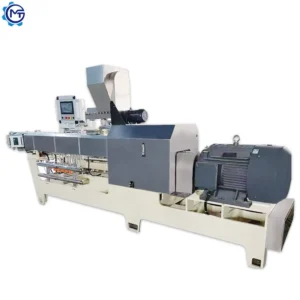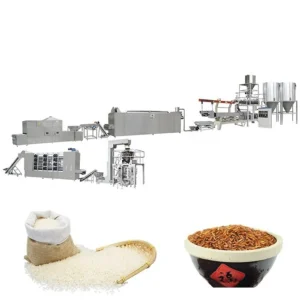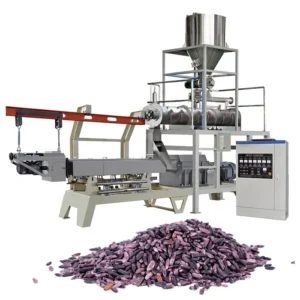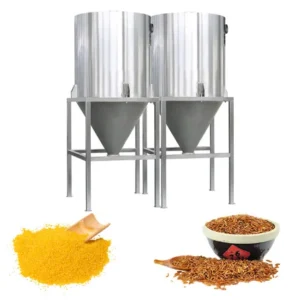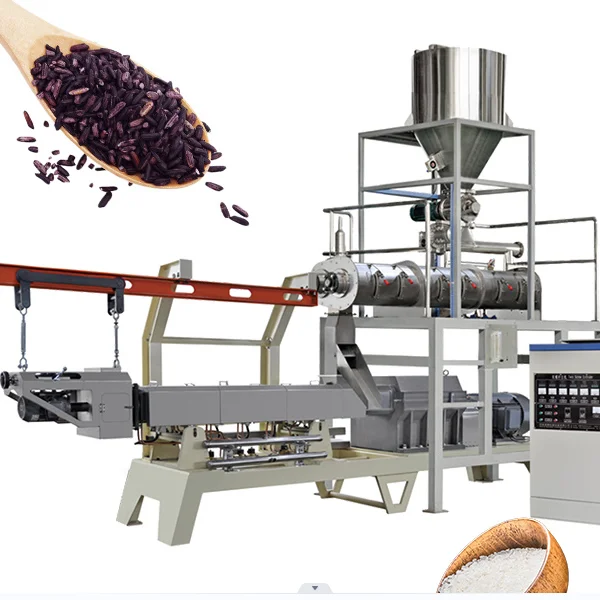

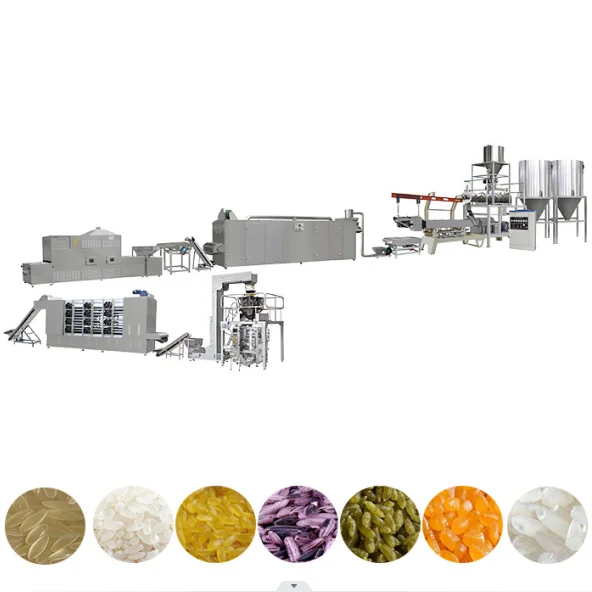
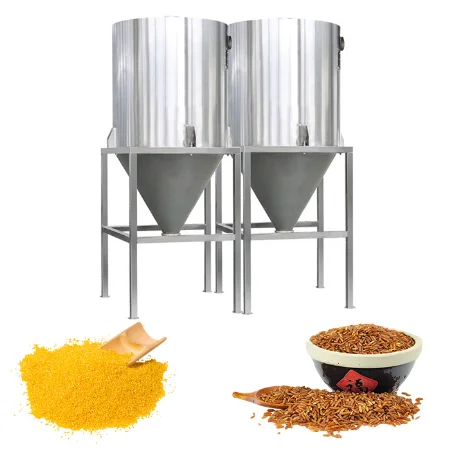

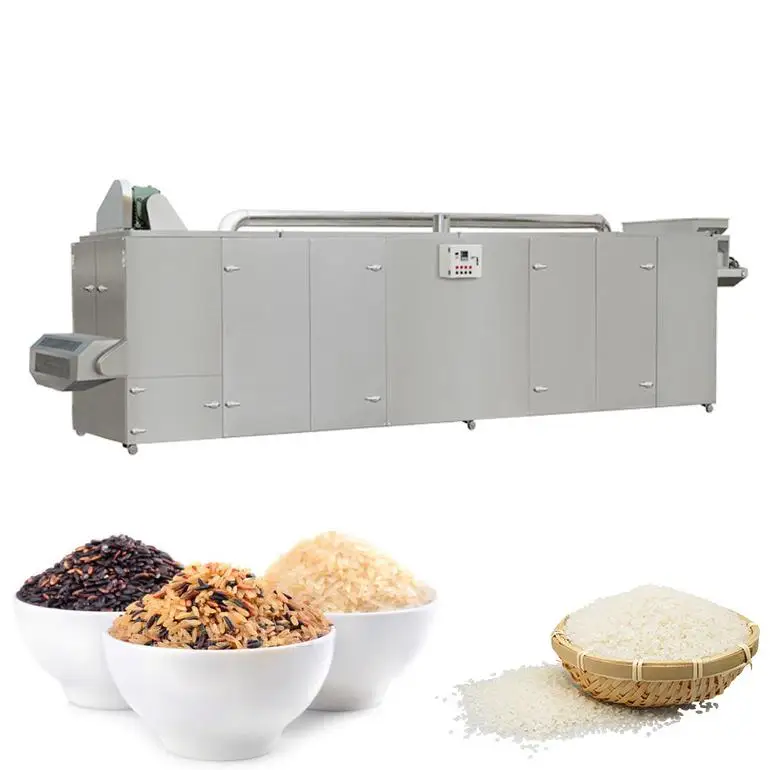
MT65 / MT70 / MT85 / MT75 / MT95 Fortified Rice Extrusion Production Line, Twin-Screw, PLC & MCC Control — configured as a complete turnkey line from batching through extrusion, drying, roasting and packing. Screw profile and die geometry are specified to your broken-rice or multi-grain blend and target kernel density, with throughput matched at every station to eliminate bottlenecks. Capacity is verified on your raw material in our testing workshop before shipment, supported by full line layout, electrical schematic and trial-run documentation.
Description
Turnkey Engineering — We deliver a complete fortified rice extrusion line from batching to packing under one supplier, with throughput calculated across every station rather than quoted only at the extruder.
Technical Specifications
| Parameter | Value |
|---|---|
| Product Type | Fortified Rice Extrusion Production Line |
| Model | MT65 / MT70 / MT85 / MT75 / MT95 |
| Screw Type | Twin-screw |
| Installed Power | 85 kW (MT65) / 120 kW (MT70) / 235 kW (MT85) / 180 kW (MT75) / 260 kW (MT95) |
| Power Consumption | 60 kW (MT65) / 85 kW (MT70) / 165 kW (MT85) / 135 kW (MT75) / 195 kW (MT95) |
| Output Capacity | 80–100 kg/h (MT65) / 100–120 kg/h (MT70) / 200–300 kg/h (MT85) / 300–500 kg/h (MT75) / 800–1000 kg/h (MT95) (basis not stated in source — confirm raw material blend & moisture) |
| Overall Dimensions | 28 × 1.2 × 2.2 m (MT65) / 30 × 1.5 × 2.2 m (MT70) / 34 × 3.5 × 4.3 m (MT85) / 32 × 3.5 × 4.3 m (MT75) / 36 × 3.5 × 4.3 m (MT95) |
| Control System | Frequency speed control, PLC and MCC |
| Feeding System | Single or double screw feeding depending on material |
| Screw Material | Wear-resistant alloy |
| Dryer Heating Source | Electric or gas |
| Dryer Feature | Circulation drying, frequency motor mesh-belt speed control |
| Line Stations | Mixing → Extruding → Vibrating → Low-temperature drying → Cooling → High-temperature roasting → Cooling → Packing |
| Certification | CE, ISO |
Application Suitability
| Application | Material or Output |
|---|---|
| Fortified Rice Kernel Production | Broken rice, rice flour, corn, millet, wheat, oats, buckwheat, bean, starch with added vitamins and minerals |
| Nutritional Food Programmes | Government and NGO tender fulfilment for micronutrient-enriched staple foods |
| Artificial Rice Manufacturing | Multi-grain reformed rice kernels for staple-food producers and food-investment contractors |
Why Nominal Capacity Quotes Fail on Multi-Grain Blends
We verify capacity on your specific raw material blend before the line is built.
Buyers often discover that a quoted capacity figure was based on a standard corn or wheat formulation, not the high-fat or high-fiber multi-grain blend they intend to run. When the actual material hits the extruder barrel, the screw profile cannot convey it at the rated throughput, and the line stalls well below nameplate output. Commissioning then stretches from days into weeks while screw elements and die geometry are swapped on-site. [NEED_CITE: material-specific capacity verification in extrusion line procurement] This is why our proposal process for a fortified rice production line turnkey always begins with a raw material report and a trial run in the testing workshop.
Phased Installation Planning for Complete Plants
A fortified rice production line turnkey involves more than placing machines in sequence. Utility routing for electric heating or gas drying, compressed air for pneumatic gates, and water supply for the mixing station all require advance planning before equipment arrives on site. Our layout proposals specify utility connection points at each station so that civil and MEP contractors can prepare the workshop in parallel with machine fabrication.
Throughput Matching Across Every Station
The extruder may be rated for a given output, but if the downstream dryer cannot remove moisture fast enough or the cooling conveyor is undersized, the entire line bottlenecks. Every station in this fortified rice production line turnkey — from the batching mixer through vibrating screen, low-temperature dryer, high-temperature roaster, and packing weigher — is sized to sustain the extruder throughput continuously. [NEED_CITE: throughput balancing methodology in food extrusion lines] This eliminates the situation where operators must slow the extruder to match a dryer that was sourced separately.
Reading the Specification Sheet for Real-World Impact
The twin-screw configuration across the MT65 through MT95 range allows screw element rearrangement to suit different starch-to-protein ratios in your formulation. A higher proportion of broken rice flour demands a different compression ratio than a blend heavy in oat or buckwheat, and the screw profile is documented before build. Installed power ranges from 85 kW to 260 kW across the models, which directly determines the thermal and mechanical energy available for gelatinisation inside the barrel. The frequency-controlled mesh-belt dryer uses circulation airflow to reduce moisture variation across the kernel bed, preventing a situation where outer-layer kernels over-dry while centre kernels remain above safe storage moisture. PLC and MCC control means production parameters — barrel zone temperatures, screw speed, feeder rate, dryer belt speed — are stored as recipes and recalled identically for each batch.
The Cost of Skipping Utility and Voltage Confirmation
We have seen lines delayed at commissioning because the local supply voltage did not match the motor nameplate, requiring transformer installation or motor replacement on site. Control panels wired for a different frequency run conveyor motors at the wrong speed, throwing off residence time in the dryer. [NEED_CITE: voltage and frequency standards by export market] When a packing station language is not specified, operators struggle with HMI menus during the first production runs, slowing ramp-up and increasing scrap during the learning period.
Why Buyers Consolidate This Line Under One Supplier
Every station is engineered and fabricated in-house, so the vibrating screen, dryer belt width, and roaster capacity are calculated against the extruder output rather than selected from a catalogue of standalone machines. Screw configuration and die geometry are specified to the buyer’s raw material report and confirmed by a trial run before shipment. Electrical schematics are reviewed against the installation site voltage, frequency, and control language during the order confirmation stage. The in-house testing workshop allows us to run your actual broken-rice or multi-grain blend and document kernel density, expansion ratio, and moisture content before the line leaves the factory. Pre-sales engineering consultation covers line layout, utility planning, and phased installation scheduling, extending through on-site commissioning and operator training.
Documentation & Verification
- Line layout and capacity calculation showing throughput at every station from mixer to packer
- Screw and die configuration record matched to your specific grain blend formulation
- Trial-run report on customer raw material documenting kernel density and moisture
- Electrical schematic with voltage, frequency, and control language confirmed to site
- Factory test record and packing photographs before container loading
Installation, Commissioning & Support
- Foundation load and floor-space plan based on overall dimensions up to 36 × 3.5 × 4.3 m
- Dedicated circuit sizing for installed power up to 260 kW with local voltage confirmation
- Assembly sequence plan for multi-station line arrival in modular shipping configuration
- First-run parameter setting for barrel temperature zones and screw speed on your material
- Operator training covering PLC recipe management, dryer belt speed, and roaster temperature
- Wear parts list specifying screw elements, die plates, and dryer belt sections for stocking
What We Need to Build Your Proposal
To prepare an accurate line configuration, share your raw material composition including the percentage of broken rice, supplementary grains, and micronutrient premix, along with target kernel dimensions and daily output requirement. Provide the workshop floor area and ceiling height, local voltage and frequency, preferred control language, and whether you need a trial run on your material before shipment.
Frequently Asked Questions
Q: How is line capacity verified on my specific broken-rice or multi-grain raw material blend?
A: We request a material data sheet and sample, then run a trial in the testing workshop using the screw and die configuration planned for your order. Kernel density, expansion, and throughput are documented in a trial-run report, and the line capacity figure in the quotation reflects those results rather than a generic nameplate value.
Q: What utility planning is included in the turnkey proposal?
A: The layout document specifies electric power draw at each station, gas supply points if gas-heated drying is selected, compressed air for pneumatic components, and water connections for the mixing system. Utility connection coordinates are marked on the floor plan so your MEP contractor can route services before equipment delivery.
Q: How do you ensure throughput matching between the extruder, dryer, and packing station?
A: Each station is sized against the extruder output for your confirmed material blend. Dryer belt length and airflow are calculated to achieve target moisture within the residence time available, and the packing weigher speed is set to handle the cooled product flow without accumulation or starvation.
Q: What is the phased installation and commissioning schedule for a complete plant?
A: Equipment is shipped in modular sections aligned to the installation sequence. Civil and utility work proceeds during fabrication, mechanical assembly follows delivery, electrical connection and dry testing take several days, and wet commissioning with your raw material begins once utilities are confirmed stable on site.
Q: How are operator training, spare wear parts, and ongoing maintenance handled after commissioning?
A: On-site training covers PLC recipe recall, screw speed and temperature adjustment, dryer belt speed setting, and routine inspection points. A wear parts list is supplied with the manual, identifying screw elements, die plates, and dryer belt sections, and we maintain stock for reorder throughout the service life of the line.
Related products
-

Fully Automatic 500kg/h Baby Cereal Nutrition Powder Extrusion Drying Line with PLC Control
¥9,500.00 Add to cart -
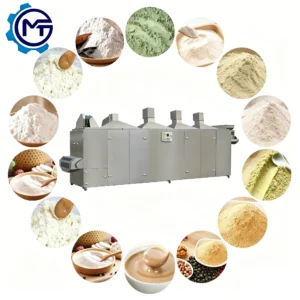
Full Automatic Complete Baby Food Nutrition Powder Porridge Processing Production Line for Infant Nutrition Factory
¥9,500.00 Add to cart -
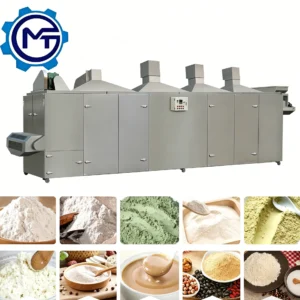
CE Approved MT Brand Organic Baby Rice Nutrition Powder Extrusion Production Line with 500kg/h Capacity and Automatic Grade
¥9,500.00 Add to cart -

High Quality Automatic PLC Controlled 500kg/h Twin Screw Extruder Machine for Baby Rice Nutrition Powder
¥8,238.27 Add to cart