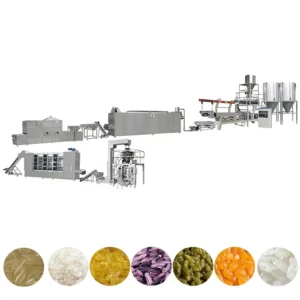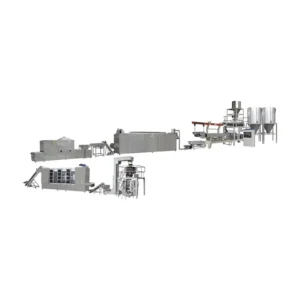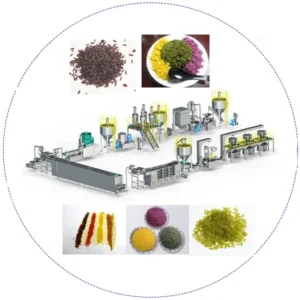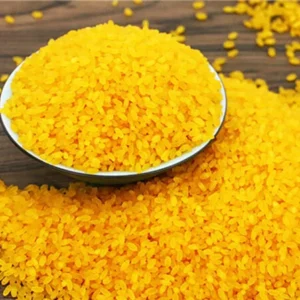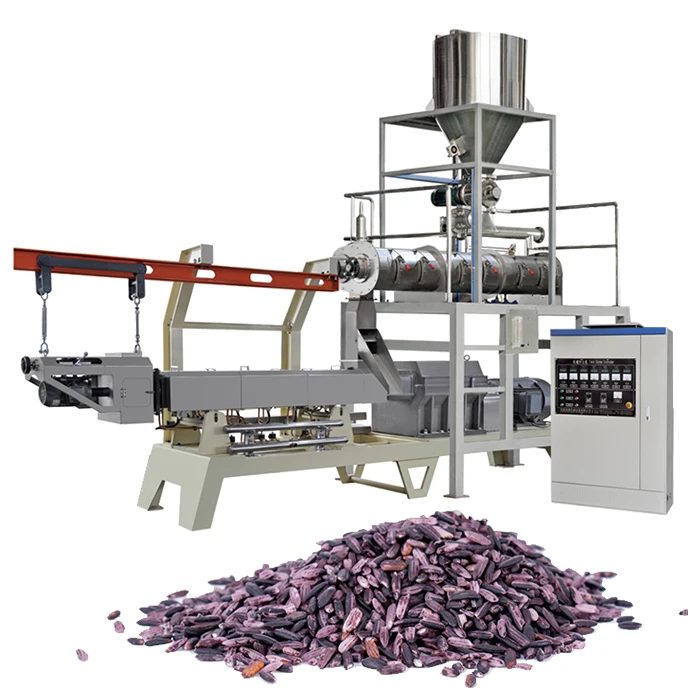


Fortified Artificial Rice Production Line, Twin-Screw Extrusion, 100–1000 kg/h Capacity Range — engineered as a complete turnkey project from batching through extrusion, drying, roasting, cooling and packing.
- Screw configuration and die design matched to your raw material — broken rice, starch blends or vitamin-fortified mixes — ensuring correct kernel density, shape and cooking behaviour
- Circulation drying with frequency-controlled mesh belt delivers consistent moisture; automatic lubrication and cooling support stable long-run production
One-supplier turnkey delivery with throughput matched at every station, in-house trial runs on your actual raw material before shipment, and on-site commissioning with operator training included.
Description
Whole-Line Throughput Matching — every station from batching to packing is sized against the others so a single bottleneck cannot stall the rest of the project.
Technical Specifications
| Parameter | Value |
|---|---|
| Product Type | Fortified Artificial Rice Production Line |
| Extruder Models Available | MT65 / MT70 / MT85 / MT75 / MT95 |
| Screw Type | Twin-screw |
| MT65 Installed Power | 85 kW |
| MT65 Power Consumption | 60 kW |
| MT65 Capacity | 80–100 kg/h (basis to be confirmed) |
| MT65 Overall Dimensions | 28 × 1.2 × 2.2 m |
| MT70 Installed Power | 120 kW |
| MT70 Power Consumption | 85 kW |
| MT70 Capacity | 100–120 kg/h (basis to be confirmed) |
| MT70 Overall Dimensions | 30 × 1.5 × 2.2 m |
| MT85 Installed Power | 235 kW |
| MT85 Power Consumption | 165 kW |
| MT85 Capacity | 200–300 kg/h (basis to be confirmed) |
| MT85 Overall Dimensions | 34 × 3.5 × 4.3 m |
| MT75 Installed Power | 180 kW |
| MT75 Power Consumption | 135 kW |
| MT75 Capacity | 300–500 kg/h (basis to be confirmed) |
| MT75 Overall Dimensions | 32 × 3.5 × 4.3 m |
| MT95 Installed Power | 260 kW |
| MT95 Power Consumption | 195 kW |
| MT95 Capacity | 800–1000 kg/h (basis to be confirmed) |
| MT95 Overall Dimensions | 36 × 3.5 × 4.3 m |
| Control System | Frequency speed control |
| Lubrication | Automatic lubricating and cooling system |
| Drying Oven Heating Source | Electric or gas |
| Drying Method | Circulation drying with frequency-controlled mesh belt |
Application Suitability
| Application | Material or Output |
|---|---|
| Fortified rice kernel production | Broken rice, rice bran, added vitamins and minerals |
| Artificial rice from reprocessed grain | Corn, millet, wheat, oats, buckwheat, bean, starch |
| Instant rice for hot water preparation | Starch blends requiring low-temperature drying and high-temperature roasting |
| Nutrition programme supply | Micro-nutrient and mineral-fortified rice kernels |
Why "Nominal Capacity" Means Little Until You Run Your Own Grain
Real throughput is only proven when your actual raw material passes through the barrel and the kernels hold their shape after drying.
A capacity figure quoted against a standard grain profile tells you nothing about how the line will behave once you feed in your own broken rice blend or starch mix with a different moisture curve. I have stood in front of extruders where the spec sheet said one thing, but the customer’s grain mix produced misshapen kernels that cracked in the dryer. That gap between brochure capacity and workshop reality is where turnkey projects stall. [NEED_CITE: material-specific extrusion behaviour and throughput variation]
A fortified artificial rice production line turnkey project must verify throughput on the buyer’s material before any production commitment is locked in.
Matching the Barrel Profile to Starch Gelatinisation
The twin-screw configuration allows the screw elements to be rearranged so that shear intensity and residence time fit the starch source you are actually processing. Broken rice behaves differently from a corn-heavy blend, and the barrel temperature zones must follow that difference. When a fortified artificial rice production line turnkey is configured for the buyer’s material, starch gelatinisation happens at the right point in the barrel, and the kernel exits the die with the density the market expects.
Drying and Roasting Stations That Keep Pace
The extruder does not work alone. The circulation drying oven uses a frequency-controlled mesh belt to hold each kernel at a consistent moisture level, and the high-temperature roasting stage that follows must handle the same mass flow without backlog. If the dryer is undersized relative to the extruder, wet kernels pile up and surface quality degrades. Throughput matching across stations is the core discipline of any turnkey line project. [NEED_CITE: sequential station balancing in food extrusion lines]
Reading the Motor and Power Data Correctly
Installed power and actual power consumption are different figures, and the gap matters for electrical infrastructure planning. The MT65 draws 60 kW in operation despite an 85 kW installed capacity, while the MT95 operates at 195 kW against a 260 kW installation. These differences shape transformer sizing and dedicated circuit requirements at the buyer’s facility. Frequency speed control across the line gives operators the ability to fine-tune each station without rewiring the panel.
The Cost of Skipping a Pre-Shipment Trial
When no trial run takes place before the equipment leaves the factory, product development starts after installation, on the buyer’s floor, with the buyer’s time and material. Screw configurations that seemed reasonable on paper may need complete rework once real grain enters the barrel. Die shapes that produce clean kernels in one blend can tear or deform in another. That rework delays commissioning, wastes raw material, and pushes back the date the line starts earning revenue. [NEED_CITE: cost of post-installation rework in food processing lines]
Why Buyers Plan the Whole Line Here
Every station from mixing through packing is sourced from one supplier, so throughput calculations are coordinated rather than left to the buyer to reconcile. Screw configurations and die designs are specified to the buyer’s actual grain blend, not copied from a generic build. An in-house testing workshop allows trial runs on the buyer’s raw material before shipment, confirming real output and kernel quality. The project scope covers layout design, phased installation, commissioning, and operator training so the line is production-ready when the contractor hands over the floor. CE-certified equipment since 2014 supports customs clearance and local regulatory filing. [NEED_CITE: CE machinery directive requirements for food processing equipment]
Documentation & Verification
- Line layout showing throughput calculations at each station from mixer to packing belt
- Trial run report on your broken rice or starch blend from the in-house testing workshop
- Screw and die configuration record matched to your raw material and kernel shape
- Electrical schematic with voltage, frequency, and control language confirmed before production
- Factory test record documenting output and kernel quality before crating
- CE declaration of conformity and ISO certificate for customs and regulatory filing
Installation, Commissioning & Support
- Foundation and floor space planned around the extruder dimensions, up to 36 × 3.5 × 4.3 m
- Dedicated circuits sized to installed power, up to 260 kW depending on model selected
- Extruder and dryer arrive in sections for on-site assembly and belt alignment
- First-run parameter setting covering barrel temperatures, screw speed, and mesh belt frequency
- Operator training on control panel, automatic lubrication system, and die changeover procedure
- Wear parts list covering screws, dies, and mesh belts with replacement intervals documented
What We Need to Configure Your Line
Share the grain or starch blend you intend to process, including moisture content and particle size, along with your target daily output in finished kernels. Provide the voltage and frequency standard at your facility, the control language your operators need, and the available workshop floor area with ceiling height. If you can send a sample of your raw material, we will run it through the testing workshop before finalising the technical agreement.
Frequently Asked Questions
Q: How is line capacity verified on my specific raw material before shipment?
A: We run your actual grain or starch blend through the extruder in our in-house testing workshop, measure real throughput, and document kernel shape, density, and surface quality. The trial run report is shared before the technical agreement is signed, so capacity figures reflect your material rather than a generic benchmark.
Q: How do you match throughput between extruder, dryer and packing so no station bottlenecks the line?
A: Each station is sized during layout design based on the mass flow from the extruder model selected. The circulation drying oven and cooling conveyors are specified to handle the same hourly output, preventing wet kernel buildup or packing backlog during continuous production runs.
Q: What voltage, frequency and control language options are confirmed before production?
A: Electrical specifications are confirmed during the technical agreement stage. The electrical schematic is issued showing the exact voltage and frequency for your site, and control panel labels and PLC interface language are set to match your operator team before the equipment enters assembly.
Q: What does on-site installation, commissioning and operator training include?
A: Our engineer oversees assembly, belt alignment, and first-run parameter setting on your floor. Training covers control panel operation, screw speed and barrel temperature adjustment, automatic lubrication monitoring, and die changeover, so your team can run the line independently after handover.
Q: Which spare wear parts are supplied and how are replacements handled?
A: A wear parts list is issued with the equipment, covering screws, dies, and mesh belts. Initial spare sets can be included in the first shipment, and replacement parts are manufactured to the same configuration record so they fit without re-commissioning the line.
Related products
-

High Precision Automatic 500kg/h Baby Food Nutrition Powder Rice Extrusion Processing Line
¥8,238.27 Add to cart -
Compact Automatic Baby Cereal Nutrition Powder Production Line with 500kg/h Capacity and PLC Control
¥9,500.00 Add to cart -
High Precision Automatic 500kg/h Baby Food Nutrition Powder Rice Extrusion Processing Line
¥9,500.00 Add to cart -

Fully Automatic 500kg/h Baby Cereal Nutrition Powder Extrusion Drying Line with PLC Control
¥9,500.00 Add to cart