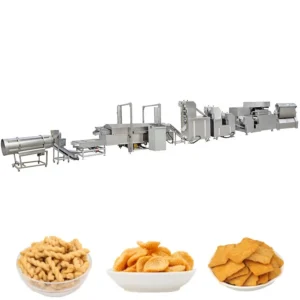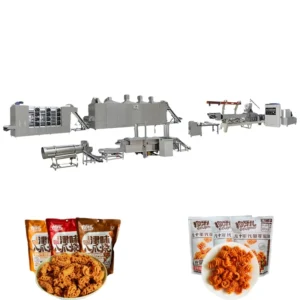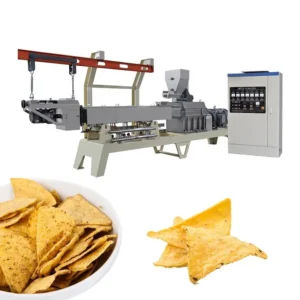


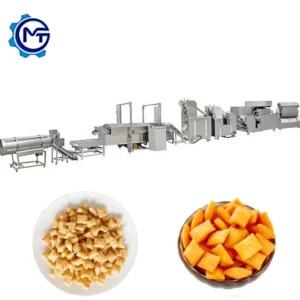
Continuous Frying Machine, 380V/50Hz, PLC Control, 320L Oil Capacity — designed as one integrated station within a turnkey fried snack production line.
- Double-layer mesh belt with stepless speed regulation sandwiches product to prevent floating, ensuring uniform deep-frying across extruded pellets and chips
- Continuous oil circulation filtration removes residue during production, extending oil service life while 304 stainless steel construction and automatic hood lifting simplify cleaning
- Throughput matched to upstream extrusion and downstream seasoning so no single station bottlenecks the line
Every fryer ships with a trial run report on your raw material, electrical schematics confirmed to your market voltage, and full installation support from layout through operator training.
Description
Throughput-Matched Fryer Integration — Every station from extrusion to frying to packing is capacity-calculated so the continuous frying machine never becomes the line bottleneck.
Technical Specifications
| Parameter | Value |
|---|---|
| Product Type | Continuous Frying Machine |
| Power Source | Electric / Gas (configurable) |
| Voltage | 380V / 50HZ |
| Heating Tube Power | 60 kW |
| Drive Power | 2.6 kW |
| Oil Capacity | 320 L |
| Capacity | 100–1000 kg/h (basis not stated in source — confirm product type, moisture, frying time) |
| Overall Dimensions (L×W×H) | 6700 × 2200 × 1200 mm |
| Net Weight | 2000 kg |
| Control System | PLC |
| Material | Food-grade 304 Stainless Steel |
| Mesh Belt | Upper and lower double-layer, frequency conversion stepless speed regulation |
| Oil Filtration | Continuous circulation filtration system |
| Lifting System | Automatic lifting for upper hood and mesh belt |
| Slag Discharge | Bottom slag discharge system |
| Assembly State | Fully assembled |
| Certification | CE |
Application Suitability
| Application | Material or Output |
|---|---|
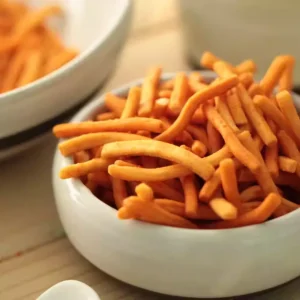
| Extruded fried snack pellets | Corn, potato starch, wheat flour-based pellets |
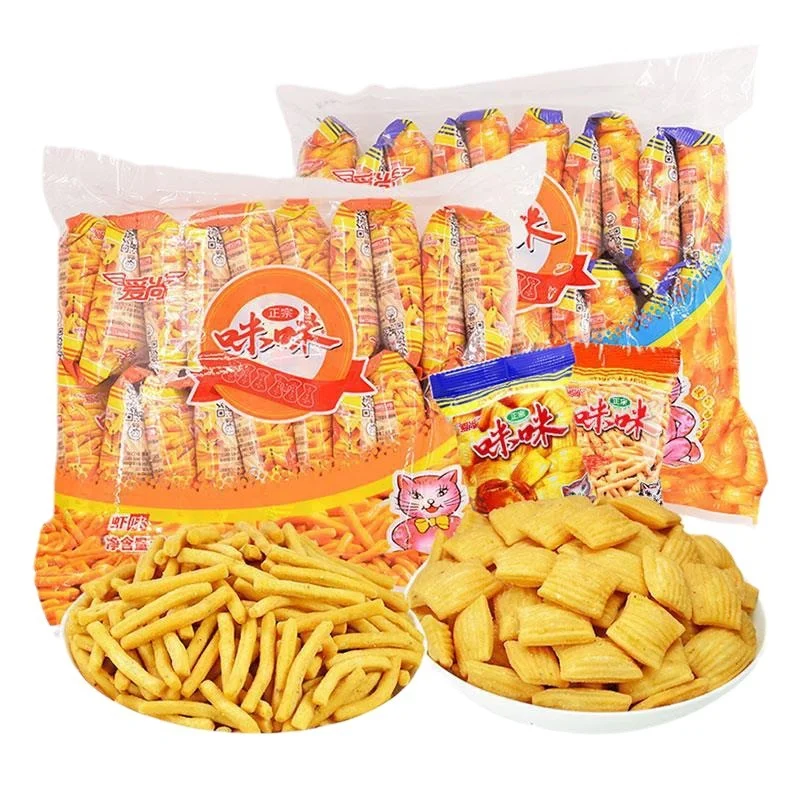
| Fried chips and crisps | 2D/3D pellet snacks, shell-shaped chips |
| Puffed snack finishing | Core-filled or co-extruded snacks requiring deep-fry finishing |
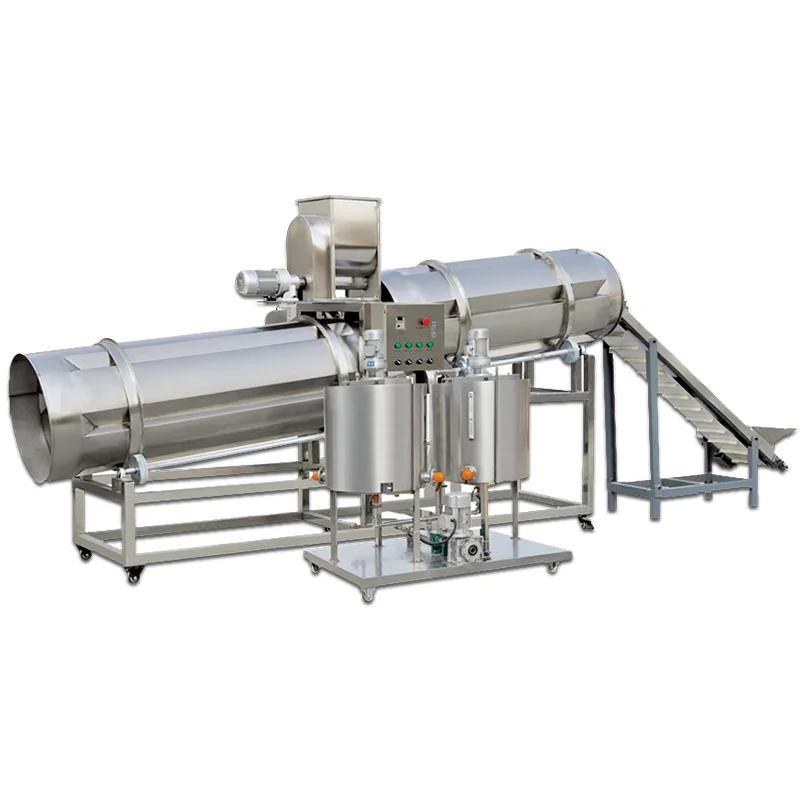
| Turnkey snack line integration | Positioned between extruder/dryer and downstream seasoning drum |
Why the Extruder-Fryer Mismatch Destroys Line Output
A fryer that cannot keep pace with the extruder forces the entire line to run at half speed.
When snack producers evaluate a continuous frying machine turnkey snack production line, they often focus on extruder throughput in isolation. The extruder may push out semi-finished pellets at a rated volume, but if those pellets carry too much residual moisture entering the fryer, the frying time must increase to achieve the target crispness. The mesh belt slows down, product piles up at the infeed, and the effective line output drops well below what either machine was supposed to deliver [NEED_CITE: throughput matching principles in snack processing lines]. I have seen situations where the fryer station became the constraint simply because nobody calculated the moisture differential between the dryer discharge and the fryer infeed requirement.
Synchronizing Every Station Around the Frying Cycle
The frying stage is where product texture and final moisture are locked in, and it has the least flexibility to absorb upstream variation. In a turnkey project, the fryer is not selected as a standalone unit. Its belt speed, oil volume, and heating capacity are calculated backward from the extruder output and forward to the cooling conveyor and seasoning drum. The continuous frying machine turnkey snack production line approach treats the fryer as one node in a throughput chain. If the extruder delivers 500 kg/h of semi-finished pellets at a specific moisture level, the fryer must process that exact mass within the required residence time without temperature drop across the oil bath.
Oil Temperature Stability Across the Full Belt Length
A 6700 mm long fryer tank holds substantial thermal mass, but introducing cold product continuously pulls heat from the oil. The 60 kW heating system must recover temperature between the infeed and discharge ends. Gas heating offers faster recovery for high-throughput runs, while electric heating provides finer temperature control for sensitive products [NEED_CITE: thermal recovery rates in continuous industrial fryers]. The PLC control monitors multiple temperature zones along the tank, adjusting energy input to maintain a consistent frying profile from the first meter of belt to the last.
Reading the Specifications Beyond the Nameplate
The 320 L oil capacity and 60 kW heating power together define how much product the fryer can absorb per hour without the oil temperature collapsing at the infeed zone. The double-layer mesh belt with frequency conversion stepless speed regulation allows operators to set frying residence time precisely — critical when switching between a dense corn pellet that needs a longer fry and a lighter starch-based chip that requires a shorter pass. The 380V / 50HZ electrical supply must be confirmed against the buyer’s facility standard before production begins, as a voltage mismatch can prevent the heating tubes from reaching rated output and stall commissioning for weeks.
What Happens When Fryer Capacity Is Undersized
If the fryer is selected on nominal capacity alone without accounting for the buyer’s actual raw material and moisture content, the consequences compound down the line. Oil temperature fluctuates, producing uneven color and texture. The seasoning drum receives product that is either under-fried or over-fried, increasing reject rates. Producers then throttle the extruder back to match the fryer, losing effective capacity across every upstream station [NEED_CITE: effects of undersized frying stations on snack line throughput]. The real cost is not the fryer itself — it is the lost output across the entire installed line.
Why Procurement Belongs in One Scope
Sourcing the fryer from the same supplier that configures the extruder, dryer, and seasoning stations eliminates the finger-pointing that occurs when stations from different vendors underperform together. The line layout and capacity calculation document shows exactly how the continuous frying machine turnkey snack production line is balanced, station by station. An in-house testing workshop runs the buyer’s actual raw material through the complete sequence before shipment, catching mismatches in a controlled environment rather than on the factory floor after installation. Pre-sales engineering through commissioning and operator training stays with one team that understands the full process chain.
Documentation & Verification
- Line layout drawing showing fryer position, belt length, and throughput match to extruder and seasoning stations
- Trial run report on buyer’s raw material documenting oil temperature profile and frying residence time
- Electrical schematic with confirmed voltage, frequency, and PLC language for the destination market
- Machine specification sheet recording mesh belt speed range, heating configuration, and oil filtration parameters
- CE declaration of conformity for the complete frying station assembly
Installation, Commissioning & Support
- Floor space planning accounting for the 6700 × 2200 mm footprint plus oil filtration and exhaust ducting clearance
- Dedicated 380V circuit sized for the 60 kW heating load plus 2.6 kW drive motor startup current
- Fully assembled delivery requiring utility connection and oil fill rather than major on-site fabrication
- First-run commissioning with PLC parameter tuning for belt speed, oil temperature zones, and filtration cycle
- Operator training covering automatic hood lifting procedure, mesh belt tensioning, and bottom slag discharge operation
- Wear parts list specifying replacement mesh belt sections, heating elements, and filtration media
What We Need to Configure Your Frying Station
To integrate this fryer into a balanced line, share your target product format, raw material recipe, and the extruder output rate you need to sustain. Confirm the available voltage and frequency at your facility, the preferred control language for the PLC interface, and whether your workshop has gas supply infrastructure or requires full electric heating. If you are retrofitting this fryer into an existing line, provide the make and output rating of your current extruder and downstream seasoning equipment.
Frequently Asked Questions
Q: How is the fryer throughput verified before shipment?
A: Throughput is confirmed during a trial run using your raw material in the testing workshop. We document the oil temperature profile, belt speed, and frying residence time required to reach target moisture and color. The trial run report becomes part of your delivery documentation, so you know the exact parameters before the line arrives at your facility.
Q: How do you match the fryer to the extruder and seasoning stations?
A: Each station is capacity-calculated as part of the line layout. The fryer belt speed and oil volume are set to absorb the extruder output at the correct moisture level, and the downstream cooling conveyor is sized to receive the full fryer discharge. No single station is allowed to constrain the others.
Q: What electrical and control details are confirmed before production?
A: We confirm voltage, frequency, and phase with your facility electrical plan. The PLC interface language, alarm text, and HMI layout are specified to your operator requirements. An electrical schematic is issued for your approval before the control panel is wired.
Q: Is a trial run performed on our specific raw material?
A: Yes. Your raw material is run through the fryer in the testing workshop before shipment. We record oil temperature, frying time, and product quality data. If adjustments to belt speed or heating zones are needed, they are made and documented before the machine leaves the factory.
Q: What is included for installation and operator training?
A: The fryer ships fully assembled. Our team handles positioning, utility connection supervision, and first-run commissioning. Operator training covers PLC operation, automatic lifting system use, oil filtration maintenance, and daily cleaning procedures specific to the 304 stainless steel construction and double-layer mesh belt.
Related products
-
Automatic Fried Crispy Bugles Snacks Food Making Machines Wheat Flour Sala Food Extruder
¥100.00 Select options This product has multiple variants. The options may be chosen on the product page -

Electric Heating Fried Puffed Food Production Line – Salad Sticks Making Equipment
¥65.00 Select options This product has multiple variants. The options may be chosen on the product page -
Fried Puffs Snack Food Making Machine Whole Line Solution Design by Factory Price Crispy Snack Machine
¥20.00 Select options This product has multiple variants. The options may be chosen on the product page -
Hot Selling Full Automatic Fried Dough Wheat Flour Bugles Snacks Frying Machine Fried Puffed Food Bugles Snack Production Line
¥7,349.41 Select options This product has multiple variants. The options may be chosen on the product page