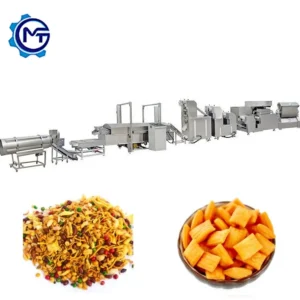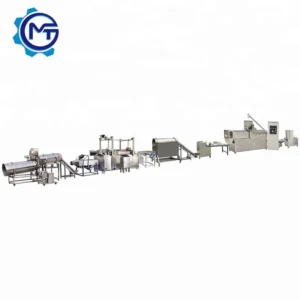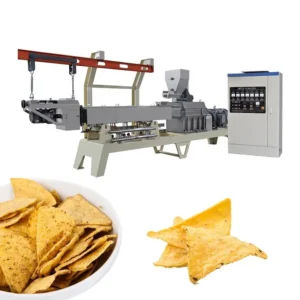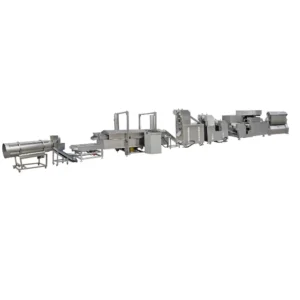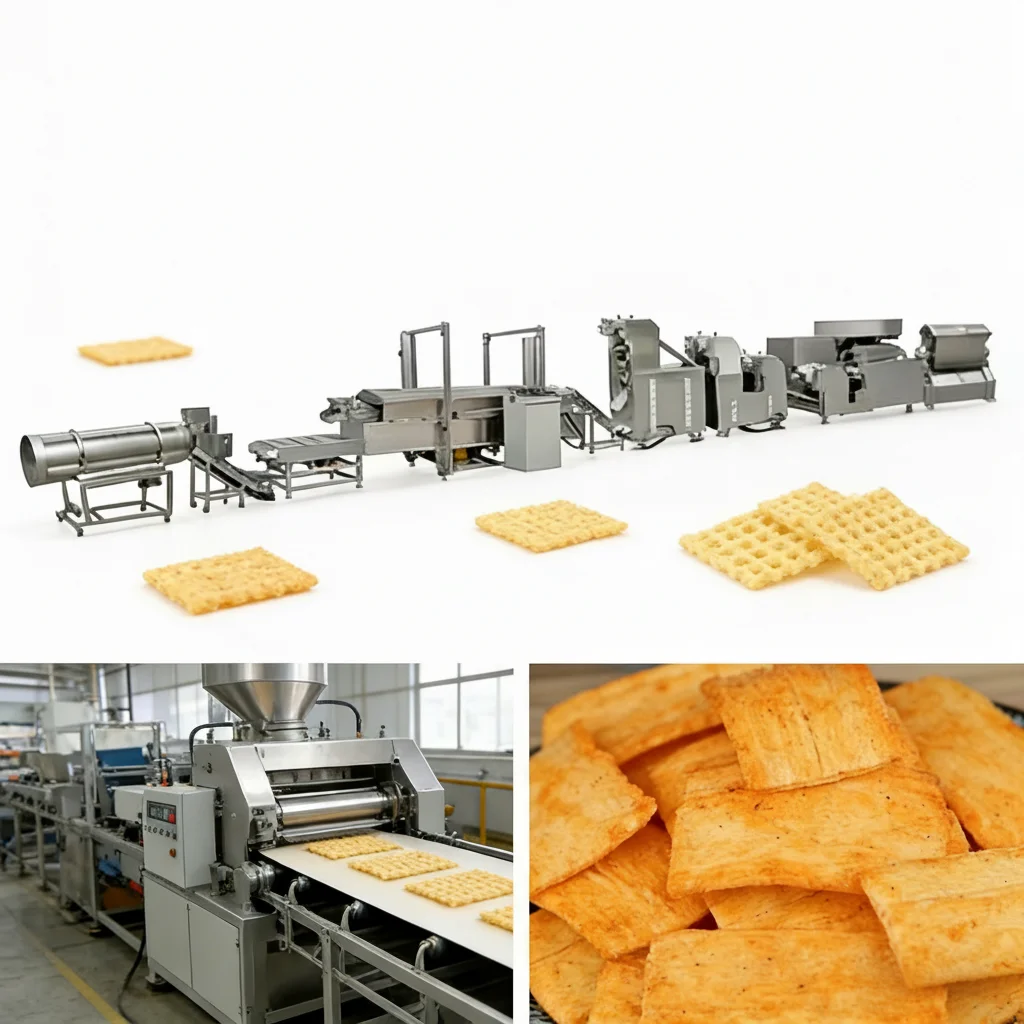

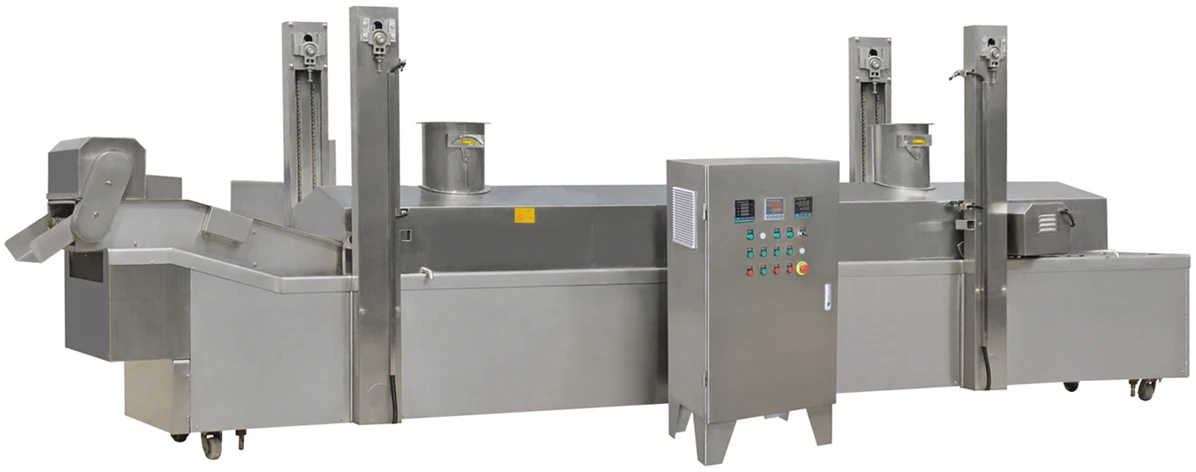


MT100/MT120 Single Screw Extruder Production Line for Puffed Snacks, 120 kg/h, 50–70 kW, CE/ISO Certified — configured for starch-based extrusion with matched frying and flavoring stations across the full turnkey layout.
- High- and low-pressure screw setup specified to raw material blend, moisture content and target expansion density
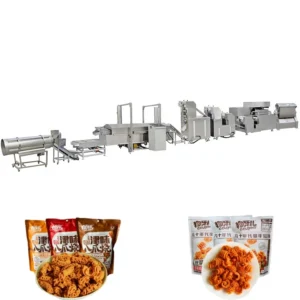
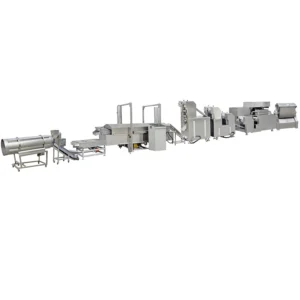
- Full line integration from mixing through extrusion, cutting, frying, flavoring and cooling with throughput balanced at every station
Pre-shipment trial runs on your actual flour or starch formulation are completed in our in-house testing workshop before dispatch.
Description
Throughput-Matched Turnkey Integration — every station from mixing to packing is calculated against your actual starch formulation so extrusion, frying and flavoring never bottleneck each other.
Technical Specifications
| Parameter | Value |
|---|---|
| Model | MT100/MT120 |
| Product Type | Single Screw Extruder Production Line for Puffed Snacks / Golgappa / Pani Puri |
| Extruder Type | Single Screw (high and low pressure screw configuration) |
| Raw Materials | Potato starch, corn starch, wheat flour |
| Output Capacity | 120 kg/h (basis not stated in source — confirm raw material blend / moisture content) |
| Installed Power | 50–70 kW (electric heating); 50–60 kW (gas / diesel heating) |
| Voltage & Frequency | Three-phase 380 V / 50 Hz; Single-phase 220 V / 50 Hz (customizable to local voltage) |
| Overall Dimensions (L×W×H) | 12,000–26,000 × 1,200 × 2,200 mm |
| Construction Material | Food-grade stainless steel 201 / 304 |
| Control / Electrical | Siemens (China) or top Chinese brand motors; Delixi or Delta inverter |
| Energy Options | Electricity / Gas / Diesel / Steam |
| Product Shapes | Screw shell, round tube, square tube, ring, cartoon shapes (adjustable via die change) |
| Certification | CE, ISO 9001 |
Application Suitability
| Application | Material or Output |
|---|---|
| Golgappa / pani puri production | Potato starch and wheat flour blends, thin-walled hollow shells after frying |
| Fried pellet snack manufacturing | Corn starch and potato starch bases, extruded into tubes and rings before secondary puffing |
| Internet-celebrity style leisure snacks | Starch-based doughs shaped into screw shells and cartoon figures, fried and seasoned |
| Starch-based extruded shape production | Mixed starch formulations formed into round tubes, square tubes and custom cartoon profiles |
What a Quoted Capacity Figure Leaves Out About Your Single Screw Extruder Snack Production Line Turnkey Project
A rated output number means nothing unless it was measured on the flour and starch blend you will actually run.
I once watched a snack line in West Africa stall every twenty minutes because the extruder was rated on corn grits while the customer’s recipe was eighty percent wheat flour with higher gluten development. The motor drew excessive current, the die clogged, and operators spent half the shift clearing blockages instead of packing product. A single screw extruder snack production line turnkey installation must be validated on your specific raw material blend, moisture level and target shape before the crate is sealed. [NEED_CITE: starch gelatinisation behaviour differences between potato, corn and wheat flour in single screw extrusion]
Pressure-Profiled Screw Geometry for Starch Doughs
The single screw extruder in this line uses a high- and low-pressure screw configuration rather than a single uniform flight. The initial low-pressure zone feeds the starch dough gently to prevent premature gelatinisation, while the downstream high-pressure section forces the material through the die at a density matched to your target shape. This sequencing matters because a single screw extruder snack production line turnkey build running hollow pani puri shells needs a different pressure curve than one producing solid cartoon-shaped pellets.
Line Station Synchronization From Extrusion Through Frying
Every station on this line — mixing, screw conveying, extrusion, pulling and cutting, automatic frying, automatic flavoring and cooling — is sized so that the output of one station feeds the next without accumulation or starvation. When the pulling and cutting machine runs faster than the fryer can accept, product piles on the belt and deforms; when the fryer runs faster, oil temperature drops as cold product floods the tank. The throughput matching is calculated before the line is built, not adjusted by trial and error on your factory floor. [NEED_CITE: throughput balance calculation methods for continuous snack extrusion and frying lines]
Reading the Specs That Actually Matter
The installed power range of 50–70 kW for electric heating and 50–60 kW for gas or diesel heating tells you the thermal capacity available for barrel temperature control — a wider gap between these figures suggests the electric option runs hotter peak loads during start-up. The stainless steel 201 / 304 construction choice affects corrosion resistance in the frying and flavoring zones where oil aerosol and seasoning acids are present; 304 is typically specified in these wet-contact areas. The overall line length of 12 to 26 metres reflects how many cooling and conveying modules are included, which directly determines how completely the product reaches ambient temperature before packing. Delixi or Delta inverters govern motor speed at each station, giving operators the adjustment range needed when switching between a dense screw shell and a lighter cartoon shape on the same single screw extruder snack production line turnkey system.
The Cost of Mismatched Drying and Frying Capacity
An extruder that produces clean, uniform shapes is useless if the fryer downstream cannot handle the volume. I have seen lines where the frying oil temperature dropped below the required range because the fryer was undersized for the extruder output, resulting in oil-soaked product that went stale within days. Similarly, an undersized flavoring drum leaves uneven seasoning coverage, which customers notice immediately when they open the bag. These failures are not caused by a bad extruder — they are caused by a line assembled from mismatched stations. [NEED_CITE: effects of fryer capacity mismatch on oil absorption and shelf life in extruded snack production]
Why Buyers Choose This Configuration
Every station from batching to packing is supplied under one responsibility, so throughput calculations are done as a single system rather than left to separate vendors to coordinate. The screw configuration and die design are specified to your raw material formulation and target product shape, not copied from a generic build. Before shipment, the complete line can run a trial on your actual flour and starch blend in the in-house testing workshop, so you see the real output and product quality before the equipment leaves the factory. The electrical package — motors, inverters and control components — is confirmed against your local voltage, frequency and preferred operating language before production begins.
Documentation & Verification
- Line layout drawing with throughput balance calculation for every station on your specific product shape
- Trial run report on your flour and starch formulation, documenting actual output and product density
- Electrical schematic with confirmed voltage, frequency and control language for your facility
- Screw and die configuration record matched to your raw material and target shape profile
- Wear parts list covering screws, dies and cutting blades with recommended replacement intervals
- CE declaration of conformity and ISO 9001 certificate included with shipping documentation
Installation, Commissioning & Support
- Foundation and utility plan based on the 12 to 26 metre line length and 50–70 kW power draw
- Dedicated circuit specification for three-phase 380 V or single-phase 220 V supply confirmed before dispatch
- Station-by-station commissioning sequence starting from mixer calibration through extruder die alignment to fryer temperature profiling
- Operator training on die changeover between screw shell, tube, ring and cartoon shapes on the single screw unit
- Spare screw, die and cutting blade inventory recommended for first-year operation based on your planned production hours
- Scheduled maintenance checklist covering inverter inspection, conveyor belt tension and fryer oil filtration system
What to Include in Your Project Enquiry
To build an accurate line configuration, we need your raw material formulation and moisture content, your target product shape and size, and your required daily output in kilograms. Provide your factory floor dimensions, available ceiling height and local voltage and frequency so the electrical package is specified correctly from the start. If you have existing upstream or downstream equipment that this line must connect to, share those machine specifications so the interface points are designed in advance.
Frequently Asked Questions
Q: How is the 120 kg/h capacity verified, and on which raw material blend?
A: The capacity figure is a starting reference that must be validated on your specific starch or flour blend, moisture content and target shape. We run your raw material in our testing workshop before shipment and document the actual throughput, product density and shape consistency. The verified output is recorded in the trial run report you receive with the line.
Q: How do you match frying and flavoring station capacity to the extruder output?
A: Each station’s throughput is calculated from the extruder’s verified output on your raw material, then the fryer basket size, oil volume, flavoring drum diameter and conveyor speeds are sized accordingly. The goal is continuous material flow with no accumulation between stations, preventing product deformation and oil temperature drops.
Q: What voltage and control language will the line be configured for?
A: Before production, we confirm your facility’s three-phase or single-phase voltage, frequency and preferred PLC or control panel language. The electrical schematic is updated to reflect these specifications so the line is ready for connection the day it arrives, avoiding the commissioning delays that happen when these details are left until installation.
Q: Can I run a trial on my own formulation before the line ships?
A: Yes. Send us your flour, starch blend and any additives in the proportions you plan to use commercially. We run the full sequence — extrusion, cutting, frying and flavoring — in our testing workshop and send you the trial report with the actual product samples, measured output and recommended screw and die configuration.
Q: What does on-site commissioning involve for this line?
A: Our engineers oversee station-by-station start-up, beginning with mixer calibration, then extruder barrel heating and screw speed adjustment, followed by fryer temperature profiling and flavoring drum timing. Operators are trained on die changeover, cutting speed adjustment and daily maintenance routines. The commissioning period covers your first production runs until the line holds stable output on your formulation.
Related products
-
Hot Selling Full Automatic Fried Dough Wheat Flour Bugles Snacks Frying Machine Fried Puffed Food Bugles Snack Production Line
¥7,349.41 Select options This product has multiple variants. The options may be chosen on the product page -
Double Screw Extruder Corn Flour Puffs Snack Nacho Chips Tortilla Doritos Making Machine Savory Snack Production Line
¥50.00 Select options This product has multiple variants. The options may be chosen on the product page -
Puffed Octopus Snack Processing Line – Full-Automatic Fried Octopus Production Machinery
¥65.00 Select options This product has multiple variants. The options may be chosen on the product page -
Orion TURTLE CHIPS Snack Puffing Machinery Internet Celebrity Puffed Four-layer Crispy Production Line
¥65.00 Select options This product has multiple variants. The options may be chosen on the product page